


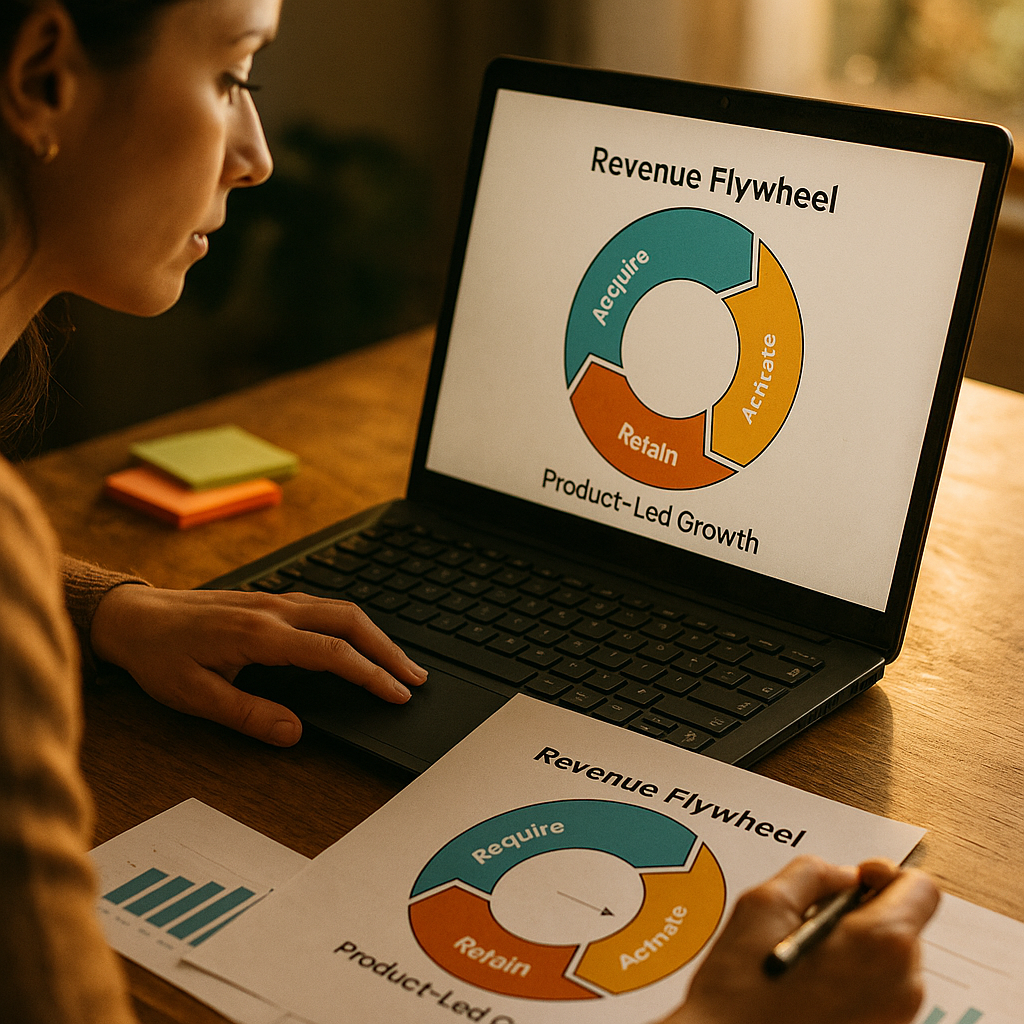
Building a Revenue Flywheel that Connects Product to Marketing is the fastest way to turn customer value into compounding growth in 2025. Instead of pushing leads through a linear funnel, you align product signals, messaging, and lifecycle campaigns so every activation and success moment fuels acquisition. When product and marketing share goals, data, and feedback loops, growth becomes self-reinforcing—here’s how to build it.
Revenue flywheel framework: how compounding growth actually works
A revenue flywheel is a system where each customer interaction increases momentum for the next one. Unlike a funnel that ends at purchase, a flywheel links acquisition, activation, retention, expansion, and advocacy so outputs from one stage become inputs to another. The strategic shift is simple: stop treating product as something marketing sells, and start treating product as a growth engine that marketing amplifies.
In practical terms, a product-to-marketing flywheel uses three kinds of energy:
- Product energy: value moments, usage patterns, feature adoption, and in-app outcomes that indicate fit.
- Marketing energy: positioning, education, proof, distribution, and lifecycle messaging that converts attention into intent.
- Customer energy: referrals, reviews, community contributions, templates, and word-of-mouth triggered by success.
To make this compounding, define a clear “value loop” that your product reliably creates. For example: user signs up → reaches a measurable outcome quickly → shares results with teammates → team adopts → the account expands → advocates create proof that improves conversion for the next cohort. The flywheel works only when you can measure each transition and improve the weakest link without breaking trust.
Helpful rule: if your team can’t explain, in one sentence, the customer outcome that drives retention and referrals, you do not yet have a flywheel—you have activities.
Product-led marketing alignment: shared outcomes, shared language, shared ownership
Connecting product to marketing starts with alignment that goes beyond meetings. In 2025, buyers expect continuity between what they read, what they try, and what they achieve. Misalignment shows up as higher churn, lower activation, and a constant need for discounts to close gaps in perceived value.
Establish alignment with three concrete moves:
- One north-star outcome: pick a metric that reflects customer value creation (not vanity traffic). Examples include “activated teams,” “weekly active accounts,” or “time-to-first-value under X minutes,” depending on your product motion.
- A shared value narrative: product, marketing, and sales must use the same definitions for key terms: who the ideal customer is, what “activation” means, which use cases matter, and what proof is credible.
- Ownership by stage: assign a primary owner for each flywheel transition (e.g., signup→activation owned by product growth; activation→retention co-owned by product + lifecycle marketing; retention→advocacy owned by customer marketing). Co-ownership prevents handoffs from becoming blame games.
Answering the common follow-up question—who leads the flywheel?—the best pattern is a small revenue-flywheel council (product, marketing, data/ops, customer success). Keep it operational: weekly review of stage metrics, one prioritized experiment per stage, and a single backlog that ties experiments to measurable movement.
Customer journey mapping: instrument the moments that create value
You cannot connect product and marketing without a shared map of how customers progress from curiosity to outcomes. A useful customer journey map is not a poster. It is a measurement model tied to user intent and product behavior.
Start by defining the “critical path” to value. Most B2B and prosumer products have a small set of actions that predict retention. Your job is to identify them and make them easier, faster, and more discoverable—then build marketing that pre-sells those actions and explains why they matter.
Build the map in this structure:
- Audience segment: role, firmographics, and the job-to-be-done.
- Trigger: what creates urgency (a deadline, a workflow breakdown, a cost spike).
- Value moments: the first time a user sees a meaningful result.
- Habit loop: the recurring behavior that leads to retention.
- Expansion trigger: what makes the user invite others or upgrade.
- Advocacy trigger: what makes them recommend you (often a visible win or measurable ROI).
Then instrument the journey with events that both teams trust. Keep the taxonomy small and consistent: signup, activation steps, key feature usage, collaboration actions, and “outcome achieved” events. This is where many teams stumble: they track everything but cannot answer basic questions such as “Which feature adoption predicts renewal?” or “Which onboarding step reduces time-to-first-value?”
To make the mapping immediately actionable, attach a “next best message” to each stage. For example:
- Pre-signup: show credible proof for the exact job-to-be-done, not generic benefits.
- Post-signup, pre-activation: deliver a short guided path, not a content library.
- Post-activation: reinforce outcomes with benchmarks, templates, and advanced playbooks.
- Expansion: prompt collaboration based on usage thresholds and role-based needs.
This answers another common follow-up—what does marketing do after signup? In a flywheel, marketing owns education and momentum throughout the lifecycle, using product usage signals to be timely and relevant.
Lifecycle marketing automation: turn product signals into personalized momentum
Lifecycle automation is the connective tissue between product behavior and revenue outcomes. The goal is not to send more messages; it is to send fewer, better-timed messages that move users to the next value moment.
Use a simple trigger framework:
- Intent triggers: pricing page visits, feature-page engagement, comparison searches, demo requests.
- Progress triggers: completed onboarding steps, invited teammates, created first project, connected an integration.
- Risk triggers: inactivity, failed setup, repeated errors, declining usage, stalled collaboration.
- Expansion triggers: hitting usage limits, cross-team adoption, frequent advanced feature usage.
For each trigger, define: the audience, the message, the channel, the timing, and the success metric. Keep the success metric tied to the flywheel stage transition, not email clicks. For example, an onboarding email sequence should be judged by activation rate and time-to-first-value, not open rate.
Channel selection in 2025 should be pragmatic:
- In-app: best for immediate guidance (checklists, tooltips, contextual tips).
- Email: best for reminders, education, and summaries of progress.
- SMS or push: best for time-sensitive prompts when users opt in.
- Retargeting: best for re-engagement when intent signals appear.
A crucial EEAT point: respect privacy and consent. If your personalization feels invasive, it erodes trust and can harm long-term retention. Use transparent preference controls, honor opt-outs instantly, and personalize based on actions within your product—not sensitive inferences.
If you have sales involvement, define clean rules for when a human should step in. Example: if an account hits “activation + invited two teammates + visited pricing,” route to sales with context: use case, features used, time-to-value, and obstacles encountered. This makes sales faster and more relevant, and it prevents customers from feeling like they are being chased randomly.
Revenue operations analytics: measure, attribute, and improve the weakest link
A flywheel improves only when measurement is trusted. That requires revenue operations discipline: consistent definitions, clean data flows, and metrics that connect product behavior to revenue.
Start with a minimal scorecard:
- Acquisition: qualified signups (or qualified pipeline), cost per qualified signup, channel mix.
- Activation: activation rate by cohort, time-to-first-value, drop-off step.
- Retention: product retention (weekly/monthly), renewal rate, usage depth among retained accounts.
- Expansion: seat growth, upgrade rate, net revenue retention drivers, expansion time lag.
- Advocacy: referral rate, review volume/quality, community contribution rate.
Attribution is often the follow-up question. Use a blended model:
- Incrementality where possible: holdouts for lifecycle campaigns, geo splits, or time-based experiments.
- Multi-touch for directionality: to understand assists, not to “prove” precision.
- Product-qualified signals: treat activation and usage milestones as leading indicators; they often predict revenue earlier than pipeline stages.
Operationalize improvement with a weekly cadence:
- Review: which stage slowed and why (cohort view beats blended averages).
- Diagnose: top three friction points, supported by qualitative feedback (support tickets, call notes, in-app surveys).
- Experiment: one change per stage, with a clear hypothesis and stop conditions.
To strengthen expertise and credibility, document what you learn. Maintain a living “growth journal” that records experiments, outcomes, and the segment impacted. This prevents repeating failed ideas and accelerates onboarding for new team members.
Go-to-market strategy: design loops for acquisition, expansion, and advocacy
The flywheel becomes durable when you deliberately create loops—mechanisms where customer value creates distribution. In 2025, the best go-to-market strategies blend product-led efficiency with targeted human help where it increases success.
Three practical loops to consider:
- Collaboration loop: the product becomes more valuable when others join (invites, shared workspaces, approvals). Marketing supports this with role-based onboarding and “invite value” messaging.
- Template/content loop: customers create reusable assets (templates, dashboards, playbooks) that can be shared publicly. Marketing curates and distributes them, giving credit and building trust.
- Outcome proof loop: the product generates measurable results (reports, savings, performance gains) that customers can share internally or externally. Marketing turns this into case studies, peer stories, and benchmark content.
To avoid shallow virality attempts, tie loops to genuine utility. Ask: Does sharing help the user succeed, or does it only help us grow? The first creates trust and longevity.
Also plan for friction. Every flywheel needs “grease”—customer education, fast support, clear onboarding, and honest pricing pages. If customers feel surprised or trapped, the flywheel slows. If they feel guided and in control, they become a growth channel.
FAQs
- What is a revenue flywheel in B2B growth?
A revenue flywheel is a growth system where acquisition, activation, retention, expansion, and advocacy reinforce each other. It uses product value creation and customer success to generate momentum, so each cohort improves the next through better conversion, higher retention, and more referrals.
- How do you connect product to marketing without creating constant meetings?
Align on one north-star outcome, define shared stage metrics, and build a joint experiment backlog. Use a single weekly review of cohort metrics and customer feedback, then execute asynchronously. The connection comes from shared data and ownership, not more status updates.
- What metrics matter most when building a product-to-marketing flywheel?
Prioritize activation rate, time-to-first-value, retention by cohort, expansion triggers, and referral/advocacy rates. Track channel mix and cost per qualified signup, but judge success by stage transitions that predict long-term revenue.
- What is the difference between product-led growth and a revenue flywheel?
Product-led growth emphasizes the product as the primary driver of acquisition and expansion. A revenue flywheel is broader: it designs compounding loops across product, marketing, sales, and customer success, using product signals and lifecycle programs to sustain momentum.
- How do you personalize lifecycle marketing responsibly?
Personalize based on in-product actions and explicit preferences, keep messaging tied to customer outcomes, and provide clear opt-outs and notification controls. Avoid sensitive inference and over-targeting that can feel invasive and reduce trust.
- How long does it take to see results from a revenue flywheel?
You can often improve activation within weeks if onboarding friction is clear. Retention and expansion effects usually take longer because they depend on usage cycles. Set expectations by stage, run controlled experiments, and measure cohort trends rather than waiting for blended revenue to move.
Connecting product and marketing into a revenue flywheel creates compounding growth: product value generates signals, marketing turns those signals into timely education, and customer success turns outcomes into retention and advocacy. Start with a shared north-star metric, instrument the critical path to value, and automate lifecycle actions based on trustworthy triggers. Build loops that help customers win, and revenue follows.