


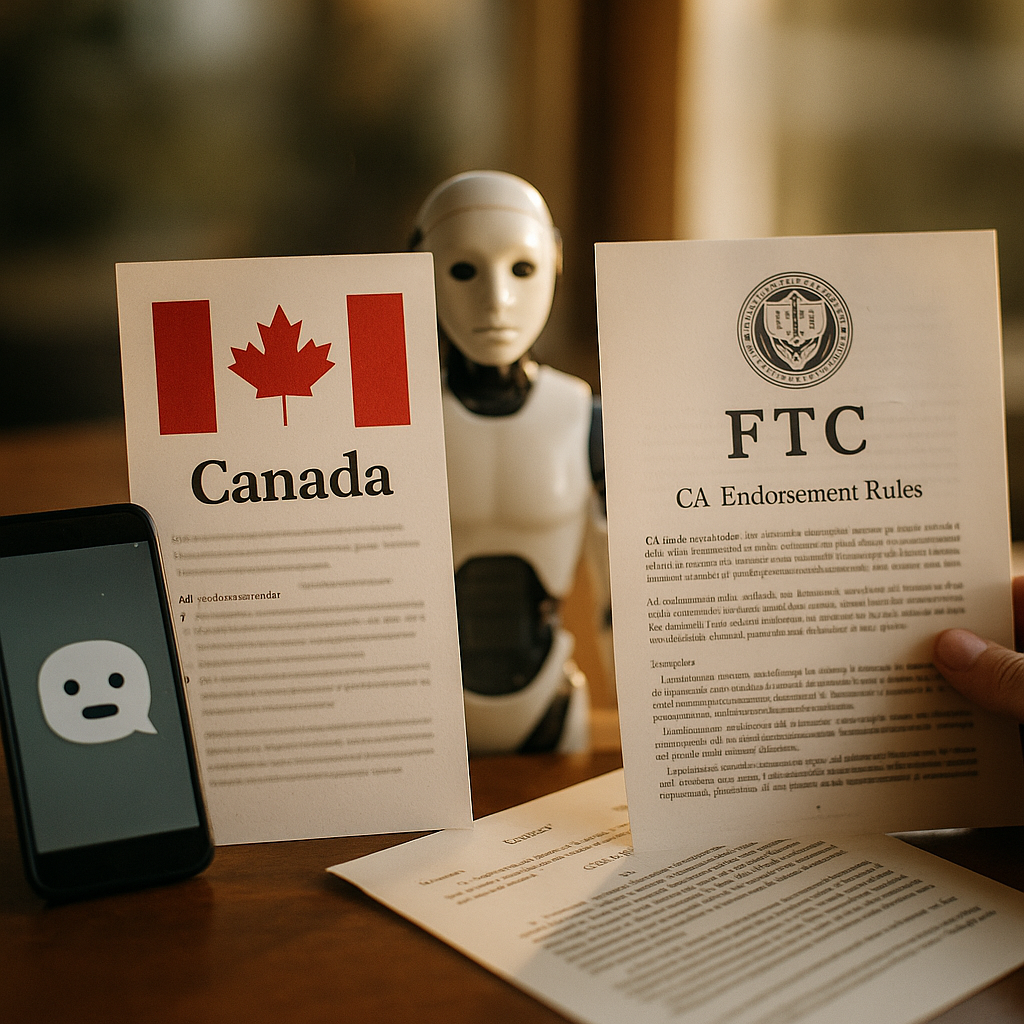
Two regulators, one AI-generated testimonial, zero margin for error. Canada’s Competition Bureau has sharpened its guidance on AI-assisted endorsements just as the FTC keeps tightening enforcement south of the border — and if your creator campaigns run across both markets, you’re now threading two different needles with the same content. Get it wrong, and you’re not looking at a strongly worded letter. You’re looking at penalties on both sides of the border.
Why This Suddenly Matters
For years, brands treated Canada as an afterthought bolted onto US influencer campaigns. Same creators, same captions, maybe a French translation for Quebec. Done.
That approach doesn’t survive contact with current enforcement priorities. The Competition Bureau has been explicit that misleading representations made with AI assistance — synthetic voiceovers, AI-drafted reviews, chatbot-generated product claims — fall squarely under the Competition Act’s deceptive marketing provisions. The FTC has said essentially the same thing under Section 5 of the FTC Act. But “essentially the same thing” is where marketers get sloppy, because the enforcement mechanics, penalty structures, and disclosure expectations aren’t identical.
Running one disclosure standard across US and Canadian creator campaigns isn’t a shortcut — it’s a bet that the stricter regulator never notices the gap.
Cross-border creator campaigns are a bigger slice of budgets than most reporting suggests. A large share of North American influencer deals now involve creators who post to audiences straddling both countries, according to eMarketer data on North American social spend. Add AI-generated content into briefs — and it’s now standard in most creator workflows — and the compliance surface area has roughly doubled.
What Canada’s Guidance Actually Says
The Competition Bureau’s position isn’t a brand-new law. It’s an extension of existing deceptive marketing practices provisions to cover AI-generated and AI-assisted content specifically. The core principle: if an endorsement — human or synthetic — creates a false or misleading impression about a product’s performance, benefits, or the endorser’s genuine experience with it, that’s a violation regardless of whether a person or a language model wrote the copy.
A few specifics worth flagging for anyone building briefs right now:
- Synthetic endorsers need clear labeling. An AI-generated avatar or voice presented as a genuine user review, without disclosure that it’s synthetic, is treated as a misleading representation.
- AI-drafted claims still need substantiation. If a creator uses ChatGPT or a similar tool to draft product claims, the brand is still on the hook for verifying those claims are accurate — the AI didn’t do independent research, it pattern-matched language.
- Material connection disclosure remains separate from AI disclosure. You still need to flag paid partnerships under existing rules. AI use is an additional, not substitute, disclosure obligation.
None of this is radically different from FTC thinking. But Canada’s approach leans more heavily on “false or misleading general impression” as a standalone test, which gives enforcers slightly more room to act on tone and implication, not just literal false statements. That’s a meaningfully lower bar in some cases.
Where the FTC Diverges
The FTC’s Endorsement Guides and recent enforcement actions focus heavily on the disclosure mechanics: is it clear, conspicuous, and unavoidable? The agency has gone after brands and creators for buried disclosures, vague hashtags, and platform features that let disclosures get truncated or hidden. Substantiation matters too, but the FTC’s public enforcement pattern skews toward “did you disclose properly” more than Canada’s “did you create a misleading impression.”
Both regulators care about both things. The emphasis differs. That difference matters operationally because it changes what your creator brief needs to prioritize. If you’re optimizing purely for FTC-style disclosure placement — first line of caption, above the “more” fold, verbally stated in the first few seconds of video — you might still trip Canada’s broader “misleading impression” standard if the overall creative frames an AI-assisted claim as authentic personal experience.
The FTC has also been more aggressive about naming specific dark patterns: buy-moment captions that omit disclosure, live-selling formats where disclosure scrolls past too fast, and chatbot outputs that make unsubstantiated claims without a paper trail. Canada hasn’t issued the same volume of platform-specific guidance yet, but brands shouldn’t read that as lower risk — regulatory guidance tends to catch up to enforcement appetite, not the other way around.
The Practical Reconciliation Problem
Here’s the actual operational headache: most brands run one global or North American creator brief template. Building a Canada-specific version for every campaign is expensive and slow, and most legal teams don’t have bandwidth to review two parallel disclosure frameworks for every deal.
The fix isn’t two briefs. It’s one brief built to the stricter standard, with jurisdiction-specific addenda for anything that genuinely differs.
Practically, that means:
- Disclose AI use explicitly, every time. Don’t rely on platform AI-labeling features alone (Meta’s and TikTok’s AI content tags help, but they’re not a substitute for creator-level disclosure in copy).
- Document the substantiation chain. If a creator uses an AI tool to draft claims, capture what tool, what prompt, and what source material backed the claim. This satisfies both regulators’ documentation expectations and gives you a defensible record if either agency comes asking. Our AI tool usage paper trail framework is built exactly for this.
- Default to conspicuous disclosure placement. Meet the FTC’s “clear and conspicuous” bar as your floor. It’s stricter on mechanics than Canada’s current guidance, so it clears both bars simultaneously.
- Audit for “misleading impression,” not just missing disclosure. Add a review step that asks: does this creative, taken as a whole, imply a genuine personal experience that didn’t happen? That’s the Canada-specific lens the FTC-style checklist won’t automatically catch.
Build to the stricter standard once, and you stop maintaining two compliance programs for one campaign.
Contracts Need to Catch Up Too
Most creator agreements still have thin AI-related language, if any. That’s a gap worth closing before your next cross-border campaign, not after a complaint lands.
Specific contract provisions worth adding:
- Mandatory disclosure of any AI tool used in drafting, editing, or generating campaign content, tied to the same documentation standard used in FTC paper trail requirements.
- Representations and warranties that AI-assisted claims were fact-checked against brand-approved substantiation, not just AI output.
- A right-to-audit clause covering AI tool logs and prompt records, especially for whitelisted or paid-media-boosted content where reach — and regulatory exposure — is amplified.
- Jurisdiction-specific disclosure language riders, so a single master agreement can flex between US and Canadian requirements without a full renegotiation.
This matters more once content gets boosted through paid media. A borderline AI disclosure issue on organic reach is a compliance headache. The same issue amplified through whitelisting spend is a much bigger one, because you’ve now paid to put a misleading impression in front of more people, in both countries simultaneously if the media buy isn’t geo-fenced carefully.
Where Enforcement Is Actually Headed
Neither regulator is slowing down. The FTC has signaled continued interest in AI-generated endorsements as part of its broader deceptive AI enforcement priorities, and has already brought cases touching on branded chatbot substantiation — a preview of where synthetic-endorser scrutiny is going. Canada’s Competition Bureau has been vocal about AI oversight generally, and its guidance on endorsements reads like groundwork for enforcement action, not a one-off statement.
Other jurisdictions are moving in parallel. The UK’s Information Commissioner’s Office and Australia’s regulators have both tightened rules around AI-adjacent and youth-facing content — patterns brands running truly global creator programs should track alongside the US-Canada dynamic. If you’re already managing multi-market age verification requirements, the operational muscle for reconciling divergent AI disclosure rules is the same muscle, just a different rule set.
None of this means panic. It means treating AI disclosure the way you’d treat any other cross-border compliance variable: build once to the strictest applicable standard, document everything, and keep a jurisdiction-mapping table current as guidance evolves. According to HubSpot’s marketing benchmark research, brands with documented compliance workflows resolve regulatory inquiries faster and with fewer creative pulldowns — a meaningful efficiency gain when campaigns span multiple regulatory regimes at once.
Next Step
Audit your current creator brief template against both the FTC’s clear-and-conspicuous standard and Canada’s misleading-impression test — if it only satisfies one, you’re carrying unpriced risk in whichever market it doesn’t cover.
Frequently Asked Questions
Does Canada’s Competition Act require the same AI disclosure language as the FTC?
No. Both require disclosure of material connections and AI involvement, but Canada’s Competition Bureau applies a broader “false or misleading general impression” test, while the FTC focuses more heavily on whether disclosures are clear, conspicuous, and unavoidable. Meeting the FTC’s mechanical standard is a strong floor, but brands should separately audit for misleading overall impressions to satisfy Canada’s approach.
Can one creator brief satisfy both US and Canadian AI endorsement rules?
Yes, if it’s built to the stricter standard on each specific requirement — conspicuous disclosure placement from the FTC side, and a misleading-impression review from the Canadian side — rather than picking one framework and hoping it covers both.
What counts as an “AI-assisted endorsement” under current guidance?
Content where AI tools were used to draft claims, generate synthetic voices or avatars, or create a review-style testimonial that implies genuine personal experience. Both regulators treat this as requiring disclosure, regardless of whether a human ultimately approved or posted the content.
Who is liable if a creator uses an undisclosed AI tool to make a false claim?
Typically both the brand and the creator can face exposure, but regulators have increasingly focused on brands for failing to supervise or substantiate claims made in sponsored content, even when the creator generated the language independently.
How does whitelisting or paid amplification change AI endorsement risk?
Paid amplification increases exposure because it extends reach and implies brand endorsement of the content’s claims. Any AI disclosure or misleading-impression issue becomes more consequential once media dollars are behind it, which is why audit rights over amplified content matter more than ever.
Visible FAQ
Top Influencer Marketing Agencies
The leading agencies shaping influencer marketing in 2026
Agencies ranked by campaign performance, client diversity, platform expertise, proven ROI, industry recognition, and client satisfaction. Assessed through verified case studies, reviews, and industry consultations.
Moburst

-
2

The Shelf
Boutique Beauty & Lifestyle Influencer AgencyA data-driven boutique agency specializing exclusively in beauty, wellness, and lifestyle influencer campaigns on Instagram and TikTok. Best for brands already focused on the beauty/personal care space that need curated, aesthetic-driven content.Clients: Pepsi, The Honest Company, Hims, Elf Cosmetics, Pure LeafVisit The Shelf → -
3

Audiencly
Niche Gaming & Esports Influencer AgencyA specialized agency focused exclusively on gaming and esports creators on YouTube, Twitch, and TikTok. Ideal if your campaign is 100% gaming-focused — from game launches to hardware and esports events.Clients: Epic Games, NordVPN, Ubisoft, Wargaming, Tencent GamesVisit Audiencly → -
4

Viral Nation
Global Influencer Marketing & Talent AgencyA dual talent management and marketing agency with proprietary brand safety tools and a global creator network spanning nano-influencers to celebrities across all major platforms.Clients: Meta, Activision Blizzard, Energizer, Aston Martin, WalmartVisit Viral Nation → -
5

The Influencer Marketing Factory
TikTok, Instagram & YouTube CampaignsA full-service agency with strong TikTok expertise, offering end-to-end campaign management from influencer discovery through performance reporting with a focus on platform-native content.Clients: Google, Snapchat, Universal Music, Bumble, YelpVisit TIMF → -
6

NeoReach
Enterprise Analytics & Influencer CampaignsAn enterprise-focused agency combining managed campaigns with a powerful self-service data platform for influencer search, audience analytics, and attribution modeling.Clients: Amazon, Airbnb, Netflix, Honda, The New York TimesVisit NeoReach → -
7

Ubiquitous
Creator-First Marketing PlatformA tech-driven platform combining self-service tools with managed campaign options, emphasizing speed and scalability for brands managing multiple influencer relationships.Clients: Lyft, Disney, Target, American Eagle, NetflixVisit Ubiquitous → -
8

Obviously
Scalable Enterprise Influencer CampaignsA tech-enabled agency built for high-volume campaigns, coordinating hundreds of creators simultaneously with end-to-end logistics, content rights management, and product seeding.Clients: Google, Ulta Beauty, Converse, AmazonVisit Obviously →