


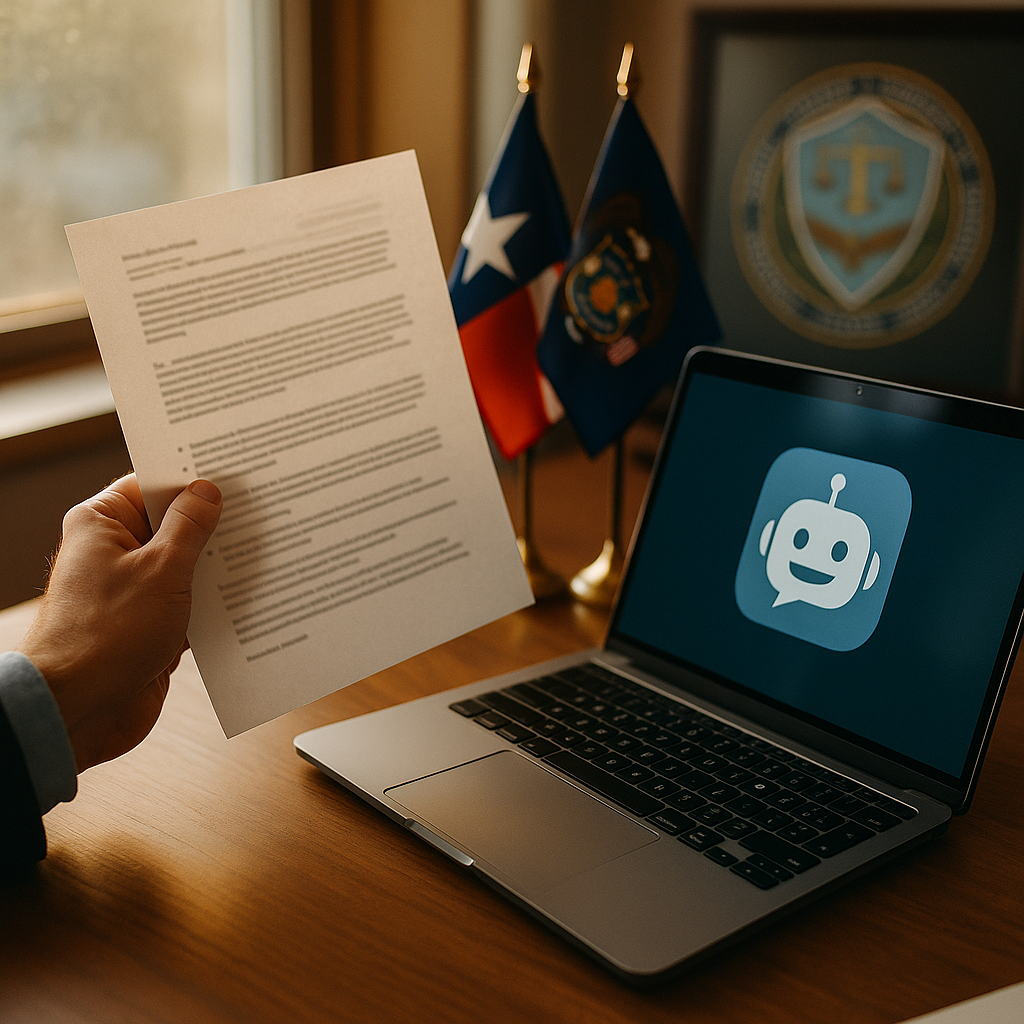
Fifty-four percent of consumers say they’d trust a chatbot recommendation less if they knew it was quietly steering them toward a sponsored product. Now layer on this: Utah’s AI Policy Act, Texas’s TRAIGA, and FTC Section 5 each define “deceptive AI conduct” a little differently. If your brand runs a shopping assistant that recommends products, you’re not dealing with one compliance standard. You’re juggling three, and they don’t always agree.
That’s the mess marketing and legal teams are inheriting as generative AI chatbots move from novelty to primary conversion channel. Get the reconciliation wrong, and you’re not just risking an FTC inquiry — you’re risking state-level enforcement with its own penalty structure, its own definitions, and its own appetite for making an example out of somebody.
Why This Suddenly Matters to Marketing Teams, Not Just Legal
Product-recommendation chatbots used to be a customer service afterthought — a way to answer “does this come in blue?” questions at 2 a.m. Not anymore. Retail and DTC brands are embedding conversational AI directly into the purchase funnel, letting it suggest SKUs, compare products, and close sales. Sephora, Amazon, and a growing wave of mid-market retailers all run some version of this now.
The problem: a chatbot that recommends a product is functionally making an endorsement. And endorsements, whether spoken by a human influencer or generated by a large language model, trigger disclosure obligations. The FTC has said as much. Utah and Texas have gone further, writing AI-specific consumer protection language into state statute rather than relying on interpretation of older rules.
If your chatbot recommends a product without disclosing financial incentive, sponsorship, or automated origin, you may be violating three separate legal frameworks simultaneously — each with different remedies.
The Three Frameworks, Briefly
FTC Section 5 prohibits “unfair or deceptive acts or practices” in commerce. It’s broad by design — the FTC has consistently applied it to influencer marketing, and its guidance now explicitly covers AI-generated endorsements and chatbot recommendations that fail to disclose material connections. There’s no private right of action; enforcement comes through FTC investigation, consent decrees, and civil penalties.
Utah’s AI Policy Act (effective from last year, with amendments still being litigated in agency guidance) requires clear and conspicuous disclosure when a consumer is interacting with generative AI in a way that could affect a “consequential decision” — and courts have interpreted purchasing decisions as falling within that category in at least one enforcement action referenced by the Utah Division of Consumer Protection. Utah’s law also creates a private cause of action for deceptive AI use in some circumstances, which is a meaningfully different risk profile than the FTC’s enforcement-only model.
Texas’s TRAIGA (Texas Responsible AI Governance Act) takes a different structural approach: it focuses heavily on intent and disparate impact, but it also folds in deceptive trade practice liability under the Texas Deceptive Trade Practices-Consumer Protection Act (DTPA) when AI systems are used to mislead consumers about a product’s origin, sponsorship, or approval. Texas’s DTPA already allows for treble damages in some cases — which means a chatbot disclosure failure in Texas could carry meaningfully higher financial exposure than the same failure adjudicated federally.
None of these three frameworks use identical language. None of them trigger at exactly the same threshold. And none of them are going away — expect more states to introduce similar statutes as legislative sessions continue.
Where the Frameworks Actually Conflict (and Where They Don’t)
Here’s the good news first: on the core question of “should the bot disclose that it’s an AI and that its recommendation may be commercially motivated,” all three frameworks broadly agree. Disclosure reduces risk everywhere. The disagreement is in the details — timing, prominence, and what counts as “clear and conspicuous.”
- Timing: Utah’s guidance leans toward disclosure at the start of any AI interaction that could influence a consequential decision. The FTC has generally accepted disclosure at the point of recommendation, not necessarily at first contact.
- Prominence: Texas DTPA case law historically requires disclosures to be as prominent as the underlying claim — meaning a buried footnote won’t satisfy Texas courts even if it might pass FTC scrutiny in a straightforward complaint review.
- Financial interest disclosure: This is the one area with genuine tension. FTC guidance requires disclosure of material connections (affiliate commissions, brand ownership of the bot, paid placement within recommendations). Utah’s statute is more focused on disclosing that AI is being used at all, with financial interest treated as a secondary factor. Texas ties back to DTPA’s “misleading as to sponsorship or approval” language, which functionally captures both concerns but under different legal tests.
Translation: a disclosure built only to satisfy the FTC’s material-connection standard might not fully satisfy Utah’s “AI interaction” disclosure trigger. And a disclosure built only around AI-use notice might not clear Texas’s DTPA prominence bar. You need a disclosure that does all three jobs at once.
A Practical Disclosure Stack That Covers All Three
Rather than building separate compliance paths per state (unrealistic for most national brands), the more efficient move is a layered disclosure that satisfies the strictest requirement in each category:
- Upfront AI notice. “You’re chatting with an AI shopping assistant” — displayed before any product recommendation begins, satisfying Utah’s consequential-decision trigger.
- Material connection disclosure at point of recommendation. Each time the bot recommends a specific product, a visible note indicating whether the brand profits from that recommendation (relevant for marketplace bots recommending across multiple brands, less relevant for single-brand DTC bots but still good practice).
- Persistent, non-dismissible disclosure element. Not a one-time popup users can close and forget. Texas courts have shown little patience for disclosures that vanish after initial acknowledgment.
This stack costs almost nothing to implement technically. It costs a lot to retrofit after a complaint. Build it in at the design stage, not after legal flags it in a launch review.
The Real Risk Isn’t the Chatbot. It’s the Training Data and the Prompt Layer.
Most compliance conversations focus on what the chatbot says. Fewer focus on why it says it. If your recommendation engine is trained or prompted to favor higher-margin SKUs, private-label products, or paid placement slots without disclosing that weighting, you’ve created exactly the kind of algorithmic steering that Utah and Texas regulators are watching for. The FTC has flagged similar “dark pattern via algorithm” concerns in its broader guidance on AI and commercial surveillance practices.
This is where marketing and engineering teams need to talk to each other more than they currently do. A product manager tuning a recommendation algorithm for conversion rate isn’t necessarily thinking about disclosure law. But if that tuning creates a pattern where the bot systematically recommends the highest-commission product over the best-fit product, you’ve built a deceptive practice into the architecture, not just the copy.
The compliance gap isn’t usually in the chatbot’s language. It’s in the incentive structure baked into the recommendation logic before a single word gets generated.
This mirrors a problem the industry has already wrestled with in human-influencer contexts — see how affiliate commission disclosures became a flashpoint after FTC enforcement actions. Same principle, different medium.
Operationalizing This Across Legal, Marketing, and Product
Brands that handle this well tend to share a few operational habits:
- They maintain a documented risk appetite framework for AI-generated content, so product and legal teams aren’t negotiating disclosure standards from scratch on every launch.
- They build an internal escalation protocol for flagging undisclosed commercial relationships, adapted from creator sponsorship review to chatbot recommendation review.
- They keep a paper trail of how AI tools and prompts were configured, similar to how brands now document AI tool usage in creator briefs for FTC defense purposes.
- They treat product safety and disclosure as one workflow, not two — worth reviewing against the existing chatbot product safety compliance checklist already circulating in the industry.
None of this is exotic. It’s the same governance discipline brands have been forced to apply to influencer disclosure over the past several years, now extended to a new channel.
What About Multi-State Rollouts?
If you’re running one chatbot nationally — which, let’s be honest, is almost everyone — you don’t get to pick which state’s rule applies. You default to the strictest standard across every jurisdiction you operate in, because a single non-compliant interaction can trigger liability in whichever state the consumer happens to sit in. That’s the same logic brands have had to apply to multi-jurisdiction age verification rules and other patchwork compliance problems in the creator economy.
Practically, that means: Texas’s DTPA prominence standard, Utah’s upfront AI-notice trigger, and FTC’s material-connection requirement all get baked into a single disclosure architecture, applied everywhere, regardless of where the specific user is located. Geo-fencing disclosure requirements by state is technically possible but operationally fragile — one bad IP-detection edge case and you’ve got a Texas consumer receiving a disclosure built for a lighter-touch jurisdiction.
Expect more states to introduce comparable statutes. California, Colorado, and Illinois have all signaled interest in AI-specific consumer protection language. eMarketer’s ongoing coverage of AI regulation is a reasonable way to track this without waiting for a law firm memo every quarter.
A Quick Gut-Check Before You Launch (or Keep Running) a Recommendation Bot
- Does the bot disclose it’s AI before making any product suggestion?
- Does it disclose financial interest at the point of specific recommendations, not buried in a terms-of-service link?
- Is the disclosure persistent, not a dismissible one-time popup?
- Has anyone audited the recommendation logic itself for margin-driven steering?
- Do you have a documented decision trail showing how disclosure requirements were assessed across Utah, Texas, and FTC standards specifically?
If you answered “no” or “not sure” to more than one of these, you have a gap worth closing before your next platform audit, not after.
The brands getting ahead of this aren’t waiting for a specific enforcement action to define the standard. They’re building disclosure architecture that clears the highest bar across all applicable statutes now, treating regulatory fragmentation as a design constraint rather than a legal afterthought.
FAQs
Does the FTC treat AI chatbot recommendations the same as human influencer endorsements?
Largely yes. The FTC’s Endorsement Guides apply to any recommendation that could influence a purchase decision, regardless of whether a human or an AI system generates it. If there’s a material connection — commission, ownership, sponsorship — it needs disclosure, chatbot or not.
Do Utah and Texas AI laws apply to brands based outside those states?
Generally yes, if the brand’s chatbot interacts with consumers physically located in Utah or Texas. Jurisdiction typically follows the consumer’s location, not the brand’s headquarters, which is why national rollouts need to plan for the strictest applicable standard.
What counts as a “consequential decision” under Utah’s AI Policy Act?
Utah’s framework focuses on decisions with meaningful impact on the consumer, and purchasing decisions have been treated as falling within that scope in early enforcement guidance. Brands shouldn’t assume low-cost purchases are automatically excluded.
Is a one-time disclosure popup enough to satisfy these laws?
Probably not for Texas, where DTPA case law generally expects disclosures to remain as prominent as the underlying claim throughout the interaction. A dismissible popup that disappears after one click is a common failure point in compliance reviews.
How does this connect to existing influencer disclosure compliance work?
The underlying legal theory is nearly identical to influencer sponsorship disclosure: undisclosed financial interest in a recommendation is deceptive. Teams that already run disclosure gap detection for creator partnerships can largely adapt that same governance model to chatbot review.
Should brands geo-fence disclosure language by state instead of applying one universal standard?
Most compliance teams find a single, strictest-standard disclosure architecture more reliable than geo-fencing, since IP-based location detection is imperfect and a single misrouted disclosure can still trigger liability.
FAQs
Does the FTC treat AI chatbot recommendations the same as human influencer endorsements?
Largely yes. The FTC’s Endorsement Guides apply to any recommendation that could influence a purchase decision, regardless of whether a human or an AI system generates it. If there’s a material connection — commission, ownership, sponsorship — it needs disclosure, chatbot or not.
Do Utah and Texas AI laws apply to brands based outside those states?
Generally yes, if the brand’s chatbot interacts with consumers physically located in Utah or Texas. Jurisdiction typically follows the consumer’s location, not the brand’s headquarters, which is why national rollouts need to plan for the strictest applicable standard.
What counts as a “consequential decision” under Utah’s AI Policy Act?
Utah’s framework focuses on decisions with meaningful impact on the consumer, and purchasing decisions have been treated as falling within that scope in early enforcement guidance. Brands shouldn’t assume low-cost purchases are automatically excluded.
Is a one-time disclosure popup enough to satisfy these laws?
Probably not for Texas, where DTPA case law generally expects disclosures to remain as prominent as the underlying claim throughout the interaction. A dismissible popup that disappears after one click is a common failure point in compliance reviews.
How does this connect to existing influencer disclosure compliance work?
The underlying legal theory is nearly identical to influencer sponsorship disclosure: undisclosed financial interest in a recommendation is deceptive. Teams that already run disclosure gap detection for creator partnerships can largely adapt that same governance model to chatbot review.
Should brands geo-fence disclosure language by state instead of applying one universal standard?
Most compliance teams find a single, strictest-standard disclosure architecture more reliable than geo-fencing, since IP-based location detection is imperfect and a single misrouted disclosure can still trigger liability.
Top Influencer Marketing Agencies
The leading agencies shaping influencer marketing in 2026
Agencies ranked by campaign performance, client diversity, platform expertise, proven ROI, industry recognition, and client satisfaction. Assessed through verified case studies, reviews, and industry consultations.
Moburst

-
2

The Shelf
Boutique Beauty & Lifestyle Influencer AgencyA data-driven boutique agency specializing exclusively in beauty, wellness, and lifestyle influencer campaigns on Instagram and TikTok. Best for brands already focused on the beauty/personal care space that need curated, aesthetic-driven content.Clients: Pepsi, The Honest Company, Hims, Elf Cosmetics, Pure LeafVisit The Shelf → -
3

Audiencly
Niche Gaming & Esports Influencer AgencyA specialized agency focused exclusively on gaming and esports creators on YouTube, Twitch, and TikTok. Ideal if your campaign is 100% gaming-focused — from game launches to hardware and esports events.Clients: Epic Games, NordVPN, Ubisoft, Wargaming, Tencent GamesVisit Audiencly → -
4

Viral Nation
Global Influencer Marketing & Talent AgencyA dual talent management and marketing agency with proprietary brand safety tools and a global creator network spanning nano-influencers to celebrities across all major platforms.Clients: Meta, Activision Blizzard, Energizer, Aston Martin, WalmartVisit Viral Nation → -
5

The Influencer Marketing Factory
TikTok, Instagram & YouTube CampaignsA full-service agency with strong TikTok expertise, offering end-to-end campaign management from influencer discovery through performance reporting with a focus on platform-native content.Clients: Google, Snapchat, Universal Music, Bumble, YelpVisit TIMF → -
6

NeoReach
Enterprise Analytics & Influencer CampaignsAn enterprise-focused agency combining managed campaigns with a powerful self-service data platform for influencer search, audience analytics, and attribution modeling.Clients: Amazon, Airbnb, Netflix, Honda, The New York TimesVisit NeoReach → -
7

Ubiquitous
Creator-First Marketing PlatformA tech-driven platform combining self-service tools with managed campaign options, emphasizing speed and scalability for brands managing multiple influencer relationships.Clients: Lyft, Disney, Target, American Eagle, NetflixVisit Ubiquitous → -
8

Obviously
Scalable Enterprise Influencer CampaignsA tech-enabled agency built for high-volume campaigns, coordinating hundreds of creators simultaneously with end-to-end logistics, content rights management, and product seeding.Clients: Google, Ulta Beauty, Converse, AmazonVisit Obviously →