


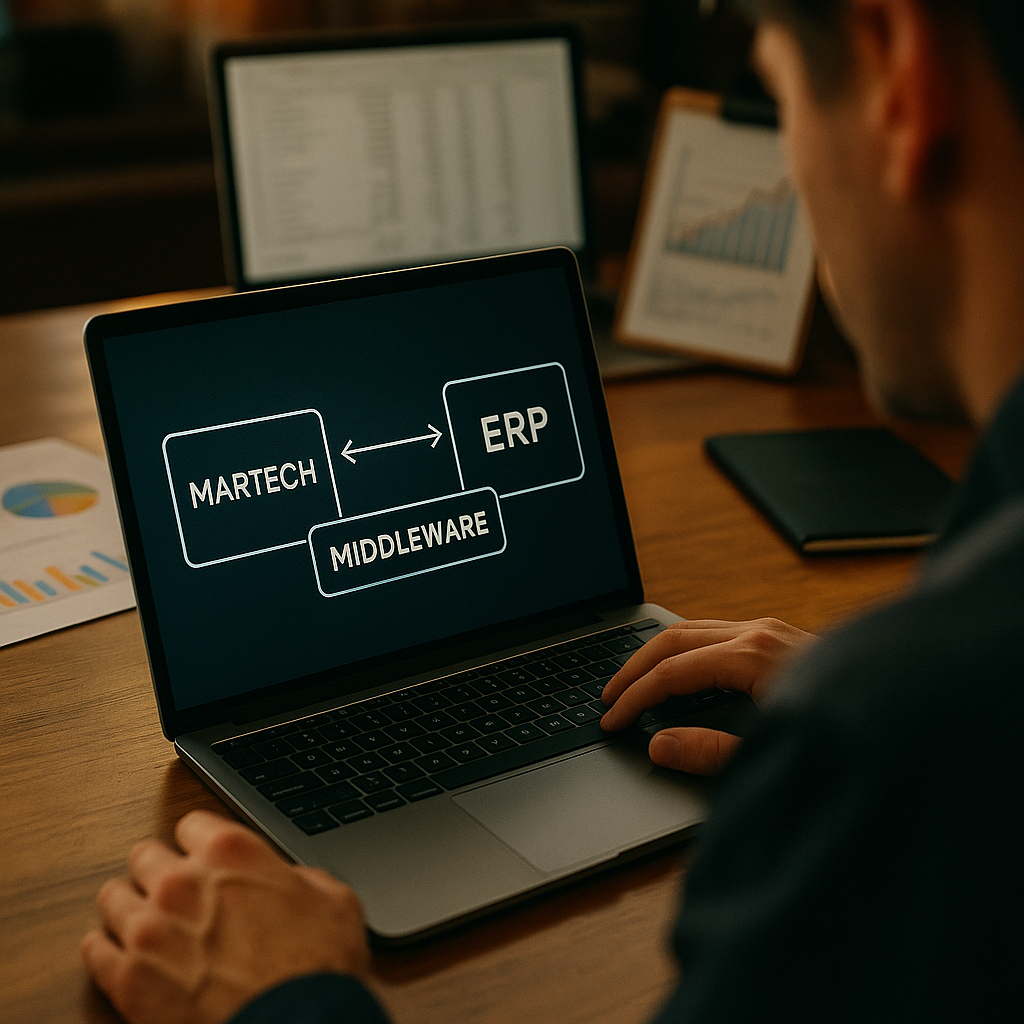
Comparing Middleware Solutions For Connecting MarTech To ERP Data is now a board-level concern as marketing teams demand real-time inventory, pricing, and customer status inside campaigns and journeys. The right integration layer reduces manual exports, improves attribution, and protects sensitive records. This guide compares leading middleware approaches, explains trade-offs, and shows how to choose confidently for 2025. Ready to connect faster?
iPaaS for MarTech-ERP integration
Integration Platform as a Service (iPaaS) tools sit between MarTech systems (CRM, CDP, MAP, analytics, ad platforms) and ERPs (SAP, Oracle, Microsoft Dynamics, NetSuite, Infor, etc.). In 2025, iPaaS is often the default choice when you need speed, prebuilt connectors, and governed workflows without building everything from scratch.
Where iPaaS fits best
- Common data sync patterns: accounts, contacts, orders, invoices, product catalogs, and consent preferences.
- Event-driven marketing triggers: shipment confirmation, backorder status, contract renewal, credit holds, or replenishment signals.
- Multi-app orchestration: ERP → CRM → marketing automation → ad audiences, with logging and retries.
What to compare when evaluating iPaaS
- Connector depth, not just count: confirm support for the specific ERP modules and objects you use (pricing conditions, product variants, customer hierarchies, returns, tax, and regional fields).
- Change data capture and webhooks: true near-real-time updates typically require CDC, event streams, or webhook support rather than batch-only polling.
- Data transformation: look for robust mapping, schema drift handling, and reusable canonical models so MarTech apps receive consistent fields.
- Operations: alerting, replay, dead-letter queues, and clear run histories to reduce integration firefighting.
- Security and compliance: SOC 2 reports, encryption at rest/in transit, least-privilege, and role-based controls.
Practical guidance: ask vendors to demonstrate one high-friction flow end-to-end (for example, ERP pricing + inventory to a product feed and then into dynamic email and paid media). If a tool struggles in the demo, it will struggle in production.
Enterprise Service Bus (ESB) and application integration
Enterprise Service Bus (ESB) platforms and traditional application integration suites are still relevant, especially when your ERP landscape is complex, highly customized, or already standardized around an enterprise integration backbone. ESB solutions often shine in regulated environments that demand tight control, on-prem deployment options, and mature governance.
Strengths
- Centralized governance: consistent policies for routing, transformations, and service contracts.
- Robust integration patterns: sophisticated orchestration, message enrichment, and guaranteed delivery for critical business processes.
- Hybrid support: strong options for connecting on-prem ERPs and data centers to cloud MarTech.
Trade-offs you should plan for
- Time-to-value: ESB programs can become platform initiatives rather than targeted marketing enablement projects.
- Specialized skills: you may need integration engineers familiar with vendor-specific tooling and patterns.
- Marketing agility: frequent campaign iterations can be slowed by centralized change control if not designed with self-service in mind.
Decision cue: if your organization already runs an ESB for finance and supply chain, extending it to marketing can reduce risk. If you have no existing ESB and your primary goal is faster MarTech activation, iPaaS is usually the more pragmatic starting point.
API management and microservices architecture
API management paired with microservices is an excellent approach when you want durable, reusable integration assets that serve multiple channels beyond marketing. Rather than point-to-point syncs, you expose well-defined business APIs (customer profile, order history, pricing, availability, loyalty, returns) and let MarTech tools consume them securely.
Why this approach wins in many 2025 architectures
- Productized access to ERP data: you reduce one-off extracts by publishing stable contracts that multiple teams can rely on.
- Performance control: caching, throttling, and rate limits protect the ERP from campaign spikes and automated audience refreshes.
- Security and auditing: centralized auth, token policies, and request logs help prove who accessed what.
What you must design carefully
- Data minimization: only expose what marketing truly needs (for example, segment flags and lifecycle states rather than full financial fields).
- Latency expectations: define which use cases require real-time (cart recovery, stock-based offers) versus near-real-time or daily (LTV refreshes).
- Versioning and change management: marketing teams will move fast; API versioning prevents breakage across tools and campaigns.
Follow-up question you will get internally: “Why not just let MarTech call the ERP directly?” The answer is risk and reliability. Direct calls increase load and expose sensitive surfaces. API management creates controlled, measurable access and makes failures observable.
Data virtualization and reverse ETL for activation
Data virtualization and reverse ETL address a common reality: many ERP-to-MarTech use cases do not need transactional immediacy, but they do need consistent, modeled data activated across multiple marketing systems.
How the pattern typically works
- ERP data lands in a warehouse/lakehouse: via batch, CDC, or replication tools.
- Teams model “marketing-ready” datasets: customer 360, product availability snapshots, purchase cohorts, service interactions.
- Reverse ETL pushes to MarTech: segments, attributes, and metrics flow to CRM, MAP, ad platforms, and personalization tools.
Benefits
- Analytics-to-action loop: what you define in BI or SQL becomes a segment in MarTech without manual exports.
- Governed definitions: you reduce disputes over what “active customer” or “high-value account” means.
- Lower ERP risk: marketing workloads run on the analytical store, not the transaction system.
Limitations
- Not ideal for real-time needs: if you must react within minutes to stock-outs or credit holds, pure reverse ETL can be too slow unless paired with event streaming.
- Data freshness depends on pipelines: SLAs must be explicit so marketing doesn’t assume “live” data.
Best practice: treat reverse ETL as an activation layer, not a replacement for operational integration. Many organizations use reverse ETL for segmentation and enrichment while keeping a smaller set of real-time operational triggers in iPaaS or APIs.
Security, governance, and compliance for ERP data access
ERP systems often contain sensitive fields (credit status, pricing agreements, tax identifiers, employee notes). Connecting them to MarTech introduces risk unless you apply strict controls. EEAT-friendly integration decisions in 2025 prioritize demonstrable governance and accountable operations.
Non-negotiable controls to compare across middleware options
- Least-privilege access: separate service accounts per integration flow; restrict to needed objects and actions.
- PII handling: hashing where possible, field-level masking, and clear retention rules for MarTech destinations.
- Consent and preference propagation: ensure opt-outs and lawful-basis changes flow quickly to all activation endpoints.
- Auditability: immutable logs, correlation IDs, and exportable run histories for investigations.
- Resilience and data quality: retry policies, idempotency, deduplication, and validation to prevent “dirty” ERP data from becoming mass messaging mistakes.
Operating model that reduces surprises
- Data owner assignments: finance owns invoice fields, operations owns inventory, marketing owns campaign attributes, and IT owns the transport and security.
- Clear SLAs: specify refresh frequency, acceptable latency, and incident response expectations.
- Release discipline: test environments, schema-change alerts, and rollback plans. Marketing calendars should not be your integration test plan.
Reader follow-up: “Which team should own middleware?” Ownership depends on risk. If ERP exposure is high, IT or an integration CoE should own the platform, while marketing ops owns requirements, acceptance criteria, and ongoing validation of outcomes.
How to choose the right middleware stack in 2025
Most organizations do not pick a single middleware category. They pick a primary integration backbone and one or two complementary tools. Your best choice depends on use cases, latency requirements, and governance maturity.
Use-case-driven selection checklist
- If you need speed and many SaaS connections: start with iPaaS, validate connector depth for your ERP and MarTech endpoints, and insist on strong monitoring.
- If you already run a centralized integration backbone: extend ESB patterns to marketing, but design self-service templates so marketing ops can move quickly.
- If you want reusable business capabilities across channels: invest in API management and microservices, with caching and throttling to protect the ERP.
- If segmentation and enrichment are the priority: use reverse ETL from your analytical store to activate modeled ERP-derived traits in MarTech.
Questions to ask vendors and internal stakeholders
- What is the source of truth for each attribute? Define this before building flows to avoid circular sync.
- What is “real-time” for each journey? Minutes, hours, or daily. Don’t over-engineer.
- How do we handle failures? Who is paged, how do we replay, and how do we prevent partial updates?
- Can we prove compliance? Ask for evidence: security reports, audit logs, and documented controls.
- What will it cost at scale? Model costs by volume (records, API calls, workflow runs), not by pilot assumptions.
Recommended approach: run a 4–6 week proof of value with two real flows: one operational trigger (for example, order shipped to customer journey) and one enrichment/segmentation flow (for example, purchase frequency and margin band to CRM fields). Measure latency, error rates, and the time it takes to change a mapping safely.
FAQs about connecting MarTech to ERP data
What ERP data is most useful for marketing activation?
Customer status, purchase history, product catalog, pricing eligibility, inventory availability, returns, service cases, renewal dates, and shipping milestones tend to drive the most impactful personalization and lifecycle automation.
Do we need real-time ERP-to-MarTech sync?
Only for specific moments, such as stock-sensitive offers, order and shipping notifications, credit holds, or contract renewals. Many segmentation and enrichment needs work well with hourly or daily refresh, especially when powered by a warehouse and reverse ETL.
How do we prevent ERP overload from marketing campaigns?
Use caching, throttling, and queue-based patterns. Prefer event-driven updates (CDC/webhooks) and warehouse-based activation for large audience refreshes. Avoid allowing MarTech tools to query ERP directly without an API gateway and limits.
Is iPaaS enough, or do we also need API management?
iPaaS often covers orchestration and SaaS connectivity, while API management provides controlled, reusable access for multiple consumers and stronger traffic governance. Many teams use iPaaS for workflows and API management for published business APIs.
What are common failure points in MarTech-ERP integrations?
Unclear source-of-truth rules, inconsistent identifiers, schema changes, missing consent propagation, duplicate records, and poor monitoring. These failures usually show up as incorrect segmentation, broken journeys, or customer-facing messaging errors.
How should we handle identity matching between ERP and MarTech?
Define a durable key strategy: customer/account IDs for B2B, household/customer IDs for B2C, and clear rules for email/phone changes. Store crosswalk tables where appropriate and implement deduplication and survivorship rules.
Choosing middleware for MarTech and ERP connectivity in 2025 comes down to matching tools to outcomes: operational triggers, scalable activation, and defensible governance. iPaaS accelerates delivery, ESB strengthens centralized control, API management enables reusable access, and reverse ETL activates modeled ERP traits across channels. Pick a primary backbone, add complementary patterns, and validate with real workflows. The payoff is faster personalization with lower risk.