


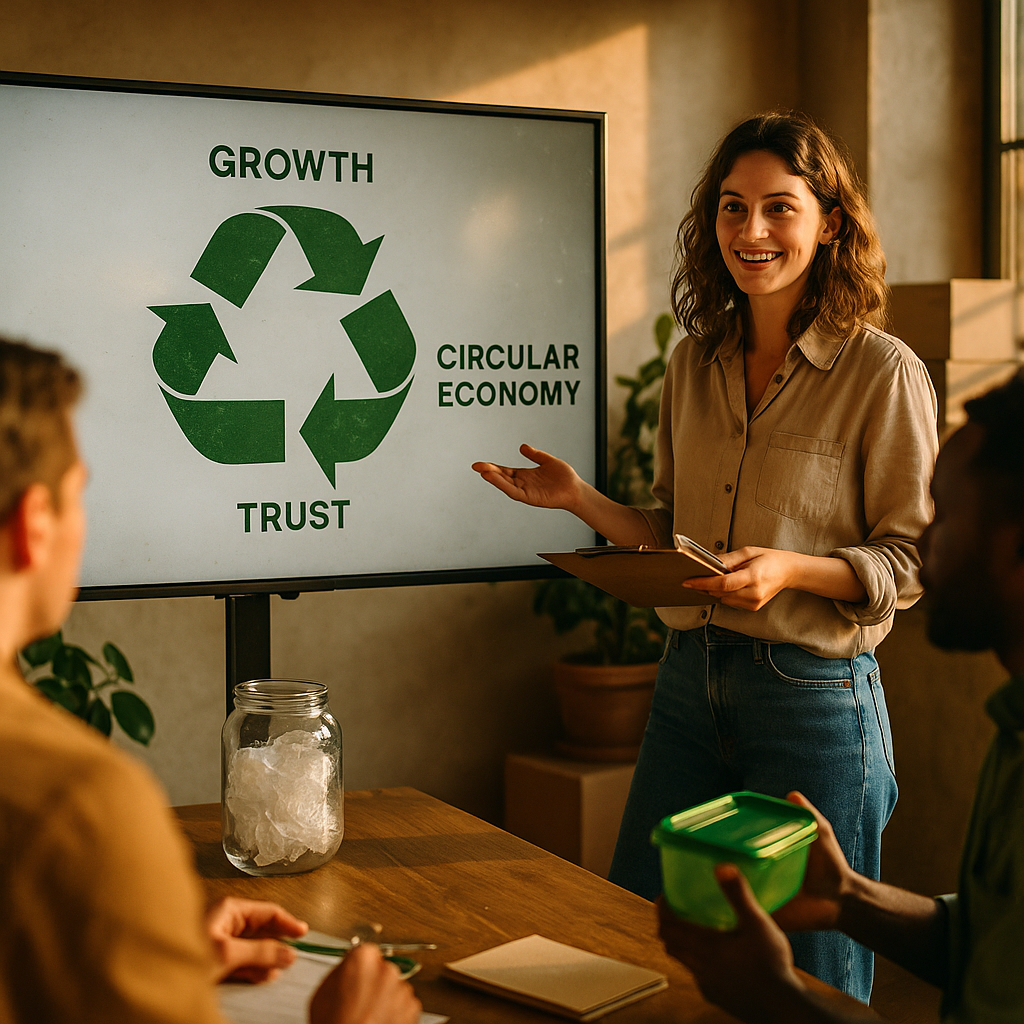
The Rise Of Circular Marketing is reshaping how brands earn trust, differentiate, and grow in 2025. Instead of pushing more products, circular strategies keep materials in use through repair, refill, resale, and recycling—then market those outcomes with proof, not hype. Done well, sustainability becomes a measurable value exchange for customers and shareholders alike. Ready to turn circularity into growth?
Circular marketing strategy: what it is and why it’s accelerating
Circular marketing strategy applies circular economy principles to the full customer journey: product design, sourcing, packaging, distribution, ownership, return, refurbishment, resale, and end-of-life recovery. Traditional marketing focuses on demand generation and short-term conversion. Circular marketing widens the lens to include what happens after the sale—because that’s where cost savings, loyalty, and credible sustainability gains often appear.
Several forces explain the acceleration in 2025:
- Economics: Volatile raw material prices make recovered materials and refurbished inventory more attractive.
- Customer expectations: Buyers increasingly want durability, repairability, and low-waste options, not just “eco” claims.
- Retail realities: Returns, excess inventory, and reverse logistics have become board-level issues; circular programs convert problems into revenue streams.
- Regulatory pressure: Policies targeting packaging waste and product responsibility are pushing brands toward take-back and reuse models.
For marketers, the shift is practical: circular programs create new offers (trade-in credits, refills, certified refurbished lines), new audiences (value-driven and sustainability-minded segments), and new data (material recovery rates, reuse cycles, return-to-resale time). The growth story becomes measurable, which strengthens credibility.
Sustainable brand growth: how circularity turns into revenue and loyalty
Circularity drives sustainable brand growth when it creates tangible customer value and reduces friction. A trade-in program is not just a sustainability initiative; it can be a customer acquisition and retention engine. Refills aren’t only about waste reduction; they can increase purchase frequency and improve margins by lowering packaging costs.
Here are the most common growth levers, and how to market them without overpromising:
- Higher lifetime value: Repair plans, spare parts, and refurbishment options keep customers within your ecosystem longer. Market this as “support for the life of your product,” with clear pricing and turnaround times.
- Lower acquisition costs through differentiation: If competitors still sell a one-way product, a circular offer can become the reason to choose you. Make the offer concrete: “Return it in any condition for credit,” or “Refill in-store in under 3 minutes.”
- New revenue lines: Certified refurbished products and resale marketplaces can attract price-sensitive buyers without undermining premium positioning—if quality standards are explicit. Promote warranty terms, inspection steps, and grading criteria.
- Improved retention through values alignment: Customers who participate in take-back or refill programs tend to repeat if the experience is easy. Market the convenience first, then the impact.
Readers often ask: “Does circularity cannibalize new product sales?” It can, but many brands offset this by capturing resale value, lowering churn, and using refurbished tiers as a gateway into the brand. The key is pricing architecture: keep new products premium through innovation and guarantees, while refurbished options expand your addressable market.
Circular economy branding: building trust with evidence and transparency
Circular economy branding succeeds when it is specific. General sustainability statements blur together and invite skepticism. Instead, anchor brand messages to verifiable mechanisms and outcomes: how products are made, how long they last, what happens when customers return them, and what percentage is recovered and reused.
In 2025, trust is built through three practices:
- Operational proof: Show the circular system, not just the intention. Publish program details: accepted items, condition rules, partner facilities, and processing steps.
- Impact accounting with boundaries: If you cite savings (waste avoided, emissions reduced), explain what’s included. Avoid vague “net positive” language unless you can substantiate it.
- Third-party validation where it matters: Certifications, audited reports, and reputable partners strengthen claims. Use them to clarify methods, not to hide behind logos.
EEAT-ready content is also customer-ready content. Provide answers your audience needs to participate:
- How do I return items?
- What do I get in exchange?
- How is refurbished quality verified?
- What happens to items that can’t be resold?
When you address these questions on product pages, emails, and paid landing pages, you reduce customer anxiety and increase conversion. Transparency becomes a sales accelerator.
Green marketing compliance: avoiding greenwashing and meeting 2025 expectations
Green marketing compliance is now a competitive advantage because enforcement and consumer scrutiny have both intensified. The risk isn’t only legal; it’s reputational. A circular marketing campaign can backfire if claims outpace operations or if disclosures are buried.
Use a disciplined claims framework:
- Prefer specific, scoped claims: “Packaging is refillable and designed for 30 reuse cycles” is stronger than “eco-friendly packaging.”
- Quantify only what you can substantiate: If you don’t have robust measurement, avoid precise numbers. Replace with process commitments and timelines you control.
- Separate product impact from company-wide impact: A take-back program for one line does not make the entire brand “circular.”
- Disclose trade-offs: If refills require customers to travel to a store, acknowledge convenience and access considerations. Credibility rises when you don’t pretend there are no constraints.
- Keep records: Maintain documentation for claims: supplier certifications, audit results, chain-of-custody evidence, and methodology notes.
Marketers should coordinate with legal, sustainability, and operations teams before launching campaigns. The best circular marketing is cross-functional by design: the message is the outcome of the system, not a layer of paint applied afterward.
Reverse logistics marketing: designing the take-back, repair, and resale experience
Reverse logistics marketing focuses on the customer experience of returns, trade-ins, repairs, and product end-of-life. If the reverse journey is confusing, circular programs stall. If it is simple, customers participate—and participation is what creates recoverable materials, refurbished inventory, and measurable impact.
To make reverse logistics a growth channel, design for low friction:
- Clear incentives: Offer instant credit, tiered rewards, or membership benefits. Communicate the value upfront and keep terms simple.
- Convenient pathways: Provide multiple options: mail-in labels, in-store drop-off, pickup for bulky items. Highlight the fastest path for each category.
- Predictable service levels: Publish repair timelines and refurbishment standards. Add tracking so customers can see progress.
- Quality assurance storytelling: Explain testing protocols and grading. A “certified refurbished” label should come with a checklist, not a slogan.
- Remarketing that respects the customer: After a trade-in, recommend compatible upgrades, spare parts, or refurbished alternatives—not only the newest model.
Brands often wonder where to start. Begin with the highest-return pathway that fits your category:
- High-value durable goods: Repair + certified refurbishment usually produces the best margins and the strongest trust signals.
- Fast-moving consumer goods: Refill and reusable packaging systems often deliver higher repeat rates if access is convenient.
- Apparel and accessories: Resale and buy-back programs can expand reach and provide authenticated entry-level options.
Then market the journey like any product: name it, simplify it, and make participation feel normal—not niche.
ESG performance metrics: what to measure and how to communicate results
ESG performance metrics turn circular marketing into accountable marketing. Without measurement, circularity remains a narrative. With measurement, it becomes a performance story investors, procurement teams, and customers can evaluate.
Choose metrics that link to both business outcomes and environmental outcomes:
- Participation rate: Percentage of customers using take-back, refill, or repair services.
- Recovery rate: Portion of returned material successfully reused, refurbished, or recycled into new supply.
- Reuse cycles: Average number of times a packaging unit or product component is reused.
- Refurbished sell-through rate: How quickly certified refurbished inventory sells, and at what margin.
- Return-to-resale time: Time from customer return to item being available for resale, a key operational efficiency indicator.
- Customer satisfaction: Repair and trade-in NPS or CSAT, plus complaint rates and resolution time.
When communicating results, aim for clarity:
- Use plain language: Explain methodologies without jargon.
- Show progress over perfection: Publish baselines, targets, and what changed operationally to produce results.
- Connect metrics to customer impact: “You can now refill at 120 locations” is more actionable than abstract savings alone.
To align with EEAT, include who owns the data internally (team or function), what standards or partners support it, and how often you update reporting. Helpful content makes measurement understandable and repeatable.
FAQs
What is circular marketing, in simple terms?
Circular marketing promotes products and services designed for reuse, repair, refill, resale, and recycling. It markets the full lifecycle experience, not just the initial purchase, so customers can participate in keeping materials in use.
How does circular marketing drive brand growth?
It creates new offers (trade-in credits, refills, certified refurbished products), increases repeat purchases through service relationships, and differentiates the brand with credible proof. It can also reduce costs through recovered materials and improved inventory outcomes.
What are the best circular marketing tactics to start with?
Start with the pathway that matches your product economics: repair and parts for durable goods, refill systems for high-frequency consumables, and resale/buy-back for categories with strong secondary markets. Prioritize convenience and clear incentives to increase participation.
How do brands avoid greenwashing in circular campaigns?
Make specific claims you can document, define boundaries (what the claim covers), use transparent program details, and avoid vague terms like “eco-friendly” without explanation. Keep evidence on file and coordinate with legal and sustainability teams before launch.
Do refurbished products hurt premium positioning?
Not if quality standards and warranties are explicit. Certified refurbished lines can expand reach and build trust when inspection steps, grading, and service terms are clear. Many brands protect premium positioning through distinct product tiers and benefits for new purchases.
Which metrics matter most for circular marketing performance?
Track participation rate, recovery rate, reuse cycles, refurbished sell-through, return-to-resale time, and customer satisfaction for repair/trade-in journeys. These metrics connect operational reality to customer value and marketing credibility.
In 2025, circular marketing is no longer a niche sustainability message; it’s a practical growth model built on repeatable systems. Brands that design for reuse, repair, refill, and resale earn loyalty through convenience and proof, not promises. Measure what changes, disclose boundaries, and make participation effortless. The takeaway: build the circular engine first, then market its results with confidence.