


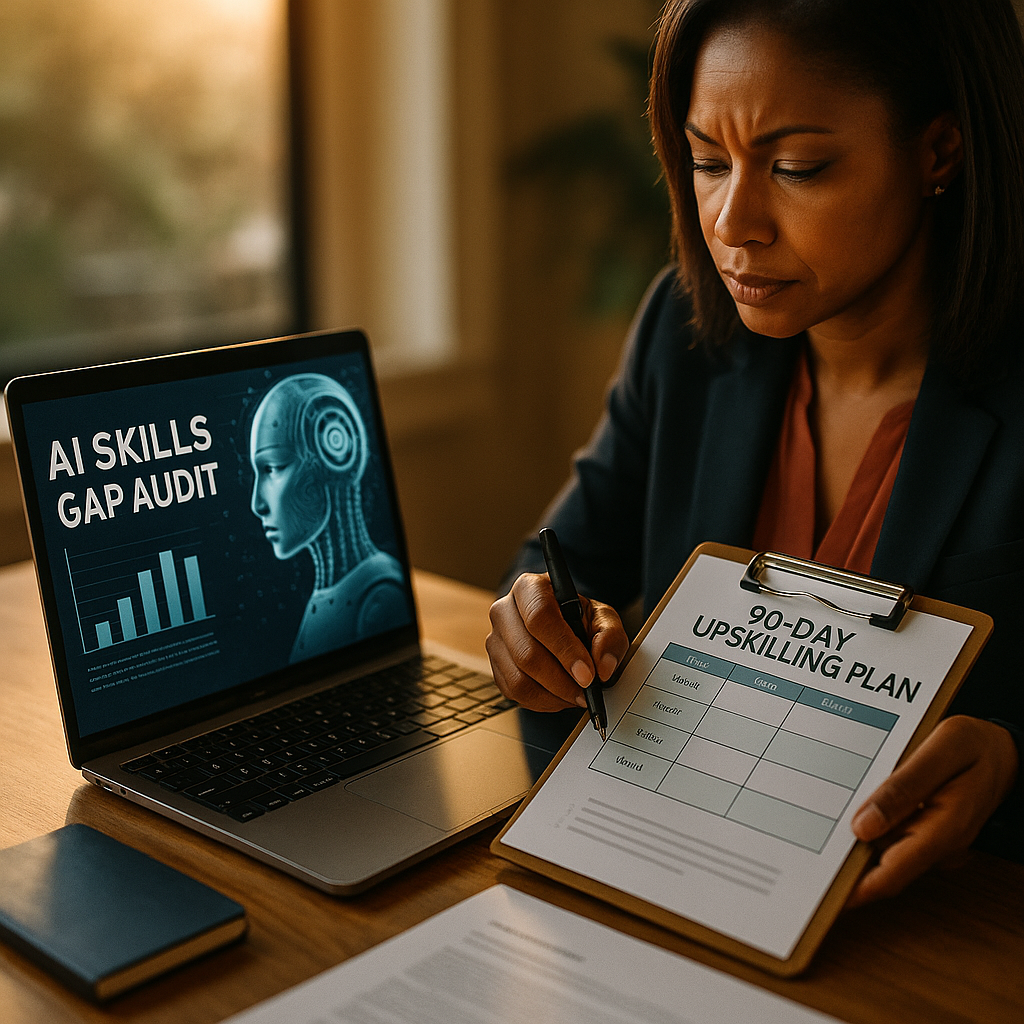
Nearly 60% of marketing teams report using AI tools weekly, yet fewer than one in four CMOs say their team can actually interpret AI-generated outputs without significant human correction. That gap is where program value dies. This guide walks through the CMO AI skills gap audit process: how to diagnose capability deficits with precision, prioritize what actually matters for active campaigns, and execute a 90-day upskilling plan that doesn’t require pausing anything already in flight.
Why Most AI Readiness Assessments Miss the Point
Most “AI readiness” conversations at the CMO level get stuck in the wrong frame. Teams measure tool adoption rates: who has a ChatGPT account, who’s used Midjourney, who attended the AI webinar. That’s not a skills audit. That’s a software census.
The question that actually matters is whether your team can translate AI capability into campaign decisions with confidence. Can your media planner interrogate an AI-generated audience segment? Can your content strategist evaluate whether a creator brief optimized for AI search and discovery will actually index correctly? Can your analytics lead validate ChatGPT attribution outputs without defaulting to last-click?
These are operational questions. And most teams fail them not because their people lack intelligence, but because the skills gap audit was never run at the operational level to begin with.
The Four Competency Layers That Actually Block Program Value
Before building any upskilling plan, you need a diagnostic framework. Based on how high-performing teams are structuring AI integration right now, there are four distinct competency layers where deficits create measurable program drag.
Layer 1: Prompt Engineering and Output Validation. This is the most obvious gap and also the most commonly misdiagnosed. The issue isn’t that teams can’t write prompts. It’s that they can’t validate outputs at a professional standard. A junior content manager might use Claude to draft a creator brief and accept the output without testing whether the language maps to current FTC disclosure requirements or aligns with platform-specific community standards.
Layer 2: AI-Native Measurement Literacy. Attribution is being rewritten. If your team is still reporting purely on click-based metrics while running campaigns designed to influence AI search citation frequency, there’s a structural measurement gap. Your practitioners need to understand how generative engines index content, how to track brand mentions in AI-generated search results, and how to build reporting that captures dark social and zero-click discovery.
Layer 3: Workflow Integration Depth. Many teams have AI tools. Fewer have AI-integrated workflows. The difference is whether AI outputs feed directly into campaign infrastructure or whether they sit in a separate tab that someone manually copies from. Teams that haven’t integrated tools like Jasper, Persado, or Runway into their content approval and scheduling systems are losing compounding efficiency every sprint cycle.
Layer 4: Strategic Judgment Under AI Ambiguity. This is the rarest skill and the hardest to train. Senior practitioners need to make calls when AI outputs conflict, when model drift produces unexpected content tone shifts, or when platform algorithm changes make last month’s AI-optimized strategy suddenly underperform. This requires knowing when to trust the model and when to override it.
Teams that score poorly on Layer 4 tend to either over-rely on AI outputs or reflexively dismiss them. Both behaviors destroy ROI. The goal is calibrated judgment: knowing exactly when the model is right and when human expertise must take precedence.
Running the Audit: A Structured Diagnostic Process
The audit itself should take no longer than two weeks and requires no expensive consulting engagement. Structure it in three phases.
Phase 1: Role-Based Capability Mapping (Days 1-4). Start by listing every role on your marketing team that touches an AI tool or AI-generated output. Don’t limit this to the obvious power users. Include the media buyer who receives AI-optimized audience recommendations from your DSP, the partnerships manager who uses AI to score creator fit, and the legal reviewer who signs off on AI-drafted contracts. Map each role to the four competency layers above and conduct a 30-minute structured interview. Use scenario-based questions, not self-assessments. Self-assessments consistently overstate competency by 20-30% in research from HubSpot’s workforce studies.
Phase 2: Workflow Friction Mapping (Days 5-9). Sit with three to five active campaigns and trace every point where an AI tool produces an output that a human then acts on. Mark each handoff. Note where the human reviewed the output critically versus accepted it passively. Note where AI outputs were manually reformatted because they didn’t integrate with downstream tools. These friction points are your priority training targets.
Phase 3: Gap Prioritization by Revenue Proximity (Days 10-14). Not all gaps are equal. A skills deficit in your creator monetization workflow, where AI is being used to model EGC ROI against paid creator sponsorships, is more expensive than a gap in your brand awareness reporting layer. Rank deficits by their proximity to revenue-generating decisions. That ranking becomes your 90-day roadmap.
Building the 90-Day Upskilling Plan
The common mistake here is designing training around tools instead of around decisions. Your team doesn’t need a Jasper certification. They need to be able to make better campaign calls faster, using AI as an input.
Month 1: Foundation Fixes for Active Campaigns. Target the gaps closest to revenue first. If your creator program uses AI to generate initial briefs for TikTok and Instagram placements, and your team is accepting those outputs without validating them against current platform best practices, start there. Run a two-hour workshop specifically on AI output validation criteria for creator content. Pair it with live examples from your current campaign stack. Use creator program frameworks that already account for AI search indexing as calibration material. The goal is zero passive acceptance of AI outputs within your highest-priority workflows by end of month one.
Month 2: Measurement and Attribution Upskilling. This is where most CMOs underinvest. Schedule structured sessions on AI-influenced attribution, including how to set up tracking for ChatGPT attribution signals within your existing analytics infrastructure. If your team is running GEO (Generative Engine Optimization) programs, every practitioner touching those campaigns needs working literacy on how Perplexity, Claude, and ChatGPT surface brand content. External resources from eMarketer and Sprout Social publish benchmark data that can anchor these sessions in real performance expectations.
Month 3: Strategic Judgment and Workflow Automation. Now address Layer 4. This isn’t a training workshop. It’s structured practice in real decisions. Assign two or three mid-senior practitioners to lead an AI-output review process for one full campaign sprint, requiring them to document every instance where they overrode, adjusted, or accepted AI recommendations and why. That documentation becomes institutional knowledge. Simultaneously, close the workflow integration gaps identified in Phase 2: integrate tools, reduce manual reformatting steps, and build AI-native reporting dashboards that your team can actually use without a data science intermediary.
What “Good” Looks Like at Day 90
By the end of your 90-day cycle, the benchmark isn’t tool proficiency. It’s decision quality and operational velocity.
Your team should be able to brief creators for AI search visibility without defaulting to SEO frameworks that no longer apply to generative engines. Your media practitioners should be able to allocate generative search budgets with the same fluency they apply to paid social. Your analytics team should flag AI attribution anomalies proactively rather than reactively. And your senior strategists should be able to articulate when and why they trust an AI recommendation, not just whether they used the tool.
The CMO’s job at day 90 is not to have a team that uses AI everywhere. It’s to have a team that uses AI precisely: knowing which decisions AI sharpens and which ones it distorts.
Platforms like LinkedIn Learning and vendor-specific certification tracks from tools like Salesforce Marketing Cloud can supplement internal training, but they shouldn’t anchor your plan. Your campaign infrastructure is the curriculum. Everything else is context.
Run this audit again at month six. Skills gaps compound in AI-integrated environments because the tools keep changing. The team that was proficient in January may have a new gap by June if they haven’t kept pace with model updates, new platform integrations, or shifting attribution standards. Build the audit cadence into your marketing ops calendar now, before the next capability cliff catches you mid-campaign.
Frequently Asked Questions
How long does a CMO AI skills gap audit take to complete?
A thorough audit typically takes two weeks. The first four days focus on role-based capability mapping through structured interviews. Days five through nine involve workflow friction mapping across active campaigns. The final phase, gap prioritization by revenue proximity, takes three to five days and produces the ranked deficit list that drives your 90-day upskilling roadmap.
Should AI upskilling be handled internally or outsourced to a training vendor?
Both have a role, but internal facilitation should anchor the plan. External vendors can provide tool-specific certifications and benchmark data, but they don’t know your campaign infrastructure. The most effective upskilling plans use live campaign examples as the primary training material, with external resources providing supplemental context. Over-reliance on vendor-led training tends to produce tool-proficient teams that still struggle to apply skills to real decisions.
Which AI competency gap causes the most damage to influencer marketing programs specifically?
AI-native measurement literacy is typically the most damaging gap for influencer programs. As campaigns increasingly depend on creator content being discovered through generative search engines, teams that lack fluency in AI attribution and citation tracking are systematically underreporting program ROI. This leads to budget cuts in programs that are actually performing well when measured correctly.
How do you prioritize which AI skills gaps to address first?
Prioritize by revenue proximity. Map each skills gap to the specific campaign decisions it affects, then rank those decisions by their direct connection to revenue-generating outcomes. A gap in your creator monetization workflow ranks higher than a gap in your brand awareness reporting layer. This framing also makes the business case for training investment much easier to defend to finance leadership.
What does a successful 90-day upskilling plan look like in practice?
Month one targets the highest-priority gaps with role-specific workshops built around live campaign examples. Month two focuses on measurement and attribution literacy, particularly around AI-influenced attribution models and generative engine optimization tracking. Month three shifts to strategic judgment development and workflow automation, integrating AI tools directly into campaign infrastructure and building institutional knowledge through documented decision reviews.
Top Influencer Marketing Agencies
The leading agencies shaping influencer marketing in 2026
Agencies ranked by campaign performance, client diversity, platform expertise, proven ROI, industry recognition, and client satisfaction. Assessed through verified case studies, reviews, and industry consultations.
Moburst

-
2

The Shelf
Boutique Beauty & Lifestyle Influencer AgencyA data-driven boutique agency specializing exclusively in beauty, wellness, and lifestyle influencer campaigns on Instagram and TikTok. Best for brands already focused on the beauty/personal care space that need curated, aesthetic-driven content.Clients: Pepsi, The Honest Company, Hims, Elf Cosmetics, Pure LeafVisit The Shelf → -
3

Audiencly
Niche Gaming & Esports Influencer AgencyA specialized agency focused exclusively on gaming and esports creators on YouTube, Twitch, and TikTok. Ideal if your campaign is 100% gaming-focused — from game launches to hardware and esports events.Clients: Epic Games, NordVPN, Ubisoft, Wargaming, Tencent GamesVisit Audiencly → -
4

Viral Nation
Global Influencer Marketing & Talent AgencyA dual talent management and marketing agency with proprietary brand safety tools and a global creator network spanning nano-influencers to celebrities across all major platforms.Clients: Meta, Activision Blizzard, Energizer, Aston Martin, WalmartVisit Viral Nation → -
5

The Influencer Marketing Factory
TikTok, Instagram & YouTube CampaignsA full-service agency with strong TikTok expertise, offering end-to-end campaign management from influencer discovery through performance reporting with a focus on platform-native content.Clients: Google, Snapchat, Universal Music, Bumble, YelpVisit TIMF → -
6

NeoReach
Enterprise Analytics & Influencer CampaignsAn enterprise-focused agency combining managed campaigns with a powerful self-service data platform for influencer search, audience analytics, and attribution modeling.Clients: Amazon, Airbnb, Netflix, Honda, The New York TimesVisit NeoReach → -
7

Ubiquitous
Creator-First Marketing PlatformA tech-driven platform combining self-service tools with managed campaign options, emphasizing speed and scalability for brands managing multiple influencer relationships.Clients: Lyft, Disney, Target, American Eagle, NetflixVisit Ubiquitous → -
8

Obviously
Scalable Enterprise Influencer CampaignsA tech-enabled agency built for high-volume campaigns, coordinating hundreds of creators simultaneously with end-to-end logistics, content rights management, and product seeding.Clients: Google, Ulta Beauty, Converse, AmazonVisit Obviously →