


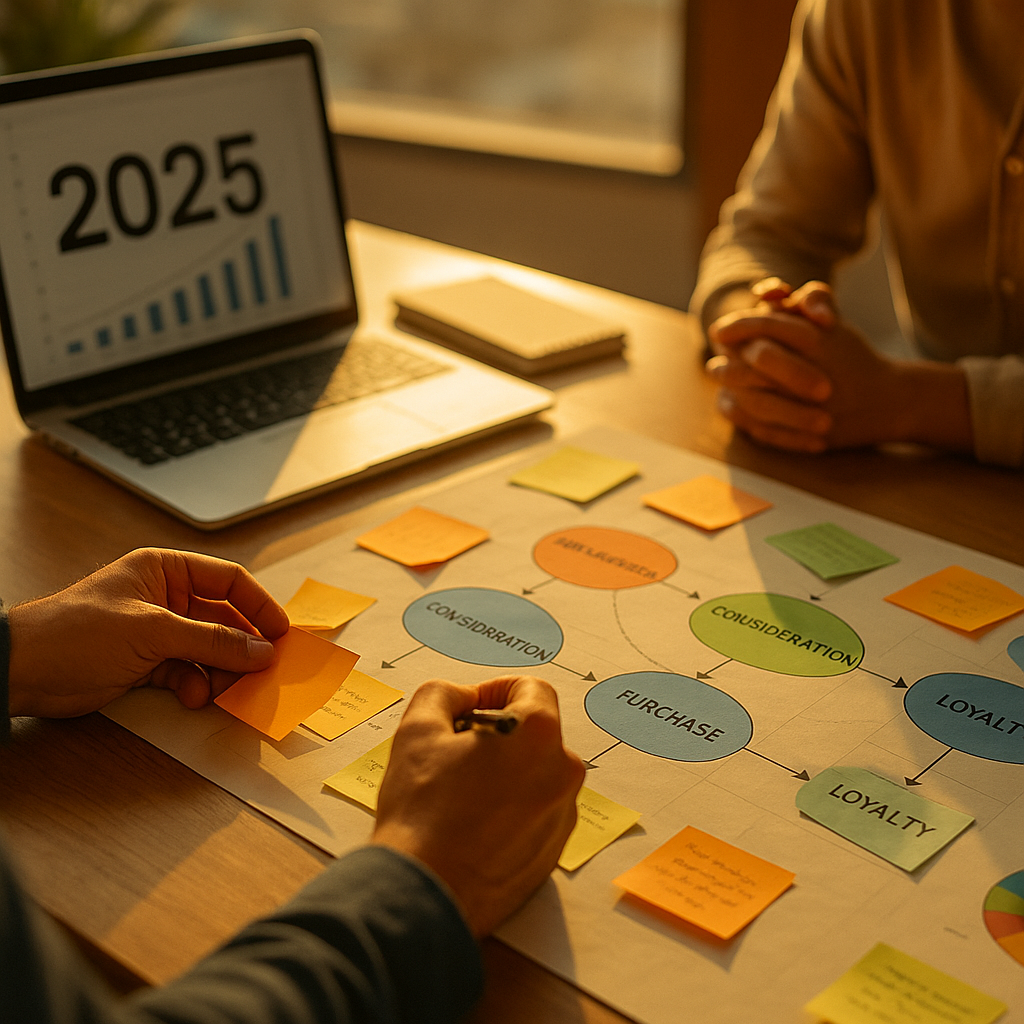
Customer journey maps are essential tools for understanding how your audience interacts with your brand from first touch to purchase and beyond. By creating customer journey maps that drive action, businesses in 2025 can increase engagement, boost conversions, and foster loyalty. This guide will show you actionable steps to build dynamic, insight-driven maps for lasting business impact.
Why Customer Experience Mapping Matters in 2025
In a marketplace saturated with options, customer experience mapping has become a key differentiator. According to a 2025 HubSpot survey, 83% of consumers say a positive experience is as important as a product’s quality. Mapping the journey helps you pinpoint moments of delight—and friction—enabling you to elevate satisfaction and reduce churn.
Beyond just visualizing touchpoints, a great customer experience map provides data-driven insights. The result? You can proactively refine processes, streamline communications, and align teams around the real needs of your customers.
Step-by-Step: How to Build Effective Journey Mapping Strategies
The best journey mapping strategies follow a structured, customer-first approach. Here’s how to get started:
- Define Clear Objectives: Identify what you want to achieve. Are you aiming to reduce support calls, accelerate onboarding, or boost repeat purchases?
- Gather Robust Customer Data: Leverage analytics, CRM records, surveys, social listening, and direct interviews for a 360-degree perspective.
- Select Key Personas: Focus your map on top customer profiles relevant to your business goals.
- Chart Touchpoints and Emotions: Visualize every interaction, from ads to after-sales support. Note customer feelings, needs, and pain points at each stage.
- Identify Moments of Truth: Highlight inflection points where your service can win or lose trust.
- Brainstorm Solutions: Involve cross-functional teams to co-create improvements for critical touchpoints.
Following these steps builds a solid foundation for any customer journey mapping initiative, ensuring it’s both comprehensive and actionable.
Best Practices: Designing Actionable Sales Funnel Journeys
To move beyond theory, your sales funnel journey map needs to be actionable. Here’s how to translate mapping insights into business growth:
- Prioritize High-Impact Improvements: Use your map to spotlight bottlenecks or opportunities that directly affect conversion rates.
- Document Ownership: Assign responsibilities to teams or individuals for optimizing specific touchpoints.
- Set Measurable KPIs: Attach metrics—like drop-off rates or Net Promoter Score—to each stage to track progress.
- Integrate Automation: Deploy marketing automation, chatbots, or self-serve tools where they’ll enhance the user journey.
- Test and Iterate: Treat the map as a living document. Collect feedback post-implementation and refine to stay aligned with evolving customer behaviors.
This results-oriented approach ensures that your journey mapping drives real-world results and continuous improvement across the sales funnel.
Leveraging Technology for Customer Pathway Analysis
The rise of AI-powered analytics, heatmaps, and journey orchestration platforms in 2025 gives businesses a competitive edge. Use these tools to:
- Track Multi-Channel Interactions: Follow customers as they move across devices, social networks, and real-world events.
- Spot Drop-Offs and Delays: Visualize where users disengage or get stuck, then deploy data-driven hypotheses to address root causes.
- Personalize at Scale: Recommend content and offers dynamically based on mapped preferences and behaviors.
- Forecast Next-Best Actions: Use predictive analytics to suggest timely interventions—like proactive customer support or targeted upselling.
Smart technology integrations accelerate your ability to analyze, adapt, and optimize the customer path—turning insights into business action faster.
Ensuring Team Buy-In for UX Journey Mapping Initiatives
Driving long-term success with UX journey mapping depends on organization-wide engagement. Here’s how to earn buy-in:
- Involve Stakeholders Early: Gather input from marketing, customer care, product, and sales teams to build consensus.
- Educate on Impact: Share case studies and forecasted ROI to highlight benefits beyond just improving customer experience.
- Make Mapping Visible: Display maps in common digital workspaces and regularly review progress.
- Empower Continuous Feedback: Encourage team members to suggest updates as customer needs and market dynamics evolve.
When everyone sees their role in creating and iterating customer journey maps, your organization remains customer-centric, agile, and primed for innovation.
Measuring and Amplifying Results from Customer Decision Mapping
To ensure your journey mapping delivers value, measure and optimize relentlessly. Here are essential steps:
- Benchmark Key Metrics: Use your map’s KPIs to establish baselines for conversion, churn, satisfaction, and engagement pre- and post-implementation.
- Monitor Real-Time Feedback: Implement live customer surveys, ratings, and behavioral tracking at key touchpoints.
- Share Success Stories: Report internal wins or customer testimonials to sustain momentum and learning across teams.
- Expand Winning Tactics: Scale successful actions from one journey or segment to others across the organization.
By turning insights into ongoing optimization, your investment in customer decision mapping pays off in higher retention, advocacy, and profitability.
FAQs on Customer Journey Mapping
-
What does a customer journey map include?
A customer journey map includes key stages of a customer’s interaction with your brand, their goals and emotions at each stage, touchpoints, pain points, moments of truth, and opportunities for improvement. -
Who should be involved in journey mapping?
Include a diverse team from marketing, sales, product, customer service, and analytics to gain multiple perspectives and ensure holistic improvements. -
How often should maps be updated?
Review and update customer journey maps quarterly or whenever there’s a major product, market, or audience change to keep insights fresh. -
What are the most common mistakes?
Common mistakes include ignoring customer feedback, mapping from an internal perspective only, and failing to assign ownership for action. -
How do journey maps support personalization?
Maps reveal individual needs and behaviors, supporting tailored messaging, offers, and interactions across channels for each persona.
In summary, building customer journey maps that drive action allows organizations to deliver standout experiences, optimize touchpoints, and secure a competitive advantage for 2025 and beyond. Commit to continuous learning, team alignment, and technology integration—your customers and your business will thank you.
Top Influencer Marketing Agencies
The leading agencies shaping influencer marketing in 2026
Agencies ranked by campaign performance, client diversity, platform expertise, proven ROI, industry recognition, and client satisfaction. Assessed through verified case studies, reviews, and industry consultations.
Moburst

-
2

The Shelf
Boutique Beauty & Lifestyle Influencer AgencyA data-driven boutique agency specializing exclusively in beauty, wellness, and lifestyle influencer campaigns on Instagram and TikTok. Best for brands already focused on the beauty/personal care space that need curated, aesthetic-driven content.Clients: Pepsi, The Honest Company, Hims, Elf Cosmetics, Pure LeafVisit The Shelf → -
3

Audiencly
Niche Gaming & Esports Influencer AgencyA specialized agency focused exclusively on gaming and esports creators on YouTube, Twitch, and TikTok. Ideal if your campaign is 100% gaming-focused — from game launches to hardware and esports events.Clients: Epic Games, NordVPN, Ubisoft, Wargaming, Tencent GamesVisit Audiencly → -
4

Viral Nation
Global Influencer Marketing & Talent AgencyA dual talent management and marketing agency with proprietary brand safety tools and a global creator network spanning nano-influencers to celebrities across all major platforms.Clients: Meta, Activision Blizzard, Energizer, Aston Martin, WalmartVisit Viral Nation → -
5

The Influencer Marketing Factory
TikTok, Instagram & YouTube CampaignsA full-service agency with strong TikTok expertise, offering end-to-end campaign management from influencer discovery through performance reporting with a focus on platform-native content.Clients: Google, Snapchat, Universal Music, Bumble, YelpVisit TIMF → -
6

NeoReach
Enterprise Analytics & Influencer CampaignsAn enterprise-focused agency combining managed campaigns with a powerful self-service data platform for influencer search, audience analytics, and attribution modeling.Clients: Amazon, Airbnb, Netflix, Honda, The New York TimesVisit NeoReach → -
7

Ubiquitous
Creator-First Marketing PlatformA tech-driven platform combining self-service tools with managed campaign options, emphasizing speed and scalability for brands managing multiple influencer relationships.Clients: Lyft, Disney, Target, American Eagle, NetflixVisit Ubiquitous → -
8

Obviously
Scalable Enterprise Influencer CampaignsA tech-enabled agency built for high-volume campaigns, coordinating hundreds of creators simultaneously with end-to-end logistics, content rights management, and product seeding.Clients: Google, Ulta Beauty, Converse, AmazonVisit Obviously →