


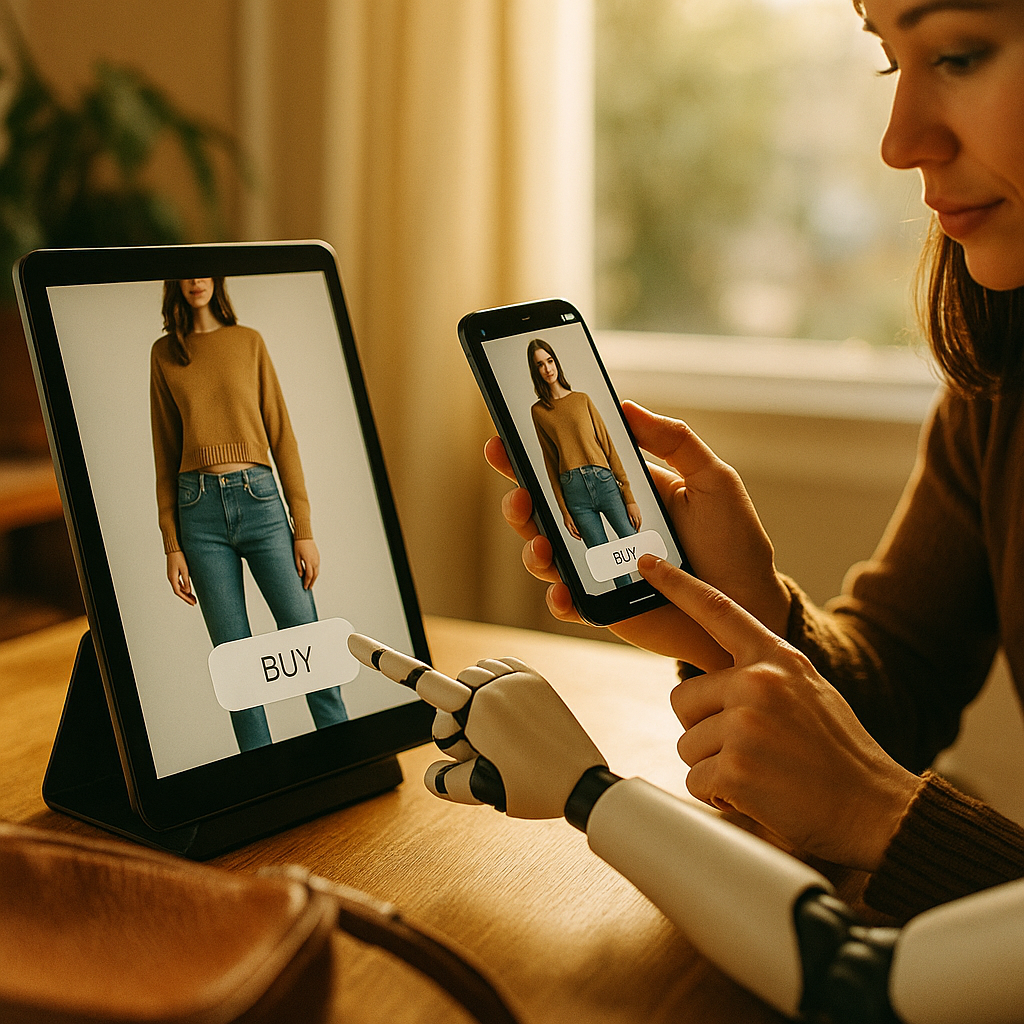
AI shopping agents now influence over 30% of product discovery journeys in conversational interfaces — and most creator briefs were written before that statistic existed. The creator-to-machine-buyer brief evolution isn’t a future-state problem. It’s a right-now operational gap that’s quietly eroding campaign ROI for brands still briefing creators like it’s a pure social play.
Two Audiences, One Asset — The New Creative Constraint
Every piece of creator content your brand produces now has to work on two fundamentally different cognitive systems. The first is a human scrolling TikTok or Instagram Reels at 11pm, making purchase decisions based on emotion, relatability, and trust in a familiar face. The second is a large language model — think Perplexity, ChatGPT Shopping, or Google’s AI Overviews — parsing structured signals to decide which product to surface when someone asks “what’s the best SPF moisturizer for oily skin under $40.”
These two systems don’t want the same things. Humans respond to narrative tension, humor, and personality. AI agents respond to specificity, schema-friendly language, and verifiable product claims. The brands winning right now are the ones who’ve figured out how to serve both — inside the same asset.
Creator content is no longer just audience-facing media. It’s structured product data in disguise — and most brands haven’t updated their briefs to reflect that reality.
What AI Shopping Agents Actually Parse From Creator Content
Let’s get specific, because this is where most marketing teams get vague when they shouldn’t.
When an AI shopping agent crawls or indexes creator content — whether via a brand’s own product page, a YouTube caption, a TikTok video description, or a syndicated UGC embed — it’s looking for a handful of signal types:
- Explicit product attributes: Ingredient names, dimensions, material specs, SKU-level identifiers
- Use-case language: “For people with sensitive skin,” “ideal for apartment living,” “works with iPhone and Android”
- Sentiment anchors: Phrases that pattern-match to trust signals — “I’ve used this for six months,” “replaced my previous routine”
- Comparison language: References to alternatives that help agents understand category positioning
- Structured captions and transcripts: Text layers that LLMs can actually read, not just visual content buried in video
Most creator briefs today ask for a vibe, a key message, and a disclosure. That’s not enough anymore. The brief needs to specify the exact language a creator should use in spoken word, on-screen text, and in the caption — not because you’re stripping their voice, but because those elements need to function as machine-readable product data.
For brands managing retail media placements, this connects directly to how creator content for retail media gets indexed on platforms like Amazon and Walmart Connect — where AI-driven recommendation engines are already making these parsing decisions at scale.
Rebuilding the Brief: The Dual-Audience Architecture
Think of the updated brief as having two layers — a human resonance layer and a machine legibility layer. Neither overrides the other. Both are non-negotiable.
Human resonance layer is what most briefs already cover: tone of voice, creative hook direction, storytelling arc, call-to-action style. If you’re producing vertical video, your video production briefs should already be optimizing for native format behavior and platform-specific hook windows.
Machine legibility layer is what’s missing. This includes:
- A required keyword set — not SEO keywords for a blog post, but natural-language product descriptor phrases that AI agents are likely to match against buyer queries
- Mandatory mention of product attributes in spoken audio (since transcription feeds LLM indexing)
- Caption structure requirements: lead with the use case, follow with the product name, close with a differentiator
- Schema alignment: if your product pages use structured data markup from Schema.org, the language in creator captions should mirror those attribute labels
This isn’t about making creator content sound robotic. A creator can say “honestly this serum is the only thing that’s worked for my combination skin after three years of trying everything” — and that sentence contains use-case language, sentiment anchoring, and implicit comparison language that an AI agent can parse. The brief just needs to be explicit that those elements must be present, and in roughly what form.
Platform Behavior Is Already Bifurcating
Here’s the operational reality: different distribution surfaces have different AI parsing behaviors, and your brief needs to account for where the asset will live after the initial social drop.
TikTok’s internal recommendation engine and its Shop product feed operate on different signals than Google’s AI Overviews or a ChatGPT plugin. A creator video briefed purely for TikTok virality — with a strong hook, trend-aligned audio, and minimal explicit product description — may perform brilliantly in the For You Page and invisibly everywhere else. That’s a distribution gap brands are starting to feel in their attribution dashboards.
The brief template for AI shopping and generative search needs to account for how content migrates: from social post to brand website embed to retail media unit to AI-surfaced recommendation. Each stop in that journey has a different parsing requirement.
A TikTok-native brief optimized for human virality and a machine-legible brief optimized for AI agent discovery are not the same document. Brands need both — ideally fused into one.
Where Creators Fit in This — And Where They Don’t
This evolution creates tension with something brands have worked hard to build: authentic creator relationships. You cannot brief a creator like you’re writing product spec sheet copy and expect the output to feel genuine. Audiences will clock it immediately, and platform algorithms penalize forced-sounding content.
The solution is structural, not creative. Brands should handle the machine legibility layer in post — through caption editing, transcript optimization, and structured data tagging on owned pages — rather than loading every requirement onto the creator’s shoulders. The creator delivers the human-resonant content. The brand’s production team or agency handles the machine-legibility layer in the asset packaging stage.
This is a model some forward-thinking teams are already running. The creator shoots the video with natural language that includes the necessary attribute mentions. The brand team writes the caption to spec. The embed on the product page is wrapped in structured data. It’s a workflow shift, not a creative compromise.
For teams managing content at scale, the multi-format production template approach — capturing one creator session and distributing across formats — maps well onto this model, since post-production machine legibility work can be applied once and propagated across placements.
Compliance Doesn’t Change — But Context Does
One thing the machine-buyer layer doesn’t affect: FTC disclosure requirements. The FTC’s guidance on endorsements still applies regardless of whether the end audience is human or AI. If anything, AI agents surfacing product recommendations in conversational interfaces add a new transparency obligation — users need to understand when a recommendation is commercially influenced. Brands should ensure disclosure language is explicit in captions and on-screen, not just buried in hashtags that text parsers may not weigh appropriately.
The Measurement Problem No One Is Talking About
How do you measure whether your creator content is influencing AI agent recommendations? Honestly, attribution infrastructure hasn’t caught up yet. Tools like Sprout Social and HubSpot track social performance. Retail media dashboards from Amazon and Walmart track conversion within their ecosystems. But the dark middle — where an AI agent surfaces your product in a ChatGPT conversation and someone then searches directly — is largely unmeasured.
Proxy metrics that forward-thinking brands are using: branded query volume lift after creator campaigns, product mention frequency in AI-generated product roundups (manually audited), and share of voice in AI Overview snippets for category queries. It’s imperfect. It’s also the best available framework until attribution tooling catches up.
Teams already experimenting with AI audience insights tools for format optimization are better positioned to build this kind of multi-signal measurement practice — because they’re already thinking about AI as both a distribution mechanism and an analytics input.
For broader context on how AI is reshaping product discovery patterns, eMarketer’s research on conversational commerce provides useful benchmarking.
Start this week: Pull three recent creator briefs and audit them against this question — does this brief produce content that an AI shopping agent could use to accurately recommend this product to the right buyer? If the answer is no, you’ve found your first rewrite target. That’s the work.
Frequently Asked Questions
What is a machine-buyer brief in influencer marketing?
A machine-buyer brief is a creator content direction document that includes requirements for AI agent legibility — not just human audience resonance. It specifies language, product attribute mentions, caption structures, and schema-aligned terminology that help AI shopping agents accurately parse and surface product recommendations in conversational interfaces like ChatGPT Shopping or Google AI Overviews.
Do I need to give creators completely different briefs for AI-optimized content?
Not necessarily. The most efficient approach is a dual-layer brief that covers both human resonance (hook, tone, storytelling) and machine legibility (required product attribute language, caption structure, spoken keyword inclusion). For teams managing scale, the machine legibility layer can also be handled in post-production through caption editing and structured data tagging on owned pages.
How do AI shopping agents discover creator content?
AI shopping agents index creator content through multiple pathways: video captions and descriptions, auto-generated transcripts, UGC embeds on brand and retail pages, and product page schema markup. Text-layer content — captions, on-screen text, spoken words converted to transcripts — is more parseable than purely visual content, which is why brief requirements for these elements matter significantly.
Does FTC disclosure compliance change when AI agents are involved?
No. FTC endorsement disclosure requirements apply regardless of whether the end audience is human or AI-mediated. However, brands should ensure disclosure language is explicit in captions and on-screen text rather than relegated to hashtags, since text parsers used by AI systems may not weigh hashtag-only disclosures appropriately.
How can brands measure whether creator content is influencing AI agent recommendations?
Direct attribution infrastructure is still maturing. Useful proxy metrics include: branded query volume lift after creator campaigns, manual audits of AI-generated product roundups for brand mention frequency, and share of voice in AI Overview snippets for category queries. Pairing these with social performance data and retail media conversion tracking gives the most complete picture available.
Top Influencer Marketing Agencies
The leading agencies shaping influencer marketing in 2026
Agencies ranked by campaign performance, client diversity, platform expertise, proven ROI, industry recognition, and client satisfaction. Assessed through verified case studies, reviews, and industry consultations.
Moburst

-
2

The Shelf
Boutique Beauty & Lifestyle Influencer AgencyA data-driven boutique agency specializing exclusively in beauty, wellness, and lifestyle influencer campaigns on Instagram and TikTok. Best for brands already focused on the beauty/personal care space that need curated, aesthetic-driven content.Clients: Pepsi, The Honest Company, Hims, Elf Cosmetics, Pure LeafVisit The Shelf → -
3

Audiencly
Niche Gaming & Esports Influencer AgencyA specialized agency focused exclusively on gaming and esports creators on YouTube, Twitch, and TikTok. Ideal if your campaign is 100% gaming-focused — from game launches to hardware and esports events.Clients: Epic Games, NordVPN, Ubisoft, Wargaming, Tencent GamesVisit Audiencly → -
4

Viral Nation
Global Influencer Marketing & Talent AgencyA dual talent management and marketing agency with proprietary brand safety tools and a global creator network spanning nano-influencers to celebrities across all major platforms.Clients: Meta, Activision Blizzard, Energizer, Aston Martin, WalmartVisit Viral Nation → -
5

The Influencer Marketing Factory
TikTok, Instagram & YouTube CampaignsA full-service agency with strong TikTok expertise, offering end-to-end campaign management from influencer discovery through performance reporting with a focus on platform-native content.Clients: Google, Snapchat, Universal Music, Bumble, YelpVisit TIMF → -
6

NeoReach
Enterprise Analytics & Influencer CampaignsAn enterprise-focused agency combining managed campaigns with a powerful self-service data platform for influencer search, audience analytics, and attribution modeling.Clients: Amazon, Airbnb, Netflix, Honda, The New York TimesVisit NeoReach → -
7

Ubiquitous
Creator-First Marketing PlatformA tech-driven platform combining self-service tools with managed campaign options, emphasizing speed and scalability for brands managing multiple influencer relationships.Clients: Lyft, Disney, Target, American Eagle, NetflixVisit Ubiquitous → -
8

Obviously
Scalable Enterprise Influencer CampaignsA tech-enabled agency built for high-volume campaigns, coordinating hundreds of creators simultaneously with end-to-end logistics, content rights management, and product seeding.Clients: Google, Ulta Beauty, Converse, AmazonVisit Obviously →