


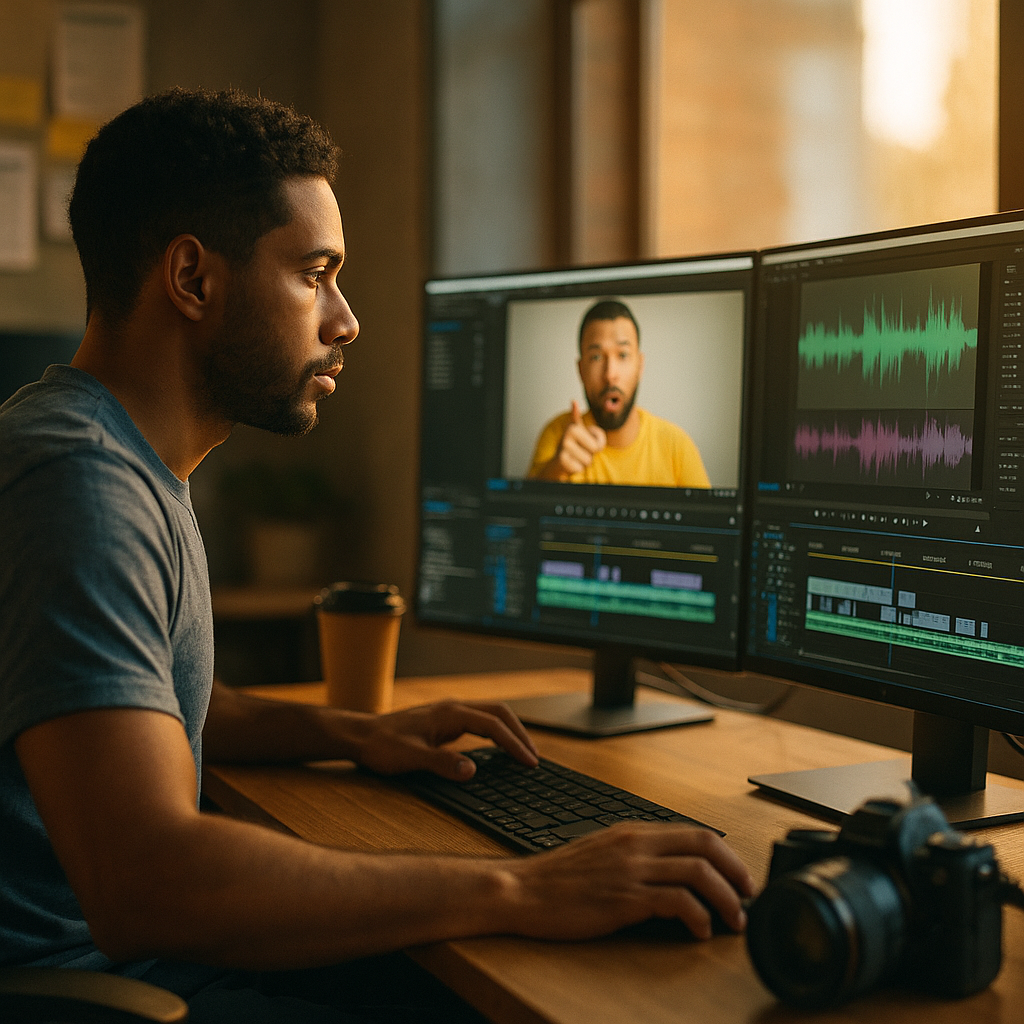
One editor on Fiverr Pro now commands $12,000 a month retainers, exclusively cutting UGC ads for DTC brands. No agency title, no fancy reel of brand films. Just a portfolio of scroll-stopping hooks and proven conversion lifts. Welcome to the new reality of the direct-response video editor hiring category, and if your production budget doesn’t already have a line item for it, you’re behind.
This isn’t a niche curiosity anymore. It’s a structural shift in how performance creative gets made, and it’s rewriting who brands hire, how they pay, and where budget flows in 2027 planning cycles.
What Changed: Editors Became Growth Operators
For years, video editing sat downstream of strategy. Someone shot the content, someone else cut it to spec, and the work moved to media buying. Direct-response editing collapses that hierarchy. These editors aren’t just trimming footage — they’re making hook decisions, pacing calls, and caption choices that directly move click-through and conversion rates.
The best ones think like media buyers. They know that a hook needs to land in under 1.5 seconds, that pattern interrupts beat polish, and that a UGC-style ad outperforming a $50,000 brand spot isn’t an accident — it’s editing craft applied to performance psychology.
Brands that once budgeted for “video production” are now budgeting separately for “conversion editing” — a line item that didn’t formally exist three years ago.
This mirrors a broader trend across creator economy hiring: skill sets are fragmenting into specialized, ROI-tied roles. It’s the same logic behind tying influencer manager hiring to CAC and LTV — the market is rewarding people who can prove a direct line to revenue, not just creative output.
Why Brand Production Budgets Are Bending Toward This Category
Three forces are pushing this shift, and none of them are going away.
- Ad fatigue is faster than ever. Meta and TikTok creative decays within days, not weeks. Brands need volume, and volume needs editors who can turn around iterations fast without sacrificing hook quality.
- Attribution pressure is real. As attribution models shift away from clicks, brands are leaning harder on creative testing to find what actually drives outcomes. Editors who understand testing frameworks become indispensable.
- UGC and creator content dominate feed real estate. Raw creator footage needs someone who can shape it into a paid-ready asset. That’s a different skill than traditional post-production.
The result? Agencies and in-house teams are quietly restructuring org charts. Traditional video producer roles are shrinking. Direct-response editor roles are multiplying, often as contractors, sometimes as full-time hires embedded inside performance marketing pods rather than creative departments.
According to eMarketer, short-form video ad spend continues to outpace overall digital ad growth, and that spend has to be fed by someone who can produce at pace. Editors are the bottleneck, and smart CMOs know it.
The Freelance Marketplace Reshuffle
Platforms built for creative freelancing have noticed. Fiverr, Upwork, and boutique talent marketplaces like Superside and Billo have all launched or expanded categories specifically for “performance editors” or “UGC ad editors.” Rate cards for this category now often exceed generalist video editing rates by 40-60%, according to marketplace pricing data reviewed informally across several platforms in late 2026.
That premium isn’t arbitrary. Buyers are paying for editors who understand:
- Platform-specific pacing (TikTok vs. Meta Reels vs. YouTube Shorts)
- Hook testing methodology and how to cut multiple variants from one shoot
- Caption and text-overlay conventions that drive retention
- Basic performance literacy — reading CTR and thumb-stop rate data to inform the next cut
That last point matters most. A direct-response editor who can’t interpret a performance dashboard is only half as valuable as one who can. This is the same algorithmic fluency trend showing up at the top of the org chart — see how algorithm fluency became a CMO hiring filter. It’s now trickling down to production-level hires too.
Budget Implications: Where the Money Actually Moves
Here’s the uncomfortable part for finance teams. This shift doesn’t necessarily shrink production budgets — it reallocates them, often in ways that look messy on a spreadsheet.
Brands are cutting big-ticket brand film budgets and redirecting a chunk into a rotating bench of freelance direct-response editors. Instead of one $80,000 hero video a quarter, teams are funding 40-60 smaller, testable assets, each cut by a specialist who’s optimizing for conversion, not cinematography.
That means:
- More vendors, smaller invoices. Finance teams used to approving a handful of large production POs now need to process dozens of smaller freelance payments monthly.
- Faster iteration cycles demand faster payment cycles. Editors expect quick turnaround on invoices if you expect quick turnaround on cuts.
- Tooling costs shift too. Editors are increasingly expected to use AI-assisted tools (CapCut, Descript, Opus Clip) to speed up variant production, which changes what “included in scope” even means on a contract.
This fragmentation echoes a warning already playing out in martech: too many disconnected tools and vendors can quietly drain budget if nobody owns the consolidation. The same logic from AI tool sprawl draining marketing budgets applies to production vendor sprawl. If nobody’s tracking the direct-response editor roster centrally, brands risk paying multiple freelancers to solve the same problem redundantly.
The brands winning here aren’t the ones spending more on editors — they’re the ones building a repeatable system for briefing, testing, and scaling what a single great editor produces.
Compliance and Risk: The Part Nobody’s Budgeting For
Fast-moving, high-volume creative production introduces risk that traditional production workflows didn’t have. Direct-response editors often work from creator-supplied UGC, which raises usage rights questions. Who owns the final cut? Does the original creator’s contract cover paid amplification? Are disclosure requirements being met when editors splice testimonial-style content into ad creative?
The FTC’s endorsement guidelines still apply regardless of who’s holding the timeline in the edit suite. Brands need contracts with their direct-response editors that explicitly cover usage rights, disclosure compliance, and revision scope — otherwise legal exposure scales right alongside creative volume.
This is a genuinely new operational headache. Legal and brand safety teams that used to review a handful of hero campaigns per quarter now need lightweight review processes for dozens of fast-turnaround assets per month. Skipping that step to keep pace with editor output is how brands end up with FTC complaints instead of conversions.
How to Actually Budget for This in 2027 Planning
If you’re building next year’s production budget right now, a few practical moves make sense.
- Separate line items for “hero production” and “performance editing.” Don’t let one eat the other’s budget by accident. They serve different funnel stages.
- Build a bench, not a single hire. One direct-response editor becomes a bottleneck fast. Two or three, each with slightly different platform strengths, gives you resilience and testing velocity.
- Tie compensation to output metrics where possible. Some brands are experimenting with base-plus-performance bonus structures for editors whose cuts hit CTR or ROAS thresholds — similar to the CAC/LTV-linked hiring logic already showing up in Whatnot and Amazon Live’s influencer manager hiring.
- Invest in a lightweight brief template. The fastest editors still need context — audience, offer, angle, platform. A reusable brief format cuts revision cycles dramatically.
- Test multi-cycle, not one-and-done. Ongoing testing across multiple content cycles consistently beats squeezing a single freelancer’s rate down, a principle already proven in multi-cycle creator testing research.
None of this requires a massive budget increase. It requires reallocation, discipline, and a willingness to admit that the org chart from three years ago doesn’t match how creative actually gets made now.
Is This a Fad or a Permanent Fixture?
Skeptics will say this is just another creator economy trend that cools off once platforms change their algorithms. Maybe. But the underlying driver — brands needing high volumes of testable, platform-native creative — isn’t going anywhere. If anything, as AI tools make raw video generation cheaper and more abundant, the scarce skill becomes knowing which cut actually converts. That’s an editing judgment call, not a generation problem, and it’s exactly why this hiring category has staying power.
For a broader view on how creator-adjacent roles keep reshaping brand org charts, it’s worth looking at how creator-executive hiring has already changed the C-suite. Editors are simply the latest role climbing up the value chain from execution to strategy.
Next step: Audit your current production spend this quarter. Flag every dollar going to long-form brand video versus short-form testable creative, then ask whether your team has even one editor on retainer who understands performance metrics. If the answer is no, that’s your first 2027 budget line to fix.
FAQs
What exactly is a direct-response video editor?
A direct-response video editor is a specialist who cuts short-form video specifically to drive measurable actions — clicks, sign-ups, purchases — rather than general brand awareness. They combine editing craft with performance marketing knowledge, often working from raw UGC or creator footage to produce ad-ready variants for testing.
How is this different from a regular video editor or motion designer?
Traditional editors optimize for polish, narrative, and brand consistency. Direct-response editors optimize for hook strength, retention, and conversion signals. They typically work faster, produce more variants, and are expected to interpret basic performance data like CTR and thumb-stop rate to inform revisions.
How much should brands expect to pay for this talent?
Rates vary widely by experience and platform focus, but marketplace data suggests performance-focused editors command a premium of roughly 40-60% over generalist video editing rates, reflecting the specialized skill set and faster turnaround expectations.
Does hiring direct-response editors replace the need for a full production team?
No. Hero brand content and long-form storytelling still require traditional production skill sets. Direct-response editors typically supplement that team, focused specifically on the high-volume, fast-iteration content that fuels paid social and performance campaigns.
What compliance risks come with this hiring category?
The main risks involve usage rights on creator-supplied footage and endorsement disclosure compliance under FTC guidelines. Brands should ensure contracts with direct-response editors and the underlying content creators explicitly address rights, revisions, and disclosure requirements before scaling paid amplification.
Top Influencer Marketing Agencies
The leading agencies shaping influencer marketing in 2026
Agencies ranked by campaign performance, client diversity, platform expertise, proven ROI, industry recognition, and client satisfaction. Assessed through verified case studies, reviews, and industry consultations.
Moburst

-
2

The Shelf
Boutique Beauty & Lifestyle Influencer AgencyA data-driven boutique agency specializing exclusively in beauty, wellness, and lifestyle influencer campaigns on Instagram and TikTok. Best for brands already focused on the beauty/personal care space that need curated, aesthetic-driven content.Clients: Pepsi, The Honest Company, Hims, Elf Cosmetics, Pure LeafVisit The Shelf → -
3

Audiencly
Niche Gaming & Esports Influencer AgencyA specialized agency focused exclusively on gaming and esports creators on YouTube, Twitch, and TikTok. Ideal if your campaign is 100% gaming-focused — from game launches to hardware and esports events.Clients: Epic Games, NordVPN, Ubisoft, Wargaming, Tencent GamesVisit Audiencly → -
4

Viral Nation
Global Influencer Marketing & Talent AgencyA dual talent management and marketing agency with proprietary brand safety tools and a global creator network spanning nano-influencers to celebrities across all major platforms.Clients: Meta, Activision Blizzard, Energizer, Aston Martin, WalmartVisit Viral Nation → -
5

The Influencer Marketing Factory
TikTok, Instagram & YouTube CampaignsA full-service agency with strong TikTok expertise, offering end-to-end campaign management from influencer discovery through performance reporting with a focus on platform-native content.Clients: Google, Snapchat, Universal Music, Bumble, YelpVisit TIMF → -
6

NeoReach
Enterprise Analytics & Influencer CampaignsAn enterprise-focused agency combining managed campaigns with a powerful self-service data platform for influencer search, audience analytics, and attribution modeling.Clients: Amazon, Airbnb, Netflix, Honda, The New York TimesVisit NeoReach → -
7

Ubiquitous
Creator-First Marketing PlatformA tech-driven platform combining self-service tools with managed campaign options, emphasizing speed and scalability for brands managing multiple influencer relationships.Clients: Lyft, Disney, Target, American Eagle, NetflixVisit Ubiquitous → -
8

Obviously
Scalable Enterprise Influencer CampaignsA tech-enabled agency built for high-volume campaigns, coordinating hundreds of creators simultaneously with end-to-end logistics, content rights management, and product seeding.Clients: Google, Ulta Beauty, Converse, AmazonVisit Obviously →