


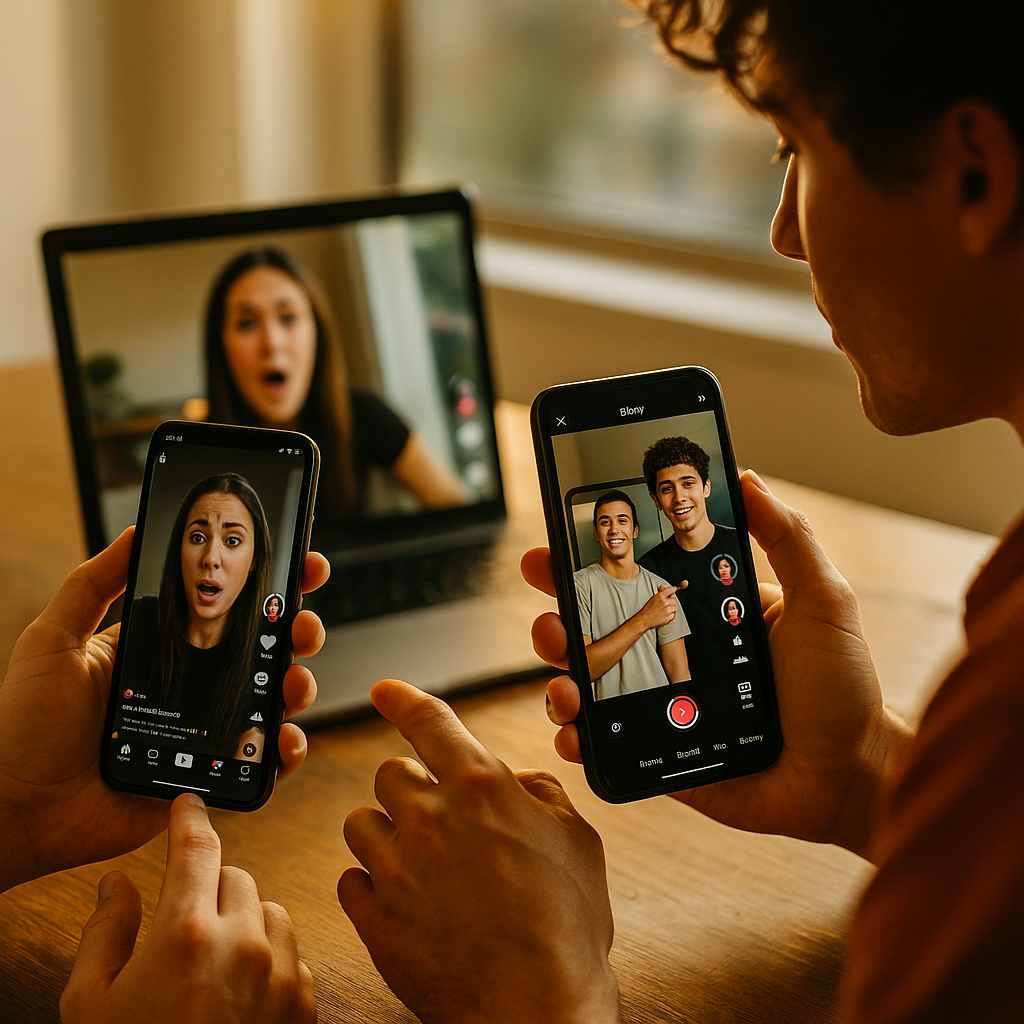
One branded clip. Four hundred creator reactions. Zero extra production spend. That’s the math behind a well-run Duet and Stitch campaign, and it’s why brands that treat these formats as a strategy rather than a novelty are quietly outperforming their paid media benchmarks. TikTok says Duet and Stitch videos generate measurably higher engagement than standalone posts, yet most brand briefs still treat them as an afterthought bolted onto a single influencer deliverable.
That’s a mistake. Done right, these formats turn your creative into a template for chain reactions you don’t have to pay for twice.
What Duet and Stitch Actually Do for a Brand
Duet lets a creator react side by side with your original content. Stitch lets them clip a few seconds of your video and build their own response on top of it. Both features exist on TikTok natively, and Instagram Reels has its own remix function that works similarly. The mechanic matters less than the outcome: your brand content becomes raw material for someone else’s audience, and their credibility gets borrowed by your message.
This is fundamentally different from a standard sponsored post. A sponsored post asks a creator to say nice things about your product. A Duet or Stitch campaign asks the internet to react to your product, in public, on the record. That’s a trust signal paid ads can’t replicate.
A single seed video, structured for reaction rather than perfection, can generate more owned media value through unpaid Duets and Stitches than the original paid placement itself.
Why Chain Reactions Beat One-Off Posts on ROI
Think about the economics. A traditional influencer campaign pays for reach once. A Duet chain pays for reach once and then collects compounding impressions as other creators (paid or organic) react, stitch, and re-stitch. Each layer adds a new audience without a new invoice.
Marketing teams running performance-driven influencer programs increasingly measure this as “amplification ratio,” meaning paid seed impressions versus total organic reaction impressions. A healthy ratio on a well-seeded Duet campaign can run three to five times the original reach, according to patterns tracked by agencies reporting into eMarketer’s creator economy coverage. Compare that to a flat sponsored post, where reach dies the moment the paid boost ends.
There’s also a cost-per-acquisition angle. Reaction content tends to read as more credible than scripted endorsement, which lowers resistance at the point of conversion. If you’ve read our piece on feeling-first content and CPA, you already know emotional authenticity outperforms polish in lower-funnel metrics. Duet chains are structurally built for that kind of authenticity because the reactor isn’t performing a script. They’re responding to something real.
Building the Seed Video: The One Decision That Determines Everything
Here’s the part most brands get wrong. They hand a creator a finished, polished ad and expect it to spark Duets. It won’t. Polished content invites admiration, not participation. Reaction formats need friction: a surprising reveal, a bold claim, an unexpected result, a moment that practically demands commentary.
Ask yourself before you greenlight a seed video: would I feel compelled to react to this if I saw it cold in my feed? If the honest answer is “I’d just scroll past,” rework it.
Strong seed videos share a few traits:
- A clear, debatable moment (a bold product claim, a surprising before/after, a controversial opinion)
- A natural pause point around the 3 to 5 second mark where a Stitch can cut in cleanly
- Visual headroom or framing that leaves space for a reactor’s face or text overlay
- No background music that overpowers a Duet creator’s own voice
Our earlier breakdown of misdirection briefs that delay payoffs applies directly here. A seed video that holds back its punchline for a beat forces the viewer to lean in, which is exactly the posture you want before they hit the Duet button.
Casting: Who Should Spark the First Wave?
Don’t start with your biggest-name creator. Counterintuitive, but true. Macro-influencers get reacted to less because their content already feels finished and authoritative; there’s nothing left to add. Nano and micro creators, by contrast, produce content that feels unfinished in a useful way. It invites peers to jump in.
This is the same logic behind nano creator ensemble casting: distribute your seed across a dozen smaller accounts instead of one large one, and let the format’s own mechanics do the amplification. Seed with five to fifteen nano or micro creators across adjacent niches, not just your core audience. A skincare brand, for example, might seed a product claim video through beauty creators, dermatology-adjacent accounts, and a few skeptical “does this actually work” commentary accounts. The disagreement is the fuel.
Scripting for Stitch: Leave Room for the Cut
Stitch only grabs up to a set clip length from your original, so your most “stitchable” moment needs to live in the first few seconds, not buried at the 40 second mark. Treat the opening of your seed video the way you’d treat a cold open on a cliffhanger format. If you’ve used cliffhanger hook scripting before, the muscle memory transfers directly.
Practical scripting checklist for Stitch-ready content:
- Front-load the claim or moment you want reacted to within the first 5 seconds
- Avoid text overlays that cover the full frame; Stitch creators need visual space to add their own commentary
- End your clip on a question or incomplete thought, not a resolved conclusion
- Caption the original with an explicit invitation: “Stitch this with your results” or “Duet if you disagree”
That last point sounds obvious, but a surprising number of brand videos never actually ask for the reaction they want. People need permission, even on a platform built around remixing. Comment prompts work the same way, and our guide on comment bait hooks covers the psychology in more depth if you want the comments section doing similar work.
Compliance: Where Chain Reactions Get Risky
This is the part brand legal teams should read twice. When your seed video gets Duet’d or Stitched by dozens of unaffiliated creators, you lose direct control over disclosure, tone, and claims accuracy. If a reactor makes an exaggerated health or efficacy claim while stitching your content, regulators don’t necessarily care that you didn’t write that specific line.
The FTC’s endorsement guidance still applies to derivative content that builds on paid or gifted brand material, and the UK’s ICO has signaled similar scrutiny for data and advertising transparency across creator-generated derivatives.
Build these guardrails into your campaign brief before launch, not after a Stitch goes sideways:
- Require disclosure language only from paid/seeded creators; organic Duets from unaffiliated accounts can’t be contractually controlled, so monitor rather than police
- Set a daily or weekly monitoring cadence using platform analytics or a social listening tool to catch problematic Stitches early
- Pre-approve claims language in the seed video itself so there’s less room for creators to misquote or exaggerate when reacting
- Document your monitoring process; if regulators ever ask, “we had a system” matters more than “we got lucky”
Platforms themselves offer some tooling here. TikTok’s business ad platform and Meta’s brand content tools both allow restrictions on who can Duet or Stitch paid partnership content, which gives you a meaningful lever if a campaign starts attracting reactions you didn’t want.
Measuring What the Chain Actually Produces
Standard influencer dashboards track views, likes, and the original post’s performance. They often miss the derivative layer entirely, which is exactly where the real value of a Duet campaign lives. Set up tracking for:
- Total Duet and Stitch volume tagged to your original sound or video ID
- Aggregate reach and engagement across derivative content, not just the seed post
- Sentiment split between supportive and skeptical reactions (both have value; skeptical reactions that get rebutted in the comments often convert better than purely positive ones)
- Branded hashtag usage that correlates with the Duet wave, to separate organic chain reaction from unrelated traffic
Tools like Sprout Social and native platform analytics can approximate this, though expect to do some manual tagging since cross-platform attribution for remix content is still clunky industry-wide. If you’re running parallel hook tests across channels, the framework in cross-channel hook testing pairs well with chain reaction measurement, since both rely on isolating which specific moment triggered the response.
A Quick Case Pattern Worth Stealing
A mid-size DTC supplement brand seeded a 7 second “taste test reaction” video through eleven nano creators, each paid a flat micro-fee under $300. Within ten days, the clip generated over 600 Duets and Stitches, most unpaid, spanning fitness, nutrition, and comedy niches that the brand had never targeted directly. Branded search volume rose during the campaign window, and the brand’s paid CPA on retargeting ads dropped because the audience arriving from derivative content already carried social proof from someone they followed organically.
None of that came from a bigger budget. It came from a seed video built for reaction instead of perfection.
Next Step
Stop briefing Duet and Stitch as an afterthought line item. Build your next seed video around one debatable claim, cast five to ten nano creators to launch it, and set a 14 day monitoring window to measure the derivative wave before you judge the campaign’s ROI.
FAQs
What’s the difference between Duet and Stitch for brand campaigns?
Duet shows the creator’s reaction side by side with your original video, while Stitch lets them clip a few seconds of your content and build fresh commentary on top of it. Duet works best for reaction and commentary formats; Stitch works best when you want creators building on a specific claim or moment.
Can brands control who Duets or Stitches their content?
Partially. Paid partnership tools on TikTok and Meta’s branded content platform allow restrictions on Duet and Stitch permissions for sponsored posts. Organic shares from unaffiliated creators, however, can’t be contractually controlled, so monitoring matters more than restriction.
How do I measure ROI on a Duet and Stitch campaign?
Track aggregate reach and engagement across the derivative content, not just the original seed post. Compare total amplification impressions against paid seed impressions to calculate an amplification ratio, and watch for shifts in branded search volume or retargeting CPA during the campaign window.
Are Duet and Stitch campaigns riskier than standard influencer posts?
They carry more compliance exposure because you can’t fully control claims made in derivative reactions. Mitigate this by front-loading accurate claims language in your seed video and setting a regular monitoring cadence rather than trying to police every Stitch after the fact.
Which creators should seed a Duet or Stitch campaign?
Nano and micro creators typically outperform macro influencers for this format because their content feels unfinished and invites participation. Seed across five to fifteen creators in adjacent niches rather than concentrating budget on one large account.
FAQs
What’s the difference between Duet and Stitch for brand campaigns?
Duet shows the creator’s reaction side by side with your original video, while Stitch lets them clip a few seconds of your content and build fresh commentary on top of it. Duet works best for reaction and commentary formats; Stitch works best when you want creators building on a specific claim or moment.
Can brands control who Duets or Stitches their content?
Partially. Paid partnership tools on TikTok and Meta’s branded content platform allow restrictions on Duet and Stitch permissions for sponsored posts. Organic shares from unaffiliated creators, however, can’t be contractually controlled, so monitoring matters more than restriction.
How do I measure ROI on a Duet and Stitch campaign?
Track aggregate reach and engagement across the derivative content, not just the original seed post. Compare total amplification impressions against paid seed impressions to calculate an amplification ratio, and watch for shifts in branded search volume or retargeting CPA during the campaign window.
Are Duet and Stitch campaigns riskier than standard influencer posts?
They carry more compliance exposure because you can’t fully control claims made in derivative reactions. Mitigate this by front-loading accurate claims language in your seed video and setting a regular monitoring cadence rather than trying to police every Stitch after the fact.
Which creators should seed a Duet or Stitch campaign?
Nano and micro creators typically outperform macro influencers for this format because their content feels unfinished and invites participation. Seed across five to fifteen creators in adjacent niches rather than concentrating budget on one large account.
Top Influencer Marketing Agencies
The leading agencies shaping influencer marketing in 2026
Agencies ranked by campaign performance, client diversity, platform expertise, proven ROI, industry recognition, and client satisfaction. Assessed through verified case studies, reviews, and industry consultations.
Moburst

-
2

The Shelf
Boutique Beauty & Lifestyle Influencer AgencyA data-driven boutique agency specializing exclusively in beauty, wellness, and lifestyle influencer campaigns on Instagram and TikTok. Best for brands already focused on the beauty/personal care space that need curated, aesthetic-driven content.Clients: Pepsi, The Honest Company, Hims, Elf Cosmetics, Pure LeafVisit The Shelf → -
3

Audiencly
Niche Gaming & Esports Influencer AgencyA specialized agency focused exclusively on gaming and esports creators on YouTube, Twitch, and TikTok. Ideal if your campaign is 100% gaming-focused — from game launches to hardware and esports events.Clients: Epic Games, NordVPN, Ubisoft, Wargaming, Tencent GamesVisit Audiencly → -
4

Viral Nation
Global Influencer Marketing & Talent AgencyA dual talent management and marketing agency with proprietary brand safety tools and a global creator network spanning nano-influencers to celebrities across all major platforms.Clients: Meta, Activision Blizzard, Energizer, Aston Martin, WalmartVisit Viral Nation → -
5

The Influencer Marketing Factory
TikTok, Instagram & YouTube CampaignsA full-service agency with strong TikTok expertise, offering end-to-end campaign management from influencer discovery through performance reporting with a focus on platform-native content.Clients: Google, Snapchat, Universal Music, Bumble, YelpVisit TIMF → -
6

NeoReach
Enterprise Analytics & Influencer CampaignsAn enterprise-focused agency combining managed campaigns with a powerful self-service data platform for influencer search, audience analytics, and attribution modeling.Clients: Amazon, Airbnb, Netflix, Honda, The New York TimesVisit NeoReach → -
7

Ubiquitous
Creator-First Marketing PlatformA tech-driven platform combining self-service tools with managed campaign options, emphasizing speed and scalability for brands managing multiple influencer relationships.Clients: Lyft, Disney, Target, American Eagle, NetflixVisit Ubiquitous → -
8

Obviously
Scalable Enterprise Influencer CampaignsA tech-enabled agency built for high-volume campaigns, coordinating hundreds of creators simultaneously with end-to-end logistics, content rights management, and product seeding.Clients: Google, Ulta Beauty, Converse, AmazonVisit Obviously →