


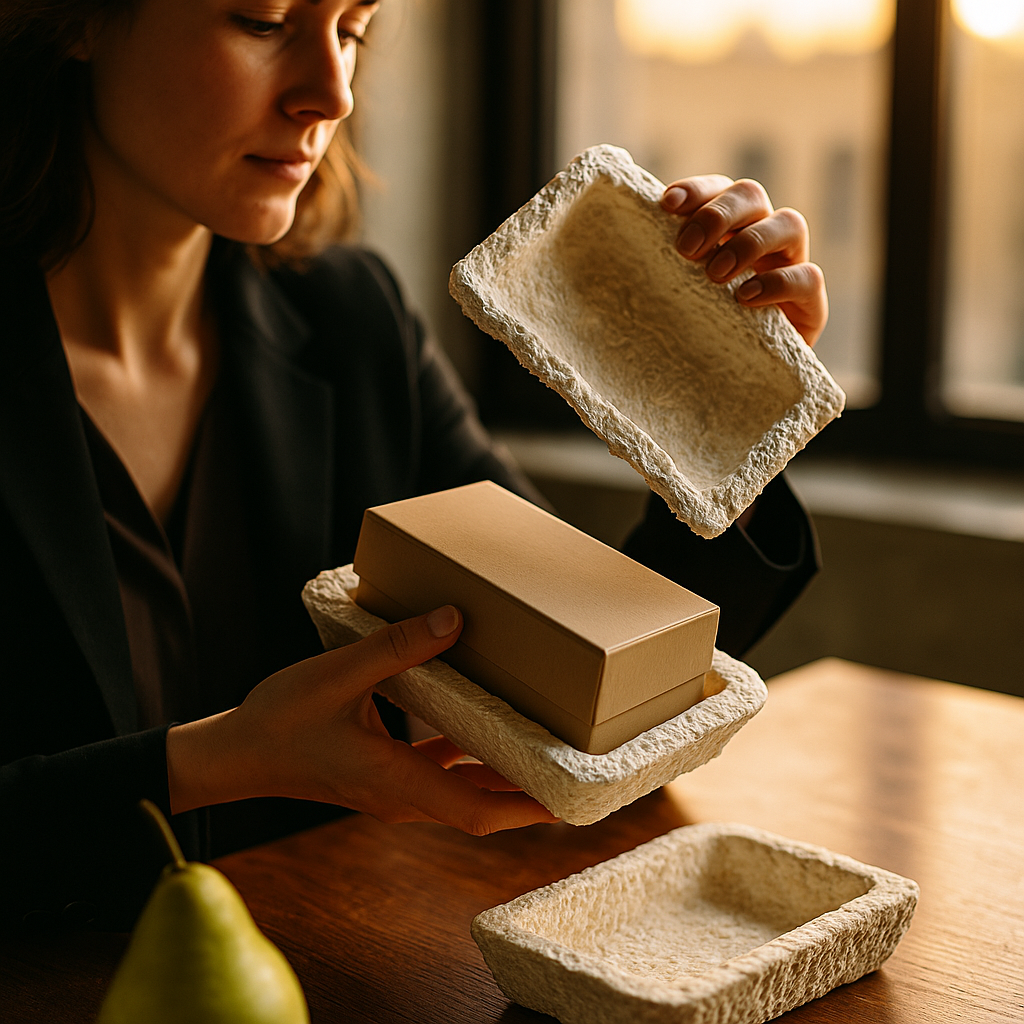
In 2025, premium brands face a hard equation: deliver a flawless unboxing while cutting waste, carbon, and risk. This case study explains how mycelium packaging helped Ecovative move from promising biomaterials innovator to trusted supplier for luxury clients. You’ll see the commercial logic, technical decisions, and go-to-market steps that made the shift credible—plus what to copy next.
Luxury sustainable packaging: Why luxury brands needed a new material
Luxury clients rarely change packaging for novelty. They change when the current system threatens brand equity or supply resilience. By 2025, three pressures converged:
- Higher expectations for sustainability claims: Marketing-led “eco” language now attracts scrutiny from regulators, watchdogs, and customers. Luxury brands want packaging that can be explained simply and verified.
- Unboxing as a brand asset: Premium packaging must feel intentional—clean edges, low dust, consistent color, and a tactile experience that matches the product’s price point.
- Packaging waste as reputational risk: For high-margin goods, customers increasingly notice when packaging looks excessive or hard to recycle. Luxury brands want solutions that reduce guilt without reducing delight.
Traditional options each carry trade-offs. Molded pulp can be elegant but may struggle with tight tolerances for intricate shapes. Foam offers performance but signals waste and can be hard to recycle at scale. Compostable plastics can confuse consumers and are frequently dependent on industrial composting access. Luxury brands needed a material that performs like foam, photographs like premium, and communicates a credible end-of-life story.
Mycelium packaging design: How Ecovative engineered “premium” performance
Ecovative’s advantage wasn’t only the story of fungi. It was the ability to translate a biological process into consistent packaging parts with predictable performance. Luxury clients do not “trial” vague concepts; they evaluate specifications. Ecovative approached mycelium as an engineered material system:
- Controlled growth + molds: The material grows into a defined mold geometry, enabling protective forms that cradle products and reduce movement during shipping.
- Surface and finish considerations: Luxury packaging needs a clean look and minimal shedding. Ecovative’s process emphasis on consistent texture and controlled drying helped meet visual and tactile standards that matter during unboxing and product photography.
- Performance tuning: For luxury goods, the priority is repeatable cushioning, compression behavior, and dimensional stability. Ecovative positioned mycelium as a foam alternative with a renewable feedstock base and a simpler end-of-life narrative.
To answer the follow-up question luxury procurement teams ask—“Will it protect as well as our current foam?”—Ecovative focused on measurable validation. Instead of broad claims, the company aligned material choices, part geometry, and packaging system design (outer box, inserts, and clearances) so the overall package passed common drop, vibration, and compression expectations used in premium fulfillment.
Equally important, Ecovative made the aesthetic feel intentional. Luxury clients don’t want packaging that looks like an “eco substitute.” They want packaging that looks like a design decision. That meant predictable coloration, crisp edges where possible, and branded assembly that integrates smoothly with existing boxes, tissue, and literature.
Eco-friendly luxury brands: The trust play—how Ecovative met procurement, legal, and brand hurdles
Winning luxury accounts is less about a single buyer and more about aligning multiple stakeholders: sustainability, packaging engineering, legal/compliance, brand/creative, operations, and finance. Ecovative succeeded by treating trust as a product.
Proof over promises: Luxury brands need documentation they can stand behind. Ecovative provided clear product specifications, repeatable test results, and straightforward guidance on end-of-life pathways so brands could communicate responsibly.
Clear end-of-life messaging: One of the fastest ways to lose a luxury client is to create consumer confusion at disposal. Ecovative positioned mycelium packaging with plain-language instructions and realistic scenarios (for example, what a customer can do at home versus what requires municipal services). That reduced the risk of greenwashing allegations and customer frustration.
Operational fit: The packaging must work in real fulfillment settings—packing speed, storage space, damage rates, and seasonal spikes. Ecovative reduced perceived risk by supporting piloting plans that mirrored real shipping lanes and by helping clients integrate inserts without slowing down packing lines.
Brand alignment: Luxury teams often ask, “Will it still feel like us?” Ecovative treated the insert as a brand touchpoint: texture, color, and form factor were evaluated like any other visual asset. This approach made sustainability feel like an upgrade, not a compromise.
Biodegradable protective packaging: The pilot-to-scale pathway that luxury clients expect
Luxury brands commonly start with limited runs: a flagship product, a seasonal release, or a specific region. Ecovative used a structured path from pilot to scale that matched how premium companies manage risk.
1) Start with high-impact SKUs: Ecovative targeted products where protective performance and sustainability storytelling both mattered—fragile goods, high average order value items, or products with highly visible unboxing moments. This created fast internal wins for brand and sustainability teams.
2) Build a packaging system, not a single part: Damage rates rarely come from the insert alone; they come from the interaction of box strength, void space, and handling. Ecovative focused on system-level fit so clients could compare total outcomes: damage reduction, fewer returns, and a consistent presentation.
3) Validate with real shipping data: Luxury clients trust field results. Ecovative encouraged testing across actual carriers, routes, and climates to prove performance stability. This step also answered a common follow-up: “What happens in humidity or temperature swings?”
4) Lock in repeatability: Scaling requires consistent dimensions and supply timing. Ecovative emphasized process controls, documented tolerances, and quality checks that a luxury brand can audit. Procurement teams care less about the novelty of biology and more about the predictability of delivery and defect rates.
5) Codify consumer instructions: Once scaled, customer support teams need fewer “How do I dispose of this?” tickets. Clear on-pack or in-box guidance lowered friction and protected the brand experience post-unboxing.
Mycelium packaging case study: What “winning luxury clients” looked like in practice
This case study focuses on the repeatable moves Ecovative made to earn luxury trust, not on a single logo. Luxury relationships often include confidentiality, but the patterns are clear and transferable.
Positioning: Ecovative did not sell mycelium packaging as a moral choice. It sold it as a premium material option that supports sustainability goals while preserving performance and aesthetics. That framing helped luxury stakeholders justify the change internally.
Design collaboration: Instead of asking clients to accept a standard insert, Ecovative treated the packaging as co-developed. Luxury brands expect customized fit and a deliberate presentation. Co-design also reduced change-management friction: when brand and engineering both help shape the solution, adoption accelerates.
Risk reduction: The company anticipated the biggest objections—damage risk, inconsistent looks, unclear disposal, and supply reliability—and answered them with documentation, structured pilots, and clear operational integration. This is a key EEAT signal: expertise shows up as anticipation of real-world constraints.
Outcome logic that finance accepts: Luxury teams ultimately need a business case. Ecovative linked material choice to measurable outcomes such as lower damage rates (where applicable), fewer returns, improved brand perception, and stronger sustainability reporting. Even when per-unit costs differ from conventional foam, total cost of ownership can improve when you account for reverse logistics, replacements, and customer lifetime value impacts.
Brand story without overreach: Ecovative supported clients with accurate language. Luxury marketing can be ambitious, but the safest sustainability communications are specific and verifiable. That approach helps brands avoid regulatory exposure and protects long-term trust.
Packaging innovation for luxury: Lessons you can apply to win premium accounts
If you’re a packaging supplier, brand, or agency trying to land luxury clients with new materials, Ecovative’s playbook offers clear lessons.
- Make performance the headline: Luxury changes when the solution protects the product and elevates the experience. Sustainability is the tie-breaker, not the only reason.
- Document everything: Provide specifications, tolerances, test methodologies, and clear end-of-life guidance. Make it easy for legal and sustainability teams to approve language.
- Design for consistency: Premium brands notice small defects. Invest in finish, cleanliness, and dimensional stability, not just compostability or renewability.
- Sell a system: Show how the insert, box, and packing workflow work together. Include pack-out guidance so operations teams trust adoption.
- Plan the scale-up early: Luxury doesn’t tolerate stockouts. Share capacity plans, lead times, and quality-control steps upfront.
- Give customers simple disposal instructions: Confusion at end-of-life damages brand experience. Use plain language and avoid implying infrastructure that isn’t widely available.
For readers wondering, “Is mycelium only for niche or boutique runs?”—the strategic answer is that luxury often serves as a high-standards proving ground. If a material can meet luxury expectations for aesthetics and performance, it becomes easier to expand to broader product lines where sustainability and protection still matter.
FAQs
What is mycelium packaging, in plain terms?
It’s protective packaging grown using mycelium (the root-like structure of fungi) combined with plant-based feedstocks in molds. The result is a shaped insert designed to cushion products similarly to foam, with a renewable-material story and a straightforward end-of-life narrative when handled correctly.
Why do luxury brands care about switching from foam if foam works?
Foam often performs well, but it can signal waste, complicate disposal, and create sustainability-claim risk. Luxury brands also manage reputation closely; packaging that looks excessive can undermine a premium product’s perceived responsibility.
Does mycelium packaging protect items as well as conventional options?
It can, when engineered and validated for the specific product and shipping conditions. The best results come from system design: the insert geometry, outer carton strength, and clearances all work together to meet drop and vibration expectations.
How do brands communicate end-of-life without greenwashing?
They use specific, verifiable language and provide realistic disposal instructions. Avoid broad claims that imply universal composting access. Clear guidance inside the box and on packaging specs helps marketing, legal, and customer support stay aligned.
What products are best suited for mycelium packaging in luxury?
High-value, fragile, or presentation-driven items benefit most—especially where a custom-fit insert improves protection and where the unboxing moment influences brand perception. Limited editions and flagship SKUs are common starting points for pilots.
How should a brand pilot mycelium packaging?
Start with one SKU and run controlled tests across real shipping lanes. Track damage rates, packing time, customer feedback, and disposal-related inquiries. Then refine design and scale to adjacent products once repeatability and supply timing are proven.
Luxury brands in 2025 reward suppliers who pair sustainability with discipline: consistent specs, validated performance, and communication that stands up to scrutiny. Ecovative earned luxury clients by treating mycelium not as a novelty, but as a premium packaging material backed by testing, documentation, and operational fit. The takeaway is direct: win luxury by reducing risk, elevating experience, and making sustainability easy to trust.