


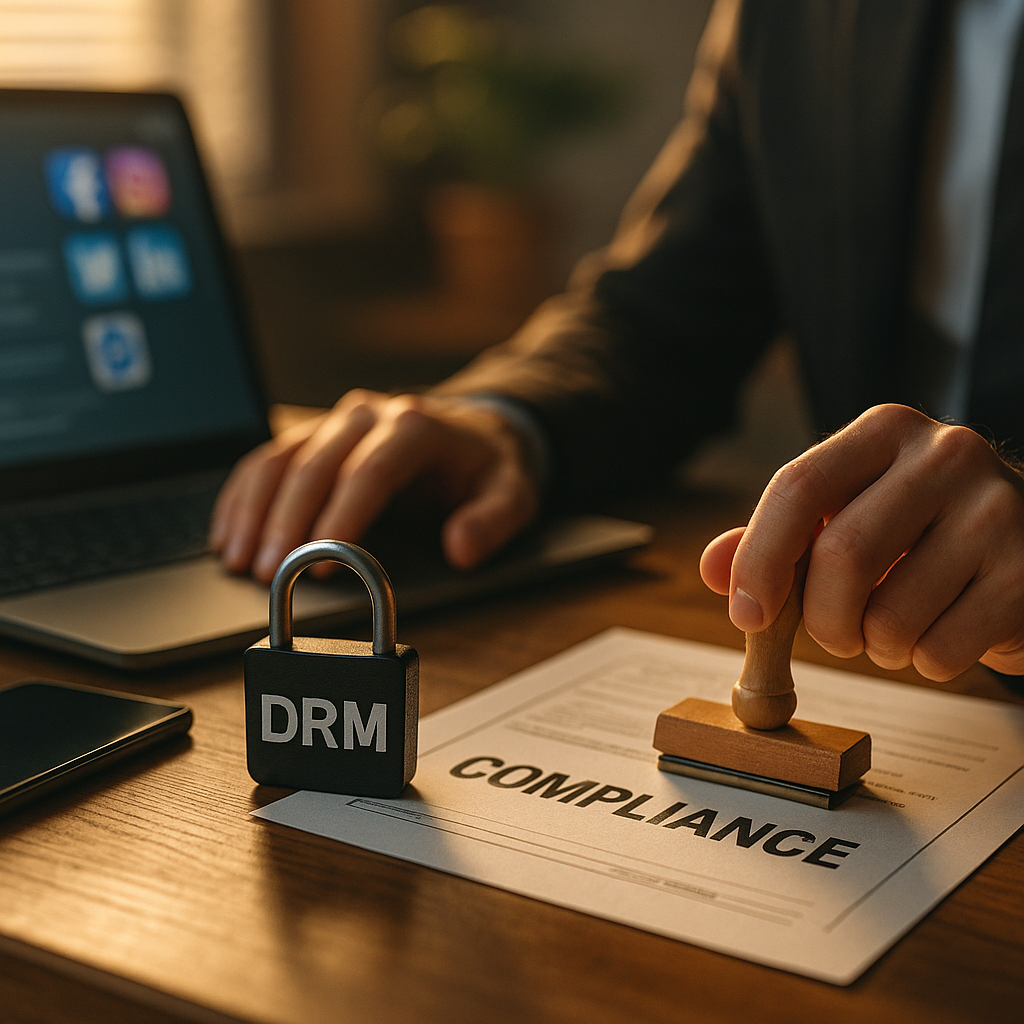
In 2025, brands publish at high velocity across regions, platforms, and partners—often with the same images, videos, and creator clips reused in dozens of places. A Review of Digital Rights Management Tools for Global Social Assets helps teams prevent takedowns, protect licensing, and keep campaigns compliant without slowing creativity. Choose the wrong approach and your social library turns into legal risk—so what actually works?
Digital rights management software: what it must do for global social teams
Digital rights management (DRM) in a social context is not only about “locking” files. For global social assets, DRM is a practical system of controls, auditability, and permissions that ensures content is used within the license, in the approved territories, on the right channels, for the correct duration, and by authorized parties.
What “good” looks like for 2025 workflows:
- Rights intelligence built into the asset record: license type, term dates, territories, usage channels (organic/paid), exclusivity, model/property releases, and creator contract references.
- Automated enforcement: alerts before expirations, usage blocks when rights lapse, and workflows to renew or replace assets.
- Distribution governance: role-based access controls (RBAC), partner portals, and approved-download variants (cropped, watermarked, subtitled).
- Traceability: audit logs of who downloaded what, when it was published, and which derivative versions exist.
- Cross-platform realities: assets travel through agencies, influencers, paid media teams, and regional social managers—often outside one core system. DRM must work across these handoffs.
Common pain points this should solve: accidental reuse after license expiration, missing releases for featured people/locations, inconsistent attribution obligations, rights conflicts between regions, and “rogue” edits that create unapproved derivatives.
Social media compliance: risks, requirements, and the rights metadata you can’t skip
Global social content compliance blends intellectual property, privacy, advertising rules, platform policies, and contractual obligations with creators and agencies. Most teams don’t fail because they lack tools; they fail because rights data is incomplete or disconnected from publishing.
Rights metadata that should be mandatory in your intake process:
- Copyright owner and source: in-house, agency, creator, stock library, UGC, partner co-marketing.
- License scope: organic social, paid social, OOH, web, TV, internal use—be explicit.
- Term and renewal terms: start/end dates, renewal options, and renewal decision owner.
- Territories and languages: “global” often has carve-outs; document them.
- Talent and property releases: whether required, where stored, and any restrictions (e.g., no health contexts, no political content).
- Music and sound rights: track ID, licensing basis, and platform restrictions for commercial use.
- Creator obligations: attribution, disclosure language, whitelisting permissions, and edit approvals.
Follow-up question teams ask: Can’t we rely on platform music libraries? Sometimes, but commercial permissions and reuse outside the platform can be limited. Your DRM approach should distinguish between “platform-only permitted use” and “brand-owned licensed use,” and it should prevent exporting assets that would violate those constraints.
Helpful operating model: treat rights as a first-class field in your content lifecycle—brief → production → review → publish → repurpose. DRM tools should connect to that lifecycle with clear gates, not just store files.
Content licensing management: tool categories and how to evaluate them
Most “DRM” solutions fall into a few practical categories. The right choice depends on whether your biggest risk is distribution leakage, rights expiration, creator contract complexity, or global partner access.
1) Enterprise DAM with rights modules
Digital Asset Management platforms often provide the strongest foundation: metadata, versioning, portals, approvals, and integrations. The best ones include rights fields, expirations, and automated warnings. Evaluate whether rights enforcement is real (blocking downloads/publishing) or only informational.
2) Rights management platforms (contract- and license-centric)
These tools prioritize licensing terms, contract clauses, renewals, and rights allocation across territories/channels. They can be ideal when you manage high volumes of licensed media (sports, entertainment, large creator rosters) and need rigorous tracking tied to agreements.
3) Social publishing suites with governance
Some social management tools provide asset libraries, approval workflows, and guardrails, but they may be lighter on contract-grade rights data. They can still work if your primary goal is preventing noncompliant publishing and you already track licenses elsewhere.
4) Watermarking and content fingerprinting tools
These help trace where assets appear and deter misuse. Fingerprinting can also support brand safety and counterfeit detection, but it rarely replaces rights metadata and contract governance.
5) UGC rights and consent management tools
Useful for requesting permissions, storing consent artifacts, and tracking usage terms for user-submitted content. For global brands, ensure the consent workflow is localized and creates a durable audit record.
Evaluation checklist (ask vendors and your internal teams):
- Enforcement: Can the system automatically block download/export if rights are expired or territory-restricted?
- Granularity: Can rights differ by channel (organic vs paid), platform, territory, and language?
- Derivatives: Does a crop, subtitle file, or edit inherit rights and expiration rules?
- Auditability: Can you produce an evidence trail quickly for legal, platform disputes, or partner questions?
- Integrations: Does it connect to your creative tools, CMS, social scheduler, PIM, and ad platforms?
- Usability: Can regional teams follow it without constant legal intervention?
Practical tip: run a 30-day “rights stress test” using real assets (influencer clips, music-heavy videos, co-branded posts). If the tool can’t handle your hardest cases, it won’t protect your everyday work.
Global brand asset protection: review of standout tools and where each fits
This section reviews major tool types and representative platforms commonly used by global organizations. Because vendor capabilities change frequently, treat this as a fit map and confirm current features, certifications, and integration options during procurement.
Enterprise DAM leaders (strong for global libraries and governance)
- Adobe Experience Manager Assets: Strong for enterprises already using Adobe’s ecosystem. Works well for structured metadata, approvals, and brand governance. Confirm how you will implement rights fields and enforcement rules, and whether you need additional modules or custom workflows for social-specific restrictions.
- Bynder: Known for brand portals, templating, and distributed teams. Often a good fit when many regional users need controlled access to approved social-ready variants. Validate rights expiration automation and how granular rights can be across territories and channels.
- Canto: Popular for mid-market to enterprise teams wanting faster adoption. Good for central libraries and straightforward permissions. For complex global licensing, assess whether rights modeling matches your legal requirements or if you’ll need a complementary rights system.
Rights and licensing-centric systems (strong for contract-grade tracking)
- FADEL: Focuses on rights and royalty management, often used where licensing complexity is high. Consider it when you need robust agreement mapping, renewals, and auditable rights allocation.
- Aprimo (DAM + workflow): Blends DAM with workflow and marketing operations. Useful when rights compliance must be embedded into end-to-end campaign processes. Check how your team will model nuanced social usage rights and automate enforcement across derivatives.
Social governance tools (strong for publishing control and approvals)
- Sprinklr: Designed for large-scale social operations with approvals, governance, and publishing. Effective if your main exposure is noncompliant publishing across many accounts. Pairing with a DAM/rights system is common when you need deeper licensing metadata.
- Hootsuite: Useful for centralized publishing and team permissions. It can support governance for many organizations, but deeper rights management typically lives in a DAM or rights platform. Confirm how asset libraries and approvals align with your legal gates.
UGC permissions and consent workflows (strong for rights capture and proof)
- Dash Hudson (UGC and social content operations): Often used for UGC management and content workflows. Evaluate it when you need streamlined permission requests and a searchable library tied to approvals. Confirm how consent artifacts are stored and exported for audit needs.
Content protection, monitoring, and anti-piracy (strong for leakage detection)
- Red Points: Commonly used for brand protection and takedown workflows across marketplaces and sites. This is valuable when your social assets are frequently scraped and reused by counterfeiters or unauthorized sellers. It complements, rather than replaces, internal rights governance.
How to choose between them (fast decision guide):
- You need one global source of truth for assets → start with an enterprise DAM that supports rights metadata and enforcement.
- You manage complex licensing contracts at scale → add or prioritize a rights-centric platform with renewals and agreement mapping.
- Your biggest risk is inconsistent publishing across hundreds of accounts → prioritize social governance and integrate it with your asset/rights source.
- Your assets are stolen or misused externally → add monitoring/takedown tools and establish escalation paths.
EEAT note: involve legal, privacy, marketing ops, and regional social leads in tool selection. The tool must reflect real approval pathways and local constraints, not only central governance ideals.
Rights metadata automation: integrations, AI assistance, and governance that scales
Global social teams win when compliance becomes the default. That requires automation at three layers: metadata capture, enforcement, and monitoring.
1) Automated intake and metadata completeness
- Standardized upload forms that require license fields before an asset can be “publishable.”
- Template-based rights profiles (e.g., “Influencer Paid Social Global 6 Months”) to reduce errors.
- Linking evidence: store contracts, releases, and consent records as attachments or references tied to the asset ID.
2) AI-assisted tagging—useful, but verify
AI can accelerate classification (detect faces, logos, locations, music cues, and text overlays), which helps flag when a model release might be needed or when an asset contains restricted marks. However, AI should support human review, not replace it. Your governance should define who validates rights-critical fields and what confidence thresholds trigger manual checks.
3) Integrations that prevent “compliance drift”
- Creative tools: ensure exported versions inherit the same rights record and identifiers.
- Social scheduling/publishing: enforce that only “approved for platform + territory + paid/organic” assets can be attached to posts.
- Ad platforms: paid usage often has different license constraints; keep paid approvals distinct.
- SSO and RBAC: consistent identity and least-privilege access across partners and regions.
4) Governance that scales with regions
Create a simple RACI: who owns rights entry, who approves exceptions, who receives expiration alerts, and who has authority to renew licenses. Add regional reviewers for language and cultural risk, but keep rights enforcement centralized in the system so policies remain consistent.
Follow-up question teams ask: How do we handle legacy assets with missing paperwork? Set a “quarantine” status. Allow internal review, but block publishing and paid use until documentation is attached or the asset is retired. This is one of the fastest ways to reduce silent risk.
Digital asset governance: implementation roadmap and measurable success criteria
Tool adoption fails when teams treat DRM as a one-time rollout instead of an operating capability. A practical implementation sequence reduces friction and increases compliance without adding unnecessary approvals.
Step 1: Map your asset journey
Document how a single social video moves from brief to edit to localization to posting to repurposing. Identify where rights decisions happen today (often in email) and convert them into system steps.
Step 2: Define your “publishable” standard
Require minimum rights fields, linked documentation, and an approval state. Create a controlled vocabulary for territories, channels, and license types so reporting is consistent.
Step 3: Build guardrails, not bottlenecks
- Auto-expire assets at end-of-term with clear replacement workflows.
- Auto-route high-risk content (minors, health claims, sensitive locations) to legal review.
- Limit exports to approved renditions (e.g., watermarked previews for partners).
Step 4: Train by role
Creators need fast rules; social managers need “safe to post” indicators; legal needs audit and exception handling. Keep training specific and short, with examples of acceptable vs noncompliant reuse.
Step 5: Measure outcomes
- Compliance KPIs: percent of assets with complete rights metadata; number of blocked downloads due to missing rights; time-to-renew before expiration.
- Operational KPIs: time to find approved assets; reduction in duplicate uploads; localization cycle time.
- Risk KPIs: number of takedowns, partner disputes, or rework incidents due to rights constraints.
Clear takeaway metric: if teams can reliably answer “Who owns this, where can we use it, and until when?” in under 30 seconds from the asset record, your DRM program is working.
FAQs: digital rights management tools for global social assets
What is the difference between DRM and DAM for social assets?
A DAM stores and organizes assets with metadata, versions, and access controls. DRM focuses on enforcing usage rights—license terms, expirations, territories, and permitted channels. Many organizations use a DAM with strong rights features, sometimes paired with a separate rights/licensing platform.
Do we need DRM if we only post organic social content?
Yes. Organic posts still trigger copyright, talent releases, territory restrictions, and platform policy constraints. Also, organic content is often repurposed into paid campaigns later. DRM prevents accidental “scope creep” beyond the original license.
How do DRM tools handle influencer and creator content?
The best setups link each asset to the creator agreement, approved edit rules, attribution requirements, and paid usage permissions (including whitelisting). They also track term dates and whether the brand can use the content across regions and channels.
Can DRM stop unauthorized users from screen-recording or reuploading?
Not fully. DRM can restrict access and downloads, watermark files, and maintain audit trails. For external misuse, pair internal DRM with monitoring and takedown tools, plus clear escalation workflows.
What features matter most for multinational brands?
Territory-based rights, multilingual metadata, partner portals with least-privilege access, derivative inheritance (localizations), strong audit logs, and integrations with social publishing and paid media systems.
How long does implementation usually take?
It depends on scope, integrations, and how much legacy content needs remediation. Many teams see meaningful improvements by launching a “publishable assets only” workflow for new content first, then progressively cleaning and migrating older libraries.
What should legal teams expect from the system during an audit or dispute?
Rapid retrieval of the license terms, proof of releases/consent, usage history, and an audit log showing who approved and distributed the asset. The system should also show whether derivatives were created and whether rights were still valid at time of posting.
In 2025, effective DRM for global social assets is less about locking content and more about making rights visible, enforceable, and auditable at every handoff. The best approach combines a governed asset library, contract-aware rights tracking, and publishing guardrails that prevent noncompliant reuse. If your team can publish faster while reducing takedowns and rework, your DRM stack is doing its job.