


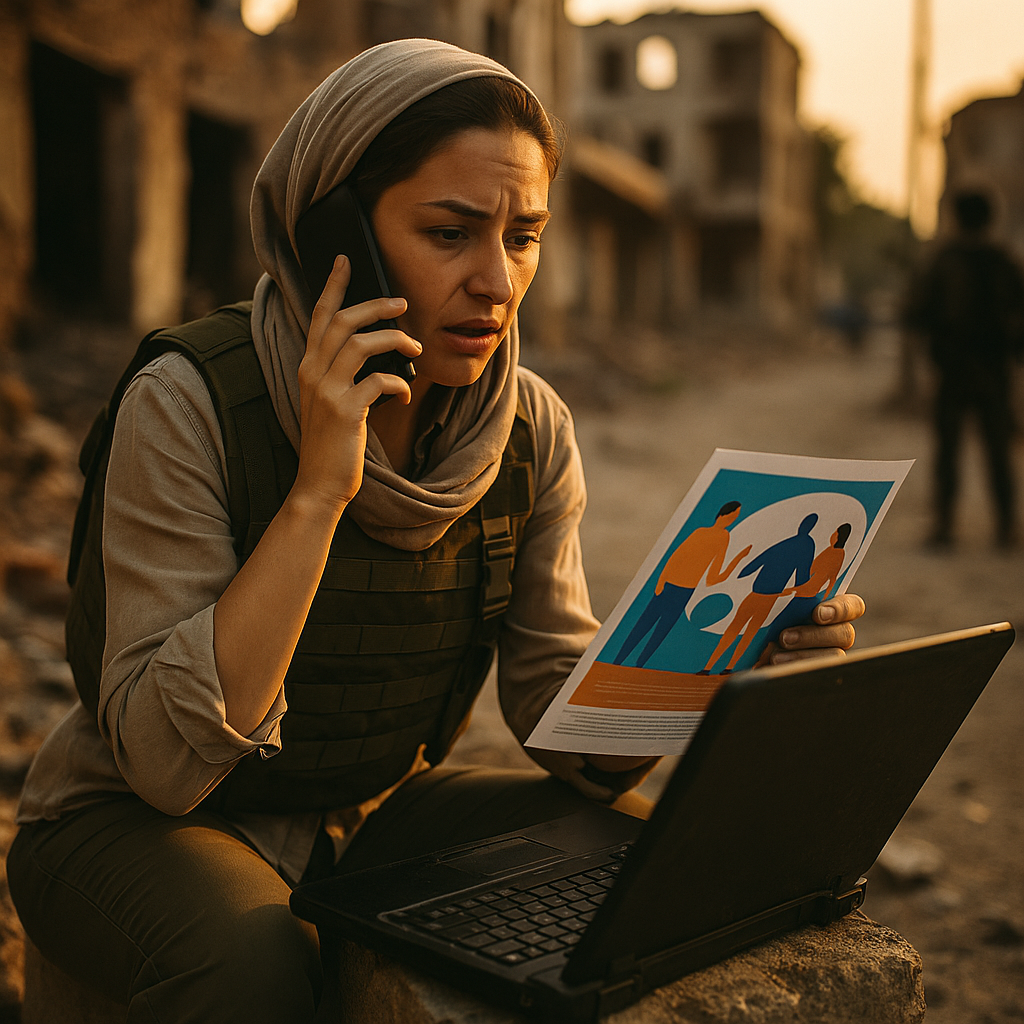
How To Market Ethically In Active Conflict Zones is no longer a niche concern in 2025; it’s a high-stakes responsibility for brands, NGOs, platforms, and agencies operating where lives, safety, and trust are fragile. Ethical marketing can protect civilians, support relief systems, and avoid propaganda dynamics—if you plan rigorously. This guide shows practical steps you can apply immediately—starting with one crucial question.
Conflict zone marketing ethics: start with “do no harm”
Ethical marketing in an active conflict zone begins with a disciplined commitment to do no harm. That principle must guide every decision: what you publish, what you promise, what you show, where ads appear, and how you collect data.
Define “harm” for your operation before you launch. In conflict settings, harm includes more than misleading claims. It can include:
- Physical risk: Revealing locations, routines, or identities that could enable targeting.
- Legal risk: Violating sanctions, export controls, anti-terror rules, or local emergency regulations.
- Social harm: Amplifying hate speech, fueling rumors, inflaming tensions, or stigmatizing groups.
- Economic harm: Distorting fragile markets, price gouging perceptions, or displacing local providers.
- Psychological harm: Exploitative imagery, trauma-triggering content, or manipulation of fear.
Make ethics operational by assigning ownership. A useful structure is a Conflict Marketing Risk Owner (senior, empowered to pause campaigns) supported by legal/compliance, security, safeguarding, and local advisors. Give that team real authority: a documented stop/go decision and a requirement to log rationale for every launch and major change.
Answer the reader’s practical question: Can we market at all during conflict? Yes—if your product or service legitimately helps people, your claims are verifiable, and your execution reduces risk. If you cannot prove benefit without creating exposure, pause and switch to humanitarian information, service updates, or neutral customer support communications.
Humanitarian messaging guidelines: communicate without exploitation
In conflict zones, messaging spreads fast, and missteps have outsized consequences. Strong humanitarian messaging guidelines help you avoid sensationalism while remaining clear and useful.
Prioritize utility over persuasion. If your audience faces disrupted power, banking, mobility, and supply chains, your marketing should answer immediate needs: availability, pricing stability, delivery constraints, safety precautions, and support channels. Put the facts first and remove manipulative urgency.
Use trauma-aware content standards. Maintain dignity and agency in visuals and copy:
- Avoid graphic imagery, “poverty porn,” and content that reduces people to symbols.
- Use informed consent for identifiable individuals, with extra care for minors and survivors.
- Do not film or photograph near sensitive sites (shelters, clinics, checkpoints) if it could expose civilians.
Separate assistance from advertising. If you are providing aid, publish it in a way that does not look like an ad campaign. Distinguish between:
- Service announcements (where to get help, how to access services)
- Product communications (what’s available, how to order, consumer protections)
- Fundraising (how donations are used, verified partners, reporting cadence)
Be specific about what you know and what you don’t. Conflict information is volatile. Avoid confident statements about causes, parties, or responsibility unless you can cite reliable, current sources and you have a clear reason to include it. Your goal is not to “win the narrative,” but to communicate safely and accurately.
Answer the likely follow-up: Should we take a public stance? If you do, ensure the stance aligns with your actions, legal constraints, and duty of care. A stance that triggers retaliation against staff, partners, or customers is not ethical. When in doubt, focus on verifiable commitments: safety measures, continuity plans, and support resources.
Sanctions and compliance marketing: build a legal-safe operating model
Sanctions and compliance marketing is not a box-ticking exercise in 2025—it’s core risk management. In conflict zones, supply networks, payment routes, and counterparties can shift rapidly. Marketing can inadvertently solicit prohibited transactions or create evidence trails that expose customers and partners.
Establish a compliance gate before creative production. Your workflow should require approvals for:
- Target geographies (including border regions and disputed areas)
- Customer segments and distribution partners
- Payment methods, pricing, and promotions (watch for dual-use implications)
- Claims about availability, delivery, or licensing
Avoid “workarounds” language. Do not promote tactics to bypass controls, reroute shipments, or evade monitoring. Even implying this can create legal exposure and reputational damage.
Vet intermediaries and influencers carefully. In conflict settings, intermediaries can be pressured, compromised, or misrepresented. Require:
- Identity verification and beneficial ownership checks where feasible
- Contract clauses prohibiting hate speech, incitement, and political mobilization
- Clear termination rights and content review requirements
Maintain an auditable record. Document approvals, targeting criteria, and evidence supporting your claims. If a regulator, platform, or humanitarian partner questions your activity, you should be able to show decision-making based on risk and harm reduction, not opportunism.
Answer the follow-up: What if rules conflict with urgent humanitarian needs? Don’t improvise in marketing copy. Escalate to legal counsel and relevant authorities or humanitarian coordination mechanisms. If an exception exists, confirm it formally and communicate within its boundaries.
Data privacy in war zones: minimize exposure and protect identities
Data privacy in war zones requires stricter standards than typical commercial environments. Phones can be seized, networks monitored, and personal data weaponized. Your marketing stack—pixels, SDKs, CRM tools, email platforms—can become a liability.
Practice data minimization by default. Collect only what you need for delivery and support. Consider whether you can operate with:
- No precise location data (use coarse region-level signals only)
- No demographic profiling beyond what is essential
- Short retention periods and aggressive deletion policies
Turn off sensitive targeting. Avoid targeting based on ethnicity, religion, political affiliation, health status, or inferred vulnerabilities. In conflict, “ordinary” interest targeting can become de facto sensitive targeting. Use contextual placements or broad categories instead.
Secure consent and offer safe alternatives. If digital consent is risky or impractical, provide non-digital channels (hotlines, in-person partner points, printed service notices). Make it easy to opt out and still receive essential information.
Harden your comms and access controls. Operational steps matter as much as policy:
- Limit staff access to customer data based on role
- Use strong authentication and device security for field teams
- Redact or anonymize case studies and testimonials
- Delay or generalize posts that could reveal time-sensitive locations
Answer the follow-up: Should we use retargeting? Generally avoid it in active conflict zones. Retargeting can expose browsing behavior, signal interest in certain services, and create trackable patterns. If you can’t justify it as essential and low-risk, do not run it.
Brand safety and misinformation: control placement and verify claims
Brand safety and misinformation risks spike during conflict. Ads can appear next to extremist content, rumor-mill videos, or propaganda; your content can be copied, reframed, and redistributed to mislead. Ethical marketing requires robust verification and placement controls.
Strengthen placement controls. Use whitelists for trusted publishers and channels. If you buy programmatically, tighten inventories, exclude user-generated content categories where you cannot control adjacency, and monitor daily. Brand safety is not a quarterly audit in conflict—it’s continuous.
Verify before you amplify. Treat every claim, photo, and testimonial as suspect until verified. Practical safeguards include:
- Require two-source verification for operational claims (e.g., “deliveries resumed”)
- Use timestamped internal logs for service availability
- Avoid sharing unverified casualty numbers or battlefield updates
Use clear labeling to reduce confusion. If you post updates, label them as “Service update,” “Safety notice,” or “Customer support information,” and include a last-updated time. This reduces accidental spread of outdated guidance.
Plan for malicious reuse. Assume your branding and posts may be screenshotted and edited. Reduce the risk by:
- Keeping statements precise and non-inflammatory
- Avoiding language that can be reframed as endorsement of a party
- Providing a verification page where audiences can confirm authentic statements
Answer the follow-up: Should we pause all ads? If you cannot control adjacency, cannot verify claims, or cannot prevent harm, pausing is the ethical choice. If you continue, shift to informational formats, strict placements, and conservative creative.
Stakeholder engagement and local partnerships: share power, improve accuracy
Ethical marketing is rarely achieved from a distance. Stakeholder engagement and local partnerships improve safety, cultural accuracy, and legitimacy—when done respectfully and without extraction.
Engage local experts early. Build a small advisory loop that includes local civil society, humanitarian operators, community representatives, and local staff who understand real-time risks. Pay people for their expertise and protect them from exposure; do not publish names without explicit, informed consent.
Co-design communications. Translate and localize beyond language. Validate:
- Terms that may inflame tensions or carry political meaning
- Imagery that could signal affiliation
- Distribution channels that might be surveilled or blocked
Set measurable ethical outcomes. Move beyond impressions and CTR. Add metrics such as:
- Number of safe-access service interactions (hotline calls, verified help-page visits)
- Complaint rate and harm reports (and resolution time)
- Accuracy audits (corrections issued, outdated posts removed)
- Partner satisfaction and safeguarding compliance
Create a rapid response protocol. In conflict, conditions change by the hour. Define:
- Who can pause campaigns immediately
- What triggers a pause (security alerts, misinformation spikes, adjacency failures)
- How you issue corrections and notify partners
Answer the follow-up: How do we avoid “savior” branding? Center local capacity and give credit appropriately. Promote local suppliers and responders when safe, avoid self-congratulation, and publish transparent reporting on what you did, what it cost, and what impact was independently verified.
FAQs
Is it ever ethical to advertise consumer products in an active conflict zone?
It can be, if the product supports basic needs, pricing is fair, availability claims are accurate, and your marketing does not increase risk for civilians. If your category is non-essential or likely to inflame tensions, pause or limit communications to customer support and safety updates.
What content should we avoid publishing during an active conflict?
Avoid graphic images, identifiable details that reveal locations or identities, unverified news, and any language that frames the conflict in partisan or dehumanizing terms. Avoid “before/after” narratives that exploit suffering to sell or fundraise.
How do we handle influencer marketing in conflict zones?
Use only vetted partners with clear contracts, safety protocols, and content controls. Do not encourage influencers to visit dangerous areas for content. Require disclosures, ban political mobilization, and monitor posts in real time with the ability to remove content quickly.
Should we collect location data to improve delivery and logistics?
Collect the minimum necessary, use coarse location where possible, and retain it briefly. In many cases, you can use pickup points, code-based routing, or partner hubs rather than precise GPS. Treat location data as highly sensitive in conflict environments.
How can we reduce misinformation risks in our marketing?
Verify operational claims with internal logs and at least one independent confirmation when feasible. Label updates with timestamps, keep messages narrowly scoped to your services, and maintain a single verification page where audiences can confirm authentic statements and see corrections.
What’s the first step to building an ethical conflict-zone marketing policy?
Map harms and assign decision authority. Create a “stop/go” approval gate that includes security, legal/compliance, safeguarding, and local input. Then implement data minimization, conservative targeting, strict placement controls, and a rapid pause-and-correction protocol.
Ethical marketing in active conflict zones demands rigorous risk management, local partnership, and disciplined restraint. Put civilian safety ahead of growth targets, verify every claim, minimize data collection, and control where your messages appear. Build a process that can pause instantly and correct publicly. In 2025, the most sustainable brand value comes from measurable harm reduction—will your next campaign prove it?
Top Influencer Marketing Agencies
The leading agencies shaping influencer marketing in 2026
Agencies ranked by campaign performance, client diversity, platform expertise, proven ROI, industry recognition, and client satisfaction. Assessed through verified case studies, reviews, and industry consultations.
Moburst

-
2

The Shelf
Boutique Beauty & Lifestyle Influencer AgencyA data-driven boutique agency specializing exclusively in beauty, wellness, and lifestyle influencer campaigns on Instagram and TikTok. Best for brands already focused on the beauty/personal care space that need curated, aesthetic-driven content.Clients: Pepsi, The Honest Company, Hims, Elf Cosmetics, Pure LeafVisit The Shelf → -
3

Audiencly
Niche Gaming & Esports Influencer AgencyA specialized agency focused exclusively on gaming and esports creators on YouTube, Twitch, and TikTok. Ideal if your campaign is 100% gaming-focused — from game launches to hardware and esports events.Clients: Epic Games, NordVPN, Ubisoft, Wargaming, Tencent GamesVisit Audiencly → -
4

Viral Nation
Global Influencer Marketing & Talent AgencyA dual talent management and marketing agency with proprietary brand safety tools and a global creator network spanning nano-influencers to celebrities across all major platforms.Clients: Meta, Activision Blizzard, Energizer, Aston Martin, WalmartVisit Viral Nation → -
5

The Influencer Marketing Factory
TikTok, Instagram & YouTube CampaignsA full-service agency with strong TikTok expertise, offering end-to-end campaign management from influencer discovery through performance reporting with a focus on platform-native content.Clients: Google, Snapchat, Universal Music, Bumble, YelpVisit TIMF → -
6

NeoReach
Enterprise Analytics & Influencer CampaignsAn enterprise-focused agency combining managed campaigns with a powerful self-service data platform for influencer search, audience analytics, and attribution modeling.Clients: Amazon, Airbnb, Netflix, Honda, The New York TimesVisit NeoReach → -
7

Ubiquitous
Creator-First Marketing PlatformA tech-driven platform combining self-service tools with managed campaign options, emphasizing speed and scalability for brands managing multiple influencer relationships.Clients: Lyft, Disney, Target, American Eagle, NetflixVisit Ubiquitous → -
8

Obviously
Scalable Enterprise Influencer CampaignsA tech-enabled agency built for high-volume campaigns, coordinating hundreds of creators simultaneously with end-to-end logistics, content rights management, and product seeding.Clients: Google, Ulta Beauty, Converse, AmazonVisit Obviously →