


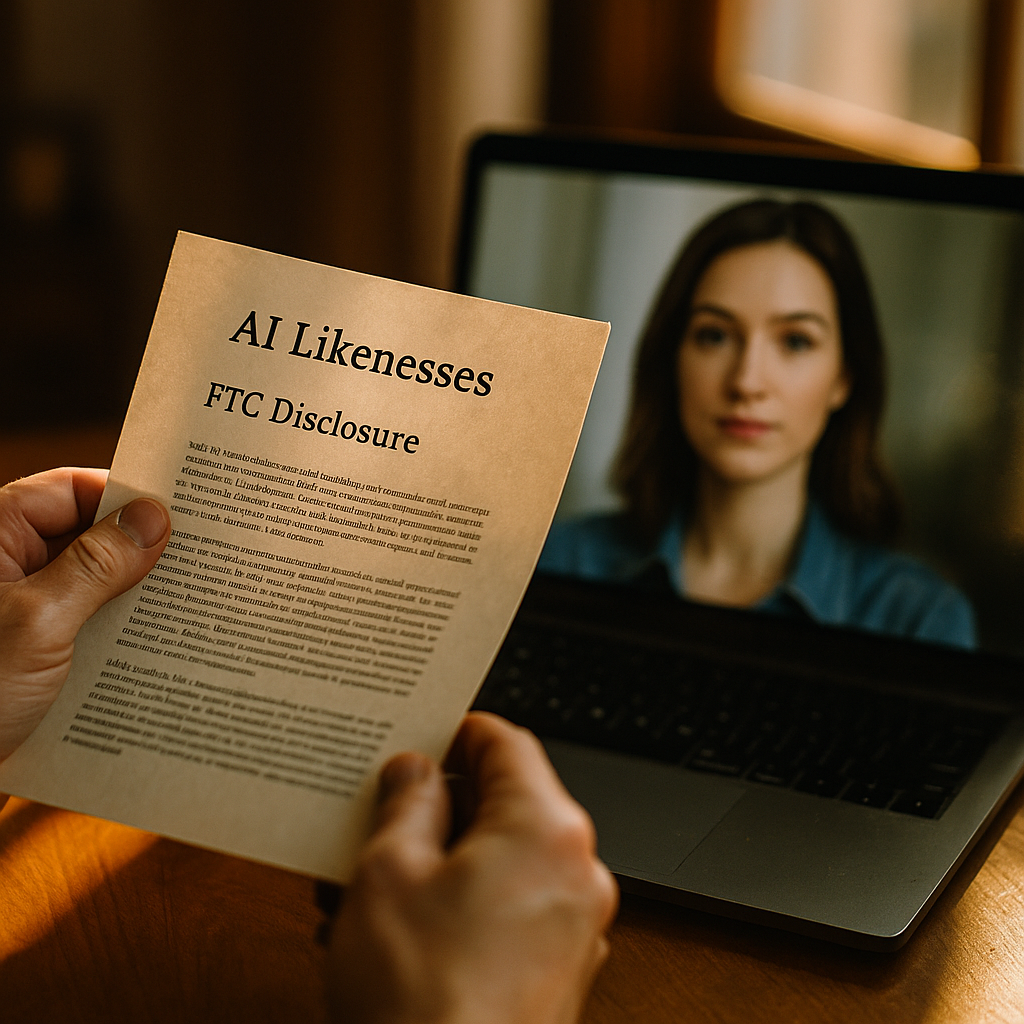
Understanding FTC Disclosure Requirements For AI-Generated Likenesses is essential for brands, creators, and agencies using synthetic faces, cloned voices, or digital doubles in advertising. In 2025, audiences expect transparency, and regulators expect proof. Disclosures must be clear, timely, and hard to miss across every platform and format. Missteps can trigger enforcement, reputational damage, and platform penalties—so what actually qualifies as “clear”?
FTC disclosure requirements: what they cover and why AI likenesses raise the stakes
The Federal Trade Commission’s core goal is straightforward: prevent deceptive or unfair advertising. When an ad could mislead a reasonable consumer, the FTC expects advertisers to correct that impression with disclosures that are clear and conspicuous. AI-generated likenesses raise the stakes because they can create powerful, realistic impressions about identity, experience, endorsements, and product performance.
In practice, FTC disclosure requirements become especially relevant when AI is used to:
- Imply a real person participated (a celebrity “appears” to endorse a product when they did not).
- Imply a real customer testimonial (a lifelike “customer” describes results that aren’t based on real experience).
- Imply live footage or documentary truth (a synthetic interview or “behind-the-scenes” clip presented as authentic).
- Mask paid promotion (AI avatars deliver scripted ad reads that look like organic content).
A useful way to think about risk: if the AI likeness changes what a reasonable viewer would believe about who is speaking, what they experienced, or whether a claim is independent, it’s not “just a creative choice.” It’s a potential material fact. Material facts require clarity.
Follow-up question most teams ask: “Is there a single FTC rule just for AI?” The FTC typically enforces long-standing deception principles and endorsement/testimonial standards against new technologies. That means your compliance burden is not smaller because the medium is new—often it’s larger because realism increases the chance of consumer confusion.
AI-generated likeness disclosure: when you must disclose and what counts as “material”
An AI-generated likeness disclosure becomes necessary when the synthetic nature of the person, voice, or scene could affect how viewers interpret the message. You should treat disclosure as mandatory in these common scenarios:
- Endorsements and testimonials: If a likeness suggests a real person is endorsing or describing real experiences, disclose that the person is AI-generated (and ensure underlying claims are substantiated).
- Impersonation risk: If the likeness resembles a real person (even without naming them), disclose and confirm you have permissions to avoid implied affiliation.
- “Real person” framing: If you use language like “meet Sarah” or “here’s what I did,” viewers will assume authenticity unless told otherwise.
- Health, finance, and high-stakes claims: Stronger disclosure is needed because consumers rely heavily on perceived credibility and lived experience.
What counts as “material” depends on context. In advertising, identity and authenticity can be material because they shape trust. If your campaign’s effectiveness relies on the audience believing the speaker is a real expert, a real customer, or a known figure, the synthetic nature of the likeness is likely material and must be disclosed prominently.
A second follow-up question: “If we disclose ‘AI-generated,’ can we say anything?” No. Disclosures do not cure false claims. If an AI avatar says, “This supplement cures insomnia,” you still need competent and reliable evidence, and many categories have additional restrictions. Disclose authenticity and substantiate claims.
Clear and conspicuous disclosure: placement, wording, audio, and video best practices
The FTC’s “clear and conspicuous disclosure” concept is practical: consumers should notice, understand, and be able to act on the information. For AI-generated likenesses, that means the disclosure must be unavoidable at the moment the likeness creates the impression.
Placement rules of thumb (adapt to your format):
- Put it where the claim appears: If the AI spokesperson makes a testimonial claim, place the disclosure on-screen during that segment, not only in the caption or end card.
- Repeat when needed: In longer videos, repeat the disclosure after transitions or before key claims, especially if viewers may join midstream.
- No “disclosure dumping”: Avoid hiding critical info in a cluster of small text, “more” links, or footnotes.
Wording that tends to be clearer than vague alternatives:
- Prefer: “This person is an AI-generated likeness. No real individual appears in this ad.”
- Prefer: “AI-generated voice and video.”
- Avoid: “Digital partner,” “virtual creative,” or “enhanced with AI” if it implies only minor editing.
Audio disclosures matter when the deception risk is auditory (voice cloning, radio, podcasts). If the key impression is created by a voice, include an audible disclosure near the beginning and again before major claims. Relying only on show notes or a landing page is risky because many listeners never see them.
Visual disclosures should be legible on mobile. Use high contrast, adequate duration, and placement that is not blocked by platform UI. If the AI likeness appears as a talking head, don’t put the disclosure in a corner that disappears behind captions or buttons.
Interactive and AR/VR disclosures should be persistent or triggered at the point of interaction. If a user “talks” to an AI concierge that looks human, disclose in the interface itself (not only in terms and conditions).
Practical checklist for teams: can a hurried viewer understand, in two seconds, that the likeness is synthetic? If not, adjust placement and language.
Influencer marketing compliance: AI avatars, sponsored content, and endorsement rules
Influencer marketing compliance becomes more complex when the “influencer” is a synthetic persona or when a real influencer’s likeness is generated or altered. The FTC expects audiences to understand both (1) the material connection (payment, free product, affiliate relationship) and (2) any other material fact that affects credibility, such as whether the “person” is real.
Key compliance principles for AI-driven campaigns:
- Disclose sponsorship clearly: Use straightforward labels like “Ad,” “Paid partnership,” or “Sponsored.” Don’t rely on ambiguous hashtags.
- Disclose AI identity when relevant: If the avatar looks like a real person, or the content is framed as a personal testimonial, clearly state it’s AI-generated.
- Don’t outsource compliance: Brands remain responsible for what their agencies, affiliates, and creators publish.
- Match the disclosure to the platform: A built-in “Paid partnership” tag may help, but you may still need an in-caption disclosure if the platform treatment is easy to miss.
Follow-up question: “If our AI avatar is obviously animated, do we still need disclosure?” Sometimes no, if the audience cannot reasonably be misled into thinking it’s a real person. But “obvious” is not a safe assumption in 2025. Many avatars are photorealistic, and even stylized characters can be mistaken for a real actor with filters. When the message depends on trust—especially testimonials—disclosure is the safer choice.
Another common question: “Can we use an AI clone of a creator who agreed?” You still need to ensure the audience is not misled about what was actually said, when it was said, and whether it reflects the person’s real views. A creator’s consent does not eliminate the need to disclose a material connection or prevent a deceptive impression.
Deepfake advertising risk: consent, substantiation, and avoiding deceptive identity claims
Deepfake advertising risk is not limited to celebrity scams. Any synthetic likeness can create deceptive identity claims—suggesting affiliation, authority, or firsthand experience that does not exist. Managing risk requires more than a disclosure line; it requires process controls.
1) Get the right permissions and document them
If the likeness resembles a real person, secure written consent that covers the specific use, channels, territories, duration, and the right to use AI generation. For voice clones, include explicit voice rights. Maintain an approval workflow so the person (or their authorized representative) signs off on final outputs, not just a concept.
2) Substantiate performance and efficacy claims
AI-generated testimonials are high risk because they can imply real consumer experience. If you use an AI spokesperson to communicate results, ensure:
- Claims reflect typical results, or you clearly and prominently disclose what is typical.
- You have competent and reliable evidence for objective claims (especially health, financial, and safety claims).
- You avoid fabricated “before and after” narratives unless they reflect real, documented outcomes.
3) Avoid implied endorsements and implied news formats
Do not format ads to look like news interviews, documentary footage, or “leaked” clips if that presentation would mislead viewers. If you use a “street interview” style with AI actors, state plainly that scenes and people are synthetic and dramatized.
4) Build internal guardrails
- Creative review: Flag AI likeness use early, not at final cut.
- Disclosure templates: Pre-approved language for different formats (short-form video, audio, static).
- Retention: Keep records of prompts, source assets, consent forms, claims substantiation, and disclosure placements.
Follow-up question: “Is disclosure enough if the likeness could be mistaken for a competitor’s spokesperson?” No. You should avoid confusing similarity and any implication of affiliation. Disclosures do not cure brand confusion or deceptive identity tactics.
Advertising transparency policy: building an EEAT-driven compliance program for 2025
An advertising transparency policy signals reliability to consumers, partners, and regulators. It also supports Google’s EEAT expectations by demonstrating experience, expertise, authoritativeness, and trustworthiness in how you produce and label marketing content.
What an effective policy includes:
- Definitions: What your organization considers an AI-generated likeness (face, voice, body, photorealistic composites, synthetic “customers”).
- Disclosure standards: Approved phrases, font/size guidance, on-screen duration minimums, audio wording, and where disclosures must appear.
- Use-case rules: Separate requirements for endorsements/testimonials, educational content, customer support avatars, and entertainment content.
- Approval workflow: Legal/compliance checkpoints, creator approvals, and brand safety review.
- Training: Short training for marketing teams, agencies, and creators on disclosure placement and claim substantiation.
- Monitoring and correction: Post-launch audits, a process for edits or takedowns, and a way to capture platform comments indicating confusion.
EEAT in practice means your content does more than comply—it helps users make informed decisions. If your brand uses AI likenesses, consider adding a short public-facing note on your site that explains how you label synthetic media and how consumers can report concerns. This improves trust and reduces confusion when ads are shared out of context.
Follow-up question: “Do we need to disclose on every re-post?” If your content is likely to be viewed without the original context (common on social), embed the disclosure in the media itself (on-screen text or audio) rather than relying on captions that may be stripped.
FAQs
Do FTC rules require a specific phrase like “AI-generated”?
No single mandated phrase applies in every case, but the disclosure must be clear and understandable. “AI-generated” or “AI-generated likeness” is often clearer than vague terms like “digital” or “enhanced,” especially for photorealistic people and voices.
Where should I place an AI likeness disclosure in a short-form video ad?
Place it on-screen while the AI person first appears and again during any testimonial-style or high-impact claims. Keep it legible on mobile, high contrast, and on-screen long enough to read.
If a real celebrity authorized an AI version of themselves, do we still need disclosure?
Often yes, if viewers could be misled into thinking the celebrity personally recorded the message. Disclosure helps clarify that the performance is synthetic while still allowing truthful statements about authorization and sponsorship.
Are AI-generated “customer reviews” allowed if the claims are true?
They are risky. Even if product claims are substantiated, presenting an AI-generated person as a real customer can mislead about the source and experience. A safer approach is to use real customer reviews or clearly label synthetic dramatizations.
Does a platform’s “Paid Partnership” label satisfy FTC disclosure expectations?
It can help, but you must assess whether it is prominent and understandable in context. If viewers could miss it, add a plain-language disclosure in the content itself.
What records should we keep to show compliance?
Keep copies of the final creative, where disclosures appear, scripts, substantiation for claims, consent and licensing documents for any real-person likeness, and internal approvals. Good records make corrections faster and reduce enforcement risk.
FTC disclosure compliance for AI likenesses comes down to one standard: don’t let realistic synthetic media create a false belief about who is speaking, what they experienced, or why they’re promoting a product. In 2025, build disclosures into the creative, not into fine print, and support them with consent, substantiation, and monitoring. Transparency earns trust—and prevents problems before launch.