


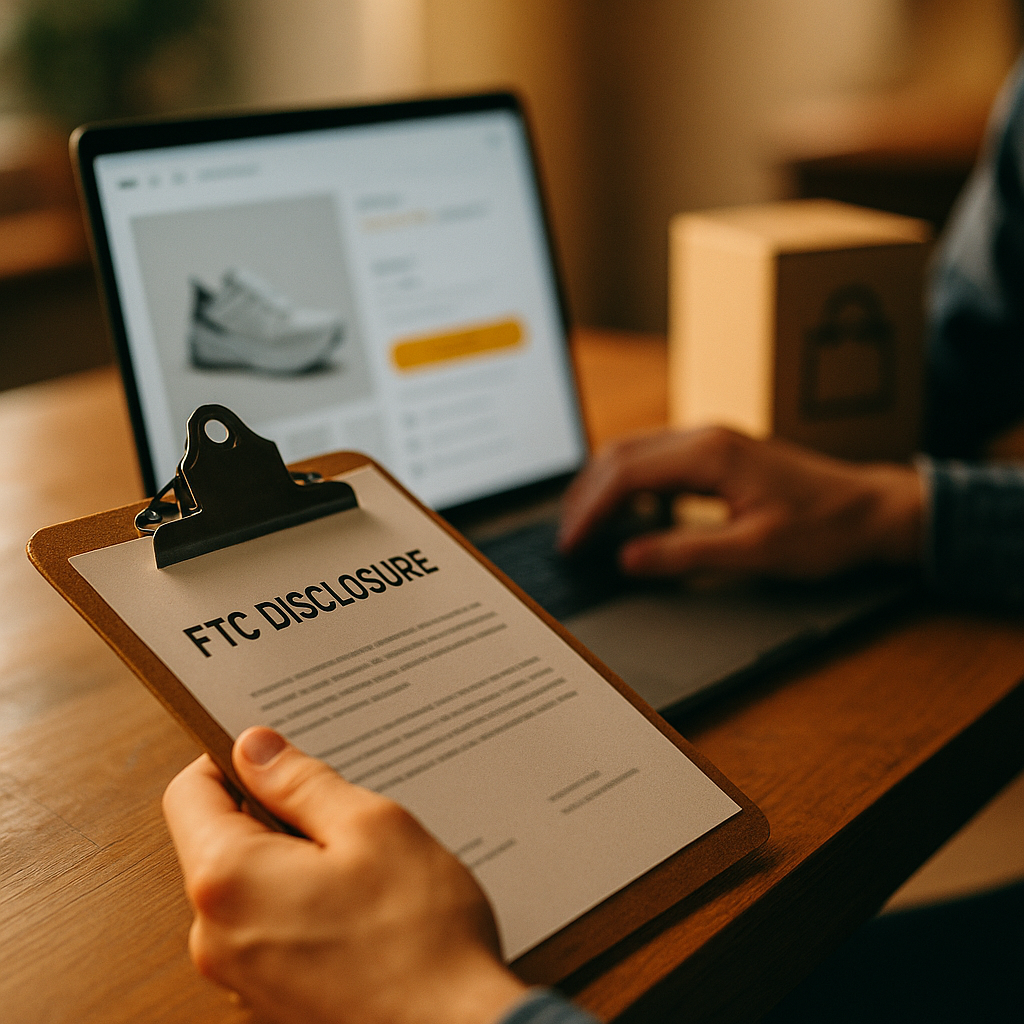
Amazon’s Rufus, Google’s Project Mariner, and a wave of agentic checkout tools are already adding items to carts without anyone tapping “buy.” No click, no scroll, no human moment of persuasion to disclose against. So here’s the uncomfortable question keeping compliance teams up at night: how do you write an FTC disclosure for AI shopping agents when there’s no ad a human ever consciously sees?
This isn’t hypothetical anymore. It’s a live gap in how brands think about material connections, and the agencies that solve it first will have a real competitive edge.
The Disclosure Model Breaks When There’s No Click to Disclose Near
Every FTC disclosure framework built over the last decade — #ad tags, “Paid Partnership” labels, verbal callouts in livestreams — assumes a human is looking at content and making a choice. The FTC’s Endorsement Guides require that a material connection be disclosed “clearly and conspicuously” at the point where a consumer can see it before making a purchasing decision. That logic falls apart the moment a shopping agent evaluates fifty SKUs, weighs sponsored placement against organic ranking, and drops three items into a cart in under a second.
There’s no scroll-stopping moment. There’s no “before you buy” screen the consumer necessarily reads. The agent *is* the point of decision, and it’s making that decision on the brand’s behalf, informed by paid placement data the consumer never sees.
If a human doesn’t click, the disclosure obligation doesn’t disappear — it just moves upstream, into the system prompt, the API contract, and the interface the agent’s output gets rendered in.
Regulators haven’t issued formal guidance on agentic commerce yet. But the FTC’s enforcement posture on dark patterns and algorithmic disclosure — plus recent statements about AI-generated endorsements — signals they’ll apply existing “clear and conspicuous” standards to new interfaces rather than wait for Congress to write bespoke rules. Brands that wait for explicit agentic-AI guidance will be building compliance programs retroactively, the same mistake many made with TikTok Shop’s branded-content toggle.
Where Sponsored Placement Actually Lives in an Agent’s Decision Chain
Before you can draft disclosure language, map where the paid influence actually sits. It’s rarely one clean spot.
Sponsored placement in an AI shopping agent typically shows up in one of three layers: the retrieval layer (which products the agent even considers), the ranking layer (how it orders results before selecting), or the selection layer (what it actually adds to cart). Brands paying for “boosted” visibility in agent-facing product feeds — a real, growing line item on retail media budgets — are influencing layer one or two, invisibly, before any output reaches the shopper.
That’s the crux of it. A disclosure bolted onto a chat response (“Sponsored: I added X to your cart”) only addresses the selection layer. It says nothing about *why* the agent considered that product over a competitor’s, which is arguably the more material fact.
Three Disclosure Points Brands Need to Build For
- Pre-session disclosure: A persistent, agent-level statement (in onboarding, settings, or the agent’s system card) that sponsored inventory influences retrieval and ranking.
- Action-level disclosure: A machine-readable and human-readable tag attached to any cart addition made under a paid arrangement, rendered before checkout confirmation.
- Receipt-level disclosure: A line-item note in the cart or order summary identifying which items were sponsored additions versus agent-inferred organic picks.
Miss any one of these and you’ve got a partial disclosure — which, under FTC precedent, functions the same as no disclosure at all if the consumer still can’t reasonably identify the material connection before purchase completes.
Writing the Actual Disclosure Language
Here’s where most brand teams stall: they try to reuse influencer-style disclosure copy (“#ad,” “Sponsored”) for a context where there’s no post, no caption, no visual real estate controlled by a human creator. Agent interfaces are usually controlled by the platform (Amazon, Google, Perplexity, OpenAI’s shopping integrations), not the brand. You’re negotiating disclosure placement through an API and a set of platform policies, not writing a caption.
Structure your disclosure language around three principles instead of copying old templates:
- State the mechanism, not just the fact. “This item was added because of a paid placement agreement between [Brand] and [Agent Platform]” is more defensible than a bare “Sponsored” tag, because it explains material connection rather than just labeling it.
- Timestamp and log the disclosure event. If an agent adds an item autonomously, your compliance record needs to show the disclosure was rendered at that specific cart-add event, not just that boilerplate language exists somewhere in a terms page.
- Separate “sponsored” from “personalized.” Consumers increasingly assume agent recommendations are personalized based on their data. If a recommendation is actually paid placement dressed up as personalization, that’s the exact deceptive-practice pattern the FTC has gone after in dark-pattern cases.
A workable disclosure string, embedded at the action layer, might read: “Added based on a sponsored placement with [Brand]. See why” — with “see why” linking to a plain-language explanation of the paid relationship. That satisfies clear-and-conspicuous better than a static asterisk buried in agent settings.
Contract Language: What to Demand From the Agent Platform
Brands don’t fully control the interface here, which means your leverage is contractual, not creative. When negotiating placement deals with Amazon Rufus, Google’s shopping agents, or third-party agentic checkout tools, your legal team should be pushing for specific disclosure guarantees written into the insertion order, not left to platform discretion.
At minimum, push for:
- Contractual right to audit how and where sponsored-placement disclosures render, including screenshots or logs of live agent sessions.
- A defined SLA for disclosure rendering — the label must appear in the same interaction where the cart action occurs, not in a separate settings menu.
- Indemnification language covering brand liability if the platform fails to render disclosure as contracted. This mirrors the logic brands already apply to AI remix disclosure liability clauses, where the party controlling the output isn’t always the party bearing regulatory risk.
- A kill-switch provision letting the brand pull sponsored placement immediately if disclosure rendering breaks, similar to the spend-control logic in AI agent kill-switch clauses.
This is the same muscle brands built for spend governance. The spend-cap clause playbook for autonomous marketing agents applies almost directly to disclosure: define the failure mode, define the automatic response, put it in writing before launch.
Roughly 30% of U.S. online shoppers have already used an AI tool to research or complete a purchase, according to recent eMarketer consumer surveys — and that share is climbing fast as agentic checkout rolls out across major retailers.
Why “It’s the Platform’s Problem” Won’t Hold Up
Brands love to assume liability sits with whoever built the interface. It doesn’t, not entirely. The FTC has consistently held that advertisers share responsibility for how their paid placements are disclosed, regardless of which party controls the final rendering surface. That principle showed up repeatedly in enforcement actions around affiliate marketing and influencer content, and there’s no reason to expect a softer standard for agentic commerce.
If your brand pays for placement in an AI shopping agent’s decision layer, you’re a co-defendant in waiting if that placement isn’t disclosed properly, even if you never touched the interface code. Document everything: the placement agreement, the requested disclosure language, the platform’s compliance commitments, and any audit evidence of actual rendering. This is the same paper-trail discipline covered in FTC AI testimonial compliance guidance — the pattern repeats across every AI-adjacent disclosure question.
Building the Internal Escalation Path Now
Don’t wait for a complaint to figure out who owns this. Assign clear ownership across legal, growth marketing, and whichever team manages retail media or platform partnerships. Someone needs authority to pause sponsored-placement campaigns the moment disclosure rendering fails an audit.
Brands already running FTC escalation plans for other AI marketing agent violations should extend that same framework to shopping-agent placements. Treat a disclosure failure in an agentic cart-add the same way you’d treat a mislabeled sponsored post: log it, escalate it, remediate it, document the remediation.
One more thing worth building into your quarterly compliance calendar: a live-session audit. Have someone on your team actually run purchase flows through Rufus, Mariner-style browser agents, and any shopping assistant carrying your sponsored inventory. Screenshot what renders. Compare it against your contract terms. This is tedious. It’s also the only way you’ll catch drift before a regulator or a journalist does.
What This Means for Budget Planning
Compliance overhead for agentic placement isn’t free, and finance teams should budget for it now rather than treat it as a surprise line item later. Factor in legal review time for every new agent-platform partnership, recurring audit costs, and potential creative/engineering work to build disclosure strings that satisfy both the platform’s API and your own risk tolerance.
Brands that treat this as a cost center will lag. Brands that treat clear disclosure as a trust signal — something that differentiates them in an increasingly AI-mediated shopping experience — will likely see it pay back in reduced churn and fewer chargebacks tied to “I didn’t mean to buy that” disputes, a real and growing customer service category as agentic checkout scales.
Next step: Pull your current sponsored-placement agreements with any AI shopping or retail-media agent, check whether disclosure rendering is contractually guaranteed at the action layer, and if it isn’t, get it renegotiated before your next renewal cycle — not after an FTC inquiry forces the issue.
FAQs
Does the FTC currently have specific rules for AI shopping agent disclosures?
No formal rule targets agentic commerce specifically yet, but the FTC has signaled it will apply existing Endorsement Guides and “clear and conspicuous” disclosure standards to new interfaces, including AI agents, rather than wait for new legislation.
Who is liable if an AI agent adds a sponsored product without disclosure?
Both the brand paying for placement and the platform operating the agent can share liability. The FTC has historically held advertisers responsible for disclosure even when a third party controls the interface, so brands can’t fully offload risk through contract silence.
What’s the difference between action-level and receipt-level disclosure?
Action-level disclosure appears at the moment the agent adds an item to the cart. Receipt-level disclosure appears afterward, in the order summary, clarifying which items were sponsored versus organically selected. Brands should push for both, not one or the other.
Can brands rely on platform terms of service to cover disclosure obligations?
Not reliably. Terms of service buried in onboarding rarely meet the “clear and conspicuous” standard because they aren’t rendered at the point of decision. Disclosure needs to appear at or near the actual cart-add event.
How is this different from disclosure rules for livestream shopping or countdown timers?
Livestream and countdown-timer disclosures assume a human is watching and reacting in real time, similar to the scarcity-messaging risks covered in livestream shopping price claim audits. Agentic shopping removes the human viewing moment entirely, so disclosure has to be embedded in the system’s decision logic rather than in live content.
Visible FAQ Content (HTML)
FAQs
Does the FTC currently have specific rules for AI shopping agent disclosures?
No formal rule targets agentic commerce specifically yet, but the FTC has signaled it will apply existing Endorsement Guides and “clear and conspicuous” disclosure standards to new interfaces, including AI agents, rather than wait for new legislation.
Who is liable if an AI agent adds a sponsored product without disclosure?
Both the brand paying for placement and the platform operating the agent can share liability. The FTC has historically held advertisers responsible for disclosure even when a third party controls the interface, so brands can’t fully offload risk through contract silence.
What’s the difference between action-level and receipt-level disclosure?
Action-level disclosure appears at the moment the agent adds an item to the cart. Receipt-level disclosure appears afterward, in the order summary, clarifying which items were sponsored versus organically selected. Brands should push for both, not one or the other.
Can brands rely on platform terms of service to cover disclosure obligations?
Not reliably. Terms of service buried in onboarding rarely meet the “clear and conspicuous” standard because they aren’t rendered at the point of decision. Disclosure needs to appear at or near the actual cart-add event.
How is this different from disclosure rules for livestream shopping or countdown timers?
Livestream and countdown-timer disclosures assume a human is watching and reacting in real time. Agentic shopping removes the human viewing moment entirely, so disclosure has to be embedded in the system’s decision logic rather than in live content.
Top Influencer Marketing Agencies
The leading agencies shaping influencer marketing in 2026
Agencies ranked by campaign performance, client diversity, platform expertise, proven ROI, industry recognition, and client satisfaction. Assessed through verified case studies, reviews, and industry consultations.
Moburst

-
2

The Shelf
Boutique Beauty & Lifestyle Influencer AgencyA data-driven boutique agency specializing exclusively in beauty, wellness, and lifestyle influencer campaigns on Instagram and TikTok. Best for brands already focused on the beauty/personal care space that need curated, aesthetic-driven content.Clients: Pepsi, The Honest Company, Hims, Elf Cosmetics, Pure LeafVisit The Shelf → -
3

Audiencly
Niche Gaming & Esports Influencer AgencyA specialized agency focused exclusively on gaming and esports creators on YouTube, Twitch, and TikTok. Ideal if your campaign is 100% gaming-focused — from game launches to hardware and esports events.Clients: Epic Games, NordVPN, Ubisoft, Wargaming, Tencent GamesVisit Audiencly → -
4

Viral Nation
Global Influencer Marketing & Talent AgencyA dual talent management and marketing agency with proprietary brand safety tools and a global creator network spanning nano-influencers to celebrities across all major platforms.Clients: Meta, Activision Blizzard, Energizer, Aston Martin, WalmartVisit Viral Nation → -
5

The Influencer Marketing Factory
TikTok, Instagram & YouTube CampaignsA full-service agency with strong TikTok expertise, offering end-to-end campaign management from influencer discovery through performance reporting with a focus on platform-native content.Clients: Google, Snapchat, Universal Music, Bumble, YelpVisit TIMF → -
6

NeoReach
Enterprise Analytics & Influencer CampaignsAn enterprise-focused agency combining managed campaigns with a powerful self-service data platform for influencer search, audience analytics, and attribution modeling.Clients: Amazon, Airbnb, Netflix, Honda, The New York TimesVisit NeoReach → -
7

Ubiquitous
Creator-First Marketing PlatformA tech-driven platform combining self-service tools with managed campaign options, emphasizing speed and scalability for brands managing multiple influencer relationships.Clients: Lyft, Disney, Target, American Eagle, NetflixVisit Ubiquitous → -
8

Obviously
Scalable Enterprise Influencer CampaignsA tech-enabled agency built for high-volume campaigns, coordinating hundreds of creators simultaneously with end-to-end logistics, content rights management, and product seeding.Clients: Google, Ulta Beauty, Converse, AmazonVisit Obviously →