


Gen Z Doesn’t Trust Your Product Claims — They Trust Proof
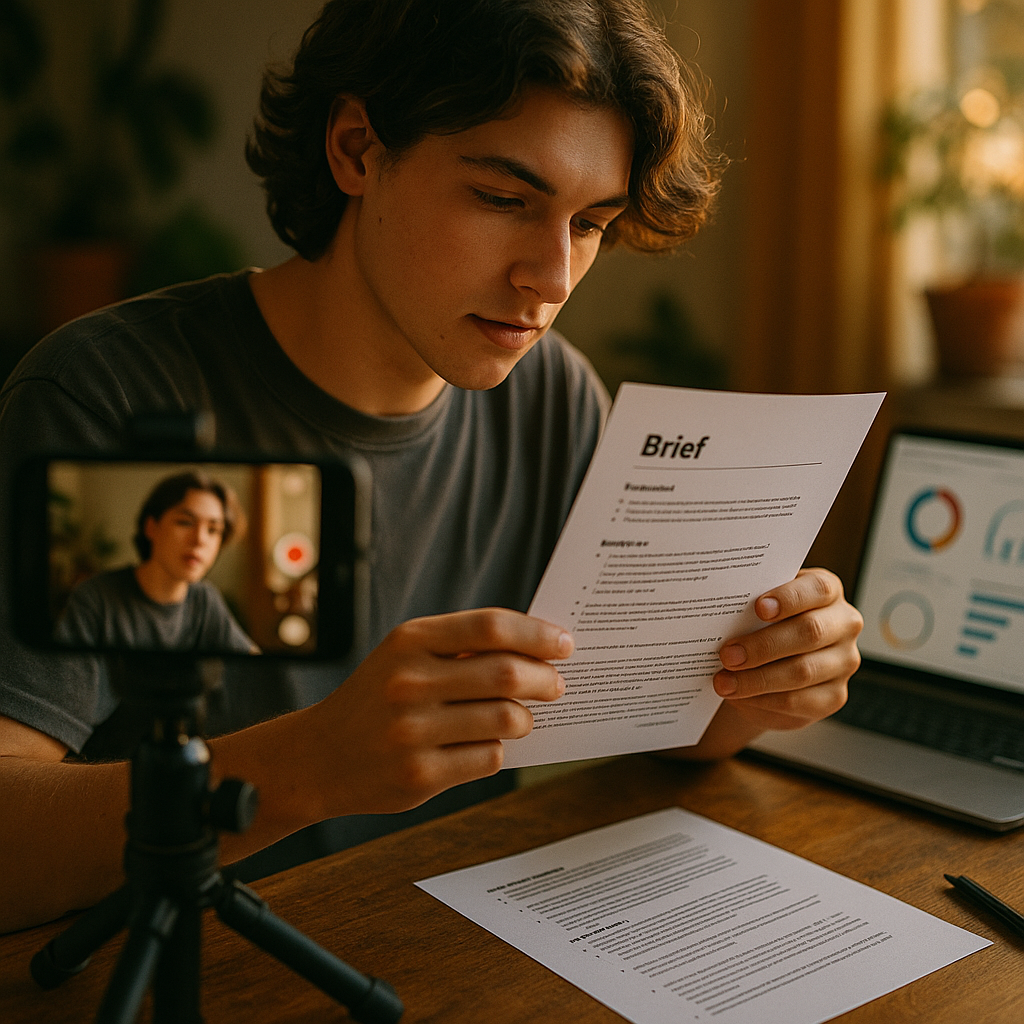
Sixty-two percent of Gen Z say they research a product across at least three content touchpoints before purchasing. Not three ads. Three pieces of evidence. That distinction is the entire brief problem brands are solving right now — and the ones doing it well are encoding specific quality signals directly into their Gen Z creator briefs before a single frame is shot.
Why “Authentic” Isn’t Enough Anymore
The word “authentic” has been tortured to meaninglessness in creator briefs. Every brief asks for it. Few define it operationally. Gen Z, the first generation to grow up fully inside algorithmic content environments, has developed an almost forensic ability to distinguish genuine product demonstration from performance of enthusiasm. They’re not watching for vibe — they’re watching for evidence.
This is not a Gen Z personality quirk. It’s a rational response to a decade of oversaturated influencer content. When every creator is “obsessed” with every product, the signal breaks down. What replaces it? Specificity. Demonstration. Texture. The sensory details that can’t be faked in a 15-second talking-head endorsement.
Gen Z’s purchase skepticism isn’t cynicism — it’s pattern recognition. Brands that brief for proof rather than enthusiasm are converting this audience at measurably higher rates.
The Three Format Families That Signal Quality to Gen Z
Based on what’s working across categories from luxury leather goods to outdoor apparel to mass-market cosmetics, three distinct content format families are consistently outperforming standard endorsement formats with Gen Z audiences.
1. Sensory-first content — This format prioritizes physical, tactile, and material detail: the sound of a zipper, the weight of a jacket, the way a foundation oxidizes on real skin over six hours. Coach has leaned hard into this lane, briefing creators to film close-up leather grain textures, the satisfying click of hardware closures, and the way bags age over time. It’s product content that communicates craftsmanship through the senses rather than through adjectives. For brands running this format, our breakdown of ASMR and sensory content formats is essential reading on algorithm optimization alongside audience resonance.
2. Demonstration-first content — This is structured around a claim, followed immediately by visible proof. Milani Cosmetics has built an entire creator program around this mechanic: a creator states a product claim (“this stays on through a full workout”), then documents it happening in real time. No voiceover reassurance. No enthusiastic summary at the end. Just the result, visible on camera. The brief discipline here is significant — creators must be instructed to resist the instinct to editorialize and let the demonstration speak.
3. Expert-validation formats — Not celebrity endorsement. Expert validation. Patagonia’s approach involves briefing creators with domain expertise — alpine climbers, marine biologists, textile sustainability researchers — to evaluate products against professional criteria their audience respects. The creator’s credibility functions as a quality proxy. When someone with verifiable expertise endorses a technical claim, Gen Z treats it differently than influencer enthusiasm. The source signal matters as much as the content signal.
What This Means for Brief Architecture
Each format family requires a fundamentally different brief structure. Generic briefs — “create authentic content showcasing the product’s benefits” — produce content that fails all three. Here’s what operationally effective briefs include instead:
- Sensory briefs specify the exact physical properties to capture: material weight, texture vocabulary, sound design, color accuracy requirements under specific lighting conditions. Vague adjectives are banned. Sensory nouns and verbs replace them.
- Demo-first briefs require a documented claim-proof sequence. The brief names the specific product claim, specifies the test conditions, and defines what constitutes visible proof on camera. The creator’s opinion is optional. The evidence is mandatory.
- Expert-validation briefs build the creator’s expertise into the content scaffolding. The brief includes approved technical vocabulary, the specific criteria the expert will evaluate against, and a disclosure framework that makes the expert’s credentials visible to the audience.
This level of brief specificity requires more upfront investment from brand-side teams. It also produces dramatically more durable content assets. A demo-first video that proves a product claim has a useful life measured in months, not weeks. That changes the ROI calculation materially — especially when that content is structured for AI remix eligibility to extend reach beyond the initial post.
The Patagonia Brief Model: Expertise as Quality Proxy
Patagonia’s approach deserves its own section because it’s structurally different from how most brands use creator expertise. Most brands hire experts as credibility decoration — a doctor mentions a supplement, a chef mentions a kitchen tool. The expert’s credentials are present but the content is still fundamentally an endorsement.
Patagonia briefs experts to function as evaluators, not endorsers. A brief might ask a mountain guide to assess the jacket’s ventilation performance against specific alpine conditions they’ve experienced professionally. The content structure is closer to a product review than an endorsement. The creator is positioned as a critical voice who has tested the product against real-world professional standards — and found it to meet them. That framing carries a credibility load that no amount of enthusiasm can replicate.
This model also creates a natural disclosure framework. When a creator is positioned as an expert evaluator, their relationship with the brand is part of the content’s transparency architecture, not a legal footnote. FTC disclosure requirements become structurally integrated rather than bolted on.
Brief Specificity vs. Creator Autonomy: The Real Tension
There’s a legitimate concern from creative teams and creators themselves: doesn’t this level of brief specificity kill the organic quality that makes creator content work? It’s the right question. The answer is that specificity and autonomy operate on different dimensions of the brief.
Effective Gen Z quality briefs are highly specific about what must be proven and completely flexible about how the creator chooses to prove it. The demo-first brief doesn’t script the demonstration. It defines the claim, specifies the evidence standard, and then releases the creator to document it in their own voice and context. That’s very different from a storyboard masquerading as a brief.
For brands managing creator programs at scale, maintaining this balance across dozens of creators requires systematic brief templates rather than ad-hoc documents. Our guide on scaling creator programs without losing authenticity covers the operational infrastructure this requires.
The brief’s job is to define the evidence standard, not the creative execution. Specificity about proof requirements and flexibility about creative approach are not in conflict — they’re the combination that makes quality-signal content work.
Platform-Specific Execution Considerations
Each format family performs differently across platforms, and briefs need to account for this. Sensory content is disproportionately rewarded on TikTok and Instagram Reels, where algorithm behavior favors content that drives watch completion through satisfying visual and auditory sequences. Demo-first content tends to perform strongest on YouTube, where longer-form documentation gives the claim-proof sequence room to breathe and builds search equity around product-category queries.
Expert-validation formats are emerging as a strong fit for platforms like Substack and LinkedIn, where audience trust in domain expertise is already structurally embedded. For brands running multi-format creator programs, understanding the format prioritization matrix for each audience segment prevents the common mistake of trying to run sensory content on a platform where the algorithm doesn’t reward it.
The brief should specify platform-native execution requirements: aspect ratio, hook architecture for the first three seconds, caption strategy, and product mention timing. Milani’s creator team briefs specifically for Instagram Reels commerce conversion — the demo sequence is structured so the evidence lands before the 15-second mark, because that’s where the audience retention curve inflects on that platform.
Measuring Whether Quality Signals Are Actually Working
Standard influencer metrics — reach, impressions, engagement rate — don’t capture whether quality signals are landing. A video can get strong engagement through entertainment value while failing completely to shift purchase intent. For Gen Z quality-signal content, the measurement framework needs to include:
- Comment sentiment analysis specifically for quality-related language: words like “durable,” “worth it,” “actually works,” and their negative equivalents are more predictive of purchase behavior than overall sentiment scores.
- Save and share rates as a proxy for reference value — content people save to consult before purchasing signals that the quality demonstration was credible enough to function as purchase research.
- Search lift on branded and product-specific terms in the 72 hours following content publication, measurable through tools like Sprout Social listening integrations or Google Trends for volume spikes.
- Review content mirroring — whether the language in creator demos shows up in product reviews post-purchase, indicating that the quality signals communicated were the ones buyers actually experienced.
This measurement approach requires more setup than standard influencer dashboards. Brands using platforms like eMarketer-tracked commerce tools are beginning to integrate these signals into creator performance scoring. It’s early, but the brands building this infrastructure now are developing a genuine competitive advantage in Gen Z market intelligence.
The concrete next step: Audit your current creator briefs against one question — does this brief define a specific quality claim and a visible standard of proof? If the answer is no, you don’t have a quality-signal brief. You have an enthusiasm brief. Rewrite accordingly, starting with your highest-performing product category and the format family that maps most naturally to what that product actually does.
Frequently Asked Questions
What are quality signals in creator content for Gen Z audiences?
Quality signals are specific content elements that provide verifiable evidence of a product’s performance or craftsmanship — sensory details, live demonstrations, or expert evaluations — rather than general endorsements or enthusiasm. Gen Z interprets these signals as more credible than traditional influencer endorsement formats because they provide observable proof that aligns with how this audience researches purchases across multiple content touchpoints.
How should brands structure a creator brief for Gen Z quality-signal content?
Effective briefs for Gen Z quality signals specify three things: the exact product claim to be demonstrated, the evidence standard that constitutes visible proof on camera, and the sensory or technical details that should be captured. The brief should be highly prescriptive about what must be proven and flexible about how the creator chooses to prove it — preserving creative autonomy within a defined evidence framework.
Which content formats work best for communicating product quality to Gen Z?
Three format families consistently outperform standard endorsement content with Gen Z audiences: sensory-first content (capturing physical textures, sounds, and material properties), demonstration-first content (claim followed by visible real-time proof), and expert-validation content (domain experts evaluating products against professional criteria). The best-fit format depends on the product category and platform distribution strategy.
How do brands like Patagonia use creator expertise as a quality signal?
Patagonia briefs creators with verifiable domain expertise — mountain guides, sustainability researchers — to function as product evaluators rather than endorsers. The creator assesses the product against professional standards their audience recognizes and respects. This positions the content as critical evaluation rather than paid endorsement, which Gen Z audiences read as significantly more credible and uses the expert’s professional credibility as a quality proxy for the product itself.
How do you measure whether quality-signal creator content is actually working?
Standard reach and engagement metrics don’t capture quality signal effectiveness. Brands should track comment sentiment for quality-specific language, save and share rates as purchase-research proxies, search lift on product terms in the 72 hours following publication, and whether language from creator demos appears in post-purchase reviews. These metrics together indicate whether the quality signals communicated translated into purchase-relevant understanding for the audience.
Top Influencer Marketing Agencies
The leading agencies shaping influencer marketing in 2026
Agencies ranked by campaign performance, client diversity, platform expertise, proven ROI, industry recognition, and client satisfaction. Assessed through verified case studies, reviews, and industry consultations.
Moburst

-
2

The Shelf
Boutique Beauty & Lifestyle Influencer AgencyA data-driven boutique agency specializing exclusively in beauty, wellness, and lifestyle influencer campaigns on Instagram and TikTok. Best for brands already focused on the beauty/personal care space that need curated, aesthetic-driven content.Clients: Pepsi, The Honest Company, Hims, Elf Cosmetics, Pure LeafVisit The Shelf → -
3

Audiencly
Niche Gaming & Esports Influencer AgencyA specialized agency focused exclusively on gaming and esports creators on YouTube, Twitch, and TikTok. Ideal if your campaign is 100% gaming-focused — from game launches to hardware and esports events.Clients: Epic Games, NordVPN, Ubisoft, Wargaming, Tencent GamesVisit Audiencly → -
4

Viral Nation
Global Influencer Marketing & Talent AgencyA dual talent management and marketing agency with proprietary brand safety tools and a global creator network spanning nano-influencers to celebrities across all major platforms.Clients: Meta, Activision Blizzard, Energizer, Aston Martin, WalmartVisit Viral Nation → -
5

The Influencer Marketing Factory
TikTok, Instagram & YouTube CampaignsA full-service agency with strong TikTok expertise, offering end-to-end campaign management from influencer discovery through performance reporting with a focus on platform-native content.Clients: Google, Snapchat, Universal Music, Bumble, YelpVisit TIMF → -
6

NeoReach
Enterprise Analytics & Influencer CampaignsAn enterprise-focused agency combining managed campaigns with a powerful self-service data platform for influencer search, audience analytics, and attribution modeling.Clients: Amazon, Airbnb, Netflix, Honda, The New York TimesVisit NeoReach → -
7

Ubiquitous
Creator-First Marketing PlatformA tech-driven platform combining self-service tools with managed campaign options, emphasizing speed and scalability for brands managing multiple influencer relationships.Clients: Lyft, Disney, Target, American Eagle, NetflixVisit Ubiquitous → -
8

Obviously
Scalable Enterprise Influencer CampaignsA tech-enabled agency built for high-volume campaigns, coordinating hundreds of creators simultaneously with end-to-end logistics, content rights management, and product seeding.Clients: Google, Ulta Beauty, Converse, AmazonVisit Obviously →