


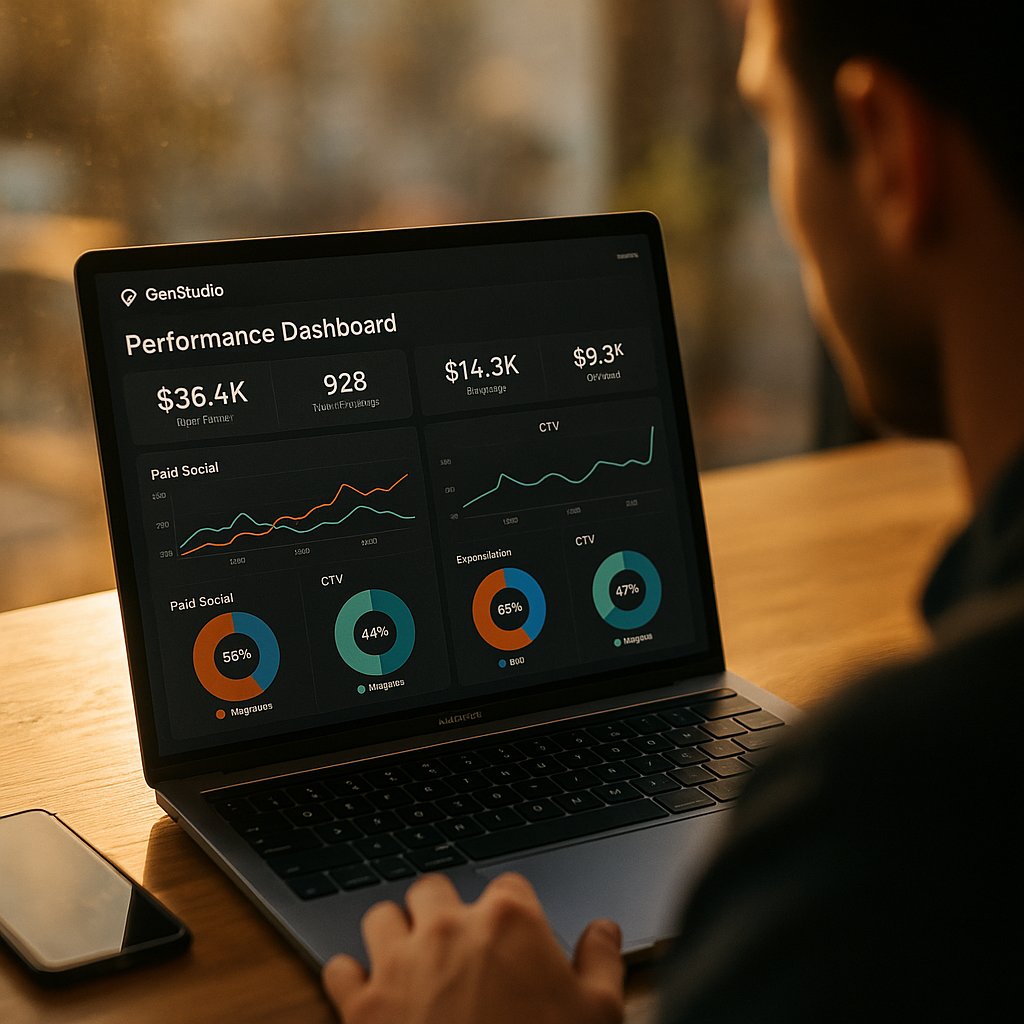
Most brand analytics teams are still running post-mortem reports on campaigns that ended two weeks ago. If your creative decisions are informed by last flight’s data, you are already losing ground to competitors who have wired Adobe GenStudio Performance Dashboard into live paid social and CTV workflows.
Why Post-Campaign Reporting Is a Strategic Liability
The average enterprise brand runs creative refresh cycles every four to six weeks. By the time a campaign debrief lands in a slide deck, the algorithmic windows on Meta and connected TV platforms have already shifted. Frequency caps have been hit. Audience fatigue has set in. The asset that performed at a 2.4x ROAS in week one is dragging down the account by week three, and nobody acted on the signal in time.
This is not a data problem. Most analytics stacks are generating signals. It is a configuration problem: teams have not set up GenStudio’s Performance Dashboard to surface next-best-asset recommendations before the damage is done.
Brands that shift from batch reporting to continuous creative intelligence cycles reduce creative waste by an estimated 30-40%, according to Adobe’s own platform benchmarking data published for enterprise customers.
How GenStudio’s Performance Dashboard Actually Works
Adobe GenStudio for Performance Marketing connects creative asset metadata, platform delivery data, and audience signals into a unified performance layer. The dashboard ingests data from Meta Ads, Google Display and Video, and — critically for 2026 planning — connected TV inventory via MNTN and similar CTV partners. Understanding GenStudio’s CTV attribution integration is essential before you configure anything else.
What makes the Performance Dashboard distinct from a standard analytics tool is its asset-level attribution logic. Rather than reporting at the campaign or ad set level, GenStudio maps performance back to specific creative attributes: background color, headline sentiment, talent presence, motion vs. static, aspect ratio, and call-to-action placement. This granularity is what enables automated creative recommendations to function at scale rather than just generating noise.
The system works in three layers:
- Ingestion layer: Platform APIs pull delivery and engagement metrics on a configurable cadence, from hourly to daily.
- Attribution layer: Creative attributes are tagged at upload via GenStudio’s AI-powered asset analysis, which reads visual and copy elements automatically.
- Recommendation layer: The system scores in-flight assets against top-performer patterns and surfaces next-best-asset signals when underperformers cross a configurable degradation threshold.
Configuring Automated Creative Recommendations Without Generating Noise
Here is where most implementations fail. Teams turn on automated recommendations at default sensitivity settings, get flooded with alerts, ignore them within two weeks, and declare the feature useless. The problem is threshold calibration, not the feature itself.
Start with a 72-hour stabilization window before any recommendation is triggered. This filters out early delivery volatility, which is especially pronounced in CTV where impression pacing is uneven in the first 48 hours of a flight. For paid social on Meta and TikTok, a 48-hour window is usually sufficient given faster data return.
Next, define your degradation triggers at the asset level, not the campaign level. A useful starting configuration:
- CTR decline of 15% or more over a 5-day rolling average
- Video completion rate dropping below your brand’s baseline by 20%
- Cost-per-result increasing 25% above the campaign’s established baseline
- Frequency crossing 4.5 on Meta placements (a reliable fatigue signal)
When any two of these conditions intersect, the system surfaces a next-best-asset recommendation. One condition alone is usually noise. Two conditions are a signal worth acting on.
For teams exploring how agentic systems can automate the response to these signals, the framework described in agentic AI orchestration for campaigns is directly applicable here. The goal is to close the loop from signal to asset swap without requiring a human to initiate every action.
CTV Integration: The Configuration Step Teams Skip
Paid social teams get GenStudio set up reasonably well. CTV integration is where the configuration almost always stalls.
The core issue is that CTV platforms, including MNTN, report on different latency cycles than social platforms. Conversion signals from CTV often arrive 24 to 72 hours after exposure, particularly for view-through attribution windows. If your Performance Dashboard is configured to compare CTV and paid social assets on the same 24-hour attribution window, you will systematically undervalue CTV creative and over-rotate toward social assets.
The fix is straightforward: configure separate attribution windows for each channel within GenStudio’s cross-channel settings. Set CTV to a 72-hour view-through window, paid social to a 1-day click / 7-day view window aligned to Meta’s defaults, and ensure your CTV creator attribution setup matches the view-through parameters your media team negotiated with the platform.
Cross-channel creative analysis becomes genuinely useful once these windows are normalized. You can then identify which creative attributes drive upper-funnel awareness on CTV and correlate them with the paid social assets that convert users in the retargeting window downstream. This is where GenStudio’s cross-channel attribution moves from a reporting feature to an actual planning input.
Next-Best-Asset Signals: Making Them Actionable in Practice
A recommendation is only as good as what happens next. Analytics teams need to define, before launch, who owns the response to a next-best-asset signal and what the SLA is. Without this, recommendations sit in dashboards while campaigns bleed budget.
The operational model that works: designate a creative performance owner (not the media buyer, not the creative director, but someone who holds both contexts simultaneously) who reviews the recommendation queue on a Tuesday-Thursday cadence. This person has pre-approved authority to swap assets within defined spend thresholds without requiring a creative review cycle. That single structural change accelerates response from the industry average of 10-14 days to under 72 hours.
For brands working with creator-originated content, the next-best-asset signal also tells you something about which creator content formats are sustaining performance versus decaying. Feed this data back into your creator briefs. If motion assets from creator partners are outperforming static brand assets by 40% on completion rate, that is a brief-level insight, not just a media-level one. The connection between creator attribution stacks and creative recommendation systems is one most teams have not yet operationalized.
The brands extracting the most value from GenStudio’s Performance Dashboard are not just using it to report on creative — they are using it to write better briefs for the next flight.
Cross-Channel Attribution That Actually Supports Real-Time Decisions
Cross-channel attribution inside GenStudio is built on Adobe’s Experience Platform identity graph, which resolves users across web, mobile, and CTV environments. For this to function at the fidelity needed for real-time decisions, your brand’s CDP or data warehouse needs to be connected and syncing on a cadence that matches your decision cycle.
If you are running on a legacy CDP that batches identity resolution weekly, your real-time dashboard is showing you week-old audience signals dressed up in a live interface. The gap between what the UI implies and what the data actually reflects is a meaningful risk. Teams evaluating their identity infrastructure should review identity graph vendor options before assuming GenStudio’s default configuration is sufficient.
For brands with mature data infrastructure, the high-value configuration is connecting GenStudio’s attribution output to your CRM so that creative performance signals inform audience suppression and lookalike seed lists in near real-time. Unified CRM attribution models provide the connective tissue between creative analytics and audience management that makes cross-channel reporting actually useful for planning.
Adobe’s own documentation on Experience Platform integrations outlines the API architecture for these connections. For brands on Meta’s Business platform, the Conversions API is the recommended data pathway for ensuring paid social signals reach GenStudio with minimum latency.
The Measurement Governance Layer You Cannot Skip
One configuration detail that analytics teams routinely underestimate: access controls and data governance settings inside GenStudio’s Performance Dashboard directly affect which teams see which creative performance data. In regulated categories, such as financial services, pharmaceuticals, or alcohol, you need to configure asset-level visibility rules so that creative performance data is not accessible to teams outside the approved review process.
This is not just a compliance formality. Unrestricted access to raw creative performance data can create off-process creative decisions where individual teams start pulling and replacing assets based on partial data views. Governance settings inside GenStudio should mirror your existing brand safety and approval workflows. For teams building out procurement governance frameworks, this connects directly to the creator procurement governance standards your organization may already have in place.
External compliance resources from the FTC and ICO are relevant wherever your attribution data intersects with consumer identity — which, in a CTV and paid social context, it almost always does.
Start with one channel, configure the degradation thresholds deliberately, assign a named creative performance owner, and connect your identity infrastructure before you trust the dashboard for real-time decisions. That sequence, not the technology itself, is what separates brands that move fast on creative from brands that just report on how slow they moved.
FAQs
What is the Adobe GenStudio Performance Dashboard?
Adobe GenStudio’s Performance Dashboard is a creative analytics interface that connects asset-level metadata, platform delivery data, and audience signals from channels including paid social and CTV. It surfaces automated creative recommendations and next-best-asset signals to help brand analytics teams make faster, data-informed decisions about which creative assets to run, pause, or replace during an active campaign.
How does GenStudio handle cross-channel attribution for CTV and paid social?
GenStudio uses Adobe Experience Platform’s identity graph to resolve users across web, mobile, and CTV environments. Attribution windows must be configured separately per channel — CTV typically requires a 72-hour view-through window while paid social aligns to platform-native windows such as Meta’s 1-day click / 7-day view default. Normalizing these windows is essential for accurate cross-channel creative comparison.
What are next-best-asset signals in GenStudio, and how should brands configure them?
Next-best-asset signals are automated recommendations triggered when an in-flight creative asset shows measurable performance degradation relative to established baselines. Brands should configure multi-condition triggers (for example, CTR decline plus frequency spike) with a stabilization window of 48 to 72 hours to filter early volatility. Single-condition triggers tend to generate false positives; two intersecting conditions are a more reliable action threshold.
Can GenStudio Performance Dashboard be integrated with external CDPs or CRM platforms?
Yes. GenStudio connects to external data infrastructure via Adobe Experience Platform APIs. For real-time decision-making, your CDP or data warehouse should sync on a cadence that matches your decision cycle. Batch-syncing weekly identity data into a platform that presents itself as a real-time dashboard will produce misleading signals. Brands should also consider connecting attribution outputs to CRM for audience suppression and lookalike seed list updates.
How should brand teams operationalize the response to GenStudio creative recommendations?
The most effective operational model is designating a dedicated creative performance owner with pre-approved authority to swap assets within defined spend thresholds on a regular review cadence (such as Tuesday and Thursday). This eliminates the bottleneck of routing every asset swap through a full creative review process, reducing response time from the typical 10-14 day industry average to under 72 hours.
Is data governance inside GenStudio Performance Dashboard important for regulated industries?
Yes. Access controls and asset-level visibility rules inside GenStudio should mirror your existing brand safety and approval workflows. In regulated categories such as financial services, pharmaceuticals, or alcohol, unrestricted access to creative performance data can create off-process decisions. Governance configuration is not optional in these contexts — it is a compliance and brand risk requirement.
Top Influencer Marketing Agencies
The leading agencies shaping influencer marketing in 2026
Agencies ranked by campaign performance, client diversity, platform expertise, proven ROI, industry recognition, and client satisfaction. Assessed through verified case studies, reviews, and industry consultations.
Moburst

-
2

The Shelf
Boutique Beauty & Lifestyle Influencer AgencyA data-driven boutique agency specializing exclusively in beauty, wellness, and lifestyle influencer campaigns on Instagram and TikTok. Best for brands already focused on the beauty/personal care space that need curated, aesthetic-driven content.Clients: Pepsi, The Honest Company, Hims, Elf Cosmetics, Pure LeafVisit The Shelf → -
3

Audiencly
Niche Gaming & Esports Influencer AgencyA specialized agency focused exclusively on gaming and esports creators on YouTube, Twitch, and TikTok. Ideal if your campaign is 100% gaming-focused — from game launches to hardware and esports events.Clients: Epic Games, NordVPN, Ubisoft, Wargaming, Tencent GamesVisit Audiencly → -
4

Viral Nation
Global Influencer Marketing & Talent AgencyA dual talent management and marketing agency with proprietary brand safety tools and a global creator network spanning nano-influencers to celebrities across all major platforms.Clients: Meta, Activision Blizzard, Energizer, Aston Martin, WalmartVisit Viral Nation → -
5

The Influencer Marketing Factory
TikTok, Instagram & YouTube CampaignsA full-service agency with strong TikTok expertise, offering end-to-end campaign management from influencer discovery through performance reporting with a focus on platform-native content.Clients: Google, Snapchat, Universal Music, Bumble, YelpVisit TIMF → -
6

NeoReach
Enterprise Analytics & Influencer CampaignsAn enterprise-focused agency combining managed campaigns with a powerful self-service data platform for influencer search, audience analytics, and attribution modeling.Clients: Amazon, Airbnb, Netflix, Honda, The New York TimesVisit NeoReach → -
7

Ubiquitous
Creator-First Marketing PlatformA tech-driven platform combining self-service tools with managed campaign options, emphasizing speed and scalability for brands managing multiple influencer relationships.Clients: Lyft, Disney, Target, American Eagle, NetflixVisit Ubiquitous → -
8

Obviously
Scalable Enterprise Influencer CampaignsA tech-enabled agency built for high-volume campaigns, coordinating hundreds of creators simultaneously with end-to-end logistics, content rights management, and product seeding.Clients: Google, Ulta Beauty, Converse, AmazonVisit Obviously →