


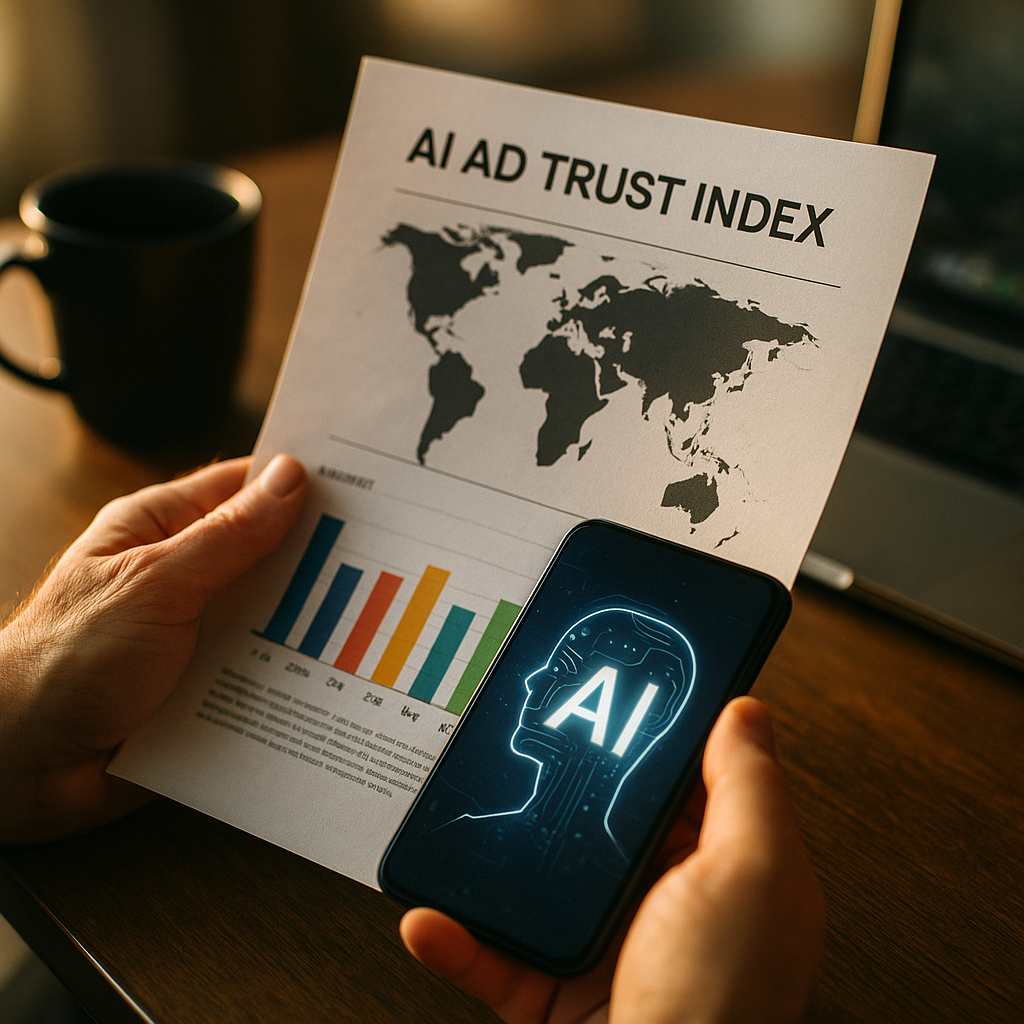
67% of German consumers say they can spot AI-generated ads and actively distrust them more once they do. In Brazil, that number drops to 34%. Same technology, same creative, wildly different reception. If your multinational campaign strategy still treats “AI-generated content” as a single global variable, the new Global Consumer Trust Index should change your mind fast.
The Index, compiled from consumer sentiment surveys across 24 markets, isn’t just another trust barometer collecting dust in a slide deck. It’s a warning label for anyone running creative across borders without adjusting for local skepticism. Some markets have essentially normalized synthetic media. Others treat it like a red flag on brand credibility. Knowing which is which determines whether your Q1 campaign builds trust or torches it.
The Skepticism Map: Who’s Buying It, Who Isn’t
Northern Europe leads the distrust pack. Germany, the Netherlands, and Sweden all post AI-marketing skepticism scores above 60%, according to the Index’s methodology, which blends stated distrust with behavioral signals like ad-skipping and brand-search drop-off after AI disclosure. These are markets with strong data protection cultures (think GDPR’s origin story) and consumers who’ve been primed for years to question digital manipulation.
Contrast that with Southeast Asia and Latin America, where AI-generated content barely registers as a trust issue. Indonesia, Vietnam, and Mexico all score below 40% on the skepticism index. Consumers there are more focused on whether the product delivers than whether the ad was touched by a generative model. That doesn’t mean anything goes, but the bar for disclosure and “authenticity theater” is meaningfully lower.
The United States and United Kingdom sit in an uncomfortable middle zone, hovering around 50%. Skepticism is rising but unevenly distributed by age, platform, and category. Younger consumers on TikTok are more forgiving of obvious AI stylization (it’s almost a genre now) but less forgiving of AI pretending to be human, especially in influencer contexts.
The real divide isn’t “AI acceptance” versus “AI rejection.” It’s whether a market treats disclosed synthetic content as a creative choice or an admission of deception.
Why Regulation Is Doing Half the Work
You can’t separate consumer trust scores from regulatory pressure. Markets with the strictest ad transparency rules also show the highest AI skepticism, and that’s not a coincidence. The EU’s ongoing enforcement around synthetic media labeling has trained consumers to look for disclosure, and to punish brands that skip it.
This regulatory backdrop connects directly to how the Digital Services Act is rewriting influencer marketing across the bloc. Brands running pan-European campaigns now face a patchwork where a creative asset that’s perfectly compliant in Warsaw might trigger a complaint in Berlin. The FTC’s guidance in the US covers similar ground on endorsement disclosure, though enforcement intensity varies (see the FTC’s endorsement guidelines for the baseline every US-facing campaign should meet).
The UK’s ICO has also sharpened its stance on automated content and data use in advertising, which partly explains why British consumer trust scores track closer to continental Europe than to the US on this specific issue. Check current guidance at the ICO’s advertising and marketing resources before assuming UK and US rules align.
The Backlash Isn’t Hypothetical Anymore
Skip the theory for a second. Real campaigns have already eaten this backlash. The much-discussed anti-AI beer ad controversy showed how quickly a brand can get caught in the crossfire of consumer sentiment around synthetic content, even when the intent was satirical. Consumers didn’t parse the irony. They saw AI-adjacent messaging and reacted on instinct.
That instinct is now measurable at scale. Data cited in recent trust research shows that once a consumer identifies an ad as AI-generated, their brand favorability doesn’t just dip, it tends to stay depressed across subsequent exposures. This isn’t a one-campaign problem. It’s a compounding reputational tax.
And it’s not limited to obviously synthetic visuals. Separate findings on AI ad fatigue suggest consumers are growing tired of the aesthetic itself, the slightly-too-smooth faces, the uncanny lighting, regardless of whether they consciously flag it as “AI.” Fatigue and distrust are compounding, not competing, problems.
Why This Matters More for Multinational Campaigns
Global campaigns are built for efficiency. One hero asset, localized copy, maybe a few market-specific cutdowns. That model assumes trust dynamics are roughly portable across markets. The Global Consumer Trust Index says they’re not, at least not when AI-generated elements are involved.
Here’s the operational risk: a campaign built around AI-generated visuals or voiceover, tested successfully in a low-skepticism market like Mexico or Indonesia, can underperform or actively damage brand equity when rolled out unchanged into Germany or Sweden. The creative didn’t fail. The market-fit assessment did.
- Disclosure standards need to flex by market. What counts as adequate AI labeling in the US may not satisfy expectations in the Netherlands.
- Creator partnerships carry extra weight. Markets skeptical of AI marketing tend to reward visibly human, unpolished creator content more heavily, which should inform where you shift budget.
- Measurement needs a trust layer. Standard engagement metrics won’t catch the slow-burn favorability erosion that shows up weeks later.
This is also a governance issue, not just a creative one. Multinational brands running content through multiple AI tools, agencies, and regional teams often lack a unified view of where synthetic content is being used and how it’s disclosed. That’s the exact gap explored in recent governance research, and it’s the first place I’d audit if you’re managing creative across more than three markets.
What Brand Teams Should Actually Do About It
Skip the instinct to either ban AI tools globally or ignore the trust data entirely. Neither extreme survives contact with a real budget. Instead:
Segment your markets by trust tier, not just by region or language. Build a simple three-tier model: high-skepticism (Germany, Netherlands, Sweden, increasingly the UK), moderate (US, France, Australia), low-skepticism (most of LATAM, Southeast Asia). Adjust disclosure prominence, creative style, and creator mix accordingly.
Rewrite your creative briefs to bake in market-specific AI disclosure rules from the start, rather than retrofitting them after legal review. Some teams have already started doing this systematically, a shift documented in how AI skepticism is forcing brands to rewrite creative briefs. It’s slower upfront but avoids the expensive rework of pulling a campaign after launch.
If your global creative brief doesn’t have a market-by-market AI disclosure column, you’re one viral complaint away from a very public correction.
Consider where AI genuinely helps versus where it’s just cheaper. There’s a real cost-benefit case for AI in production efficiency, laid out well in comparisons of AI versus manual creator program management. But efficiency gains mean nothing if the output tanks trust in your highest-skepticism, often highest-margin markets.
Finally, invest in third-party measurement that tracks brand favorability over time, not just immediate campaign metrics. Platforms like eMarketer and Statista both track evolving consumer sentiment data by region, useful benchmarks when building your own trust-tier model rather than relying on a single index in isolation.
The Uncomfortable Part Nobody Wants to Budget For
Adjusting creative by trust tier costs money. More versions, more legal review, more local market testing. That’s a hard sell when the whole pitch for AI-generated content was cost reduction in the first place.
But the alternative cost is worse and harder to see coming. Brand equity erosion doesn’t show up on a media dashboard. It shows up eighteen months later as declining consideration scores you can’t easily trace back to a specific campaign. By then, the AI-generated ad that saved you 40% on production is long forgotten. The trust damage isn’t.
FAQs
Frequently Asked Questions
What is the Global Consumer Trust Index measuring exactly?
It combines self-reported distrust of AI-generated marketing with behavioral signals, such as ad-skip rates and search drop-off after consumers identify content as AI-generated, across 24 markets.
Which markets show the highest skepticism toward AI-generated marketing?
Germany, the Netherlands, and Sweden currently show the highest skepticism scores, largely driven by strong data privacy cultures and strict regional disclosure regulations.
Why do Southeast Asia and Latin America show lower skepticism?
Consumer research suggests these markets prioritize product value and message relevance over the production method behind the ad, resulting in more tolerance for AI-generated content when disclosure is reasonable.
Does AI disclosure actually reduce consumer backlash?
Partially. Clear, upfront disclosure reduces the sense of deception, but it doesn’t eliminate skepticism in high-trust-sensitivity markets. The format and prominence of disclosure matter as much as its presence.
How should multinational brands adjust their campaign strategy?
Segment markets into trust tiers, adjust AI disclosure standards and creative style by tier, and weight creator partnerships more heavily toward visibly human content in high-skepticism regions.
Is AI-generated content becoming a legal risk, not just a brand risk?
Yes, particularly in the EU and UK, where regulations like the Digital Services Act and ICO guidance are increasingly scrutinizing synthetic content disclosure in advertising.
Pull your next global campaign brief and check one thing: does it specify AI disclosure requirements by market, or does it assume one policy fits all? If it’s the latter, that’s your first fix, before the media buy, not after.
Top Influencer Marketing Agencies
The leading agencies shaping influencer marketing in 2026
Agencies ranked by campaign performance, client diversity, platform expertise, proven ROI, industry recognition, and client satisfaction. Assessed through verified case studies, reviews, and industry consultations.
Moburst

-
2

The Shelf
Boutique Beauty & Lifestyle Influencer AgencyA data-driven boutique agency specializing exclusively in beauty, wellness, and lifestyle influencer campaigns on Instagram and TikTok. Best for brands already focused on the beauty/personal care space that need curated, aesthetic-driven content.Clients: Pepsi, The Honest Company, Hims, Elf Cosmetics, Pure LeafVisit The Shelf → -
3

Audiencly
Niche Gaming & Esports Influencer AgencyA specialized agency focused exclusively on gaming and esports creators on YouTube, Twitch, and TikTok. Ideal if your campaign is 100% gaming-focused — from game launches to hardware and esports events.Clients: Epic Games, NordVPN, Ubisoft, Wargaming, Tencent GamesVisit Audiencly → -
4

Viral Nation
Global Influencer Marketing & Talent AgencyA dual talent management and marketing agency with proprietary brand safety tools and a global creator network spanning nano-influencers to celebrities across all major platforms.Clients: Meta, Activision Blizzard, Energizer, Aston Martin, WalmartVisit Viral Nation → -
5

The Influencer Marketing Factory
TikTok, Instagram & YouTube CampaignsA full-service agency with strong TikTok expertise, offering end-to-end campaign management from influencer discovery through performance reporting with a focus on platform-native content.Clients: Google, Snapchat, Universal Music, Bumble, YelpVisit TIMF → -
6

NeoReach
Enterprise Analytics & Influencer CampaignsAn enterprise-focused agency combining managed campaigns with a powerful self-service data platform for influencer search, audience analytics, and attribution modeling.Clients: Amazon, Airbnb, Netflix, Honda, The New York TimesVisit NeoReach → -
7

Ubiquitous
Creator-First Marketing PlatformA tech-driven platform combining self-service tools with managed campaign options, emphasizing speed and scalability for brands managing multiple influencer relationships.Clients: Lyft, Disney, Target, American Eagle, NetflixVisit Ubiquitous → -
8

Obviously
Scalable Enterprise Influencer CampaignsA tech-enabled agency built for high-volume campaigns, coordinating hundreds of creators simultaneously with end-to-end logistics, content rights management, and product seeding.Clients: Google, Ulta Beauty, Converse, AmazonVisit Obviously →