


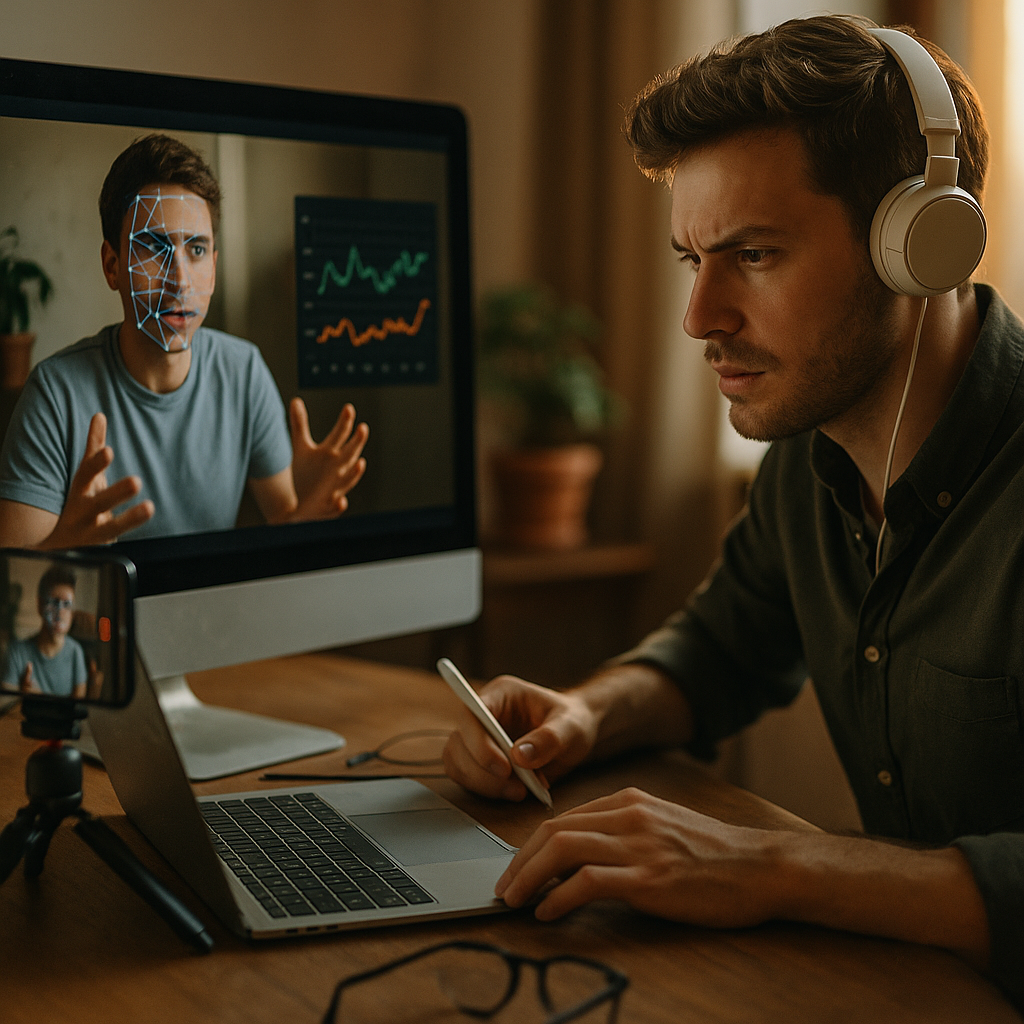
In 2025, creators compete in the first seconds of every feed. Using AI to Map the Biometric Response of Users to Video Hooks turns that battle into measurable insight by linking attention, emotion, and behavior to specific frames, words, and sounds. Done well, it improves relevance without guessing or gimmicks. Want to know which moment truly earns attention—and why?
AI video analytics: What “biometric response” means for hooks
A “video hook” is the opening sequence designed to earn continued viewing—often the first 1–5 seconds on short-form platforms and the first 10–30 seconds on long-form. A “biometric response” is any measurable physiological signal that correlates with attention, arousal, or cognitive load. When paired with AI video analytics, these signals become a practical map of how viewers react to specific micro-moments in your edit.
Common biometric signals used in hook testing include:
- Eye tracking: fixations, saccades, and gaze paths that show what draws attention and what gets ignored.
- Facial expression analysis: action units (e.g., brow raise, lip press) that correlate with surprise, confusion, or delight.
- Electrodermal activity (EDA/GSR): skin conductance changes that reflect arousal or engagement intensity.
- Heart rate and heart rate variability (HR/HRV): indicators of stress, engagement, and mental effort, especially during information-dense hooks.
- Voice and respiration proxies (in lab settings): how users react while speaking or narrating their thoughts.
AI’s job is not to “read minds.” Its job is to align time-stamped biometric streams with time-stamped video features—cuts, captions, on-screen text, sound hits, camera movement, pacing, and spoken language—so you can pinpoint which elements triggered measurable changes. This approach also answers a common follow-up: Is the hook failing because of content, pacing, or clarity? A biometric map helps separate “not interesting” from “not understood.”
Biometric engagement metrics: Signals that predict retention and recall
Raw biometric data is noisy. The value comes from converting it into biometric engagement metrics that align with creative decisions and business outcomes. In practice, teams create a “moment-by-moment” engagement curve and then compare that curve to retention, click-through, completion, and recall tests.
High-utility derived metrics include:
- Attention stability: how long viewers maintain fixations on the intended focal point (product, face, key text).
- Arousal peaks: short spikes in EDA/HR that often correlate with novelty, tension, humor, or surprise.
- Confusion markers: facial action patterns plus gaze jitter or repeated re-fixation that can indicate cognitive overload.
- Information absorption windows: segments where attention is stable and arousal is moderate—often ideal for key claims, pricing, or instructions.
To make these metrics actionable, connect them to clear creative questions:
- Does the first line land? Look for an attention “lock” in the first second plus a reduction in confusion markers.
- Do captions help or distract? Eye tracking shows whether captions support comprehension or steal focus from the visual proof.
- Is the pace too aggressive? Rapid cuts can raise arousal but also increase cognitive load; a good hook often balances both.
Teams using this method usually discover that “more intensity” is not always better. A hook that creates constant spikes can exhaust attention, while a hook with a single clean peak (problem reveal) followed by clarity (solution cue) often produces better downstream retention.
Emotion AI for creators: Turning frame-level reactions into editable insights
Emotion AI for creators works best when it focuses on decision support rather than labels like “happy” or “angry.” For hook optimization, the goal is to identify the exact frames, words, and sounds that reliably produce attention and comprehension across a target audience.
How AI translates video into “features” you can edit:
- Visual features: faces, objects, logos, brightness changes, motion intensity, shot scale, and scene changes.
- Audio features: loudness peaks, music onsets, silence gaps, speech rate, and emphasis.
- Text features: caption density, reading level, claim wording, and on-screen text timing.
- Semantic features: what the hook is “about” (problem, promise, proof, curiosity gap) via natural language understanding.
AI then correlates these features with biometric changes to produce insights like:
- “Cut at 1.2s increases attention stability” (viewers fixate faster after the cut).
- “On-screen claim triggers confusion” (spike in confusion markers and gaze wandering).
- “Proof shot creates a clean arousal peak” (EDA rises while gaze stays centered).
Creators often ask, Will this make everything formulaic? Not if you treat the model as a microscope, not a script. You can keep your style while removing avoidable friction—unclear phrasing, misplaced captions, overlong preambles, or visuals that fight the message.
Video hook optimization: A practical workflow from test design to iteration
To use biometrics responsibly and effectively, you need a workflow that produces repeatable findings. The strongest teams treat hook testing like product experimentation: clear hypothesis, controlled variants, sufficient sample size, and documented decisions.
1) Define the hook goal and audience
Pick one primary outcome (e.g., 3-second hold, 10-second hold, click intent, or message recall). Define the audience segment precisely. Hook performance varies dramatically by familiarity, intent, and platform context.
2) Create controlled hook variants
Keep everything after the hook constant so differences are attributable. Useful variables to test include:
- Opening line (promise vs problem vs contrarian claim)
- First shot (talking head vs result/proof vs pattern interrupt)
- Caption style (none vs minimal vs high-density)
- Pacing (single continuous shot vs rapid cuts)
- Sound design (music onset timing, silence, impact hits)
3) Collect biometric and behavioral data
Use lab-grade sensors for depth, or calibrated camera-based methods for speed—depending on stakes. Pair biometric streams with behavioral signals such as watch time, rewinds, drop-off points, and post-view surveys for comprehension and recall.
4) Build a moment map
Align signals to the timeline and annotate key events (cut, caption appears, claim spoken, product revealed). The deliverable should be a readable chart plus a list of “moments that matter.”
5) Turn findings into edits, not opinions
Translate insights into specific edit instructions:
- Move the proof shot earlier by 0.5–1.0s
- Reduce caption density during the first claim
- Replace jargon with a concrete benefit statement
- Insert a brief pause before the key phrase to improve comprehension
6) Re-test and document learnings
Create a hook playbook by niche and audience. Over time, you’ll see patterns—what consistently produces attention stability, which claims trigger confusion, and which visuals support trust.
A common follow-up is, How many participants do I need? There’s no universal number, but for biometric testing, consistency across participants matters more than sheer volume. Start with enough users to see stable patterns across your key segment, then validate the winning hook in a larger live A/B test using platform analytics.
Privacy and consent in biometric research: Ethical, legal, and brand-safe practices
Biometrics are sensitive data. If you want sustainable results—and brand trust—you must treat privacy and consent as core requirements, not paperwork. In 2025, regulators and platforms increasingly scrutinize biometric processing, especially when it involves facial analysis or inferred emotional states.
Best practices for privacy and consent in biometric research:
- Explicit informed consent: state what you collect (e.g., facial video, eye tracking, EDA), why, how long you keep it, and who can access it.
- Data minimization: collect only what you need. If your question is about attention timing, you may not need identity-linked facial video.
- De-identification and access controls: separate identifiers from sensor data; restrict access; log usage.
- Purpose limitation: don’t reuse biometric data for unrelated targeting or profiling without new consent.
- Bias checks: validate that models perform consistently across skin tones, lighting conditions, age ranges, and accessibility needs.
- Human oversight: treat outputs as probabilistic signals, not truth. Review anomalies and avoid high-stakes decisions based solely on emotion inference.
Answer the practical question teams worry about: Can we do this without being creepy? Yes—when testing is transparent, voluntary, and focused on improving clarity and relevance rather than manipulating vulnerability. Many brands also add a “creative improvement” disclosure in research recruitment to set expectations clearly.
Synthetic panels and multimodal models: What’s changing in 2025
Hook testing is moving faster because multimodal AI can interpret video, audio, and text together, and because teams can pre-screen concepts with simulated methods before running human studies. The opportunity is speed; the risk is overconfidence.
What’s new and useful:
- Automated moment annotation: AI detects cuts, text overlays, loudness peaks, and topic shifts to speed analysis.
- Predictive “attention heatmaps”: models estimate likely gaze focus based on saliency and scene structure, helping you find obvious problems early.
- Faster creative iteration: editors can test micro-variants (first line, first shot, caption timing) in hours, not weeks.
- Hybrid validation: combine predicted attention with small biometric samples, then confirm at scale with platform A/B tests.
Where you should be cautious:
- Synthetic panels (AI-simulated viewers) can help brainstorm, but they cannot replace real physiological measurement or real audience behavior.
- Emotion inference remains context-dependent; the same expression can signal different states depending on the narrative and the viewer.
- Platform effects matter: autoplay, sound-off defaults, and feed context change how hooks are perceived.
The best approach in 2025 is pragmatic: use AI to narrow options and identify likely friction points, then use real participants and real distribution tests to confirm what actually improves retention, comprehension, and brand outcomes.
FAQs
What biometric signals are most useful for improving video hooks?
Eye tracking (attention and focus) and EDA/GSR (arousal intensity) tend to be the most directly actionable for hook edits. Facial action analysis can help diagnose confusion or surprise, but it should be interpreted cautiously and validated with surveys or interviews.
Can I use webcam-based biometrics instead of lab sensors?
Yes for directional insights, especially for gaze estimation and facial action tracking, if lighting and camera quality are controlled. For higher-stakes decisions, validate key findings with lab-grade sensors or a larger behavioral A/B test.
How do I connect biometric results to real performance metrics like retention?
Time-align biometric curves with audience retention graphs and annotate the creative events at those timestamps. Then confirm improvements by publishing controlled variants and comparing retention, completion, and click outcomes within the same audience segment.
Is using emotion AI ethical for marketing videos?
It can be ethical when participants give informed consent, data is minimized and protected, and the goal is relevance and clarity rather than exploitation. Avoid covert collection, identity linkage without necessity, and any use that targets vulnerable audiences based on inferred states.
What is a “good” biometric pattern for a hook?
Typically: fast attention lock (stable gaze on the focal point), a single clear arousal peak at the promise/problem reveal, low confusion markers during the claim, and stable attention during proof. The ideal pattern depends on category and audience intent.
How often should I re-test hooks?
Re-test whenever you change the opening concept, audience segment, or platform context. Many teams also schedule periodic tests because audience fatigue and creative norms shift, and what works this quarter may soften next quarter.
AI-driven biometric mapping turns the first seconds of video into a measurable system: attention, arousal, and comprehension tied to specific creative choices. In 2025, the winning workflow pairs multimodal analysis with real participant consent, rigorous testing, and platform validation. Use biometrics to remove friction, place proof earlier, and sharpen clarity. The takeaway: optimize hooks with evidence, not instinct.