


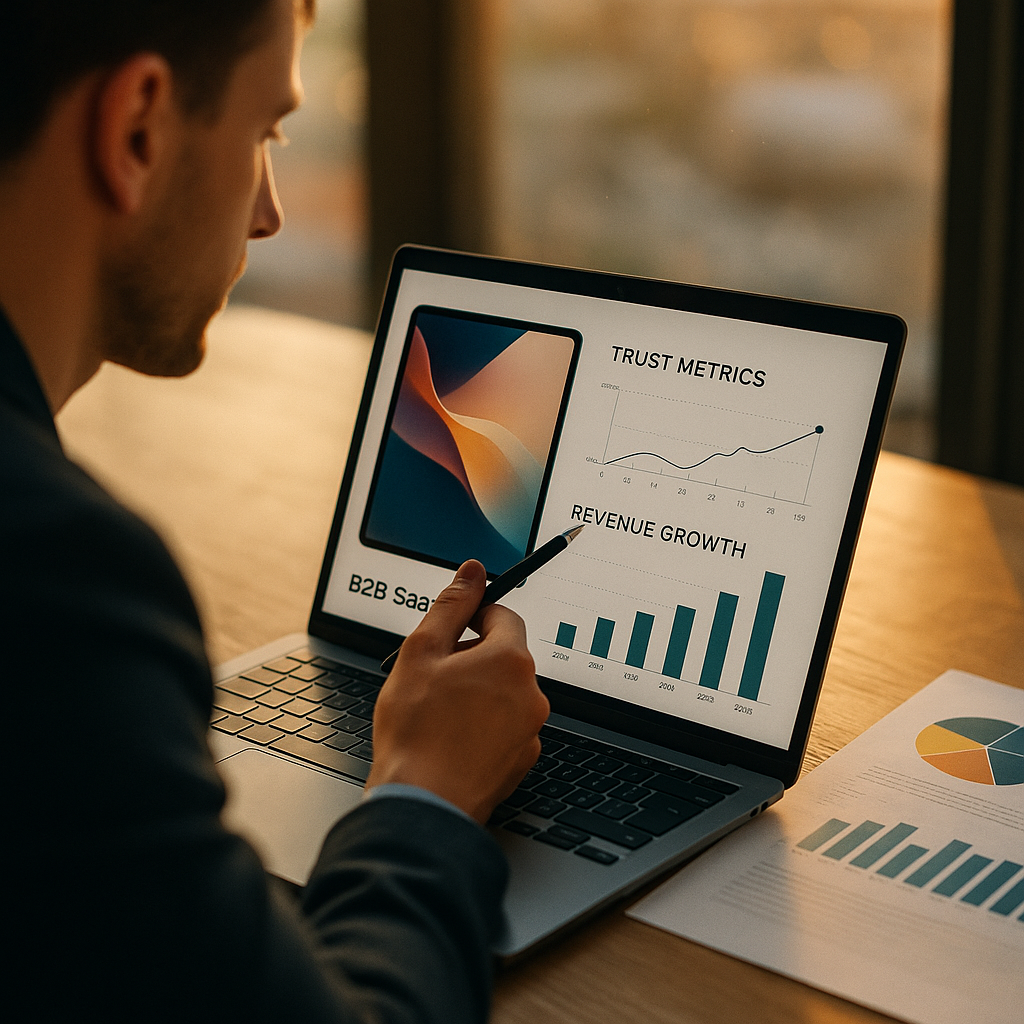
In 2025, buyers judge software in seconds, and design is no longer cosmetic. The role of aesthetics in B2B SaaS now affects trust, adoption, and renewals as directly as features do. Great-looking products reduce friction, communicate clarity, and signal competence to risk-averse teams. If “pretty” sounds superficial, consider what it really changes: decisions, behaviors, and revenue.
Why aesthetics in B2B SaaS influences first impressions and trust
B2B software is purchased under pressure: deadlines, budget scrutiny, stakeholder alignment, and career risk. In that environment, users and buyers look for signals of reliability. A polished interface becomes a visible proxy for invisible qualities like engineering discipline, security maturity, and long-term support. That proxy is not perfectly accurate, but it is powerful.
When a product looks outdated or inconsistent, prospects infer “maintenance risk.” They worry about brittle workflows, hidden bugs, and slow response times—even if the backend is excellent. Conversely, visual coherence can reduce perceived risk by showing that the company invests in details and has clear product standards. That perception matters in B2B procurement because the cost of a wrong decision is high and often public internally.
Modern buying also happens asynchronously. Stakeholders explore a trial, watch a demo, scan screenshots, and share links in Slack. Many of those touchpoints happen without a salesperson present to frame value. Aesthetics makes the product speak for itself. Clear typography, consistent spacing, restrained color, and intentional hierarchy help stakeholders understand what the product does and how it fits into their process.
Practical takeaway: treat visual design as part of your trust architecture. If your security posture is strong, your interface should look like it. If your workflows are simple, your interface should feel simple. Misalignment between brand promises and on-screen experience creates doubt and slows deals.
UI design for enterprise software that reduces cognitive load
“Pretty” enterprise software wins when beauty serves comprehension. In practice, the strongest competitive advantage of good aesthetics is lower cognitive load: the user spends less mental energy figuring out what to do next and more time completing valuable work.
Enterprise users face dense screens, complex permissions, and cross-functional processes. Aesthetic choices such as whitespace, contrast, and alignment are not decoration; they are navigation systems for the brain. Strong UI design makes complexity feel manageable by using clear visual hierarchy and predictable patterns.
To reduce cognitive load without oversimplifying, focus on:
- Information hierarchy: Put the primary action in the same place across modules. Use size and contrast to show what matters now.
- Consistency through a design system: Reuse components, spacing rules, and interaction patterns so users can transfer learning from one screen to the next.
- Legibility over style: Choose readable type, adequate line-height, and accessible contrast. Avoid “thin and trendy” UI that fatigues users.
- Progressive disclosure: Show the essentials first; reveal advanced controls when needed. This keeps screens calm without removing power.
- Meaningful color: Use color to encode status and priority, not to decorate. If everything is bright, nothing is important.
Teams often worry that better aesthetics will slow feature delivery. In reality, consistent UI patterns accelerate delivery. A solid design system reduces one-off decisions, shortens QA cycles, and prevents rework caused by usability confusion.
Follow-up question buyers ask: “Will my team actually use this?” A low-cognitive-load UI answers that with every click. It makes training feel optional, and that is a measurable economic benefit.
UX and conversion rate optimization across the B2B funnel
Aesthetics impacts revenue long before a user enters the app. In 2025, most B2B SaaS funnels blend product-led and sales-led motions: landing pages, interactive demos, trials, and procurement reviews all influence the final decision. Design quality affects each stage by increasing confidence and reducing friction.
At the top of the funnel, prospects compare vendors quickly. They look for clarity: what the product does, who it is for, and how it fits into existing workflows. Clean layout, consistent iconography, and disciplined use of screenshots improve comprehension and keep the reader moving.
In the middle of the funnel, evaluation becomes hands-on. Here, aesthetics helps conversion because it guides the evaluator to “aha moments.” The interface can nudge them toward high-value actions through:
- Onboarding that feels calm: Short steps, clear progress indicators, and minimal jargon.
- Empty states that teach: Helpful examples, templates, and next steps instead of blank tables.
- Guided setup flows: Default settings that work, plus explainers for advanced options.
In the late funnel, stakeholders need justification. A product that looks trustworthy makes it easier for champions to sell internally. They can share screenshots that communicate order and reliability. Procurement teams also interpret polish as maturity, which can reduce the effort required to overcome objections.
How to measure impact: track trial-to-activation rate, time-to-first-value, completion rates for key setup flows, and self-serve upgrade conversions. When aesthetics improves usability, these metrics typically move together because the user encounters fewer “what is happening?” moments.
Product branding and visual consistency that drives differentiation
Many B2B SaaS categories have feature parity. When competitors all claim “automation,” “insights,” and “AI,” differentiation shifts to experience. Product aesthetics becomes a strategic brand asset: a recognizable, consistent visual language that users associate with a certain level of quality.
Brand in B2B is not just your logo and website. It is how the product behaves: motion, micro-interactions, empty states, tone of UI copy, and the predictability of layouts. A cohesive aesthetic reinforces your positioning every time someone logs in.
To turn aesthetics into differentiation, align three layers:
- Brand promise: What you claim (fast, secure, intuitive, precise, premium).
- Product principles: How you design and build (clarity first, fewer screens, auditability, guided workflows).
- UI execution: Component library, typography, color, data visualization patterns, and accessibility rules.
Visual consistency also reduces stakeholder conflict. Without a shared system, every feature team designs “their version” of a table, filter, or modal. Users experience that as chaos, even if each piece is individually attractive. A coherent aesthetic makes the product feel simpler than it is because it behaves like one product, not ten.
Buyer follow-up question: “Will this vendor still feel modern in two years?” In 2025, a living design system and clear UI standards signal that your product will not stagnate. That reassurance can tilt long-term contracts in your favor.
Accessibility and inclusive design as a competitive advantage
Aesthetics that ignore accessibility are fragile. An interface can look modern but still fail real users through low contrast, small hit targets, unclear focus states, or reliance on color alone. In B2B, those failures become support tickets, training costs, and adoption blockers.
Inclusive design is not only ethical; it is commercial. It expands the pool of users who can work efficiently, including people with low vision, color blindness, motor constraints, or cognitive fatigue. It also supports enterprise requirements, where accessibility reviews may be part of vendor selection.
Build accessible aesthetics by default:
- Use accessible contrast and typography: Favor readability in dashboards, tables, and dense forms.
- Design clear states: Hover, active, focus, error, and disabled states should be visually distinct and consistent.
- Don’t encode meaning only with color: Pair color with labels, icons, or patterns in charts and status indicators.
- Support keyboard navigation: Visible focus rings and logical tab order improve speed for power users too.
- Write UI copy that helps: Error messages should explain how to fix the issue, not just what went wrong.
Accessible design improves aesthetics by making visual communication clearer. When you optimize for clarity under constraints, the product looks more intentional. That intention reads as quality.
Answer to a common concern: “Will accessibility make our UI look boring?” No. Accessibility constraints push better choices: stronger hierarchy, cleaner layouts, and more purposeful color. Many premium products look premium precisely because they are legible and calm.
Design ROI in SaaS: retention, expansion, and reduced support costs
Leaders approve design investments when the ROI is explicit. In B2B SaaS, aesthetics contributes to ROI by improving adoption, reducing churn, enabling expansion, and lowering the cost-to-serve.
Here is how the economics work:
- Higher activation: If users reach first value faster, more accounts convert from trial or early rollout to active usage.
- Better retention: A product that feels easy and modern becomes part of routine, reducing the chance that teams switch tools.
- Expansion revenue: Clean UX makes advanced features discoverable, increasing seat growth and add-on adoption.
- Lower support burden: Clear UI and helpful empty/error states reduce “how do I…?” tickets and training sessions.
- Faster sales cycles: A polished product reduces doubt during evaluation and helps champions persuade stakeholders.
To make design ROI credible, tie it to operational metrics, not opinions. Establish baselines for onboarding completion, task success rates, time-on-task for core workflows, support volume by category, and churn reasons. Then prioritize aesthetic improvements that remove friction in high-frequency tasks.
Execution guidance for 2025 teams: treat aesthetics as a continuous product capability. Run design QA alongside engineering QA, keep a measurable UX backlog, and enforce consistency through a design system with documented guidelines. Pretty software wins when it stays coherent as the product grows.
FAQs about aesthetics in B2B SaaS
Is aesthetics really important for enterprise buyers who care about functionality?
Yes. Enterprise buyers care about functionality, but they also care about risk, adoption, and change management. Aesthetics influences perceived quality and makes functionality easier to understand and prove during evaluation.
What’s the difference between “pretty UI” and good UX?
Pretty UI focuses on visual appeal. Good UX focuses on outcomes: speed, clarity, and task success. The best products combine both, using aesthetics to reinforce hierarchy, reduce cognitive load, and guide actions.
How can a small B2B SaaS team improve aesthetics without a full redesign?
Start with a lightweight design system: typography scale, spacing rules, color tokens, and a small set of core components (buttons, inputs, tables, modals). Then fix the most-used screens first and remove inconsistent patterns that cause confusion.
Which product areas benefit most from aesthetic upgrades?
Onboarding flows, navigation, tables/filters, forms, dashboards, and empty/error states. These areas shape daily experience, training costs, and how quickly users reach value.
How do we prove ROI from UI and visual design work?
Measure activation rate, time-to-first-value, task success, support ticket volume, feature discoverability, retention, and expansion. Run before/after comparisons on the same workflows and track changes over multiple cohorts.
Can strong aesthetics compensate for missing features?
Only temporarily. Aesthetics can improve comprehension and confidence, but it cannot replace core capabilities. The winning strategy is using design to make existing strengths obvious while product work closes genuine gaps.
In 2025, aesthetics is not a finishing touch; it is part of product strategy. When visuals clarify complexity, reinforce trust, and support accessibility, the software feels easier, safer, and more valuable. That drives faster adoption, fewer support issues, and stronger retention. The takeaway is simple: invest in design systems and UX clarity, and “pretty” becomes a durable growth lever.