


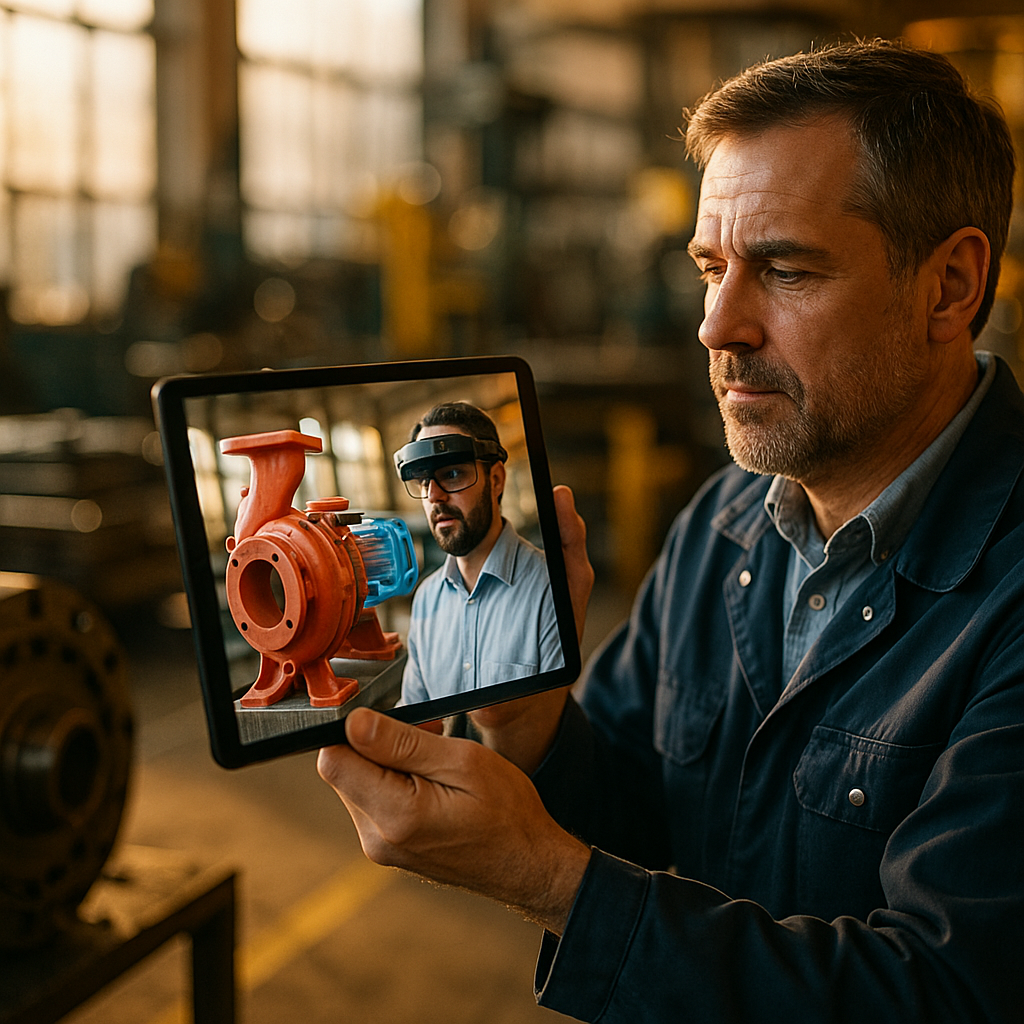
In 2026, industrial buyers expect speed, clarity, and confidence before they commit to complex purchases. This case study on AR for remote sales shows how a traditional manufacturer modernized its sales process without abandoning its legacy strengths. By combining product expertise with practical augmented reality tools, the company shortened sales cycles, improved buyer trust, and unlocked growth across distributed markets. What changed first?
Why augmented reality sales became a strategic priority
The company in this case study is a mid-sized industrial equipment manufacturer with decades of experience selling large, configurable machinery to distributors, plant managers, and procurement teams. Its products were respected for durability and performance, but its sales model had become a liability. Buyers increasingly wanted faster evaluation, fewer site visits, and clearer technical validation before speaking to a field representative.
For years, the manufacturer relied on in-person demos, trade shows, printed spec sheets, and engineering consultations. That approach worked when travel schedules were predictable and local relationships drove most purchasing decisions. By 2026, however, remote buying behavior had become standard in B2B markets. Decision-makers expected digital experiences that matched the sophistication of the products they were buying.
The leadership team identified three barriers:
- Complex products were hard to explain remotely. Static PDFs could not show scale, installation requirements, or configurable components.
- Sales cycles were slowed by logistics. Shipping demo units and coordinating site visits consumed time and budget.
- Buyers hesitated without visual proof. Procurement and operations teams needed to see how machinery would fit into real environments.
Rather than replace its sales team, the company decided to equip it with better tools. Augmented reality sales emerged as the most practical option because it let prospects visualize equipment in their own spaces through tablets, phones, and browser-based experiences. That meant less guesswork and more informed conversations.
The decision was not based on novelty. It was based on a straightforward commercial question: could AR help experienced sales reps communicate product value more clearly and close deals faster? The answer, as the rollout proved, was yes.
How remote B2B sales challenges were hurting revenue
Before launch, the manufacturer audited its full sales journey. This step matters because many AR projects fail when companies start with technology instead of business friction. The internal audit included interviews with account executives, solutions engineers, channel partners, and recent customers. Several repeat pain points surfaced.
First, qualification calls were too abstract. Prospects asked whether a machine would fit near existing production lines, whether service panels would remain accessible, and how optional modules would affect the footprint. Sales reps often answered with drawings and dimensions, but buyers struggled to translate technical documents into real-world understanding.
Second, late-stage objections frequently appeared after site reviews. A deal might progress for weeks, only to stall when an operations lead realized that installation clearance or operator workflow would be more complicated than expected. Those surprises increased discount pressure and reduced forecast accuracy.
Third, the manufacturer’s strongest product experts were overloaded. Engineers spent too much time supporting early-stage sales conversations that could have been resolved through better visualization. This created bottlenecks and delayed proposals.
The company also found that remote B2B sales introduced a trust gap. In a physical demo, buyers could walk around the equipment, inspect features, and ask spontaneous questions. In a video call, that confidence was harder to build. The sales team needed a way to recreate situational understanding without requiring travel for every opportunity.
From this analysis, the manufacturer defined clear objectives:
- Reduce time from first demo to formal proposal
- Improve buyer confidence in fit, configuration, and installation
- Decrease dependency on physical demo units
- Free engineering resources for qualified opportunities
- Support distributors with a consistent digital selling tool
These goals anchored the initiative in measurable business outcomes, which is essential for helpful, trustworthy implementation.
Building an industrial AR case study around real buyer needs
The manufacturer did not attempt a broad, expensive transformation on day one. Instead, it launched a focused pilot around its most requested product line: modular packaging equipment used in food and consumer goods facilities. This line was ideal because it involved multiple configurations, large footprints, and recurring questions about line integration.
The pilot team included sales leadership, product marketing, engineering, IT, and a small group of distributor partners. Their job was to identify the minimum viable AR experience that would deliver immediate value. They chose four capabilities:
- Life-size product visualization so buyers could place equipment in a real environment using a mobile device.
- Interactive configuration views to switch modules, dimensions, and access points.
- Guided annotations highlighting maintenance areas, safety clearances, and utility connections.
- Session sharing so sales reps, buyers, and technical stakeholders could review the same model during remote meetings.
To improve accessibility, the experience was designed to run in a browser whenever possible, with no heavy app download required for first-time use. That mattered because some procurement teams had strict device policies. The company also created lightweight demo links that sales reps could send immediately after an initial call.
Accuracy was non-negotiable. Engineering validated the models against current product specifications, and every AR scene included disclaimers about final site verification. This helped the company maintain trust while still giving prospects a practical planning tool.
Training was another success factor. Experienced reps were not asked to become technical operators. Instead, they received scenario-based coaching:
- How to use AR during discovery calls
- How to answer common fit and installation questions
- How to capture buyer reactions and objections
- When to escalate to engineering for site-specific review
This implementation approach reflected EEAT principles well. The content and experience were grounded in real expertise, validated by product specialists, and framed transparently. Buyers were not being sold a gimmick. They were being given a clearer way to evaluate a complex purchase.
AR product visualization in action across the sales funnel
Once deployed, AR product visualization began changing conversations at every stage of the funnel. In top-of-funnel outreach, sales reps used short video clips generated from the AR models to personalize prospecting emails. Instead of asking a plant manager to imagine how a machine might fit, the rep could show a realistic view of the equipment placed near a similar production layout. Response rates improved because the message felt relevant and concrete.
During discovery and qualification, reps asked prospects to open the AR link on a tablet or phone and place the machine within their facility environment. This instantly changed the quality of discussion. Buyers no longer asked only, “What are the dimensions?” They asked better questions: “Can the operator stand here comfortably?” “Will service access conflict with our conveyor path?” “What happens if we add the labeling module later?”
That shift matters. Better questions signal stronger buying intent and accelerate technical alignment.
In mid-funnel presentations, the AR view replaced many static slides. Reps walked stakeholders through configuration options, maintenance zones, and installation requirements in a way that was easy to understand even for non-engineers. Procurement could assess commercial implications, operations could judge workflow practicality, and executives could feel more confident approving the next step.
In late-stage deals, the manufacturer used AR as a pre-validation tool before formal site engineering. This did not eliminate the need for final technical review, but it reduced preventable surprises. As a result, proposals required fewer revisions and discounting pressure decreased because buyers felt more certain about what they were purchasing.
Distributor partners also benefited. Previously, they depended heavily on manufacturer support to explain product layouts. With AR, they could run stronger first meetings on their own, then bring in specialists only when needed. This expanded coverage without sacrificing accuracy.
The most important outcome was trust. Buyers could see that the manufacturer understood the realities of their environment. The sales process felt consultative, not promotional. That distinction often determines whether a traditional manufacturer can modernize successfully without weakening its brand.
Digital transformation manufacturing results and lessons learned
Within months of rollout, the manufacturer compared pilot opportunities with a matched set of deals from its prior process. While results varied by product complexity and buyer readiness, the trend was clear. Opportunities that used AR earlier in the sales cycle moved faster to proposal, involved fewer repetitive clarification meetings, and reached technical review with higher-quality information.
The company reported gains in five areas:
- Shorter sales cycles: reps reached proposal stage sooner because visualization reduced back-and-forth on fit and configuration.
- Higher buyer confidence: prospects arrived at internal approval discussions with better visual evidence.
- Improved engineering efficiency: technical teams spent less time on early-stage explanation and more time on qualified solution design.
- Better distributor enablement: channel partners handled more opportunities independently.
- Lower demo costs: the company reduced its dependence on shipping physical demonstration equipment for initial evaluation.
Leadership also tracked softer signals that often predict long-term success. Sales reps adopted the tool because it helped them close business, not because management forced usage. Customers mentioned the AR experience positively in post-sale feedback. Internal teams began asking where else visualization could improve decision-making, from service training to installation planning.
Still, the rollout revealed practical lessons:
- Start with one product line. A narrow, high-impact use case builds momentum faster than a broad platform launch.
- Validate every model. In manufacturing, credibility depends on precision.
- Keep access simple. Browser-first experiences reduce friction for buyers and partners.
- Train for conversations, not features. Sales reps need business context more than technical depth.
- Measure operational impact. Tie AR usage to proposal speed, engineering hours, and win quality.
This is the core lesson from digital transformation in manufacturing: the best technology initiatives solve a specific commercial problem and respect how buyers actually make decisions.
Remote sales technology best practices for traditional manufacturers
For manufacturers considering a similar move, the takeaway is not simply to “add AR.” The better question is where remote sales technology can remove uncertainty for the buyer. If your products are large, configurable, technical, or difficult to demo in person, AR is worth serious consideration.
Start by mapping your current sales process and identifying where deals slow down. Is it at first explanation, internal stakeholder alignment, technical review, or final approval? Then match AR capabilities to those friction points. A simple footprint visualization may deliver more value than a fully immersive environment if the real blocker is fit validation.
It is also important to build cross-functional ownership. Sales can define use cases, but engineering must validate data, product marketing must shape messaging, and IT must ensure secure deployment. A trustworthy AR experience depends on all three.
Traditional manufacturers should also plan governance early. Product configurations change. Dimensions evolve. Accessories are updated. Assign clear responsibility for model accuracy and content maintenance. Outdated visualization can damage trust faster than no visualization at all.
From a buyer-experience perspective, keep these principles in mind:
- Be transparent about what AR can and cannot confirm before final site assessment.
- Make the experience useful immediately with minimal setup and clear instructions.
- Support group decision-making by making it easy to share views across operations, finance, procurement, and leadership.
- Use AR to answer real questions about workflow, safety, service access, and scalability.
Finally, measure adoption honestly. If reps are not using the tool, the issue is usually not resistance to innovation. It is often a sign that the workflow is clumsy, the content is incomplete, or the value is unclear. Fix that first. In successful programs, AR becomes part of how the sales team sells, not an extra task they tolerate.
FAQs about AR for remote sales in manufacturing
What is AR for remote sales in manufacturing?
It is the use of augmented reality to help buyers visualize industrial products in real environments during remote sales interactions. This can include life-size placement, configuration changes, annotations, and collaborative viewing without requiring an in-person demo.
Why is AR effective for traditional manufacturers?
Traditional manufacturers often sell complex, high-value products that are difficult to explain with static documents alone. AR reduces ambiguity around size, fit, access, and configuration, which helps buyers make faster and more confident decisions.
Does AR replace site visits or engineering reviews?
No. AR works best as a pre-validation and communication tool. It helps qualify opportunities, improve stakeholder alignment, and reduce avoidable misunderstandings. Final site verification and engineering approval are still necessary for many industrial purchases.
What products benefit most from AR product visualization?
Large machinery, modular systems, configurable equipment, facility-based installations, and products with maintenance or clearance requirements usually benefit the most. If buyers need to understand scale and context, AR can be highly useful.
How can a manufacturer start using AR without a massive budget?
Begin with one high-value product line and a focused use case, such as footprint visualization during sales calls. Use browser-based delivery when possible, validate model accuracy carefully, and train a small pilot group before scaling.
What should manufacturers measure after launching AR for sales?
Track proposal speed, sales cycle length, engineering support hours, distributor adoption, buyer engagement, and win quality. Also review qualitative feedback from customers and reps to understand whether the tool improves clarity and trust.
Will distributors and channel partners actually use AR tools?
They will if the tool helps them run better first meetings, answer buyer questions more clearly, and reduce dependency on manufacturer support. Ease of use and accurate product data are critical for channel adoption.
What is the biggest mistake companies make with AR in B2B sales?
The biggest mistake is leading with novelty instead of customer need. AR should solve a real problem in the buying journey. If it does not improve understanding, speed, or confidence, it will not deliver meaningful commercial value.
This case study shows that AR can help a traditional manufacturer modernize sales without losing technical rigor or buyer trust. By focusing on real buying obstacles, validating product accuracy, and training teams around customer conversations, the company turned visualization into revenue impact. The clear takeaway is simple: when complex products are hard to evaluate remotely, practical AR becomes a competitive sales advantage.