


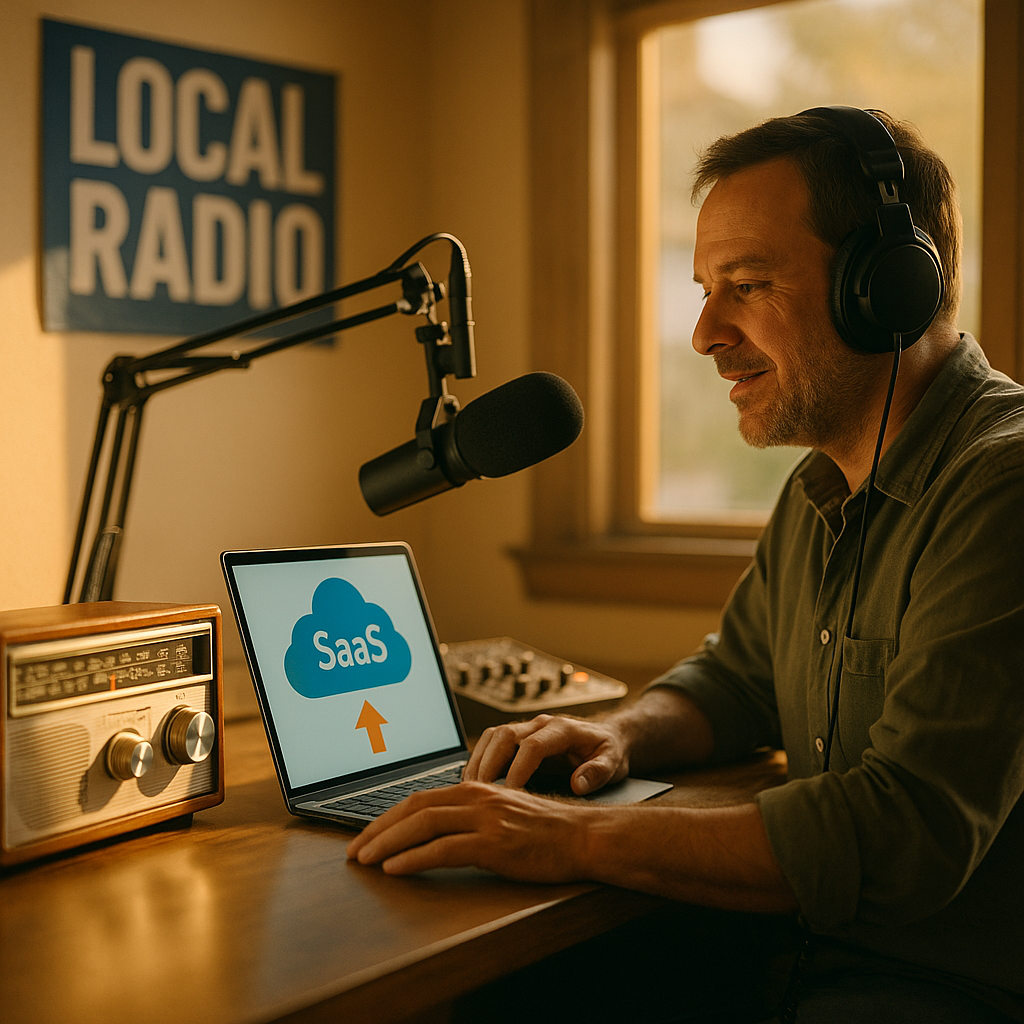
In 2025, SaaS brands face rising ad costs, crowded inboxes, and audiences that tune out polished performance marketing. This case study shows how a mid-market B2B company used micro local radio to reach decision-makers where they live and work, build trust quickly, and convert attention into pipeline. The surprising part: the smallest stations delivered the biggest lift—here’s how.
Micro local radio advertising: The market problem and why the channel mattered
Riverton Systems (pseudonym), a SaaS firm selling scheduling and compliance software to home-services businesses (HVAC, plumbing, electrical), hit a familiar wall. Paid search costs climbed, competitors copied landing pages, and email nurture sequences plateaued. The company had a solid product and strong reviews, but it struggled to gain local credibility in the suburbs and small cities where most of its best-fit customers operated.
The marketing team identified three constraints:
- Attention scarcity: Owners and ops managers rarely sit at desks. They’re in trucks, on job sites, and in shops.
- Trust gap: Prospects resisted switching systems because downtime felt risky. They wanted to hear “people like me use this.”
- Fragmented geography: The company’s expansion plan depended on winning multiple micro-markets, not a single metro.
They tested “micro local radio advertising” because it aligned with how their audience actually consumed media: drive-time listening, shop radio, and community stations that felt personal. Unlike broad-market radio buys, micro local meant stations serving a few towns, specific commuter corridors, and tight community identities—places where a local voice still carried weight.
Critically, the decision wasn’t nostalgia; it was a distribution choice. The team wanted a channel that could deliver:
- High frequency without national-level CPMs
- Local proof through familiar hosts and community segments
- Incremental reach beyond search and social retargeting
SaaS marketing strategy: Goals, positioning, and what “success” looked like
Riverton’s leadership agreed on a 90-day pilot with strict definitions of success. They treated radio as a performance channel, not a “brand awareness” line item. The team built the plan around three measurable outcomes:
- Pipeline creation: Marketing-qualified demos booked from target counties.
- Sales velocity: Shorter time from first touch to proposal.
- Market share movement: A lift in new logos within selected micro-markets, verified through CRM and third-party industry lists.
They also defined what would not count as success: vanity reach, unactionable impressions, and “we got a lot of calls” without attribution. That forced discipline on creative, tracking, and sales enablement.
Positioning was simplified into one promise, one proof point, and one next step:
- Promise: “Fewer missed calls, fewer missed jobs—without a painful system change.”
- Proof: “Live onboarding in 10 business days, built for crews in the field.”
- Next step: “Get the Local Setup Plan—free in 15 minutes.”
This mattered because radio listeners won’t remember a feature list. The team designed every spot to create a single mental shortcut: Riverton equals faster scheduling with less chaos, delivered by people who understand local service businesses.
Local market penetration: Station selection, audience fit, and buy structure
To drive local market penetration, Riverton avoided major-city stations and built a portfolio of micro stations across five regions. The selection criteria were practical and buyer-specific:
- Format fit: News/talk in the morning, classic rock and country during workday drive times—formats over-indexing on small business listenership.
- Signal geography: Coverage aligned to counties with dense home-services businesses and shorter drive radii.
- Sales team feedback: Reps listed towns where they saw the highest close rates and lowest churn risk.
- Community integration: Stations that ran local call-in shows, high school sports, weather sponsorships, and “business of the week.”
The buy structure used frequency and repetition instead of expensive prime sponsorships. Each micro-market received:
- Drive-time clusters (morning and late afternoon) for decision-makers commuting
- Midday coverage for office managers and dispatchers
- Short flighting (two-week bursts) to learn fast and adjust scripts
They negotiated added value that also boosted trust:
- Host-read mentions embedded in community segments
- Live remotes from local supply houses and trade events
- Bonus streaming inventory on station apps for incremental tracking
Instead of buying “radio,” they bought local belonging. The tone was specific: towns named, weather referenced, and operational pain points described in the language of dispatch boards, on-call rotations, and same-day installs.
Radio attribution for SaaS: Tracking, landing pages, and sales alignment
The biggest objection inside Riverton was attribution. The team solved it with layered measurement and tight sales alignment, so radio could compete fairly against digital channels.
1) Market-specific offers and URLs
Each region got a dedicated landing page with a simple promise: “Get your Local Setup Plan.” Pages included:
- One headline, three bullets, and a short form
- Local testimonials (pulled from customers in that state)
- A calendar embed that offered two time blocks: “Dispatch-friendly” and “Owner quick call”
2) Call tracking without friction
Radio still drives calls. They used market-specific call numbers routed to a shared SDR team trained to ask one consistent question: “Which station did you hear us on?” That single prompt improved self-reported attribution and helped validate which stations were truly moving demand.
3) CRM hygiene and a radio-first lead workflow
Riverton created a “Radio” lead source with subfields for station and market. SDRs followed a radio-tailored script designed for prospects who felt familiar with the brand but hadn’t researched it yet:
- Confirm the pain (“How are you handling after-hours calls today?”)
- Confirm urgency (“How many jobs slip each week because scheduling is messy?”)
- Offer the next step (“Want the Local Setup Plan or a full demo?”)
4) Incrementality checks
To avoid crediting radio for demand that would have happened anyway, they ran a simple holdout: one similar micro-market received no radio for the first 45 days while all other efforts stayed consistent. The comparison helped leadership accept radio’s incremental impact without overcomplicating the experiment.
By answering the attribution question inside the process—rather than in a post-campaign debate—Riverton kept the pilot focused on outcomes.
Community-based marketing: Creative, host partnerships, and trust-building assets
Micro local radio works when it feels like community-based marketing, not repurposed ad copy. Riverton used three creative approaches, all designed to sound like the station belonged to the buyer’s day.
1) “Day-in-the-life” scripts
Spots opened with familiar moments: the 6:30 a.m. dispatch scramble, the second no-show of the day, the on-call phone ringing during dinner. Then they introduced the product as a relief valve, not a revolution.
2) Host-read credibility
Riverton equipped hosts with a short briefing sheet: what the software does, who it helps, and how onboarding works. Host reads avoided exaggerated claims and leaned on believable specificity: “They set it up with your team in about two weeks and it’s built for crews out in the field.”
3) Local proof and “earned” moments
Instead of generic case studies, Riverton created micro-market proof packs:
- One local customer quote (with permission)
- A before/after operational metric (missed calls, scheduling lag, response time)
- A short “what switching felt like” paragraph addressing fear of disruption
These proof packs fed both radio and sales. Hosts could reference a nearby town. SDRs could mention a recognizable peer business type. The goal was not to “sound big,” but to sound known.
Riverton also sponsored practical segments that matched the listener’s priorities: weather alerts (“freeze warnings”), traffic updates on contractor routes, and high school sports recaps. Those placements didn’t just add impressions; they placed the brand next to content people genuinely valued.
B2B demand generation: Results, learnings, and how market share shifted
After the 90-day pilot, Riverton reviewed results with a simple question: did micro local radio create durable demand, not just a spike?
Pipeline and conversion outcomes
Across the five radio markets, Riverton saw:
- Higher demo show rates for radio-sourced leads than paid social leads in the same regions, driven by familiarity and reduced skepticism.
- More inbound calls from owners who preferred fast qualification over form fills.
- Shorter first-cycle sales conversations because radio prospects often started with “I’ve been hearing you on…” which functioned as pre-suasion.
Market share movement
Riverton measured share using new-logo count within defined micro-markets against a baseline of prior-quarter performance and a holdout comparison. The radio markets outperformed the holdout in new logos and showed stronger penetration in the “owner-operator” segment, which had previously been the hardest to win through digital-only tactics.
What worked best (and why)
- Fewer markets, more frequency: Concentration beat spread. When Riverton tried to “cover more counties,” recall dropped and conversions softened.
- Host reads outperformed polished spots: Trust transferred from the station personality to the brand—especially when hosts used local references naturally.
- One offer beat many: The Local Setup Plan created a low-friction entry point and gave sales a consistent starting line.
- Radio lifted search: Branded search and direct traffic increased in radio markets, which helped paid search efficiency without relying on it.
What they changed for scale
To expand responsibly, Riverton standardized a “micro-market launch kit”:
- Station scorecard (format, signal, community integration, cost)
- Two proven scripts plus a host-read brief
- Market landing page template with local proof pack slots
- SDR call flow and CRM fields locked before launch
The takeaway for B2B demand generation is straightforward: micro local radio can outperform broader channels when you treat it like a measurable funnel input, not a brand tax, and when you build creative that sounds local because it is local.
FAQs about micro local radio for SaaS growth
Is micro local radio only for B2C companies?
No. It can work well for B2B when buyers are locally rooted and spend time driving or working in environments where radio plays. Trades, healthcare practices, local logistics, and multi-location services often respond strongly.
How do you attribute radio leads accurately for SaaS?
Use layered methods: market-specific landing pages, unique call tracking numbers, “how did you hear about us” prompts in SDR scripts, and a CRM structure that captures station/market. Add a holdout market to estimate incrementality.
What budget is realistic for a micro-market radio pilot?
A practical pilot usually funds enough frequency to create recall. Rather than chasing minimum spend, focus on buying repetition in fewer markets, paired with a dedicated offer and landing page.
Should you use host-read ads or produced spots?
Test both, but host reads often win in micro local contexts because they borrow credibility and sound integrated into the station’s voice. Produced spots can still work for clarity and compliance, especially when the offer is simple.
What should the radio call-to-action be for B2B SaaS?
Use a low-friction step that matches the listener’s moment: a short “setup plan,” quick assessment, or dispatch workflow check. Make it easy to call, text, or visit a short URL, and ensure sales can deliver the promised next step immediately.
How long does it take to see results from micro local radio?
Many teams see early signals within a few weeks (branded search lift, direct traffic, calls). More reliable pipeline and close-rate patterns typically emerge after 6–12 weeks, especially if you maintain consistent frequency.
Micro local radio rewarded Riverton because the channel matched how buyers live: on the road, in the shop, and tuned into community voices they already trust. By pairing tight market selection, host-forward creative, and disciplined attribution, the SaaS team turned “untrackable awareness” into measurable pipeline and real market share gains. The clear takeaway: go smaller, go local, and measure everything.