


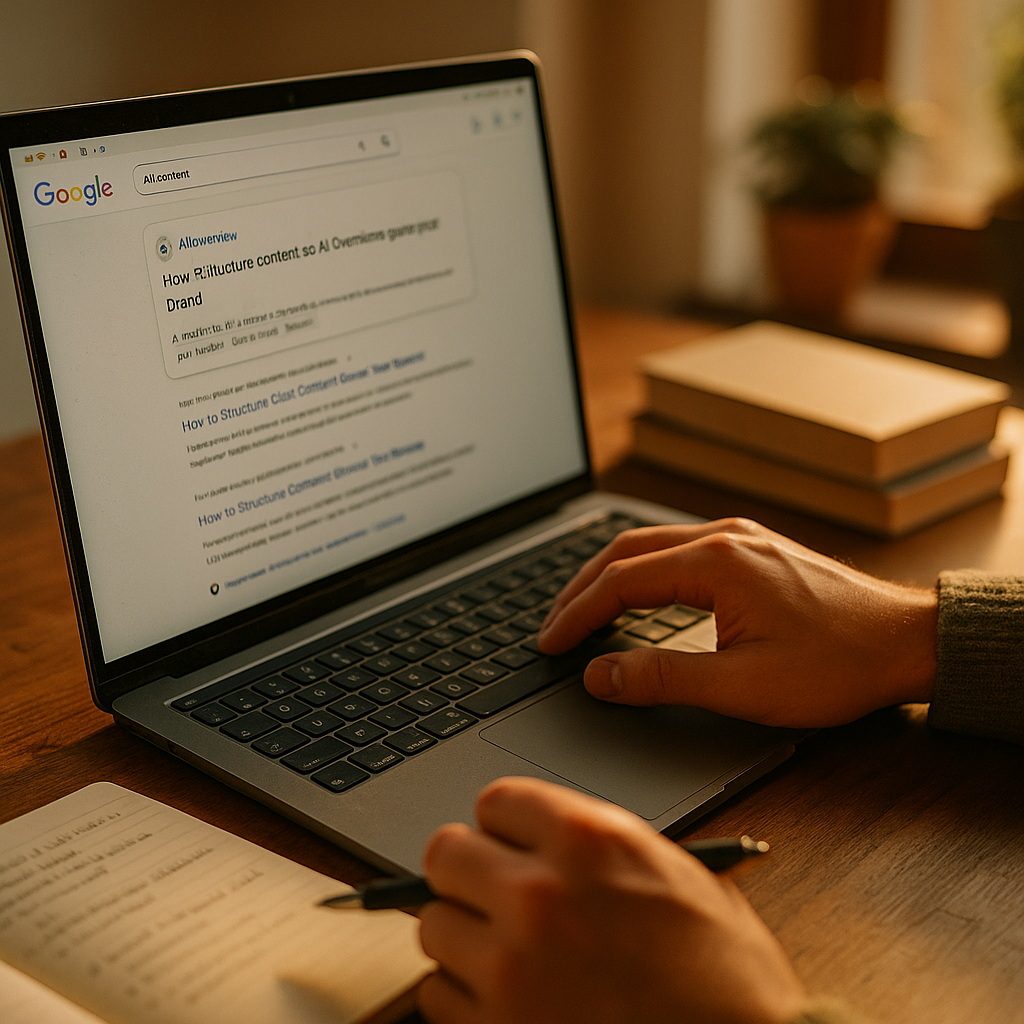
Sixty percent of Google searches now end without a click, and AI Overviews are the biggest reason why. If your product pages and blog posts aren’t written to be lifted verbatim into a summary box, you’re invisible before the buyer even scrolls. This isn’t a content quality problem. It’s a formatting and structure problem, and it’s fixable.
The Click-Through Cliff Nobody Budgeted For
Marketing teams built a decade of content strategy around one assumption: rank high, earn the click, convert on-site. That assumption is breaking. Data cited by eMarketer and multiple industry studies now peg organic click-through rate declines at 30-40% on queries where an AI Overview appears above the fold. Some informational queries see drops closer to 60%.
The mechanism is simple. Google’s AI Overview pulls a synthesized answer from several sources, credits them with small citation links, and most users read the summary and move on. No click, no session, no attributed conversion. Your content did the work. Someone else’s UI captured the value.
If your page can’t be extracted as a clean, self-contained answer in two or three sentences, it’s competing for a click-through model that’s already 30-40% smaller than it was two years ago.
This matters more for B2B and considered-purchase brands than for e-commerce impulse buys. Someone researching “best influencer marketing platforms for mid-market brands” is doing exactly the kind of comparison research AI Overviews love to summarize. If you’re not the quoted source, you’re not in the consideration set. It’s that blunt.
What “Quotability” Actually Means
Quotability isn’t a vibe. It’s a technical property of a text block. Google’s generative systems (and the underlying models powering Bing Copilot, Perplexity, and ChatGPT search) favor content that is:
- Self-contained — the sentence or paragraph makes sense without the surrounding context
- Declarative — states a fact or definition rather than hedging with “it depends” or marketing fluff
- Structurally isolated — sits under a heading, in a list, or in a table where the model can extract it cleanly
- Numerically specific — includes a stat, percentage, or concrete figure rather than a vague claim
- Attributed — clearly sourced to your brand, author, or study, which helps with both extraction and E-E-A-T signals
Think of it as writing for two audiences simultaneously: a human skimming for the answer, and a retrieval system deciding whether your paragraph is the cleanest candidate to quote. Most brand content fails the second audience entirely. It buries the answer in paragraph four, after two paragraphs of scene-setting nobody asked for.
Why Your Current Content Probably Fails This Test
Open any typical brand blog post. The first 150 words are usually throat-clearing: “In the ever-evolving world of influencer marketing, brands are constantly seeking new ways to…” That’s not quotable. It’s not even skimmable. An AI summarization model reads that paragraph and moves past it, looking for the sentence that actually answers the query.
Compare that to a paragraph structured like this: “Micro-influencers (10K-100K followers) deliver 60% higher engagement rates than macro-influencers, according to a 2024 Sprout Social benchmark study.” That sentence is a complete unit. It has a subject, a stat, a source. A model can lift it into a summary without editing a word.
This is the same discipline behind structuring product content so AI assistants recommend you, and it applies just as directly to editorial and blog content competing for AI Overview placement.
The Restructuring Framework: Five Technical Moves
1. Front-load the answer, then explain. Every section should open with a direct, quotable answer to the implied question in its heading. Save nuance, caveats, and methodology for the sentences that follow. This is the inverted-pyramid style journalists have used for a century, and it happens to be exactly what extraction models want.
2. Convert prose comparisons into tables. If you’re comparing platforms, pricing tiers, or campaign formats, a table gets extracted more reliably than a paragraph describing the same data. Google’s AI Overviews show a visible preference for pulling structured data (tables, lists, definitions) over narrative text, likely because it’s lower-risk to summarize accurately.
3. Write standalone definitional sentences. Somewhere on every cornerstone page, include a single sentence that defines your core term or product category cleanly. “Influencer marketing platforms are software tools that help brands discover, vet, and pay creators at scale” — that’s a definition a model can quote with zero editing.
4. Add a stat with a named source in every major section. Vague claims don’t get cited. Specific, attributed numbers do. If you don’t have proprietary data, cite a recognizable third party like HubSpot or Sprout Social and link to their domain.
5. Use FAQ schema and question-formatted subheadings. This is the single highest-leverage technical change most teams haven’t made. Structured FAQ markup gives search engines an explicit, machine-readable question-answer pair, which is precisely the format AI Overviews are built to consume.
Structure Is Now a Ranking Signal, Not Just a UX Nicety
Here’s the uncomfortable part for content teams that pride themselves on narrative voice: AI Overview optimization rewards a slightly more clinical writing style. Not robotic, but tighter. Less scene-setting, more density. This doesn’t mean killing brand voice. It means moving the voice into the framing and keeping the factual core lean.
This is also where generative engine optimization (GEO) overlaps heavily with traditional technical SEO, but with a twist: GEO cares less about backlinks and more about whether your content can be lifted whole. Teams still treating this as a link-building exercise are optimizing for the wrong decade. For a deeper look at why cross-team alignment on source data matters here, see why GEO fails without a unified source of truth, and the related piece on GEO without unified CRM and identity data.
Measuring What You Can’t See in GA4
Here’s the operational headache: when a user reads your quoted stat in an AI Overview and never clicks, GA4 shows nothing. No session, no event, no attribution. Your content is doing brand-building work that’s functionally invisible in standard reporting.
Some teams are addressing this by tracking branded search lift, direct traffic increases, and share-of-voice in AI answers (using tools that scrape or sample AI Overview results for target queries) as proxy metrics. It’s imperfect, but it beats reporting zero impact for content that’s actually driving awareness. If your leadership team is asking hard questions about AI-driven traffic attribution, the framework in building a GA4 AI search referral model that survives CFO review is worth adapting for this exact conversation.
Being quoted in an AI Overview with zero click is still a brand impression, and a fairly premium one. The buyer sees your company name attached to the answer. That’s worth measuring even if it never shows up as a session.
What This Means for Content Team Structure
Restructuring existing content at scale isn’t a one-person job, and it’s not something you solve with a single style guide update. Some practical operational notes:
Audit your highest-traffic pages first. Pull your top 50 organic landing pages by impressions in Search Console, and check which ones already trigger AI Overviews for their target queries (you’ll see this directly in the SERP). Prioritize restructuring those.
Build a lightweight template. A consistent section format (question heading, direct-answer sentence, supporting stat, brief elaboration) speeds up production and gives every writer a quotability checklist without needing a two-hour training session.
Don’t outsource the judgment calls to AI blindly. If you’re using large language models to help restructure content at scale, the same governance questions apply as anywhere else in your AI stack, including checking for drift in tone or accuracy. The prompt discipline covered in prompt library governance for creative rework translates directly to content restructuring workflows, and the drift-testing approach in automated brand voice testing is worth applying here too, since restructured content still needs to sound like you.
The Competitive Angle Most Teams Miss
There’s a scarcity mechanic at play that most content teams underestimate. AI Overviews typically cite three to five sources per query. If your competitor’s page is more quotable than yours, even with weaker overall SEO authority, they can win the citation slot you used to win the click for.
This flips the traditional SEO hierarchy slightly. Domain authority still matters for getting considered, but structural quotability increasingly decides who gets picked from the shortlist. A mid-authority site with a tight, well-tabled comparison page can out-quote a higher-authority competitor whose content is all narrative.
Check who’s currently being cited in AI Overviews for your top five commercial queries. Read their structure, not their arguments. Notice the sentence length. Notice whether they use tables. That’s your actual competitive benchmark now, not just their domain rating in Statista or Ahrefs.
FAQs
What are AI Overviews and why do they reduce click-through rates?
AI Overviews are Google’s generative summaries shown at the top of search results, synthesizing answers from multiple sources. They reduce click-through rates because users often get their answer directly from the summary and never visit the underlying pages, even when those pages are cited.
How do I know if my content is being used in AI Overviews?
Search your target queries manually and check whether an AI Overview appears, then look for your domain in the small citation links beneath the summary. Some third-party rank tracking tools now offer AI Overview visibility tracking as a separate metric from traditional rankings.
Does restructuring content for AI Overviews hurt traditional SEO rankings?
No. The structural changes that improve quotability, like clear headings, direct-answer paragraphs, tables, and FAQ schema, are also core technical SEO best practices recommended by Google Search Central. There’s no meaningful tradeoff between the two goals.
Should I stop writing narrative or brand-voice content altogether?
No. Brand voice should live in the framing, examples, and transitions around the quotable core facts, not disappear entirely. The goal is density and clarity in the factual sentences, not a wholesale switch to robotic writing.
How do I measure ROI from content that gets quoted but not clicked?
Track branded search volume, direct traffic trends, and share-of-voice in AI answers as proxy metrics, since standard GA4 click attribution won’t capture zero-click impressions. Treat AI Overview citations as a brand awareness channel, not a direct-response one.
Visible FAQ Section (HTML)
What are AI Overviews and why do they reduce click-through rates?
AI Overviews are Google’s generative summaries shown at the top of search results, synthesizing answers from multiple sources. They reduce click-through rates because users often get their answer directly from the summary and never visit the underlying pages, even when those pages are cited.
How do I know if my content is being used in AI Overviews?
Search your target queries manually and check whether an AI Overview appears, then look for your domain in the small citation links beneath the summary. Some third-party rank tracking tools now offer AI Overview visibility tracking as a separate metric from traditional rankings.
Does restructuring content for AI Overviews hurt traditional SEO rankings?
No. The structural changes that improve quotability, like clear headings, direct-answer paragraphs, tables, and FAQ schema, are also core technical SEO best practices recommended by Google Search Central. There’s no meaningful tradeoff between the two goals.
Should I stop writing narrative or brand-voice content altogether?
No. Brand voice should live in the framing, examples, and transitions around the quotable core facts, not disappear entirely. The goal is density and clarity in the factual sentences, not a wholesale switch to robotic writing.
How do I measure ROI from content that gets quoted but not clicked?
Track branded search volume, direct traffic trends, and share-of-voice in AI answers as proxy metrics, since standard GA4 click attribution won’t capture zero-click impressions. Treat AI Overview citations as a brand awareness channel, not a direct-response one.
Pick your top ten commercial-intent pages this week, rewrite the opening two sentences of every H2 section into standalone, quotable answers, and add a comparison table where a competitor currently only has prose. That’s the fastest path to reclaiming visibility in a search results page that no longer guarantees you the click.
Top Influencer Marketing Agencies
The leading agencies shaping influencer marketing in 2026
Agencies ranked by campaign performance, client diversity, platform expertise, proven ROI, industry recognition, and client satisfaction. Assessed through verified case studies, reviews, and industry consultations.
Moburst

-
2

The Shelf
Boutique Beauty & Lifestyle Influencer AgencyA data-driven boutique agency specializing exclusively in beauty, wellness, and lifestyle influencer campaigns on Instagram and TikTok. Best for brands already focused on the beauty/personal care space that need curated, aesthetic-driven content.Clients: Pepsi, The Honest Company, Hims, Elf Cosmetics, Pure LeafVisit The Shelf → -
3

Audiencly
Niche Gaming & Esports Influencer AgencyA specialized agency focused exclusively on gaming and esports creators on YouTube, Twitch, and TikTok. Ideal if your campaign is 100% gaming-focused — from game launches to hardware and esports events.Clients: Epic Games, NordVPN, Ubisoft, Wargaming, Tencent GamesVisit Audiencly → -
4

Viral Nation
Global Influencer Marketing & Talent AgencyA dual talent management and marketing agency with proprietary brand safety tools and a global creator network spanning nano-influencers to celebrities across all major platforms.Clients: Meta, Activision Blizzard, Energizer, Aston Martin, WalmartVisit Viral Nation → -
5

The Influencer Marketing Factory
TikTok, Instagram & YouTube CampaignsA full-service agency with strong TikTok expertise, offering end-to-end campaign management from influencer discovery through performance reporting with a focus on platform-native content.Clients: Google, Snapchat, Universal Music, Bumble, YelpVisit TIMF → -
6

NeoReach
Enterprise Analytics & Influencer CampaignsAn enterprise-focused agency combining managed campaigns with a powerful self-service data platform for influencer search, audience analytics, and attribution modeling.Clients: Amazon, Airbnb, Netflix, Honda, The New York TimesVisit NeoReach → -
7

Ubiquitous
Creator-First Marketing PlatformA tech-driven platform combining self-service tools with managed campaign options, emphasizing speed and scalability for brands managing multiple influencer relationships.Clients: Lyft, Disney, Target, American Eagle, NetflixVisit Ubiquitous → -
8

Obviously
Scalable Enterprise Influencer CampaignsA tech-enabled agency built for high-volume campaigns, coordinating hundreds of creators simultaneously with end-to-end logistics, content rights management, and product seeding.Clients: Google, Ulta Beauty, Converse, AmazonVisit Obviously →