


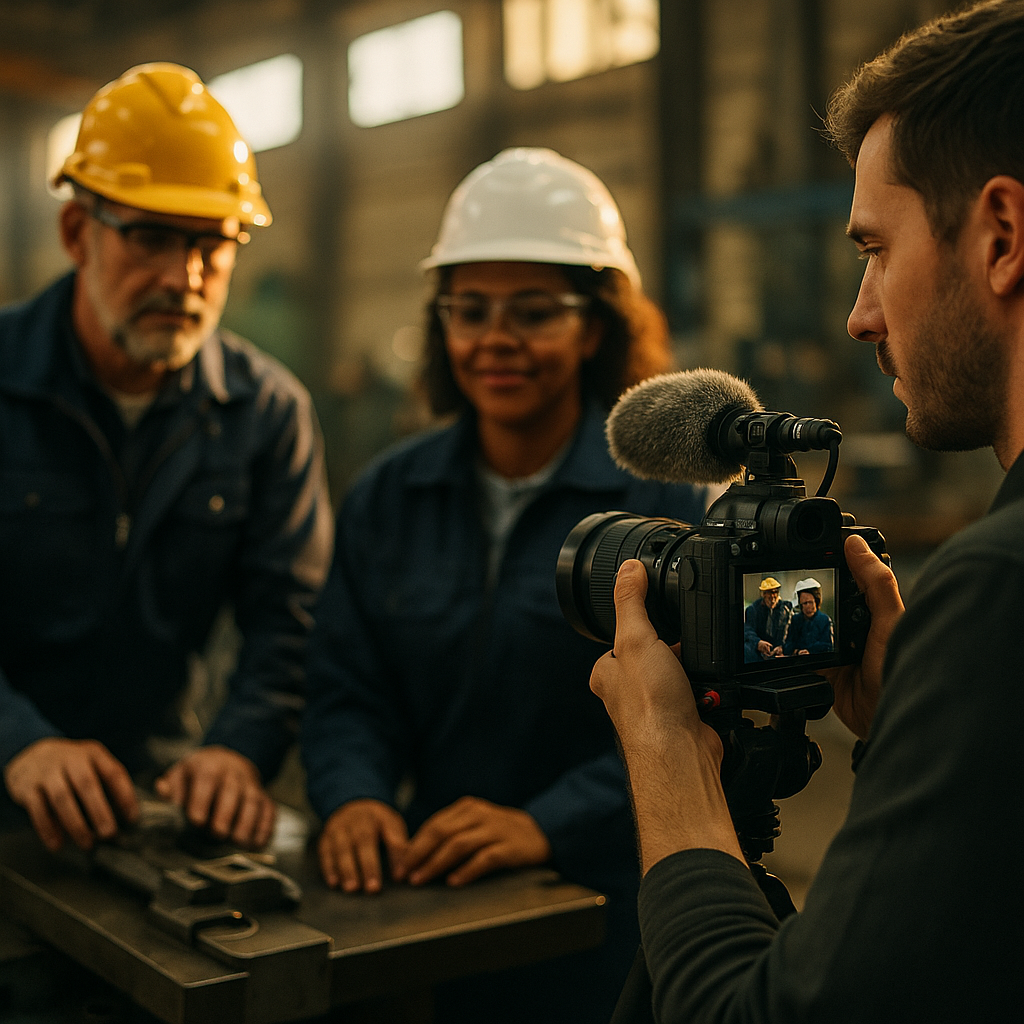
Case Study: A Traditional Manufacturer Using Video To Humanize Internal Teams shows how a legacy plant can build trust, clarity, and pride without changing what it makes. In 2025, internal communication competes with shift work, safety demands, and fragmented attention. This case study reveals the strategy, workflows, and governance behind a video program that connected people across roles and locations—so what actually changed?
Internal video communications strategy: the company, the challenge, and the goal
IronVale Components is a mid-sized, privately owned manufacturer with multiple facilities and a workforce spanning production, maintenance, engineering, quality, logistics, and corporate functions. The company had strong operational discipline, yet internal perception surveys showed a persistent gap: employees understood what to do, but not always why decisions were made or how teams connected across sites.
Three issues surfaced in interviews with supervisors, HR, and safety leaders:
- Information fragmentation: Updates lived in emails, bulletin boards, toolbox talks, and an intranet few shop-floor employees regularly accessed.
- Low cross-team visibility: Office teams often did not understand shop constraints, while production teams rarely saw the people behind procurement, engineering, quality, and planning.
- Change fatigue: New SOPs, equipment upgrades, and scheduling changes felt constant. Employees wanted context and consistency, not more messages.
The goal was not “more content.” Leadership defined a measurable objective: increase internal trust and alignment by making communication more human, more accessible on mobile, and more credible through familiar faces. Video was chosen because it can compress context quickly, convey tone, and be consumed during short breaks or at home. A cross-functional working group created a plan that balanced engagement with safety, legal, and operational realities.
Employee engagement through video: what they produced (and what they stopped doing)
IronVale launched three repeatable video formats designed around the daily rhythms of manufacturing. The formats were short by design and built for people who do not sit at desks.
1) “Shift Start Stories” (60–120 seconds)
A weekly micro-video shown on breakroom screens and posted to the employee app. It featured one person from a different team each week: a forklift operator explaining a near-miss lesson, a planner discussing how schedule changes ripple to shipping, a quality tech showing what a defect looks like downstream. Each video ended with one practical “what you can do today.”
2) “Inside the Work” (3–5 minutes)
A biweekly mini-profile following a process end-to-end, such as incoming material inspection to finished goods staging. The goal was to connect functions and reduce “us vs. them” thinking. Engineers and operators co-presented whenever possible to reinforce partnership.
3) “Leadership in the Plant” (90 seconds)
A monthly walk-and-talk filmed on the floor, not in an office. Leaders answered two employee-submitted questions and highlighted one decision with tradeoffs explained plainly. This format addressed a frequent follow-up question: “Why did we choose this change when it makes my job harder?”
Equally important was what they stopped doing. The working group replaced long all-staff emails and dense slide decks with a single page summary plus a short video. The written summary ensured accessibility for employees who prefer text and helped with translation, while video handled tone and context.
To avoid “internal marketing” vibes, they adopted two content rules:
- No scripts longer than a few bullet points for most videos. Natural language mattered more than perfect delivery.
- No forced positivity. Videos could acknowledge constraints, defects, downtime, and learning moments, as long as they focused on actions and improvements.
Humanizing internal teams: storytelling techniques that built trust on the shop floor
Humanizing teams worked only when the audience recognized themselves in the stories. IronVale used a practical storytelling playbook tuned for manufacturing:
- Start with the job: The first 5 seconds showed the person doing real work—scanning parts, calibrating gauges, changing tooling—before any introduction.
- Use “what I didn’t know” moments: Contributors shared one misconception they once had about another team. This reduced defensiveness and encouraged curiosity.
- Show constraints, not just outcomes: For example, maintenance explained how parts lead times affect downtime, while procurement explained supplier limits and quality requirements.
- Keep language concrete: Replace “operational excellence” with “why we switched the checklist” or “what happens when labels print wrong.”
They also designed for credibility. Videos featured line-level experts more often than executives. Leaders appeared mainly to answer questions, remove barriers, or explain decisions. This aligned with how trust forms in plants: people trust those who “know the work” and those who “own the decision.”
To handle the follow-up question—“Isn’t this just leadership spin?”—the team built a visible feedback loop. Each month, they published a short “You asked, we acted” segment highlighting two employee suggestions and the action taken (or why it could not be done yet). That transparency made the program feel less like broadcasting and more like conversation.
Manufacturing culture and change management: rollout, governance, and safety compliance
IronVale treated video as a change-management initiative, not a creative side project. The rollout included governance to protect safety, privacy, and consistency across plants.
Rollout approach
- Pilot in one facility for 8 weeks with three formats only, then scale based on watch patterns and feedback.
- Union and supervisor alignment before filming began, clarifying participation was voluntary and not tied to performance evaluation.
- Clear filming zones to prevent distractions near critical operations.
Safety and compliance rules
- PPE compliance on camera was non-negotiable. If PPE was required in the zone, it appeared on screen. This prevented accidental normalization of unsafe behavior.
- No filming of restricted panels, security procedures, or sensitive customer markings.
- Release and consent process for anyone on camera, with extra care for contractors and visitors.
Editorial governance
- Owner: Internal Comms partnered with EHS and HR, with Plant Managers as approvers for site-specific content.
- Review SLA: 48-hour review to avoid backlog. Delayed content loses relevance in operations.
- Voice standard: Plain language, direct answers, and a consistent closing line: “Here’s who to contact if you need help.”
This governance supported EEAT in a practical way: subject-matter experts reviewed technical details, EHS ensured safety accuracy, and HR protected employee rights. The result was content that employees could rely on, not just consume.
Workforce communications metrics: how they measured impact and proved ROI
In manufacturing, engagement is meaningful only if it connects to performance, retention, and safety behavior. IronVale used a scorecard with leading and lagging indicators, all trackable in 2025 without intrusive monitoring.
Leading indicators (monthly)
- Reach by employee type: % of production vs. salaried employees who viewed at least one video.
- Completion rate: Especially for 60–120 second videos; low completion signaled too much talking or slow intros.
- Question submissions: Count and theme trends; a rise often indicated psychological safety and trust.
- Repeat contributors: Number of new faces on camera each month, by department and shift.
Lagging indicators (quarterly)
- Internal trust pulse: Short survey items such as “I understand why decisions are made” and “I know who to go to for answers.”
- Change adoption: For specific SOP updates, they tracked training completion plus audit findings and rework tied to the change.
- Safety learning signals: Near-miss reporting volume and quality of reports (not just recordables), interpreted carefully with EHS.
What improved
Within two quarters of scaling, IronVale saw higher participation from production employees compared to prior intranet engagement. Supervisors reported fewer repetitive questions after major schedule changes because employees had a single video link to share. Quality leaders also noted that defect-prevention messages delivered by peers were discussed more often in daily huddles.
How they calculated ROI
They avoided fuzzy “brand” metrics and focused on time and waste:
- Reduced meeting time: Some recurring update meetings were shortened because video handled the pre-brief. Saved hours were estimated by role and headcount.
- Fewer rework drivers: For one process change, audit findings dropped after a targeted “Inside the Work” episode showed the correct method and the reason behind it.
- Lower onboarding friction: New hires used a curated playlist to learn “who does what,” reducing early confusion and speeding up integration.
They also anticipated a common follow-up question: “How do we know the videos caused the change?” The team used simple attribution: they paired each major operational change with a video and measured the delta vs. similar past changes that used only text and meetings. It was not perfect causal proof, but it was credible enough for operational leaders making budget decisions.
Video production for internal comms: tools, workflow, and lessons learned
IronVale kept production simple to scale. The most effective videos were consistent, not cinematic.
Tools and setup
- Capture: Smartphone with a gimbal for walk-and-talk segments; a lavalier mic for noisy areas; basic LED light for offices and training rooms.
- Editing: A lightweight editor with templates for intros, captions, and safety disclaimers.
- Distribution: Employee app with push notifications, QR codes posted in breakrooms, and screens in common areas.
Workflow (repeatable and fast)
- Intake: Monthly planning with plant leadership, EHS, and HR; topics sourced from questions, incidents, and upcoming changes.
- Pre-brief: 15-minute outline and safety check (filming location, PPE, restricted visuals).
- Film: 30–45 minutes for micro-videos; up to 2 hours for “Inside the Work.”
- Review: Fact check by SME; safety check by EHS; people/privacy check by HR.
- Publish: Video plus a short text recap, links, and a named contact for follow-up.
Lessons learned
- Captions are mandatory: Noise, accents, and accessibility needs made on-screen captions essential.
- Respect shift realities: Posting at the end of first shift reduced reach. They scheduled releases to match shift changes and break windows.
- Empower local champions: Each site had a trained “video captain” who could capture quick stories while the central team handled editing and governance.
- Keep credibility high: If a video promised an action, the next video cycle needed an update. Broken promises damaged trust faster than silence.
By the end of the first full cycle, video became a normal part of how work was explained and how people were recognized. More importantly, it created a shared language for change, anchored in real faces and real constraints.
FAQs about using video to humanize internal teams in manufacturing
What types of internal videos work best for manufacturing employees?
Short, practical formats perform best: shift-start micro-videos, process walk-throughs, and brief leader Q&A filmed on the floor. Each should answer one question, show the work, and end with a clear next step.
How do we ensure internal videos don’t compromise safety or confidentiality?
Define filming zones, enforce PPE on camera, and create a review step with EHS and a site approver. Ban restricted visuals (security controls, customer identifiers, proprietary settings) and use a consent process for anyone appearing on screen.
Do we need professional production equipment?
No. A modern smartphone, a stabilizer, and a quality microphone cover most needs. Consistent audio and captions matter more than high-end visuals, especially in loud plant environments.
How long should internal videos be?
Aim for 60–120 seconds for routine updates and 3–5 minutes for process stories. If the topic is complex, split it into a series and include a text recap with links for deeper reading.
How can we get employees comfortable on camera?
Use volunteers, film them doing real work, and rely on bullet points rather than scripts. Pair first-time contributors with a familiar peer, and keep takes short. Make participation clearly optional and not performance-related.
What metrics prove impact beyond views?
Track completion rate, questions submitted, and cross-team representation on camera. Connect key videos to specific outcomes like SOP adoption audit results, rework drivers, onboarding ramp time, and reductions in repetitive supervisor questions after changes.
IronVale’s experience shows that internal video succeeds when it supports real work, not corporate theater. By highlighting peers, explaining tradeoffs, and building a reliable feedback loop, the company improved understanding across roles and reduced friction during change. The takeaway for 2025: keep formats simple, governance tight, and stories grounded in the plant—then let employees’ expertise lead the message.