


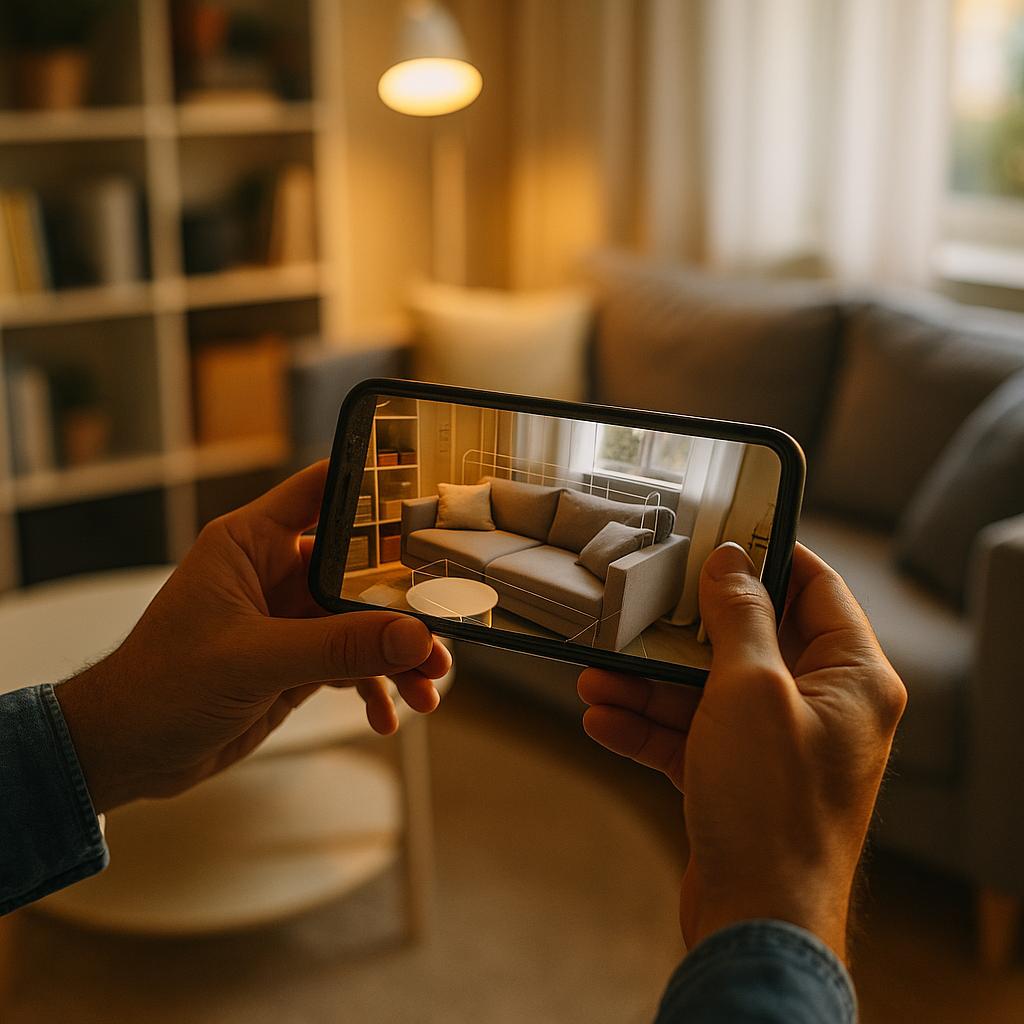
IKEA Kreativ turned a familiar shopper frustration into a measurable growth engine: uncertainty. By letting customers scan rooms, remove existing furniture digitally, and test products at scale, IKEA reduced hesitation across discovery, consideration, and checkout. This case study explains how AR room scanning evolved from a novelty into a revenue driver, and what brands can learn from that transformation.
AR room scanning: the customer problem IKEA Kreativ solved
Furniture shopping has always carried unusual friction. Customers do not just ask whether they like a sofa or table. They ask whether it fits, whether it clashes with existing décor, whether it blocks movement, and whether it feels right in a real room rather than a showroom vignette. Those questions slow purchase decisions and increase the chance of abandoned carts, delayed purchases, and costly returns.
IKEA recognized that traditional product pages, static lifestyle images, and even standard 3D viewers were not enough. Shoppers needed a way to project confidence into their own spaces. That is where IKEA Kreativ changed the experience. Instead of simply placing one product through basic augmented reality, the platform enabled customers to create a digital version of an actual room, clear out existing furniture virtually, and then redesign the space with IKEA products.
This mattered because it moved the buying journey from imagination to simulation. Consumers no longer had to mentally estimate spacing, color harmony, or layout logic. They could see the outcome before committing. In practical commerce terms, that means fewer doubts at the exact moment when doubt usually kills conversion.
From an EEAT perspective, this is what makes the case compelling. The product did not succeed because AR was trendy. It succeeded because it solved a documented retail pain point with a high-intent, utility-first experience. Helpful technology tends to outperform flashy technology, especially when average order values are high and visual fit strongly influences purchase behavior.
Augmented reality ecommerce: how the experience worked in practice
IKEA Kreativ combined computer vision, spatial computing, and product visualization into a consumer-friendly flow. The process was designed to feel intuitive, not technical. A shopper scanned a room using a smartphone, generated a digital space, removed existing furniture elements virtually, and explored IKEA products in context. That sequence reduced the gap between browsing and planning.
Several design choices explain why the experience generated commercial value:
- Low-friction onboarding: Users did not need expert knowledge to begin. Simplicity increased trial.
- Room-level context: Instead of placing a single lamp or chair in isolation, customers could rethink the full space.
- Catalog integration: The experience connected directly to purchasable IKEA items, keeping inspiration close to transaction.
- Visual confidence: Scale, layout, and style questions were addressed in a more realistic environment.
- Planning utility: The tool supported both quick decisions and larger room redesigns.
This is an important distinction for ecommerce leaders. Many AR implementations fail because they act as disconnected engagement features. IKEA Kreativ functioned as part of the buying system. It supported product discovery, layout planning, decision support, and eventually checkout. That integration is what transformed it from a brand experience into a revenue mechanism.
It also aligned with how modern shoppers behave in 2026. Consumers increasingly expect digital tools to remove guesswork. They want speed, but they also want accuracy. A room scanner that helps validate product fit offers both. In categories where returns are expensive and shopper hesitation is common, that combination is commercially powerful.
Customer experience optimization: why IKEA Kreativ increased conversion intent
The strongest retail technologies improve behavior, not just perception. IKEA Kreativ likely influenced revenue by improving several critical ecommerce metrics at once.
First, it increased purchase confidence. When shoppers can test products in their own homes, perceived risk drops. A couch that looked uncertain on a product page becomes easier to approve when viewed inside the exact living room where it will sit. Reduced uncertainty often leads directly to higher conversion intent.
Second, it encouraged larger baskets. Room-based visualization naturally promotes coordinated purchases. A shopper who starts with a storage unit may add a rug, lighting, side tables, or accessories after seeing how the whole room comes together. Instead of shopping item by item, they begin designing a complete environment.
Third, it reduced decision paralysis. Furniture sites often overwhelm users with dimensions, colors, configurations, and style variants. AR room scanning narrows the field by showing what actually works in context. Less friction in comparison can mean faster path to checkout.
Fourth, it can reduce return risk. While no visualization system eliminates returns entirely, helping customers judge fit and appearance before buying should improve selection quality. In furniture ecommerce, even small gains in return reduction matter because logistics costs are significant.
Fifth, it extended engagement time with purpose. Not all longer sessions are good. But when users spend more time actively designing a room and saving viable options, that engagement often signals deeper buying intent rather than passive browsing.
These effects reinforce one another. Better confidence leads to stronger conversion. Stronger conversion plus cross-sell opportunities increases average order value. Better pre-purchase fit can lower post-purchase regret. That is how a well-built AR feature shifts from experimental to profitable.
For brands evaluating similar tools, the lesson is clear: measure the experience against business outcomes, not novelty metrics. Time spent, shares, and press coverage may look impressive, but conversion lift, basket expansion, and return-rate impact determine whether AR truly contributes to revenue.
Retail innovation strategy: the business model behind revenue impact
IKEA’s broader strategic advantage came from matching the technology to its business model. The company sells products that are visual, spatial, and often purchased as part of a room set. That makes immersive planning especially relevant. IKEA Kreativ fit the category economics.
Why did that matter so much?
The product range is modular and combinational. Customers rarely purchase one isolated piece. They combine storage, seating, tables, textiles, and lighting. A room scanner creates opportunities for natural bundling without forcing the upsell.
The brand serves both inspiration-led and budget-conscious shoppers. These customers want confidence that they are spending wisely. Seeing products in their actual space strengthens perceived value because the purchase feels intentional, not speculative.
Omnichannel behavior benefits from pre-visit planning. Some users buy online immediately. Others use digital tools to shortlist products before visiting a store. In both scenarios, the room scan improves readiness and shortens the path from interest to action.
The feature builds proprietary behavioral insight. When customers design spaces digitally, IKEA can better understand room types, product combinations, style preferences, and decision patterns. Used responsibly, those insights can improve recommendations, merchandising, and lifecycle marketing.
This is where many case studies become too simplistic. IKEA Kreativ did not generate value only at the interface level. It likely created value at the merchandising, personalization, and operational levels too. The experience produced signals that standard browsing cannot capture. For example, adding a bookshelf to a cart tells you one thing. Placing that bookshelf in a scanned home office beside a desk and task lamp tells you much more about intent and context.
That richer context can support smarter follow-up communications, better product recommendations, and more accurate forecasting around complementary demand. In other words, AR room scanning can influence not just direct conversion but also the quality of retail decision-making behind the scenes.
3D visualization marketing: lessons other brands can apply
Not every company can replicate IKEA’s exact implementation, but many can apply its principles. The key is to start with a meaningful use case rather than an impressive demo.
- Target a high-friction decision. AR works best when shoppers struggle with fit, scale, placement, or compatibility. Home goods, décor, appliances, flooring, and even B2B space planning can benefit.
- Integrate with commerce. The experience must connect directly to inventory, product details, saved lists, and checkout. Standalone visualization rarely sustains ROI.
- Design for mobile reality. Customers will use the tool in everyday settings, with imperfect lighting, limited patience, and varying device quality. Ease matters more than feature depth.
- Build for room logic, not just product placement. People think in spaces. The more the experience supports realistic planning, the stronger the buying confidence.
- Measure serious KPIs. Track conversion rate, assisted revenue, average order value, repeat use, return impact, and downstream store visits if applicable.
- Support both inspiration and action. Great retail experiences let customers dream and decide in the same flow.
Another lesson is organizational. Revenue-driving immersive tools usually require cooperation across product, engineering, ecommerce, analytics, merchandising, and marketing. If ownership is fragmented, the experience may launch but fail to scale. IKEA Kreativ demonstrates the value of aligning innovation with commercial accountability.
Brands should also prepare for common reader questions. Does AR only help premium products? No. It can support value-focused retail even more effectively when customers are cautious with spending. Does it require perfect scans to be useful? Not necessarily. The goal is decision support, not architectural precision. Is adoption too limited to matter? That depends on usability and placement. If the feature is easy to access at high-intent moments, adoption can be commercially meaningful even without universal use.
Digital commerce growth: what IKEA Kreativ proves in 2026
By 2026, the market no longer rewards immersive commerce simply for being immersive. Expectations have matured. The winners are brands that use advanced interfaces to remove real obstacles in the buying journey. IKEA Kreativ is a strong example because it addressed a specific source of lost revenue: uncertainty about how furniture will look and fit in a real home.
The transformation from AR room scanning to revenue happened through a chain of practical outcomes:
- More confidence before purchase
- Better visualization of full-room solutions
- Higher likelihood of multi-item baskets
- More efficient decision-making
- Potential reduction in costly mismatches and returns
- Stronger integration between digital inspiration and transaction
For retail leaders, the broader takeaway is strategic. Emerging technology creates value when it compresses the distance between desire and certainty. In furniture, certainty is difficult because every home is different. IKEA Kreativ narrowed that gap more effectively than standard ecommerce tools.
This case also reflects an important EEAT principle: useful content and useful products win trust when they show clear purpose, expertise, and relevance. IKEA did not ask customers to learn a futuristic behavior. It adapted advanced technology to a familiar shopping need. That balance between innovation and usability is what made the experience commercially credible.
If your brand is considering AR, ask the same question IKEA appears to have answered well: what costly uncertainty can we remove for the customer? Start there, and the path to revenue becomes much easier to justify.
FAQs about IKEA Kreativ and AR room scanning
What is IKEA Kreativ?
IKEA Kreativ is a digital room design experience that lets shoppers scan their spaces, remove existing furniture virtually, and place IKEA products inside a realistic version of their rooms to support purchase decisions.
How did IKEA Kreativ turn AR into revenue?
It reduced uncertainty around fit, layout, and style, which likely improved conversion intent. It also encouraged coordinated room purchases, helping raise basket size while supporting more confident decisions.
Why is AR room scanning effective for furniture ecommerce?
Furniture purchases depend heavily on spatial fit and visual harmony. AR room scanning helps customers test products in context before buying, which addresses one of the biggest causes of hesitation in the category.
Does AR room scanning reduce returns?
It can help reduce returns by improving pre-purchase confidence and product selection. While it will not eliminate all returns, better fit and style validation should lower mismatches that often lead to costly reversals.
What metrics should brands track when launching similar technology?
Focus on conversion rate, assisted revenue, average order value, repeat engagement, product attach rate, return rate, and if relevant, store-visit influence from users who engage with the tool before shopping offline.
Is AR room scanning only useful for large retailers?
No. Mid-sized and niche brands can benefit if they sell products where fit, placement, or configuration affects purchase confidence. Success depends more on relevance and usability than on company size alone.
What is the main lesson from the IKEA Kreativ case study?
The main lesson is that immersive technology drives growth when it solves a real buying problem. AR became valuable because it removed uncertainty, supported room-level planning, and connected seamlessly to commerce.
IKEA Kreativ shows that AR succeeds when it helps customers decide, not when it merely entertains them. By solving uncertainty around fit, style, and room planning, IKEA created a stronger path from inspiration to purchase. The clearest takeaway for brands in 2026 is simple: build immersive tools around practical customer friction, and revenue impact becomes far more achievable.