


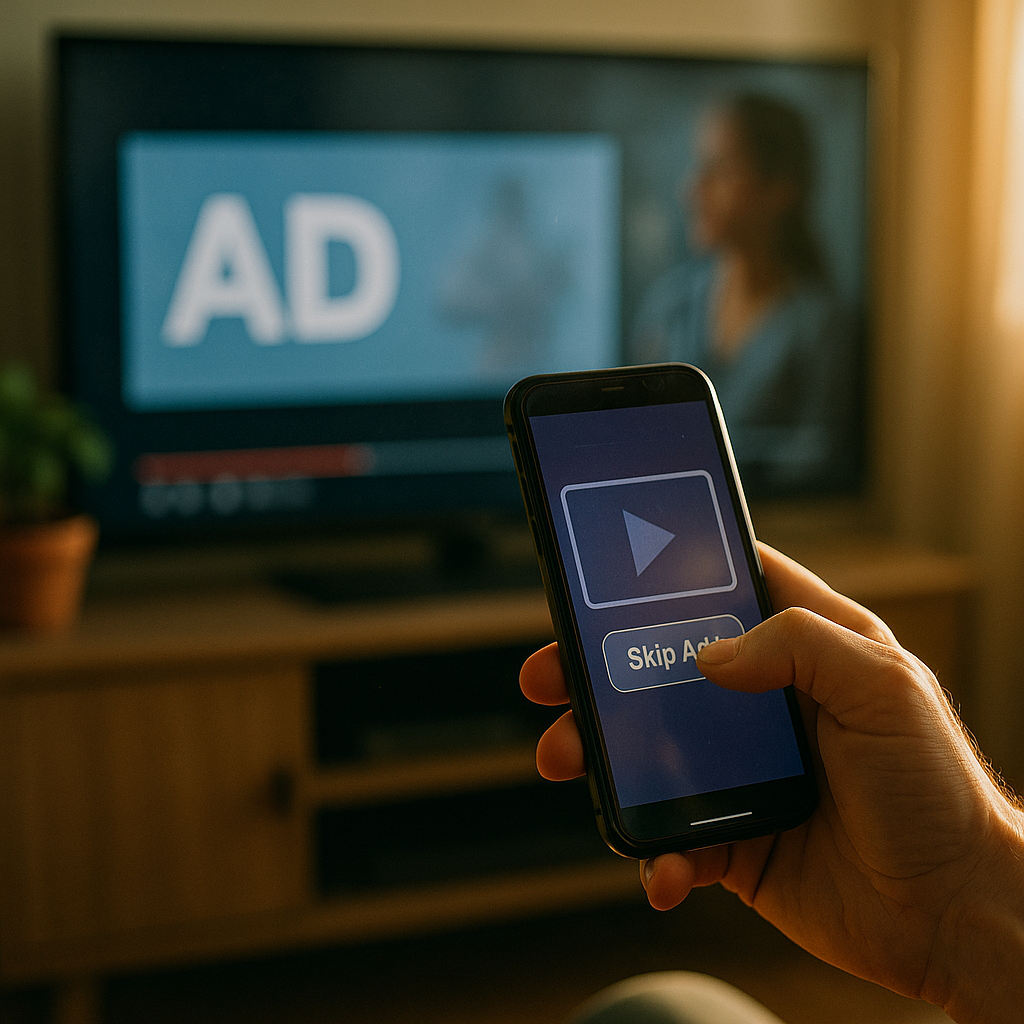
The art of interruption free ads is no longer a creative experiment; it is a performance and trust mandate in 2025. People tune out anything that steals attention, yet they welcome messages that remove friction, answer questions, or save time. The best brands now behave like utilities: present, useful, and easy to ignore until needed. So how do you earn attention without interrupting it?
Interruption-free advertising: why attention must be earned
Interruption-free advertising works because it aligns with how people actually use media in 2025: on-demand, multitasking, and increasingly guarded by subscription choices, privacy controls, and ad blockers. The core principle is simple: if your message doesn’t help, it doesn’t belong in the moment.
Recent industry benchmarks underline the direction of travel. In 2024, the IAB reported that most consumers support advertising when it is relevant and enhances content, but react negatively when it feels intrusive or repetitive. That shift matters because it reframes the job of advertising: not “win attention,” but “deserve attention.”
To meet that standard, interruption-free ads typically share three traits:
- They match intent: the message fits what the person is trying to do right now.
- They respect control: clear dismiss, mute, skip, or frequency limits are built in.
- They deliver immediate value: a useful tool, answer, comparison, reminder, or next step.
If you’re wondering whether this reduces reach, the opposite is often true. When ads stop fighting the user, they earn longer engagement, better brand recall, and fewer negative signals (hides, blocks, complaints). In practice, this approach also reduces wasted spend because it prioritizes relevance over volume.
Helpful utility content: designing ads that solve problems
Helpful utility content is the bridge between “marketing” and “service.” It treats your ad unit, landing page, or embedded content as a mini-product that solves a real problem in seconds. This is where interruption-free ads become scalable: usefulness can be standardized, tested, and improved.
Start by mapping the top jobs-to-be-done around your category. People rarely want a product; they want an outcome. A bank customer wants clarity on fees and cash flow. A travel customer wants confidence and low risk. A B2B buyer wants a fast way to assess fit and total cost.
Then choose utility formats that match those jobs:
- Calculators and estimators: pricing, savings, ROI, or time-to-value. Keep inputs minimal; show assumptions transparently.
- Checklists and templates: “What to bring,” “How to prepare,” “RFP template,” or “Launch checklist.” Deliver instantly, not behind aggressive gates.
- Interactive comparisons: plan selector, feature match, compatibility checker, or “best option for your needs.”
- Contextual explainers: a 30-second answer embedded where confusion appears (FAQ snippets, tooltips, short video with captions).
- Alerts and reminders: back-in-stock, price drop, renewal windows, maintenance intervals—opt-in and easy to manage.
Anticipate the reader’s next question: “Does utility content still sell?” Yes, because it reduces uncertainty. People buy when they feel informed and in control. Your utility should lead to an unobtrusive next step: “See plans,” “Talk to an expert,” “Try a demo,” or “Save results,” with no pressure tactics.
Make value measurable. Track completion rate (e.g., calculator finished), repeat usage, time saved proxies, and downstream conversion quality (lower refunds, fewer support tickets, better retention). Utility content should improve customer outcomes, not just clicks.
Native ad formats: fitting the environment without disguising intent
Native ad formats often get misunderstood. “Native” should not mean “camouflaged.” In 2025, the best-performing native placements are clearly labeled, visually aligned with the platform, and genuinely useful. The goal is to reduce disruption, not to blur disclosure.
Effective native placements include:
- In-feed units: a helpful tip, short guide, or tool preview that matches the feed’s content rhythm.
- Sponsored content hubs: evergreen resources hosted on the publisher’s site, with strong editorial standards and transparent sponsorship.
- Contextual units: placed next to content where the user is already seeking solutions (e.g., mortgage calculators alongside homebuying articles).
- Shoppable but optional overlays: lightweight product info that expands only on user action.
To preserve trust, follow three non-negotiables:
- Labeling clarity: “Sponsored” or “Ad” should be unmissable, not hidden in low-contrast text.
- Editorial alignment: match the audience’s needs and the publisher’s tone; avoid bait topics that inflate clicks.
- Experience first: fast load, minimal tracking, and no surprise redirects.
Answering the common follow-up: “Will clear labeling hurt performance?” Clear labeling tends to improve long-term performance by filtering for higher-intent engagement and reducing backlash. In many categories, the cost of mistrust (brand damage, negative sentiment, and wasted impressions) is larger than the gain from deceptive clicks.
User experience marketing: reducing friction across the journey
User experience marketing treats every touchpoint as part of the product experience, including ads. If your ad promises “fast,” “simple,” or “transparent,” the landing experience must deliver those qualities immediately. Otherwise, you create cognitive dissonance—one of the fastest ways to lose trust.
Design for friction removal:
- Speed: keep pages lightweight, reduce scripts, compress media, and prioritize mobile performance.
- Clarity: a single primary action, plain language, and visible pricing or next steps.
- Control: easy opt-outs, preference centers, and predictable navigation.
- Accessibility: readable contrast, keyboard support, captions for video, and descriptive labels.
Interruption-free ads also depend on frequency discipline. When people see the same message too often, even a helpful ad turns into noise. Use frequency caps and rotate creative based on journey stage:
- Discovery: problems, use cases, and utility tools.
- Consideration: comparisons, proof points, and FAQs.
- Decision: transparent pricing, implementation steps, guarantees, and support access.
- Retention: onboarding checklists, usage tips, and renewal reminders.
Build “helpfulness” into your creative process. Before launch, ask: What task does this ad help the user complete? If the answer is vague (“brand awareness”), refine it into a tangible utility (“learn which plan fits in 30 seconds”). This keeps teams aligned and makes optimization straightforward.
Brand trust signals: applying EEAT to advertising and content
Google’s EEAT expectations—Experience, Expertise, Authoritativeness, Trustworthiness—apply to helpful content, and the same principles strengthen interruption-free advertising. In 2025, trust is not a soft metric; it is a conversion lever and a retention driver.
Here is how to apply EEAT in practice:
- Experience: show real usage context. Include screenshots, step-by-step demos, or “what happens next” walkthroughs that reflect actual customer workflows.
- Expertise: use qualified contributors for sensitive topics (health, finance, security). Provide accurate definitions, constraints, and best-practice guidance.
- Authoritativeness: reference reputable sources and standards. When you cite statistics, use recognized industry or research bodies and link the insight to the decision the reader must make.
- Trustworthiness: state assumptions, disclose sponsorship, and avoid inflated claims. Provide contact options and support pathways.
EEAT also shows up in the small things that many ads ignore:
- Transparent data handling: explain what you collect, why, and how to control it. Keep consent choices clear.
- Accurate pricing and terms: avoid “from” pricing without context; show typical ranges and key exclusions.
- Proof that matters: customer outcomes, not vanity metrics. Share case studies with constraints: industry, company size, timeline, and what did not work.
If the reader is thinking, “This sounds like a lot for an ad,” that’s the point. In a low-trust environment, the brands that operationalize trust win. A utility-first approach makes this easier because it naturally demands accuracy, clarity, and real-world usefulness.
Performance measurement: KPIs for non-intrusive growth
Interruption-free ads still need to perform, and measurement should reflect the strategy. If you only optimize for click-through rate, you may reward curiosity clicks and punish true utility (which can deliver value without an immediate click). Instead, use a balanced scorecard that captures quality and downstream impact.
Recommended KPIs include:
- Attention quality: viewable time, scroll depth, video completion with sound-off and captions considered.
- Utility engagement: tool completion rate, template downloads, saves, shares, and repeat usage.
- Conversion quality: qualified leads, demo-to-close rate, churn/return rate, and support ticket volume by cohort.
- Brand sentiment signals: hide/report rates, unsubscribe rates, negative feedback, and brand search lift.
- Incrementality: lift tests, geo experiments, or holdout groups to validate what your ads truly drive.
Answering a common follow-up: “How do I prove impact if users don’t click?” Use view-through and on-site behavior carefully, but prioritize incrementality where possible. Run controlled experiments: expose one group to the utility ad and compare downstream behaviors (brand search, direct traffic, conversions, retention). This is especially important as privacy changes reduce the reliability of user-level tracking.
Optimization should focus on making the utility more effective, not louder. Improve instructions, reduce steps, clarify outputs, and tighten relevance. If performance stalls, revisit intent alignment before increasing frequency or expanding targeting.
FAQs
What are interruption free ads?
They are ads designed to respect the user’s attention by fitting the context, offering control (skip, close, mute, frequency limits), and delivering immediate value. They aim to help rather than distract, which often improves long-term performance and brand trust.
How can advertising act as a helpful utility?
By providing tools or resources that solve a real problem quickly—like calculators, checklists, plan selectors, explainers, or opt-in alerts. Utility ads reduce uncertainty and friction, making the next step feel natural instead of forced.
Do interruption-free ads reduce conversions?
Not when measured correctly. They may produce fewer low-intent clicks but often improve conversion quality, retention, and sentiment. When you track downstream outcomes and incrementality, utility-first campaigns frequently show stronger business impact.
What ad formats work best for non-intrusive advertising?
Contextual in-feed native units, sponsored content with clear disclosure, interactive tools embedded near relevant content, and opt-in messaging (email/SMS/push). The best format depends on user intent and the task you can help them complete.
How do I apply EEAT to ad content?
Use real-world experience cues (demos, walkthroughs), validate claims with credible sources, involve qualified experts for sensitive topics, and maintain transparency on pricing, terms, sponsorship, and data use. Make it easy for users to verify and contact you.
What metrics should I track for interruption-free campaigns?
Track attention quality (viewable time), utility engagement (tool completion), conversion quality (qualified leads, churn), sentiment (hide/report), and incrementality (holdout tests). Avoid relying only on CTR, which can misrepresent true value.
Interruption-free ads win in 2025 by behaving less like interruptions and more like reliable utilities. When you align messages with intent, build clear control into the experience, and offer practical help, you earn attention instead of taking it. Apply EEAT standards to strengthen trust and measure success with quality and incrementality. The takeaway: design ads people would choose because they make life easier.