


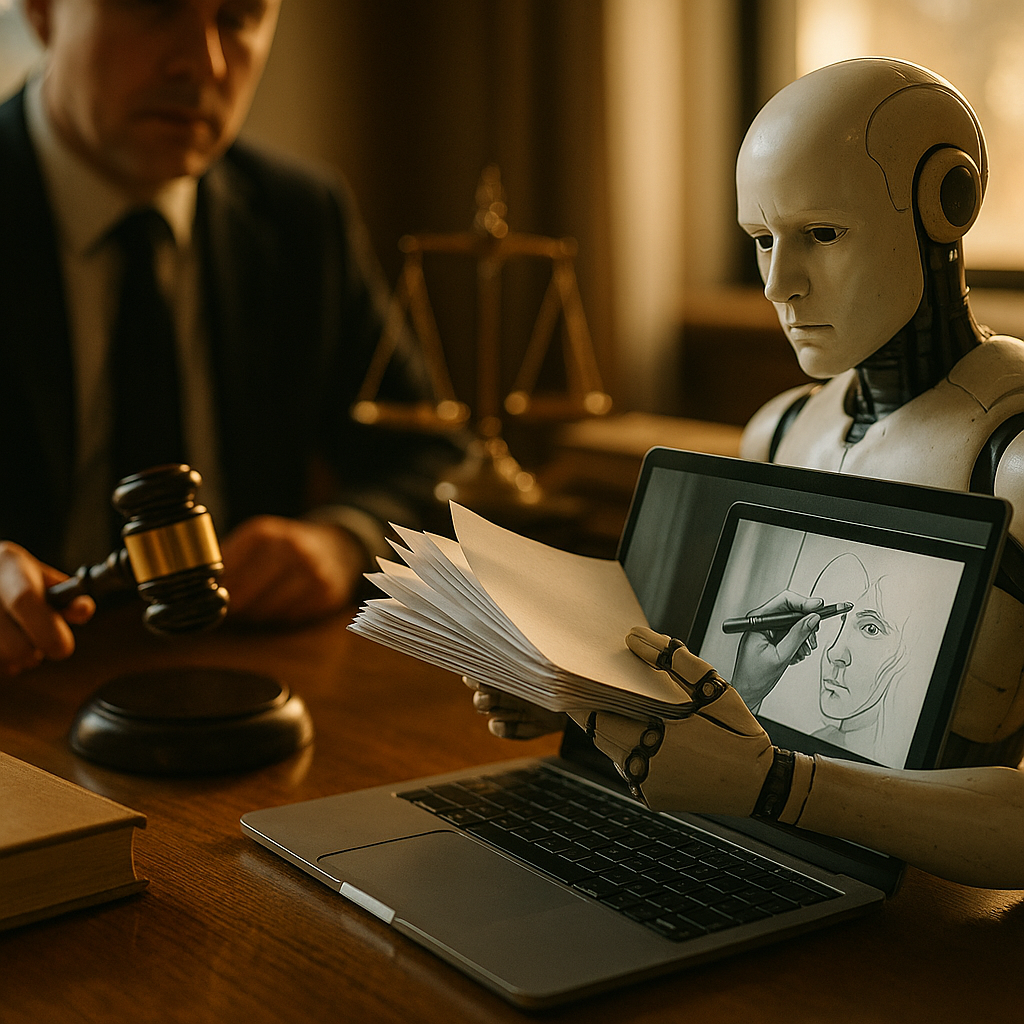
Creative teams are adopting systems that generate, refine, and reuse their own outputs at scale. That feedback loop boosts speed, but it also compounds mistakes, provenance gaps, and rights conflicts. This article explains the Legal Risks of Recursive AI in Creative Workflows, focusing on ownership, licensing, privacy, and liability in 2025. If your AI iterates on prior AI-made assets, what could go wrong—and how do you stay safe?
Copyright ownership and authorship in recursive AI
Recursive AI changes how creative work is made: drafts become inputs; outputs become training or prompt material; versions blend together across time. That makes a basic legal question surprisingly hard: who owns what?
In many jurisdictions, copyright protection generally requires human authorship. When a system produces content with minimal human creative input, the result may be unprotectable or only partially protectable. In practice, that creates two business risks:
- Weak exclusivity: If your output lacks protectable authorship, competitors may legally reuse similar content without infringing.
- Unclear chain of title: Investors, distributors, and enterprise customers often require proof of rights. Recursive creation can make it harder to demonstrate which parts are human-created, AI-assisted, or fully automated.
Recursion amplifies the problem because later iterations may incorporate earlier AI outputs that were never clearly documented. A “final” asset might contain layers of machine-generated elements, human edits, stock media, and third-party references—without a clean audit trail.
Practical answer: treat authorship as a design requirement. Define what “meaningful human control” looks like in your workflow (e.g., human-led selection among alternatives, substantive edits, and intent-driven composition). Maintain version history that distinguishes human contributions from automated ones, and preserve prompts, parameters, and review notes as evidence of creative control.
Training data liability and model contamination
Recursive AI often involves reusing internal assets for fine-tuning, retrieval-augmented generation, style transfer, or iterative prompting. If those internal assets include third-party material without the right permissions, your recursion can spread contamination across many outputs.
Two related issues drive legal exposure:
- Input rights: Do you have rights to ingest each source into an AI system, especially if it is used to train or tune a model? A typical content license may allow “use” but not “machine learning,” “text-and-data mining,” or “derivative model training.”
- Output traceability: Even if an output is not a direct copy, it can echo protectable expression. When recursion repeats, the chance of recognizable similarity can increase—especially for distinctive characters, lyrics, or signature visual styles.
In 2025, the legal landscape remains dynamic across regions, and organizations cannot rely on a single global assumption about what is permitted. Courts and regulators increasingly focus on whether the use was authorized, transparent, and controllable, and whether safeguards were in place to reduce infringement risk.
Practical answer: establish “clean input” rules. Maintain a registry of permitted sources (owned, commissioned with ML clauses, properly licensed libraries). Block unverified scraping, personal accounts, and ad hoc uploads. If you use external foundation models, review their documentation for training disclosures, rights programs, and opt-out handling; align that with your risk tolerance and client promises.
Derivative works, style imitation, and right of publicity
Recursive systems excel at consistency: they can iteratively converge on a visual look, a voice, or a persona. That creative advantage can also trigger claims that the work is an unauthorized derivative or a misappropriation of identity.
Derivative works and substantial similarity: If the AI is guided to replicate a specific character, franchise, or copyrighted composition, each recursion can pull the output closer to recognizable protected elements. Even when teams intend to “be inspired,” tight iterative feedback can become a reproduction engine. You should assume that “close but not exact” is still risky when the source is distinctive.
Style imitation: Pure “style” may not always be protected in the same way as specific expression, but real-world disputes often focus on concrete similarities: composition, signature motifs, phrasing, and recurring elements. Recursion raises the odds that these concrete similarities accumulate.
Right of publicity and voice cloning: If recursion uses a real person’s name, likeness, or voice—especially a celebrity or employee—permission becomes central. A model that iteratively improves a synthetic voice can cross from “generic narration” into a recognizable identity. That can trigger publicity, unfair competition, or consumer protection claims, and it can also violate platform policies or union agreements.
Practical answer: implement a “no-target list” and a consent-first policy. Prohibit prompts that request imitation of living artists, named performers, or protected characters unless you have written authorization or a clear legal basis. For people, obtain explicit releases that cover AI synthesis, re-recording, and future reuse, including recursive improvement and new contexts.
Licensing, vendor terms, and IP warranties in AI tools
Many legal problems in recursive AI are contract problems. Creative teams often stitch together multiple tools: a foundation model, a design platform, a voice engine, and a versioning system. Each layer has its own terms, and recursion can violate them unintentionally.
Watch for these contract traps:
- Restrictions on using outputs as inputs: Some providers limit using generated content to train other models or to create competing services. Recursion often does exactly that.
- Ownership clauses: Terms may grant you rights to outputs, but with carve-outs for provider retained rights, shared output similarity, or prohibited uses.
- No warranty / limited indemnity: Many vendors disclaim infringement risk. If your client contract includes strong IP warranties, the gap becomes your liability.
- Confidentiality and data use: Uploading client materials into a model that stores prompts or uses them for service improvement can breach NDAs or data processing agreements.
Recursive workflows increase exposure because they scale small contractual mismatches into repeated, systematic violations. One overlooked term about “no model training” can affect thousands of assets if you are looping outputs back into tuning sets.
Practical answer: align your toolchain contracts with your client promises. Maintain a plain-language “AI terms map” that notes: what can be uploaded, whether prompts are retained, whether outputs can be re-used for training, and what indemnities exist. In client agreements, avoid absolute guarantees like “non-infringing” unless you can support them with process controls; use reasonable standards tied to documented safeguards.
Privacy, confidentiality, and data protection in iterative generation
Recursion can cause data to travel farther than intended. A single sensitive detail in an early prompt can persist across drafts, get embedded into metadata, or influence future outputs. That creates privacy and confidentiality risk even when the final deliverable looks harmless.
Key risk areas include:
- Personal data in prompts and training corpora: Names, emails, voice recordings, headshots, and behavioral data can create regulated obligations depending on location and context.
- Client confidential information: Strategy decks, product roadmaps, unreleased scripts, and brand guidelines can be exposed if the tool retains content or if staff reuse prompts across accounts.
- Re-identification through recursion: Iterative refinement can inadvertently regenerate distinctive details (a real person’s bio, a private address, a unique internal codename) even if later prompts do not mention them.
In 2025, privacy enforcement and contractual audits are more common, and clients increasingly ask for proof that AI-assisted work respects data minimization and access controls.
Practical answer: treat prompts as sensitive records. Use enterprise plans with data controls; turn off provider training on your data where possible; segregate client workspaces; and adopt prompt hygiene rules (no personal data unless necessary, no secrets, no unreleased financials). Build a “do not store” pathway for high-sensitivity projects, using local or private deployments when appropriate.
Liability, documentation, and governance for AI-assisted content
When something goes wrong—an infringement claim, a defamation allegation, a false endorsement issue, or a privacy complaint—teams need to show they acted responsibly. Recursive AI complicates accountability because content evolves through many micro-decisions.
Legal exposure typically falls into three buckets:
- Direct liability: Publishing infringing or unlawful content, even if AI generated it.
- Contractual liability: Breaching client warranties, confidentiality terms, or platform rules.
- Operational liability: Failing to supervise vendors, train staff, or implement reasonable controls.
Strong governance is not bureaucracy for its own sake; it is evidence. If you can show your organization used a repeatable review process, maintained provenance logs, and responded quickly to issues, you are better positioned to resolve disputes and reduce damages.
Practical answer: build an “AI content defensibility file” per project. At minimum, keep:
- Asset provenance: sources used, license proofs, and whether materials were approved for AI ingestion.
- Model and tool record: which tools were used, key settings, and any safety filters enabled.
- Human review notes: who approved the output, what checks were performed (copyright, publicity, factual accuracy, brand), and what changes were made.
- Release and consent forms: for voice, likeness, commissioned creatives, and freelancers, explicitly covering AI and recursive reuse.
Also designate an accountable owner—often a cross-functional partnership between legal, security/privacy, and creative operations—so decisions about acceptable risk are consistent across teams.
FAQs about recursive AI and legal risk
What is “recursive AI” in a creative workflow?
It is a loop where AI outputs are repeatedly reused as inputs—through iterative prompting, automated revisions, fine-tuning, retrieval, or templated remixing—so the system progressively shapes future content based on past generated content.
Can I copyright AI-generated work if a human edited it?
Often, you can protect the human-authored parts if the human contribution is sufficiently creative and documented. The safest approach is to ensure humans make substantive choices (selection, arrangement, rewriting, compositing) and to retain records that show those choices.
Is it legal to train or fine-tune on my company’s past designs and copy?
It can be, if your company owns the materials or has licenses that explicitly allow machine learning uses. If your archive includes agency work, stock assets, fonts, photography, or freelance contributions, confirm the contracts permit AI ingestion and derivative reuse.
Do vendor terms matter if the output is “mine”?
Yes. Even if you receive broad output rights, terms can restrict how you use outputs (including feeding them into other models), how you handle confidential inputs, and what warranties you can rely on. Terms mismatches are a common source of client disputes.
How do we reduce infringement risk without stopping innovation?
Use clean-source inputs, block prompts that target protected characters or living artists, require human review for publication, and keep provenance documentation. For high-value campaigns, add similarity checks and legal sign-off at defined milestones.
When do we need a release for voice or likeness?
Get a release whenever an identifiable person’s face, voice, name, or persona is used or intentionally evoked, including synthetic or “sound-alike” voices. The release should cover AI synthesis, iterative improvement, future contexts, and territory-specific publicity rights.
What should clients ask for in an AI transparency statement?
Clients typically need: which tools were used, whether their data was retained or used for training, what inputs were permitted, what human review steps were performed, and whether any third-party assets require attribution or additional licensing.
Recursive AI can accelerate creative production, but it also multiplies legal exposure by repeating and spreading unclear rights, sensitive data, and contractual misalignment. In 2025, the most resilient teams treat provenance, consent, and documentation as part of the creative process, not afterthoughts. Build clean inputs, human-led approvals, and toolchain-aligned contracts—then innovate confidently without leaving your rights and reputation to chance.