


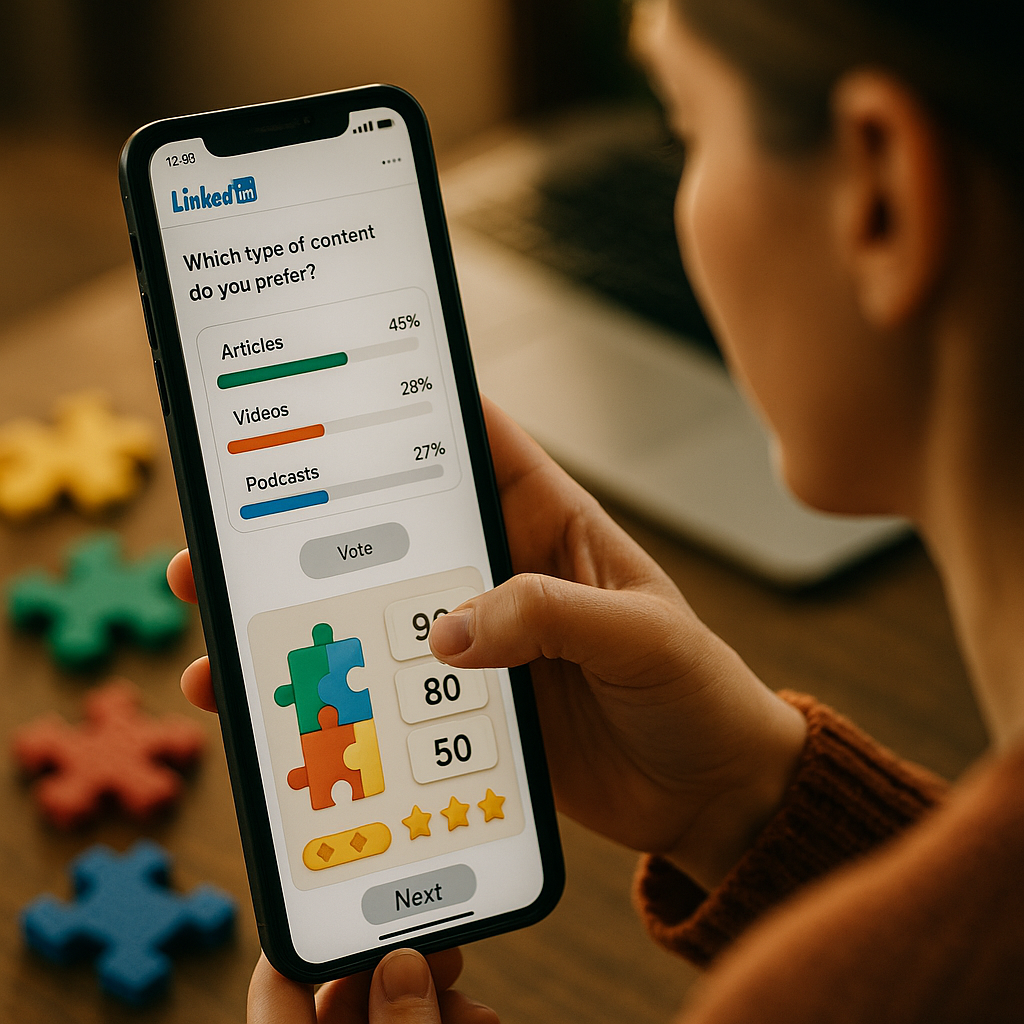
Interactive polls and gamification on LinkedIn have moved from “nice engagement trick” to a reliable way to learn from your market, spark conversations, and qualify leads without sounding salesy. In 2025, the difference is execution: thoughtful questions, smart incentives, and clean measurement. This playbook shows how to design, launch, and optimize campaigns that build trust and results—starting with one question your audience can’t ignore.
LinkedIn engagement strategy: start with a measurable goal and a clear audience
Before you write a single poll option or design a game mechanic, decide what you want the interaction to do. “More engagement” is not a goal; it’s an outcome. A better approach is to pick one primary objective and align everything to it:
- Market insight: validate a pain point, feature priority, pricing sensitivity, or job-to-be-done.
- Demand generation: attract the right roles into your funnel and move them to a next step (newsletter, demo, webinar).
- Community building: strengthen relationships with followers, customers, partners, and employees.
- Brand authority: demonstrate expertise by publishing informed commentary around the results.
Next, define your target segment in practical terms. On LinkedIn, that means role, seniority, industry, company size, and the context in which they experience the problem. If you sell to RevOps leaders at mid-market SaaS, don’t write a question that also appeals to students, job seekers, and generalists—unless broad awareness is your explicit objective.
To apply EEAT principles, write down the “why you’re qualified” angle behind the poll. It can be firsthand experience (you manage the process), customer patterns (you see results across accounts), or research (you synthesize sources). You’ll use that in the post copy and in follow-up comments to keep the interaction credible and useful.
Practical planning tip: set a simple measurement plan before launch: what does success look like in votes, comments, click-throughs, and lead quality? If you can’t define success, you can’t optimize it.
LinkedIn polls best practices: write options that create clarity, not confusion
A strong LinkedIn poll feels easy to answer, but it’s designed with discipline. Your job is to reduce friction while protecting data quality.
Use a single-variable question. Avoid “Which tool and why?” or “What’s your biggest challenge and what would you pay?” If you need nuance, ask it in the comments as a follow-up question after someone votes.
Make options mutually exclusive. Overlapping options inflate noise. For example, “Not enough time” and “Too many priorities” can describe the same reality. Consolidate, then add an “Other (comment)” option if needed.
Use balanced language. Don’t bias the outcome by making one option sound smarter. If your option implies competence (“We have an advanced process”) and another implies failure (“We do nothing”), the results say more about social desirability than truth.
Keep it scannable. Poll options should be short, concrete, and comparable. Aim for similar length and the same grammatical structure.
Pick the right poll type. Most LinkedIn polls work best as one of these:
- Diagnostic polls: “What’s the main blocker to X?”
- Maturity polls: “Which stage best describes your process?”
- Preference polls: “If you had to choose, which would you prioritize?”
- Prediction polls: “What will be the biggest shift in X this year?”
Answer the likely follow-up: “Should I include a link in the poll?” Usually, no. Treat the poll post as a conversation starter. If you want to drive traffic, add the link in a pinned comment after initial engagement, and frame it as a resource that expands on the results.
Quality control checklist: Can a busy decision-maker answer in under five seconds? If not, tighten it.
Gamification marketing on LinkedIn: use light mechanics that respect professional context
Gamification works on LinkedIn when it feels like a professional challenge, not a gimmick. Your aim is to increase participation and retention while keeping trust high.
Choose mechanics that match LinkedIn behavior. People scroll quickly, they engage publicly, and they value credibility. Effective mechanics include:
- Micro-challenges: “Comment your 3-step checklist” or “Share your best template line.”
- Scavenger hunts: “Find the answer in the carousel and comment it.” (Works well for educational slides.)
- Bracket-style choices: Run a series of polls where winners advance (e.g., “Top KPI,” “Best onboarding step”).
- Scorecards: A self-assessment (“If you answered A/B/C, your process is Level 2”).
- Community recognition: Highlight thoughtful comments in a follow-up post; recognition is a strong incentive in a professional network.
Keep rewards aligned with EEAT. Instead of giveaways that attract low-intent participants, offer value that reinforces expertise:
- Templates: checklists, scripts, calculators, dashboards.
- Work samples: anonymized examples, teardown notes, before/after metrics.
- Access: invite to a live Q&A, office hours, or a private mini-workshop.
Design for fairness and transparency. State the rules clearly in the post: how to participate, how winners (if any) are chosen, and what people will receive. Avoid tactics that pressure users to tag others or spam reactions; these can backfire and erode trust.
Answer the likely follow-up: “Should I run a contest?” Only if you can deliver a meaningful prize and manage it professionally. In most B2B contexts, recognition plus a useful asset outperforms random prizes for lead quality.
Audience segmentation on LinkedIn: run poll series that qualify intent and personalize follow-up
One poll can spark engagement; a poll series builds a narrative and helps you segment your audience based on their answers. Think of your series like a mini-research project with branching paths.
Structure a 3-part sequence:
- Problem poll: Identify the primary pain (“What’s the hardest part of X?”).
- Process poll: Determine maturity (“How are you handling it today?”).
- Solution poll: Learn priorities (“Which outcome matters most?”).
After each poll closes, publish a short analysis post. This is where EEAT shines: interpret the results using your firsthand experience, note limitations (sample bias, audience mix), and share a practical recommendation. Avoid pretending it’s statistically representative of the entire market; it’s a directional signal from your network.
Turn answers into segments. For example:
- “We do it manually” voters: send a checklist or template; invite them to a beginner-focused resource.
- “We have a tool but it’s messy” voters: share a teardown guide and a diagnostic framework.
- “We’re advanced” voters: share benchmarks, edge-case strategies, or a peer roundtable.
Use comments as the qualifier layer. The poll captures a quick signal; the comments capture context. Add one targeted prompt immediately after posting:
- Prompt example: “If you chose B, what’s the one thing you wish your process did better?”
Answer the likely follow-up: “How do I follow up without being pushy?” Offer help that matches their stage, then invite them to opt in. For instance: “If you want, I can send the template I use. Comment ‘template’ and I’ll share it.” This keeps consent explicit and maintains professionalism.
LinkedIn analytics for polls: measure outcomes, not just engagement
Polls can generate a lot of activity that looks impressive but doesn’t move the business. Track leading indicators and downstream impact so you can repeat what works.
Core metrics to monitor:
- Vote-to-impression rate: a quick signal of relevance and clarity.
- Comment rate: indicates depth; comments often correlate with trust and intent.
- Follower growth: useful when you run educational series and consistent analysis.
- Profile visits and connection requests: an indicator that people want more context about you.
- Link clicks (if used): measure via UTM parameters and a dedicated landing page.
- Qualified conversations: count replies and meetings that reference the poll topic.
Build a simple experiment loop. Run controlled changes so you learn faster:
- Hypothesis: “Shorter options will increase vote rate.”
- Change one variable: option length, question framing, posting time, or call-to-comment prompt.
- Compare against a baseline: use your last 3–5 polls as the reference.
- Document results: keep a lightweight spreadsheet with topic, audience, format, and outcomes.
Interpretation matters. A poll can “win” on vote volume but “lose” on lead quality. If your goal is pipeline, prioritize signals like seniority in commenters, relevance of profiles viewing, and the number of meaningful DMs sparked by the discussion.
Answer the likely follow-up: “How often should I post polls?” For most brands and creators, 2–4 polls per month is a sustainable cadence. Increase frequency only if you can publish analysis follow-ups and keep quality high; otherwise engagement can flatten as your audience habituates.
Trust and compliance for LinkedIn campaigns: protect credibility while scaling
Gamified engagement is powerful, but trust is fragile. If your posts feel manipulative, you’ll lose the very audience you’re trying to build.
Stay transparent about intent. If you’re collecting insights for a report, say so. If you’re testing messaging, you can be honest: “I’m exploring how teams describe this challenge.” Transparency strengthens authority.
Avoid dark patterns. Don’t require people to tag colleagues, spam reactions, or comment personal data to participate. Keep participation respectful and low-risk.
Handle data responsibly. Poll results are aggregated, but comments can contain sensitive details. If you plan to quote comments in a future post or report, ask permission and anonymize when appropriate.
Maintain professional relevance. LinkedIn is not a casual entertainment feed. Your gamification should reinforce learning, decision-making, and peer exchange.
Build proof of expertise. Strengthen EEAT by:
- Showing your work: explain how you reached a recommendation from the poll outcome.
- Using real examples: anonymized case patterns and practical steps.
- Noting constraints: “This reflects my network, which skews toward X roles.”
Answer the likely follow-up: “What if the poll result contradicts my thesis?” Treat it as a credibility moment. Acknowledge the result, explore why it might be happening, and invite more context. Being willing to update your view is a trust multiplier.
FAQs
How long should a LinkedIn poll run?
Most polls perform well with a duration that gives your network time to see it across time zones. Choose a window that lets you comment and respond actively during the first day, then return for a mid-cycle push and a final-day reminder.
Should I reveal the “right answer” in a gamified poll?
If the poll is educational (e.g., a quiz), reveal the answer with a brief explanation and a source or framework. If it’s research-oriented, share insights after it closes and explain how you interpret the outcome.
What topics work best for interactive polls in B2B?
Questions tied to active decisions: priorities, trade-offs, blockers, budget ownership, process maturity, tool adoption, and success metrics. Avoid overly broad “thought leadership” prompts that don’t connect to a real workflow.
How do I increase comments without begging for engagement?
Ask one specific follow-up that invites experience, not opinion. Example: “What did you try first?” or “Which step breaks most often?” Then respond quickly and thoughtfully to early commenters to model the tone.
Can company pages run effective polls, or is this only for personal profiles?
Company pages can succeed, especially with educational series and recognizable subject-matter experts in the comments. Pair page posts with employee amplification where team members add their perspective rather than simply resharing.
How do I convert poll participants into leads?
Offer a relevant asset aligned to the poll outcome, use an opt-in prompt (“comment ‘guide’”), and follow up with a short message that references their interest. Keep it helpful first: share the resource, then ask one qualifying question.
Interactive polls and gamification work best when they create real utility: clearer decisions, sharper language, and faster learning. Set a goal, write clean options, add lightweight game mechanics, and publish follow-up analysis that earns trust. Measure outcomes beyond votes, then refine your series with intent-based segmentation. If you do one thing next, run a three-part poll sequence and turn the results into an actionable playbook.