


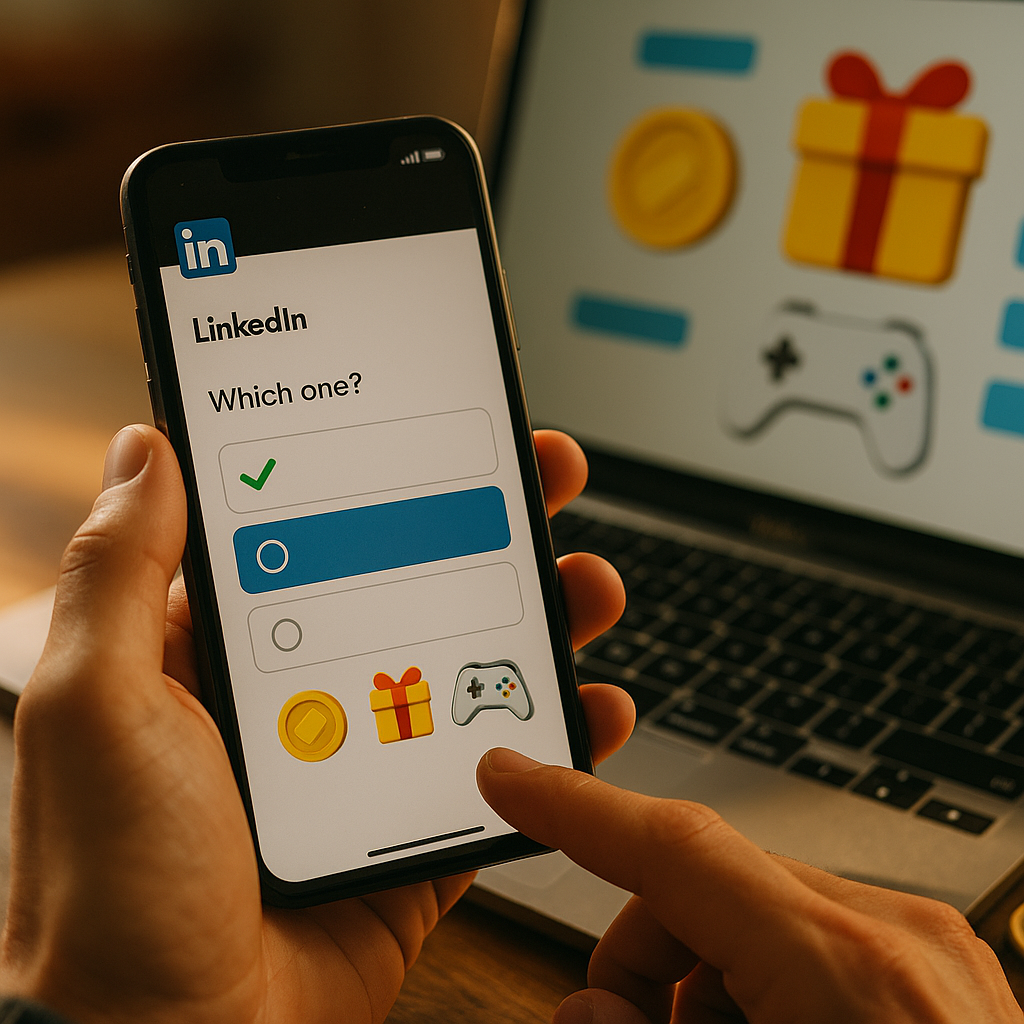
In 2025, LinkedIn rewards posts that spark meaningful actions, not passive scrolling. This playbook for interactive polls and high engagement gamification on LinkedIn shows you how to turn quick votes into conversations, leads, and community signals without gimmicks. You’ll learn formats, timing, copy patterns, and measurement that compound over time—so each post teaches you what to publish next.
LinkedIn interactive polls: choose the right objective before you post
Most polls fail because they start with an idea (“Let’s do a poll”) instead of a business outcome. Before you draft options, decide what the poll must accomplish. In practice, LinkedIn interactive polls can do four high-value jobs:
- Market sensing: Validate priorities, objections, pricing models, or feature demand. Use when you need directional insight fast.
- Audience segmentation: Identify who is in your feed (buyers, operators, founders, recruiters) so you tailor future posts and offers.
- Content research: Let your audience pick what you should publish next. This improves relevance and reduces guesswork.
- Conversation ignition: Generate replies from people who voted. The poll becomes a “permission slip” to ask a follow-up question.
Pick one primary objective per poll. Then align every element—question, options, post copy, and comments strategy—to that goal. For example, a segmentation poll should use options that map cleanly to personas (“In your role, which best fits?”), while a market-sensing poll should tie to a specific decision (“Which rollout risk worries you most?”).
Answer the follow-up question readers always have: “Can I use polls for lead generation?” Yes, but indirect lead generation works better on LinkedIn. Use the poll to start a discussion, then offer a helpful resource in the comments or in replies to people who ask. If you force the pitch in the poll itself, you reduce trust and comment quality.
EEAT note: State your context when you interpret results. A poll is not a representative survey; it’s a signal from your network. Treat it as directional input, then validate with customer calls, CRM notes, or product analytics.
LinkedIn gamification strategy: design for meaningful engagement, not vanity
Gamification works on LinkedIn when it increases participation and produces useful discussion. In 2025, the strongest LinkedIn gamification strategy is lightweight, ethical, and tied to professional value. Use these mechanics:
- Micro-commitments: Ask for a vote, then a short comment (“Vote, then comment why in 6 words”). This upgrades engagement without demanding an essay.
- Progressive disclosure: Promise a breakdown after the poll closes (“I’ll share what I learned and what I’m changing in my process”). This encourages return visits.
- Challenge framing: “Pick one option, then argue the opposite in the comments.” This creates thoughtful replies and shows nuance.
- Prediction games: “Vote first, then guess the final outcome in the comments.” People come back to see if they were right.
- Role-play scenarios: “You’re the hiring manager. Which candidate profile do you choose and why?” These produce high-signal comments.
Keep the stakes professional. Avoid “like-to-win” giveaways. Instead, reward with learning: a template, teardown, or a short audit you’ll do for a few commenters. When you offer something, make it specific and feasible (“I’ll DM a 1-page checklist to anyone who comments ‘checklist’”). Then actually deliver—trust is the multiplier.
Practical guardrails:
- Do not manipulate. Don’t ask for votes “for reach.” Ask for votes because the result will change a decision.
- Do not overload options. Four choices is the usual maximum. If you need nuance, use the comments.
- Do not hide the point. State why the question matters in the first two lines of the post.
Follow-up the reader is thinking: “Will gamification make me look less serious?” Not if the prompt matches your domain. A CFO can run scenario polls about budgeting trade-offs; a security leader can run risk prioritization polls. The tone can stay professional while still being interactive.
Poll question ideas LinkedIn: copy patterns that earn votes and comments
Great poll question ideas for LinkedIn share three traits: they’re specific, they create a real trade-off, and they invite explanation. Use these copy patterns to draft your next five polls quickly.
1) Forced trade-off pattern
Question: “If you had to choose one KPI to optimize this quarter, which is it?”
Options: Four KPIs that your audience actually uses.
Comment prompt: “What would you sacrifice to protect that KPI?”
2) Stage-based segmentation pattern
Question: “Where are you right now with [process]?”
- Exploring
- Implementing
- Optimizing
- Replacing
Comment prompt: “What’s the bottleneck at your stage?”
3) Myth vs reality pattern
Question: “Which statement is closer to your experience?”
- “Tools fix it”
- “Process fixes it”
- “People fix it”
- “Strategy fixes it”
Comment prompt: “What did you try that didn’t work?”
4) Scenario decision pattern
Question: “You have 30 days to improve [outcome]. What’s your first move?”
Comment prompt: “What’s move #2 after that?”
5) “Most overlooked” pattern
Question: “What’s the most overlooked part of [topic]?”
Comment prompt: “What changed your mind?”
How to write options that don’t confuse people
- Make options mutually exclusive: Avoid overlapping choices (“SEO” and “Content”) unless you define them.
- Keep reading level consistent: Don’t mix “Reduce churn” with “Customer success operations and renewals.”
- Anchor around the same dimension: All options should be channels, or stages, or risks—never a mix.
Common concern: “What if none of the options fit?” Add a line in the post: “If you’d pick ‘Other,’ comment it—those are often the best answers.” You can’t add an “Other” button in a standard poll, but you can design for it.
LinkedIn engagement tactics: timing, distribution, and comment engineering
A poll is a distribution asset, but it still needs intentional launch steps. Use LinkedIn engagement tactics that increase quality interaction without spam.
Before posting: pre-wire the first 30 minutes
- Write the first comment in advance: Add context, your current hypothesis, and a question. This prevents an empty comment section.
- Identify 5–10 relevant peers: People who can add insight. Do not ask them to “boost.” Instead, ask a specific question after you post: “Curious how you’d choose between A and B in your role.”
- Set a response window: If you can’t reply for hours, wait to post. Early replies train the thread toward depth.
Posting: structure for scanning
- Line 1: Why it matters (“I’m deciding X this week.”)
- Line 2: The trade-off (“Both options work, but they optimize different outcomes.”)
- Poll: Clear question and clean options
- Call to action: “Vote, then share your reasoning in one sentence.”
After posting: run a comment “ladder”
- Reply fast, then deepen: Start with a short acknowledgment, then ask a clarifying question that invites specifics (“What industry?” “What team size?” “What constraint made you pick that?”).
- Synthesize in-thread: Every 20–30 comments, add a summary comment: “So far, the theme is…” This keeps the discussion coherent and signals expertise.
- Create a second touchpoint: When the poll ends, publish a follow-up post: what won, what surprised you, and what you will do next. Tag only people who explicitly asked to be tagged.
Answer the likely question: “How often should I use polls?” Use them as a recurring format, not a daily crutch. For many professionals, one poll every 2–4 weeks is enough to maintain novelty while still generating insights. Fill the gaps with posts that apply what you learned.
Measure poll performance LinkedIn: metrics that map to business outcomes
If you only track votes, you’ll optimize for shallow reach. Measure poll performance on LinkedIn using a simple scorecard that connects to your objective.
Core engagement metrics (what happened)
- Votes: A participation indicator, not a quality indicator.
- Comments: The best proxy for meaningful engagement, especially when replies include specifics.
- Comment-to-vote ratio: Higher ratios typically mean stronger prompts and clearer stakes.
- Shares: Indicates the poll is useful enough to pass along, but verify share quality by checking who shared it.
Audience quality metrics (who engaged)
- Role and seniority of commenters: Are the right people entering the conversation?
- Company types: Are they in your target segment or adjacent?
- Repeat engagers: Are the same people coming back? That’s a community signal.
Business outcome metrics (what it produced)
- Profile visits and follow rate: Did the poll increase qualified curiosity?
- Inbound messages: Count DMs that reference the poll or the follow-up post.
- Content pipeline impact: Track which future posts came directly from poll insights and how they performed.
- Sales and recruiting signals: Mentions in discovery calls (“I saw your poll about…”), or candidate conversations initiated.
Make the results credible (EEAT)
- Disclose limitations: “This reflects my network of X professionals; it’s directional.”
- Cross-check: Compare poll outcomes with customer interviews, support tickets, win/loss notes, or product usage data.
- Document decisions: Keep a simple log: question → result → what you changed. This turns posting into an iterative system.
Reader follow-up: “What if a poll underperforms?” Treat it like a diagnostic. Usually the issue is one of these: the question is too broad, options overlap, the stakes are unclear, or the comment prompt is weak. Fix one variable and rerun a tighter version later.
Build trust with ethical gamification on LinkedIn: safety, inclusivity, and long-term authority
High engagement is only valuable if it builds authority and relationships. Ethical gamification on LinkedIn protects trust, reduces backlash, and strengthens your professional reputation.
Do:
- Use transparent intent: “I’m collecting perspectives before I update our process.”
- Invite dissent: Ask for counterexamples and edge cases. Experts respect nuance.
- Credit contributors: When you publish a follow-up, highlight insights from commenters (with permission if you quote them directly).
- Design for accessibility: Avoid jargon in options; define terms briefly in the post copy.
- Moderate calmly: Remove abuse, not disagreement. Redirect heated threads back to evidence and context.
Don’t:
- Weaponize social pressure: Avoid “Only serious professionals pick option A.”
- Bait with false binaries: Trade-offs are useful; false dilemmas are not.
- Overpromise insights: A LinkedIn poll is not peer-reviewed research. Present it as a conversation starter.
How trust compounds: When you repeatedly ask good questions, synthesize comments into actionable takeaways, and show what changed, your audience learns that engaging with you leads somewhere. That is the most durable form of gamification: participation that produces value.
FAQs
Do LinkedIn polls still work in 2025?
Yes, when you treat them as an insight and conversation tool rather than a reach hack. Polls that include clear stakes, clean options, and strong comment prompts can produce high-quality discussion and measurable downstream outcomes like profile visits, DMs, and follow-up post performance.
What is the best number of options for a LinkedIn poll?
Use four options in most cases. Four is enough to capture variety while keeping the decision simple. If you need nuance, invite “Other” answers in the comments and use those responses to create a follow-up poll or post.
How do I get more comments on a poll without being pushy?
Add a specific, low-effort comment prompt such as “Vote, then share your reason in one sentence,” and reply with clarifying questions. Also post your own first comment to set the tone and show the depth you want.
Can I use polls for B2B lead generation on LinkedIn?
Yes, indirectly. Use the poll to surface pains and priorities, then offer a relevant resource in the comments or in replies when someone asks. The goal is to earn permission and start conversations, not to funnel everyone immediately.
How often should I publish LinkedIn polls?
For most professionals and brands, one poll every 2–4 weeks is a sustainable cadence. Pair polls with non-poll posts that apply the insights you collected so your audience sees progress and expertise.
What should I do after the poll ends?
Publish a follow-up post that summarizes the results, highlights themes from the comments, and states what you will do differently because of what you learned. This closes the loop and trains your audience to engage again next time.
Interactive polls and gamified prompts work best when they serve a clear purpose: learning, segmentation, and conversation that leads to decisions. In 2025, focus on clean trade-offs, thoughtful comment engineering, and honest interpretation of results. Build a repeatable system: ask, synthesize, apply, and report back. When your audience sees outcomes, engagement stops being a metric and becomes a relationship.