


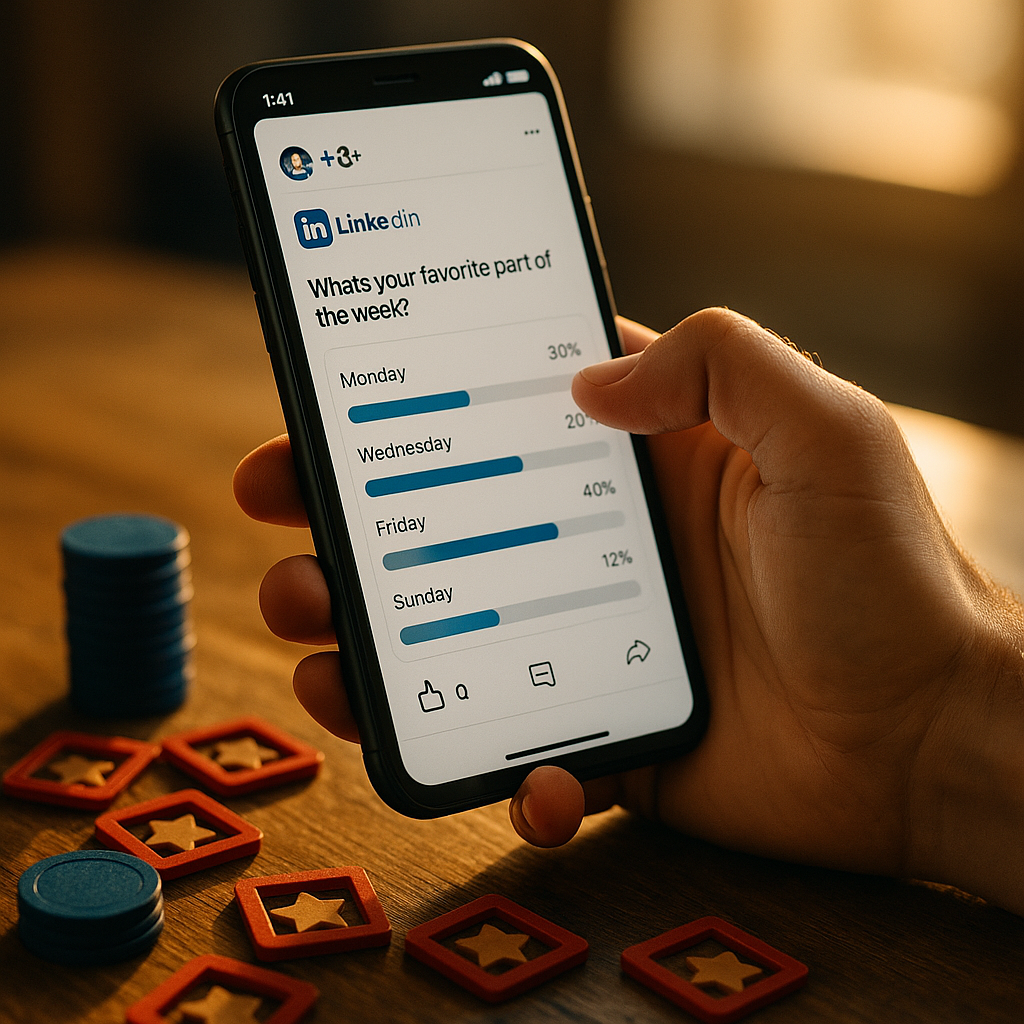
Interactive polls and high engagement gamification on LinkedIn can turn passive scrolling into measurable participation, stronger brand recall, and better first-party audience insight. In 2026, LinkedIn rewards content that sparks meaningful interaction, not empty clicks. The opportunity is clear: design experiences professionals actually want to join, then use the response data to improve targeting, messaging, and conversion. Here’s the playbook.
Why LinkedIn polls strategy matters for modern engagement
LinkedIn has matured into a platform where audience quality often matters more than audience size. For B2B marketers, founders, recruiters, consultants, and thought leaders, the value of a post is not simply reach. It is whether the interaction reveals intent, pain points, preferences, or buying readiness. That is why a strong LinkedIn polls strategy deserves a defined place in your content plan.
Polls work because they lower the effort required to engage. A user can contribute in one tap, but the best polls do more than collect votes. They start conversations in comments, invite peer comparison, and create a reason for the author to publish follow-up analysis. This gives one post multiple lives: the vote itself, the discussion it triggers, and the insights it informs later.
Gamification extends that effect. When you add mechanics such as prediction, scoring, reveal sequences, challenges, or recognition, you increase repeat participation. Professionals are busy, but they still respond to well-designed experiences that are useful, fast, and socially relevant. On LinkedIn, the key is to keep the game aligned with professional identity. Your audience wants to feel smart, current, and involved, not manipulated.
From an EEAT perspective, credibility matters. Polls should reflect real expertise, not random opinion harvesting. If you work in cybersecurity, ask about cloud risk priorities. If you lead growth marketing, ask about attribution models or creative testing bottlenecks. Relevance tells users you understand their world, which increases both participation and trust.
Core principle: every poll should answer one strategic question for your brand and one practical question for your audience. If it does only one of those, engagement may rise briefly, but value will not compound.
How to build LinkedIn poll ideas that professionals actually answer
The difference between a poll that stalls and one that attracts comments is usually not luck. It is structure. Strong LinkedIn poll ideas are specific, timely, and framed around a tension your audience recognizes immediately.
Start by choosing one of these proven poll angles:
- Priority polls: Ask what matters most right now. Example: Which KPI is hardest to improve this quarter?
- Prediction polls: Ask what users think will happen next in their industry.
- Benchmark polls: Help users compare their process, tools, or maturity against peers.
- Decision-stage polls: Surface obstacles in selection, approval, or implementation.
- Myth-versus-reality polls: Test assumptions and use comments to unpack nuance.
Then apply these rules:
- Ask one question only. If the reader has to interpret too much, votes drop.
- Make the options mutually exclusive. Overlapping answers create friction and bad data.
- Use audience language. Avoid internal jargon unless your audience uses it daily.
- Keep options balanced. Do not write three serious choices and one joke choice unless humor is the point.
- Design for comment follow-up. Add “Why?” or “What’s driving that choice?” in the post copy.
For example, a weak poll asks, “What’s your biggest marketing challenge?” A stronger version asks, “What slows budget approval the most for B2B demand generation in 2026?” and then provides clear options such as attribution uncertainty, weak forecast confidence, long procurement cycles, or leadership misalignment. The stronger poll signals expertise, narrows the context, and gives respondents a reason to discuss specifics.
Another best practice is to pre-plan your response. If your poll gets traction, comments will arrive quickly. Be ready to engage early, clarify edge cases, and thank users who add substance. LinkedIn often amplifies posts that continue generating meaningful interaction after publication.
Helpful content test: could someone use your poll results to make a better decision? If yes, your idea is likely strong enough to post.
Using LinkedIn gamification tactics without hurting credibility
LinkedIn gamification tactics work best when they reward insight, participation, or progression. They fail when they feel childish, deceptive, or disconnected from professional goals. The platform’s culture is still business-first, so the mechanics should be subtle and purposeful.
Here are effective gamification formats for LinkedIn in 2026:
- Prediction series: Ask users to predict a trend, then publish the outcome later and tag the most insightful commenters.
- Comment-to-reveal: Invite readers to comment with their answer before you reveal the correct benchmark, framework, or result in a follow-up post.
- Score-yourself frameworks: Share a short maturity checklist and ask users to count their score, then compare in comments.
- Mini challenges: Example: write your value proposition in 12 words, or rewrite a weak CTA in one sentence.
- Bracket voting: Run a multi-post showdown between tools, tactics, channels, or leadership priorities.
The most effective mechanic is often the simplest one: a structured progression. Instead of one isolated post, create a three-part sequence. Post one asks a question. Post two reveals segmented insights. Post three offers a practical template based on what the audience chose. That sequence makes users feel part of an unfolding experience, which increases return visits and follow-through.
To keep credibility high, avoid these mistakes:
- Manufactured scarcity: Do not pretend a normal insight is exclusive if it is not.
- Vanity scoring: A score should mean something actionable, not just flatter the user.
- Irrelevant rewards: Generic giveaways often attract the wrong audience and low-intent activity.
- Engagement bait: “Comment yes if you agree” is weak. Ask for useful specifics instead.
If your audience includes senior decision-makers, tie the game to expertise. For example, ask leaders to rank budget priorities and then compare responses by company size or function in a follow-up post. This positions you as a curator of market intelligence, not just a content publisher.
Rule of thumb: on LinkedIn, gamification should make the audience feel more informed and more visible, not more sold to.
Creating a high engagement LinkedIn content workflow that scales
High performance comes from systems. To produce high engagement LinkedIn content consistently, build a workflow that connects research, publishing, community management, and repurposing. This is where many teams underperform: they publish the poll, but they do not extract the full value.
A scalable workflow looks like this:
- Research audience friction points. Use sales calls, customer success notes, webinar questions, and CRM objections to identify themes.
- Map each poll to a funnel stage. Awareness polls uncover broad priorities. Consideration polls expose barriers. Decision polls surface implementation concerns.
- Write the post copy around the vote. Do not rely on the poll alone. Add context, stakes, and an invitation to explain answers.
- Schedule active response time. Reserve the first hour after posting for comment replies and follow-up prompts.
- Turn results into assets. Convert winning insights into carousels, short articles, email content, sales enablement material, or webinar talking points.
You should also define participation roles inside the team. For example, the content strategist develops the question, the subject-matter expert validates answer options, and the community manager handles comment moderation and escalation. This process improves both accuracy and speed.
Cadence matters. Weekly polls can work if the quality is high, but many brands do better with two strong polls per month paired with lighter conversational posts. The objective is not to train the audience to expect constant games. It is to build a reputation for consistently valuable prompts.
Timing still matters, but relevance matters more. Test when your audience is active by region and function, then compare vote rate, comment depth, and profile visits. Senior audiences may engage differently from practitioner audiences, and international reach may change the best publishing windows.
Operational insight: your poll is not finished when voting ends. That is when the real content opportunity starts.
Tracking LinkedIn engagement metrics that prove business value
It is easy to confuse activity with performance. To make interactive content defensible, you need LinkedIn engagement metrics that connect attention to outcomes. Likes alone are not enough. Poll votes alone are not enough either. The right measurement stack includes quality, intent, and downstream action.
Track these primary metrics:
- Vote rate: votes relative to impressions. This indicates how compelling the question was.
- Comment rate: comments relative to impressions. This shows whether the topic prompted deeper participation.
- Meaningful comment ratio: comments with explanation, examples, or follow-up questions versus low-value reactions.
- Profile visits: a strong signal that the content created curiosity about your expertise.
- Follower growth from poll days: helps isolate whether interactive content attracts the right audience.
- Click-through on follow-up assets: measures whether insight-based content converts attention into action.
- Lead quality indicators: demo requests, qualified conversations, newsletter sign-ups, or inbound messages from target personas.
You should segment results by audience type whenever possible. A poll that performs modestly overall may still be excellent if it attracts comments from buyers, industry analysts, or senior operators. Likewise, a poll with huge vote volume may be low value if it draws broad curiosity but little relevance.
Document what happened after the post. Did sales use the comment language in outreach? Did product teams learn which objections dominate? Did the next webinar topic come directly from poll feedback? These are real business outcomes and fit EEAT principles because they show your content was grounded in real-world practice and produced usable insight.
A practical reporting model includes three layers:
- Engagement layer: impressions, votes, comments, shares.
- Intent layer: profile visits, connection requests, direct messages, asset clicks.
- Outcome layer: qualified leads, meetings, influenced pipeline, customer insight captured.
Best measurement question: what did this poll help us learn, and what did we do with that learning?
Advanced LinkedIn audience engagement tactics for 2026
If you already run polls successfully, the next step is to increase depth, not just volume. Better LinkedIn audience engagement comes from personalization, sequencing, and clear editorial ownership.
First, build recurring poll franchises. A franchise is a repeatable theme your audience recognizes, such as “Monday Forecast,” “Operator’s Choice,” or “One-Question Benchmark.” Repetition lowers cognitive load and makes participation habitual. It also helps your brand own a niche conversation over time.
Second, segment by audience maturity. New followers may engage with broader, trend-led questions. Existing followers and customers often want more nuanced prompts about process, trade-offs, or execution. Do not ask the same level of question to everyone forever.
Third, use comment prompts strategically. After users vote, invite them to add context with one focused ask:
- What influenced your choice most?
- What would need to change for you to choose a different option?
- Is this issue different for enterprise versus mid-market teams?
These prompts produce richer threads and help you gather language your audience naturally uses. That language can improve future posts, landing pages, sales scripts, and webinar titles.
Fourth, publish synthesis posts. Once a poll closes, do not simply thank people for voting. Publish a concise interpretation: what surprised you, what patterns emerged in comments, where the minority view was strongest, and what action readers should consider next. This step is where authority compounds. You are not just collecting opinions. You are interpreting the market responsibly.
Finally, protect trust. If you ask for participation, demonstrate that you listened. Reference audience input in future content. Correct yourself if new information changes your perspective. Expert-led humility is a powerful trust signal in 2026.
Advanced play: turn recurring poll themes into a quarterly insights recap. This gives your audience a reason to keep participating because they can see their input shaping a larger narrative.
FAQs about LinkedIn polls and gamification
How often should I post LinkedIn polls?
For most brands, one or two high-quality polls per month is enough. If you publish more often, maintain strong relevance and clear follow-up analysis. Frequency should never reduce insight quality.
What makes a LinkedIn poll get more comments?
A strong poll asks a specific question tied to a real professional tension, uses clear answer options, and includes post copy that invites explanation. Early author replies also help sustain discussion.
Are gamified LinkedIn posts suitable for B2B audiences?
Yes, if the mechanics support learning, benchmarking, or decision-making. B2B audiences respond well to prediction posts, scorecards, and challenge formats when they are practical and respectful of professional context.
What should I avoid when using gamification on LinkedIn?
Avoid gimmicks, low-value giveaways, manipulative engagement bait, and games unrelated to your expertise. If the format weakens trust or attracts the wrong audience, it hurts long-term performance.
How do I turn poll results into leads?
Use the poll to identify pain points, then publish a follow-up asset that helps solve the issue. This can be a checklist, short guide, webinar, or case-based post. The transition from insight to solution is what creates lead opportunities.
Do LinkedIn polls work for personal brands and company pages?
Yes. Personal brands often drive stronger conversation because they feel more direct and human. Company pages can still succeed when the topic is sharp, timely, and backed by visible expertise.
How long should a LinkedIn poll stay open?
Choose a duration that matches the topic and your audience’s activity. Shorter windows can create urgency, while longer windows can improve reach across time zones. The best duration is the one that supports timely engagement and a prompt follow-up post.
Can I use poll data as market research?
Yes, but treat it as directional insight rather than a statistically representative study unless your methodology supports stronger claims. Be transparent about the sample and careful with conclusions.
Interactive polls and gamification work on LinkedIn when they serve a professional purpose, reveal real audience insight, and lead to useful follow-up content. Focus on sharp questions, credible framing, active community management, and outcome-based measurement. If each interaction teaches your audience something and teaches your brand something, engagement will grow with trust, not at the expense of it.