


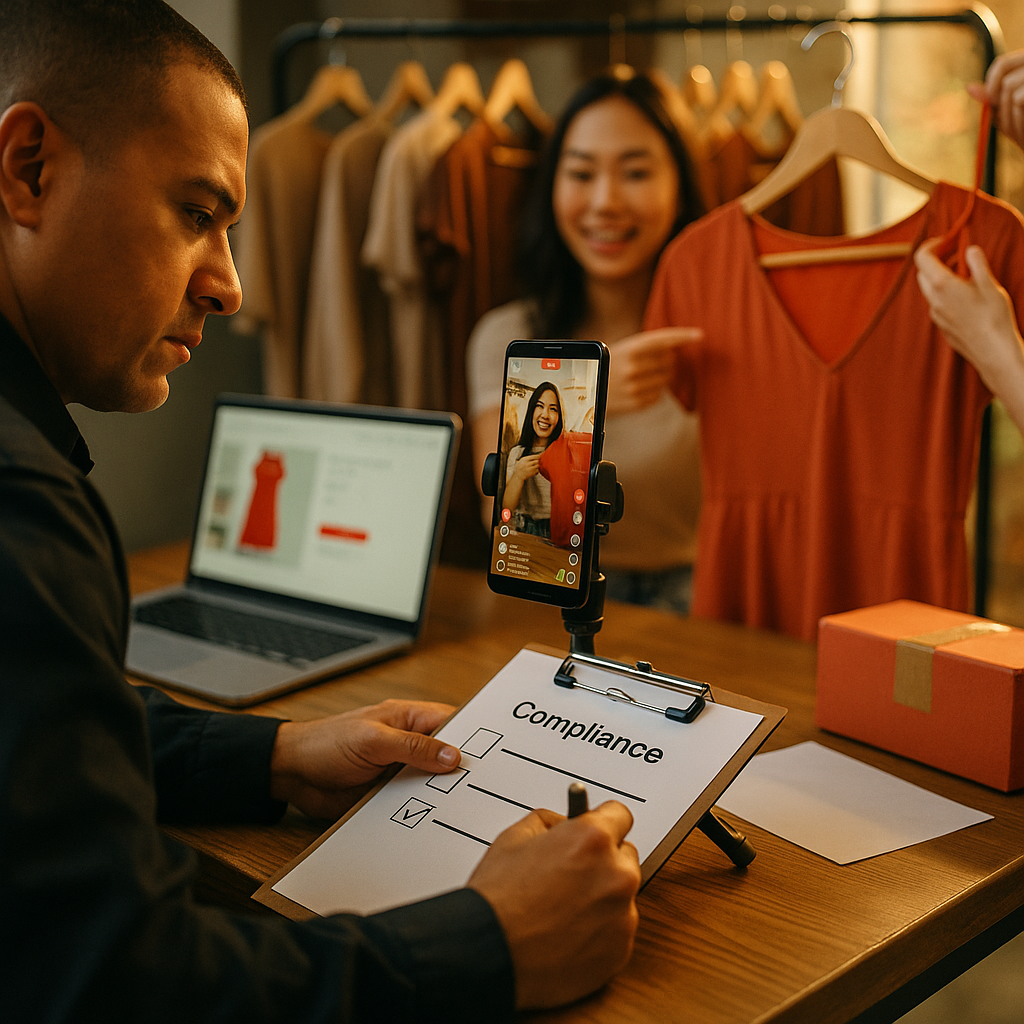
The FTC received over 2.6 million fraud reports tied to online shopping in the past year, and livestream commerce is the fastest-growing complaint category nobody’s built a real process for. If your brand runs TikTok Shop or Amazon Live activations without a documented internal escalation protocol, you’re not managing risk. You’re waiting for it.
Most brands have a vague sense that “someone” handles compliance complaints. That’s not a protocol. That’s a hope.
Why Livestream Shopping Breaks Your Existing Compliance Process
Traditional influencer compliance workflows were built for static posts. A caption goes up, someone reviews it, maybe a legal team spot-checks a sample. Livestream shopping doesn’t work that way. A host can make an undisclosed material connection claim, an unsubstantiated efficacy claim, or a fake urgency tactic (“only 3 left!”) in real time, to thousands of viewers, and the clip disappears from the main feed within minutes even though the replay often lingers.
By the time your team notices, the damage window has already closed and reopened as a saved screen recording somewhere.
This matters because the FTC has been explicit that livestream shopping events are commercial speech subject to the same disclosure rules as any other endorsement. The agency’s endorsement guidance doesn’t carve out an exception for “it happened fast.” Speed is not a defense. It’s an aggravating factor, because it suggests your review process couldn’t keep up with your own commerce format.
A complaint that sits unaddressed for two weeks looks like negligence to a regulator. A complaint that triggers a documented, tiered response within 48 hours looks like a functioning compliance program.
What Counts as an “Undisclosed Claim” in a Livestream Context?
Before you can build an escalation protocol, your team needs shared language. Ambiguity here is where most programs fail — not because nobody cares, but because the social media manager, the legal team, and the agency partner all define “disclosure failure” differently.
Undisclosed livestream shopping claims typically fall into a few buckets:
- Missing or buried material connection disclosure — no verbal “sponsored” mention, or a disclosure that appears only as tiny on-screen text during a fast-moving segment.
- Unsubstantiated product claims made verbally, off-script, that never went through your usual content approval process.
- False scarcity or urgency claims generated by the platform’s own livestream tools or by the host improvising (“selling out right now”) without factual basis.
- Price or discount claims that don’t match the actual checkout price, a growing issue as platforms auto-generate strike-through pricing.
- AI-generated or synthetic-voice hosts presenting as human reviewers without disclosure — an emerging category regulators are watching closely.
If your brand hasn’t defined these categories internally, your team is improvising triage in real time, which is exactly the failure mode that turns a fixable complaint into a regulatory referral. For related pricing and livestream risk mapping, see our TikTok Shop content policy audit on pricing and livestream risk.
The Three-Tier Escalation Model
Here’s the structure we recommend to brand compliance leads and agency partners managing multiple livestream shopping programs simultaneously. It’s deliberately simple. Complicated protocols don’t get followed under pressure.
Tier 1: Frontline Flag (0–4 hours). Any team member, community manager, or even a customer service rep, who sees or hears about a potential undisclosed claim logs it immediately in a shared tracker. No judgment calls at this stage. The bar for logging should be low: “if in doubt, log it.” This tier exists to catch signal before it’s buried in a Slack thread nobody revisits.
Tier 2: Compliance Review (4–24 hours). A designated compliance owner (not necessarily legal counsel, but someone trained on FTC endorsement standards) reviews the flagged clip, pulls the archived replay, and classifies severity. Low severity: a disclosure that was present but poorly formatted. High severity: no disclosure at all, paired with a health or earnings claim. This is also the stage where you check whether the claim originated from your creator’s own words or from an AI-assisted script your team approved — a distinction that matters enormously for liability. Brands running AI-assisted content should already have a pre-flight checklist for AI-generated ad assets feeding into this review.
Tier 3: Legal and Regulatory Escalation (24–72 hours). High-severity flags move to legal counsel, who decides whether corrective disclosure, creator communication, platform reporting, or proactive outreach to the FTC is warranted. This is also where you loop in the creator’s agency or management, document remediation steps, and, critically, close the loop with a written record showing the timeline from flag to fix.
Every tier needs a named owner, not a department. “Marketing will handle it” is not an owner. “Sarah in compliance, backup: James” is an owner.
Why Documentation Timing Is the Whole Game
Regulators don’t just evaluate whether a violation happened. They evaluate whether the company had a reasonable system for catching and correcting it. This is the same logic underpinning the FTC’s approach to substantiation more broadly, and it’s why brands running supplement or GLP-1 adjacent campaigns already build this muscle, as covered in our FTC substantiation checklist for GLP-1 creator campaigns.
A protocol without timestamps is just a flowchart on a slide. You need:
- Timestamped logs of when a flag was raised (Tier 1)
- Timestamped review notes showing severity classification (Tier 2)
- Timestamped legal decision and remediation action (Tier 3)
- Timestamped confirmation the corrective action was completed — creator re-recorded a disclosure, platform post edited, or public correction issued
This timeline is your evidence of good faith if a complaint ever does escalate externally. Compare that to a brand that discovers a complaint only after a consumer reports it to the platform or, worse, files with the FTC directly. At that point, you’re reacting to someone else’s timeline, not yours.
Where This Intersects With Platform Risk and State AG Exposure
Livestream shopping claims rarely trigger just one type of regulatory exposure. An undisclosed material connection can simultaneously violate FTC guidance, breach the platform’s own commerce terms of service, and in some states, trigger consumer protection statutes enforced by the state Attorney General. Your escalation protocol shouldn’t just ask “did this violate FTC rules?” It should route the same flag through parallel checks for platform ToS and state-level exposure, ideally using a shared framework like the one outlined in our escalation matrix aligning FTC, state AG, and platform risk.
Why does this matter operationally? Because the remediation steps differ. A platform ToS violation might just need content removal. An FTC-level disclosure failure needs documented corrective action and possibly consumer-facing correction. A state AG issue might require outside counsel with jurisdiction-specific knowledge. Treating all three as one bucket slows down your response and risks under-correcting the highest-exposure category.
This is especially relevant if your livestream programs run across TikTok Shop, Amazon Live, and Instagram simultaneously, since each platform’s own AI-generated labels or auto-captions can create disclosure conflicts your team didn’t author. We’ve covered this exact tension in platform AI labels clashing with FTC disclosure requirements, and it’s a growing source of accidental non-compliance.
Building the Tracker: What It Actually Needs to Contain
Skip the elaborate software procurement cycle. Most mid-size brands can run this effectively from a shared spreadsheet or a lightweight ticketing tool, as long as the fields are standardized across every team member who might log a flag. At minimum, track:
- Date/time of the livestream and the flagged segment
- Platform and creator/host name
- Description of the claim and screenshot or clip link
- Severity classification and who assigned it
- Escalation tier reached and date
- Remediation action and completion date
- Whether the creator’s contract included substantiation or disclosure clauses relevant to the claim
That last field matters more than people assume. If your creator agreements already contain clear disclosure obligations, your remediation conversation is a contract enforcement conversation, not a negotiation. Brands still relying on ad hoc creator terms should look at standardizing this, particularly around data and disclosure clauses, similar to the approach in our creator data processing agreement guidance for cross-jurisdiction consistency.
Industry benchmarks from eMarketer show livestream shopping continuing double-digit growth in the US, which means the volume of potential flags scales with your program’s success. A protocol that works at ten livestreams a month will buckle at fifty unless you build in staffing thresholds now, not after the backlog starts.
Training the Frontline: The Weakest Link Is Usually Awareness, Not Process
Most escalation protocols fail at Tier 1, not Tier 3. Legal teams tend to build airtight review processes for the flags that reach them. The problem is getting flags to reach them at all. Community managers watching livestream chat, customer service reps fielding post-purchase complaints, and even the creators’ own agencies need a shared understanding of what’s flaggable.
Run a quarterly 30-minute training, not an annual one. The regulatory and platform landscape moves fast enough that annual training is stale within a few months.
Keep the training scenario-based. Show real (anonymized) examples: a host saying “this literally cured my eczema” with no disclosure, a countdown timer that resets after supposedly hitting zero, an AI-voiced host reading a script without identifying itself as synthetic. That last scenario deserves its own attention as synthetic hosting tools proliferate; if your livestream program uses any AI-generated presenters, pair your escalation training with the disclosure standards in our synthetic performer disclosure clause guidance covering NY, CA, and EU AI Act requirements.
What Happens After You Actually Get a Referral Threat
Suppose the protocol didn’t catch something in time and a consumer complaint reaches the FTC’s referral desk. Does your existing tracker help you now? It should. A documented history of Tier 1 through Tier 3 responses across your program, even for unrelated incidents, demonstrates a functioning compliance culture rather than a single reactive fix.
Legal counsel handling an actual inquiry will want that history first, before anything else, because it frames the entire conversation: “here’s our standing process” versus “here’s what we did after we got caught.”
Brands that treat this as a one-time fire drill rather than an ongoing operational function tend to repeat the mistake within a year, usually with a different creator, same root cause: nobody owned Tier 1.
Next step: Audit your last three livestream shopping events this week. If you can’t produce a timestamped record of who reviewed disclosure compliance and when, you don’t have a protocol — you have a policy document nobody’s tested. Build the three-tier tracker before your next livestream airs, not after your next complaint lands.
FAQs
What triggers an FTC referral for livestream shopping complaints?
A referral typically follows a consumer complaint alleging an undisclosed material connection, a deceptive scarcity or pricing claim, or an unsubstantiated product claim made during a livestream commerce event. Volume of complaints and lack of documented brand response both increase referral likelihood.
How quickly should a brand respond to a flagged livestream claim?
Best practice is initial logging within 4 hours, compliance classification within 24 hours, and legal escalation for high-severity issues within 72 hours. Faster response demonstrates good-faith oversight if regulators ever review your process.
Who should own Tier 1 flagging in an escalation protocol?
Anyone customer-facing: community managers, customer service reps, social media coordinators. The bar should be low and inclusive, since the goal is catching signal early, not filtering it at the point of first contact.
Does an internal escalation protocol reduce legal liability?
It doesn’t eliminate liability, but a documented, consistently applied protocol demonstrates reasonable oversight, which regulators and courts weigh favorably compared to brands with no process or an inconsistently applied one.
How does livestream shopping compliance differ from standard influencer post compliance?
Livestreams involve real-time, often unscripted speech, auto-generated platform labels, and dynamic pricing or urgency tools that static posts don’t have. This requires faster review cycles and clearer definitions of what counts as an undisclosed claim.
Should synthetic or AI-hosted livestreams follow the same escalation protocol?
Yes, and they need additional scrutiny since failure to disclose an AI-generated host adds a separate compliance risk layer beyond standard endorsement disclosure requirements.
Top Influencer Marketing Agencies
The leading agencies shaping influencer marketing in 2026
Agencies ranked by campaign performance, client diversity, platform expertise, proven ROI, industry recognition, and client satisfaction. Assessed through verified case studies, reviews, and industry consultations.
Moburst

-
2

The Shelf
Boutique Beauty & Lifestyle Influencer AgencyA data-driven boutique agency specializing exclusively in beauty, wellness, and lifestyle influencer campaigns on Instagram and TikTok. Best for brands already focused on the beauty/personal care space that need curated, aesthetic-driven content.Clients: Pepsi, The Honest Company, Hims, Elf Cosmetics, Pure LeafVisit The Shelf → -
3

Audiencly
Niche Gaming & Esports Influencer AgencyA specialized agency focused exclusively on gaming and esports creators on YouTube, Twitch, and TikTok. Ideal if your campaign is 100% gaming-focused — from game launches to hardware and esports events.Clients: Epic Games, NordVPN, Ubisoft, Wargaming, Tencent GamesVisit Audiencly → -
4

Viral Nation
Global Influencer Marketing & Talent AgencyA dual talent management and marketing agency with proprietary brand safety tools and a global creator network spanning nano-influencers to celebrities across all major platforms.Clients: Meta, Activision Blizzard, Energizer, Aston Martin, WalmartVisit Viral Nation → -
5

The Influencer Marketing Factory
TikTok, Instagram & YouTube CampaignsA full-service agency with strong TikTok expertise, offering end-to-end campaign management from influencer discovery through performance reporting with a focus on platform-native content.Clients: Google, Snapchat, Universal Music, Bumble, YelpVisit TIMF → -
6

NeoReach
Enterprise Analytics & Influencer CampaignsAn enterprise-focused agency combining managed campaigns with a powerful self-service data platform for influencer search, audience analytics, and attribution modeling.Clients: Amazon, Airbnb, Netflix, Honda, The New York TimesVisit NeoReach → -
7

Ubiquitous
Creator-First Marketing PlatformA tech-driven platform combining self-service tools with managed campaign options, emphasizing speed and scalability for brands managing multiple influencer relationships.Clients: Lyft, Disney, Target, American Eagle, NetflixVisit Ubiquitous → -
8

Obviously
Scalable Enterprise Influencer CampaignsA tech-enabled agency built for high-volume campaigns, coordinating hundreds of creators simultaneously with end-to-end logistics, content rights management, and product seeding.Clients: Google, Ulta Beauty, Converse, AmazonVisit Obviously →