


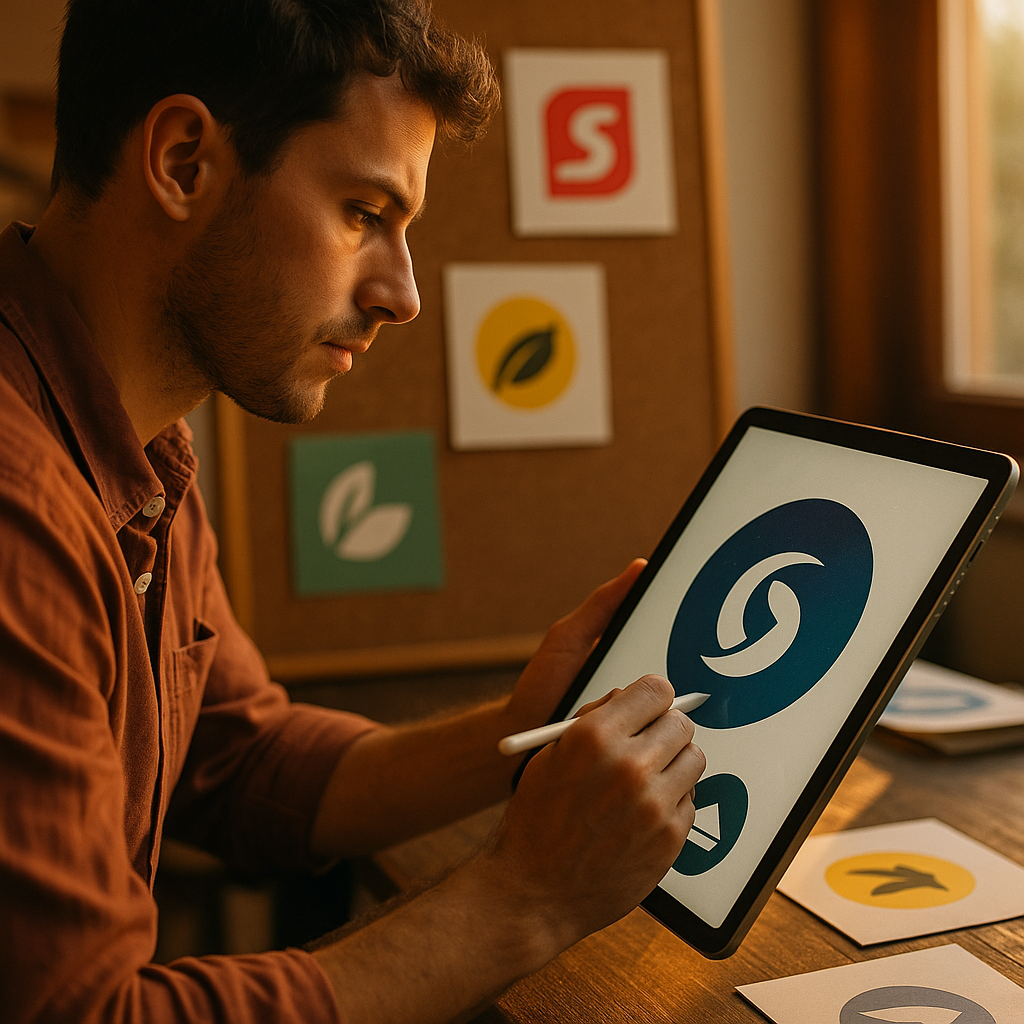
In 2025, brands rarely live in one place. They move across apps, packaging, videos, product UI, and social feeds, often in seconds. Living logos answer that reality with identities designed to adapt while staying recognizable. When paired with generative design, they can scale variation without losing control. The question is no longer “Can a logo move?”—it’s “Can it stay coherent while it does?”
Living logo design: what it is and why it matters
A living logo is a mark built to change form, motion, texture, or composition based on context—without breaking its core identity. Think of it as a system, not a single file. It can shift to fit a smartwatch screen, animate in a product onboarding flow, or respond to data in a campaign, while remaining unmistakably “you.”
In practical terms, living logo design prioritizes:
- Recognizability under variation: a stable “DNA” (geometry, proportions, a key motif, or a signature motion).
- Contextual fit: versions optimized for small sizes, dark mode, motion-first placements, or audio-reactive environments.
- System governance: clear rules that define what may change and what must never change.
Why it matters now: audiences encounter your brand in fragments. A static logo can still work, but it often forces compromises—over-simplifying for icons, over-complicating for animation, or losing impact in dynamic layouts. A living logo system avoids that trade-off by designing for change from the start.
Follow-up questions usually come next: “Will it confuse people?” It won’t if you design the invariants—those unchanging cues that the brain latches onto—then let everything else flex.
Generative design in branding: how algorithms create controlled variety
Generative design in branding uses rule-based logic—sometimes enhanced with machine learning—to produce many brand-consistent outputs from a single system. Instead of drawing 200 logo variations manually, you define constraints, inputs, and aesthetic rules; the system generates variations automatically.
Generative approaches range from simple to advanced:
- Parametric variation: adjust parameters like stroke weight, corner radius, spacing, or rotation within set limits.
- Procedural patterns: generate textures, grids, or shapes using algorithms (noise fields, tiling, Voronoi, L-systems).
- Data-driven identity: map live or campaign data (location, time, user behavior, sustainability metrics) to visual properties.
- Model-assisted exploration: use AI to explore options, then curate and lock the system with human art direction.
The most important principle is control. Generative branding should not mean “anything goes.” Strong systems define:
- Inputs (what changes): data feeds, themes, product categories, languages, or user states.
- Constraints (the guardrails): minimum contrast, legibility thresholds, safe-area rules, motion limits, and accessibility requirements.
- Invariants (the anchors): a core silhouette, signature angle, fixed relationship between elements, or a unique motion curve.
If you’re wondering where humans stay essential: in establishing the brand strategy, defining aesthetic intent, setting constraints, and curating outcomes. Algorithms can generate options; they can’t decide what your brand should stand for.
Fluid branding systems: building a recognizable “DNA” across touchpoints
Fluid branding systems treat the identity as a toolkit that adapts to each channel while remaining consistent. The logo is one component—often the most visible—but it only works as “living” when it’s connected to a broader system of type, color, layout, motion, and sound.
To build a coherent fluid system, define your brand’s DNA at three levels:
- Primary identifiers (high-recognition): the master mark, wordmark, and the most stable icon.
- Secondary identifiers (supporting cues): patterns, shape language, corner styles, illustration rules, and photography direction.
- Behavioral identifiers (how it acts): motion principles, transitions, easing, tempo, and responsiveness.
Then map that DNA to real contexts. A living logo should have planned “states,” not improvised ones:
- Micro state: favicon, app icon, small UI placements (often simplified, fewer details, stronger silhouette).
- Standard state: web headers, stationery, product pages (balanced detail and clarity).
- Motion state: video intros, UI animations, digital signage (signature movement that becomes a recognition cue).
- Expressive state: campaigns, collaborations, events (more variation, but still within constraints).
A common follow-up: “How do we keep it consistent globally?” Use a system of tokens and rules. For example, define a palette with accessible contrast pairs, a type scale, spacing units, and motion parameters. If every team draws from the same tokens, the brand stays cohesive even as outputs vary.
Algorithmic logos and identity rules: constraints, tokens, and governance
Algorithmic logos succeed when governance is designed as carefully as aesthetics. Without rules, you get drift: uneven quality, inconsistent emotion, and assets that look “AI-generated” rather than brand-authored.
Build governance into three layers:
- Design constraints: the non-negotiables that protect recognition and legibility.
- Production constraints: the technical limits that ensure performance and compatibility.
- Approval constraints: the workflow rules that keep outputs on-brand.
Practical constraints that matter in 2025:
- Legibility thresholds: set minimum sizes for each state and define when the system must switch to a simplified mark.
- Contrast and accessibility: require contrast-safe color pairings and limit low-contrast textures in essential UI uses.
- Motion limits: cap speed, strobe-like effects, and rapid flashing; define reduced-motion behavior for accessibility settings.
- Print and fabrication rules: specify flat-color versions, spot-color equivalents, and minimum stroke widths for embroidery, engraving, or packaging.
Tokens turn brand rules into reusable building blocks:
- Color tokens: primary, secondary, semantic (success/warning), dark-mode pairs, and campaign accents.
- Typography tokens: families, weights, optical sizes, and fallback stacks for global languages.
- Shape tokens: corner radii, stroke profiles, and curvature rules that keep geometry consistent.
- Motion tokens: easing curves, durations, delays, and transition styles.
Governance also includes curation. Even when a system can generate thousands of outputs, most brands should publish a curated library of “approved” variations for common use cases, plus a controlled generator for advanced teams. That balance improves quality and keeps internal adoption high.
Dynamic brand identity in practice: workflow, tools, and measurement
A dynamic brand identity is only as good as the workflow behind it. If it takes weeks to generate a campaign lockup or if engineers can’t implement the rules, the system will be ignored. Aim for a pipeline that supports both designers and product teams.
A practical workflow looks like this:
- 1) Define strategy and signals: what should the living logo express (trust, speed, playfulness), and what inputs drive variation (product line, geography, user state, data)?
- 2) Prototype the system: start with a small set of parameters and constraints; prove recognizability at tiny sizes and in motion.
- 3) Build a curated set: create “default” and “safe” variants for everyday use, including monochrome and reduced-motion versions.
- 4) Productionize: package assets (SVG, Lottie, video), document rules, and provide templates for common channels.
- 5) Test and iterate: validate accessibility, performance, and recognition; refine constraints and tokens.
Tools will vary by team, but the capabilities you need are consistent:
- Parametric design and scripting for generating variations reliably.
- Motion design tooling for signature animation and responsive states.
- Design systems integration so brand tokens align with product UI tokens.
- Version control and asset delivery so teams pull the latest approved outputs.
Measurement is often overlooked. You can and should evaluate a living logo system using:
- Recognition checks: quick internal and external tests asking viewers to identify the brand from variants.
- Accessibility validation: contrast audits, reduced-motion compliance, and readability tests across devices.
- Performance metrics: file size, render time, and battery impact in-app.
- Adoption metrics: how often teams use the system vs. creating off-brand one-offs.
If you anticipate the next question—“How do we avoid looking trendy?”—the answer is to ground the system in brand meaning. Generative variation should express your story: what changes should feel intentional, not decorative.
Brand authenticity and EEAT: trust, accessibility, and responsible AI use
Living logos and generative systems can strengthen trust when they are designed responsibly. They can also damage credibility if they produce inconsistent quality, mimic competitors, or create accessibility problems. EEAT-friendly branding focuses on expertise, clear decision-making, and user benefit.
To align with EEAT best practices in 2025, prioritize:
- Expert-led direction: document the strategic rationale for the system, not just the visuals. Explain what the brand promises and how the identity expresses it.
- Transparent governance: publish internal rules, ownership, and approval paths so the identity doesn’t devolve into subjective debates.
- Accessibility by default: include reduced-motion variants, high-contrast options, and clear minimum-size rules.
- Originality and rights safety: use licensed type and owned assets; avoid training or generating outputs that replicate protected marks or recognizable styles too closely.
- Human curation: ensure outputs are reviewed for meaning, tone, and cultural sensitivity—especially for global campaigns.
Responsible AI use in branding also includes operational safeguards:
- Data minimization: if personalization drives logo behavior, avoid using sensitive user data; favor contextual or aggregated signals.
- Auditability: keep a record of generator settings and versions so you can reproduce or roll back outputs.
- Bias and cultural review: test whether generated forms unintentionally resemble symbols with negative meanings in certain regions.
The payoff is a brand that feels alive without feeling random. When the system is intentional, audiences experience consistency as a pattern of behavior, not a single frozen graphic.
FAQs
What is the difference between a living logo and an animated logo?
An animated logo is usually one fixed design that moves. A living logo is a flexible system with multiple states and variants, often responsive to context or data, designed to remain recognizable across many outputs.
Will generative design make our brand look inconsistent?
Not if you define invariants and constraints. Inconsistency comes from uncontrolled parameters. A strong generative system locks key cues (silhouette, proportions, signature motion) and limits variation to approved ranges.
How do we choose what can change in a living logo?
Start with what your audience uses to recognize you fastest: outline, a distinctive letterform, a symbol relationship, or a motion signature. Keep those stable. Allow change in areas that add expression without harming recognition, like texture, color accents, or background patterns.
Are living logos practical for small businesses or only big brands?
They can work for smaller brands if scoped correctly. Begin with a minimal system: a master mark, a simplified icon, and one motion behavior. Add generative variation only where it reduces effort (templates, social assets) rather than adding complexity.
How do we ensure accessibility with a dynamic identity?
Provide reduced-motion behavior, enforce contrast-safe color pairs, test legibility at small sizes, and set rules for when the system must switch to a simplified mark. Treat accessibility as a constraint in the generator, not a manual afterthought.
What deliverables should a living logo system include?
Include a master logo set (full color, mono, reverse), responsive sizes, motion assets, a parameter/constraint spec, brand tokens (color/type/motion), templates for key channels, and a curated library of approved variants with usage rules.
Living logos and generative design succeed when they behave like a disciplined identity system, not a novelty. Build a recognizable DNA, define constraints, and operationalize the workflow so teams can use it without friction. In 2025, the strongest fluid branding feels consistent because it is governed, accessible, and purpose-led. Design for change—then control it—so every variation strengthens trust.