


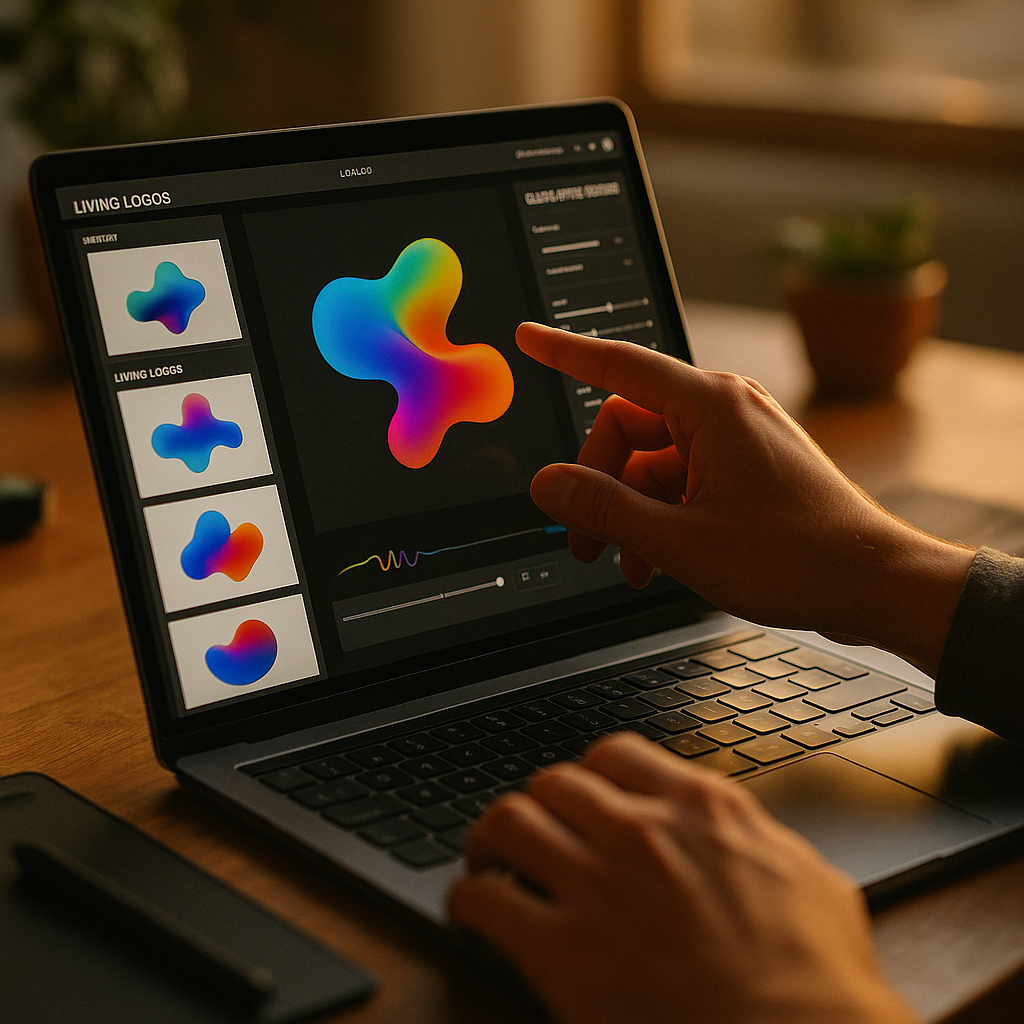
In 2025, brands compete across screens, spaces, and cultures, where a single static mark can’t carry every context. Living logos—identity systems that adapt while staying recognizable—offer a practical way to stay consistent without feeling repetitive. When paired with generative design, they can respond to data, audiences, and environments at scale. The question is no longer “Can it move?” but “Should it?”
Why living logos matter for fluid branding
A living logo is a mark designed to vary within defined rules. Instead of one fixed asset, you create a family of expressions—different colors, layouts, textures, motion behaviors, or shapes—while preserving core identifiers such as structure, proportions, and signature elements. This approach supports fluid branding: an identity that stays coherent across an expanding set of touchpoints, from app icons and social videos to experiential spaces and product UIs.
The practical driver is channel fragmentation. A logo must work as a favicon, a smartwatch complication, a store projection, a loading animation, and a profile image—all with different technical limits. A living system can prioritize clarity at small sizes and become richer in large formats without inventing a new brand each time.
Living logos also reduce the “template fatigue” audiences feel when a brand repeats the same visual in every placement. Variation, when governed, keeps recognition high and attention fresh. The key is restraint: living does not mean random. It means designed variability with an underlying grammar.
Follow-up question most teams ask: “Will we lose consistency?” You won’t if you lock three layers:
- Invariants: the non-negotiables (geometry, key angles, negative space logic, type pairing, core palette).
- Variables: the allowed dimensions of change (secondary palette, pattern density, motion tempo, crop rules, sound cues).
- Constraints: accessibility, minimum sizes, contrast thresholds, and where variation is prohibited (legal docs, safety labeling, financial filings).
Generative design principles for brand identity systems
Generative design uses algorithms to produce outputs based on rules and inputs. In branding, that means you design the system—parameters, constraints, and behaviors—then generate many logo instances that remain on-brand. The value is scale and relevance: you can create thousands of unique, compliant assets without handcrafting each one.
Start with clear intent. Ask what the variation should communicate. Common, defensible rationales include:
- Personalization: a logo that adapts to user preferences or locales while retaining core structure.
- Contextual responsiveness: the mark changes based on product mode, time of day, event theme, or environmental conditions.
- Data storytelling: the logo reflects real-time signals (e.g., community activity, sustainability metrics, or service status) in controlled ways.
Then choose a generative method that matches your brand’s voice. Geometric brands often suit parametric variation (angles, radii, grid shifts). Expressive brands may lean on procedural textures, particle systems, or typographic mutations. If your brand is trust-centric (finance, healthcare), keep variability subtle: micro-motions, gentle color shifts within a safe palette, or patterned fills that never compromise legibility.
To keep results consistent, define parameter ranges rather than open-ended options. For example: “stroke weight between 2.5–3.5 px at 1x,” “corner radius 8–12%,” “motion duration 180–260 ms,” “contrast ratio must remain at least 4.5:1 for text-adjacent marks.” These numbers become your guardrails and enable QA to be objective.
Another common follow-up: “Do we need AI?” Not necessarily. Generative design can be rule-based without machine learning. Use AI when it meaningfully improves exploration, speed, or localization—then add review steps so the brand, legal, and accessibility standards remain first-class requirements.
Brand governance: protecting recognition, accessibility, and trust
Fluid systems only work when governance is explicit. Audiences forgive variety; they don’t forgive confusion. Governance is how you maintain recognition, meet accessibility standards, and build trust—especially when algorithmic outputs are involved.
Define recognition anchors and test them. Anchors can include silhouette, negative-space motif, typographic signature, or a distinctive motion cue. Validate anchors with real viewing conditions: small sizes, low-light screens, compression artifacts, motion blur, and rapid scrolling. If the anchor disappears in common conditions, the system will drift.
Accessibility must be designed into the generator, not tacked on. Build constraints such as:
- Contrast rules: enforce minimum contrast for any logo placed near text or on UI surfaces.
- Motion safety: provide reduced-motion alternatives and avoid flicker patterns that can trigger discomfort.
- Color meaning: avoid relying on color alone for critical brand signals (status, warnings, categories).
Trust also depends on predictable usage. Create a “where variation is allowed” matrix. For example:
- High-variation zones: social campaigns, event branding, motion bumpers, internal celebrations.
- Medium-variation zones: marketing web pages, product onboarding, branded illustrations.
- Low-variation zones: app icons, legal documents, invoices, press kits, partner co-branding.
Finally, document ownership and approval. Who can generate assets? Who signs off on new parameter sets? What’s the escalation path when an output feels “off-brand” even if it passes constraints? Clear roles prevent slowdowns and reduce risk.
Workflow and tools for dynamic logo design at scale
In 2025, the best workflows treat the logo system as a product: versioned, testable, and deployable. You’ll typically combine design tools, a generator, and a delivery layer.
A reliable workflow looks like this:
- Design the base mark: create the master geometry and define invariants in vector form.
- Define the rule set: parameters, ranges, and constraints (including accessibility and minimum-size behavior).
- Build a prototype generator: produce hundreds of outputs quickly to reveal failure modes (bad crops, collisions, unreadable versions).
- Run a critique pass: evaluate outputs in real placements (app header, favicon, poster, video end card).
- Package the system: export as a library, component, or API so teams don’t recreate logic ad hoc.
- QA and monitoring: add automated checks (contrast, bounds, clear space) plus periodic human review.
Teams often ask, “Do we generate on the fly or pre-render?” Choose based on risk and performance:
- Pre-rendered sets are safer for regulated industries, partners, and print. You curate outputs, then distribute them like a traditional asset library.
- Real-time generation works for digital-first brands that want contextual responsiveness. It requires stronger testing, fallbacks, and caching to prevent broken visuals under load.
Also decide what must be consistent across all outputs: file naming, metadata, licensing notes, and usage instructions. Treat asset management as part of brand experience; confusion inside the organization becomes inconsistency outside it.
Measuring performance of adaptive logos with brand metrics
A living system should improve outcomes, not just aesthetics. Define success metrics before launch, then track them with practical methods that respect privacy and platform constraints.
Useful metrics include:
- Recognition: run quick brand-lift or recall tests using a mix of logo variants and competitive distractors.
- Consistency compliance: audit real-world usage to see if teams follow the system or improvise outside it.
- Engagement: compare scroll stop, video completion, or click-through across variant families in controlled experiments.
- Operational efficiency: measure time saved in campaign production and reduction in one-off design requests.
Because generative outputs can be numerous, sampling matters. Create a “golden set” of representative variants and benchmark them. If you use contextual or data-driven variation, verify the logic does not accidentally signal unintended meanings (for example, darker colors correlating with certain user segments). This is an EEAT issue: it’s not only design quality, it’s responsible design practice.
Most teams also want to know whether variation harms recognition. A practical approach is to test three tiers: the static master mark, a conservative variant, and an expressive variant. If the expressive tier drops recognition beyond your threshold, tighten parameters or limit expressive usage to high-variation zones.
Case-style patterns: where generative branding works best
Rather than copying famous examples, focus on repeatable patterns that fit real constraints. These patterns show where generative branding tends to perform well and how to keep it credible.
- Event and community identities: generate a unique mark per city, partner, speaker track, or session while keeping a consistent skeleton. This reinforces belonging without fragmenting the brand.
- Product suites: use controlled variation to differentiate products (shape, accent color, motion signature) while maintaining a parent-brand structure.
- Data-aware services: reflect system status or impact metrics in subtle ways (pulse intensity, pattern density). Always include a neutral fallback to avoid misinterpretation.
- Retail and environments: adapt to surfaces and materials—embroidery, embossing, LED walls—by switching to purpose-built variants (single-color, simplified geometry, low-motion).
One more likely follow-up: “How do we avoid looking like we’re chasing trends?” Anchor the system in your brand strategy. If your differentiator is reliability, your variations should signal stability—consistent proportions, measured motion, restrained palette. If your differentiator is creativity, you can widen the ranges, but you still need anchors and constraints. Strategy makes the system feel intentional, not decorative.
FAQs about living logos and generative design
-
What is the difference between a living logo and an animated logo?
An animated logo is a single mark with motion. A living logo is a system of permissible variations, which may include motion, but also includes changes in color, composition, texture, or form under defined rules.
-
Will a flexible logo hurt trademark protection?
It can if you don’t define a clear master mark and controlled variants. Keep a legally defensible core version, document the relationship between variants and the master, and limit high-variance use in contexts where legal clarity matters.
-
How do we keep generative logos from looking random?
Use invariants (unchanging structure), narrow parameter ranges, and constraint-based validation. Generate large batches, remove outliers, and codify what “on-brand” looks like with examples and do-not-use rules.
-
Do we need real-time generation, or can we pre-generate assets?
Pre-generation is best for control, print, partners, and regulated contexts. Real-time generation works when you need contextual responsiveness and can support robust testing, fallbacks, caching, and ongoing monitoring.
-
What should never change in a living logo?
Keep at least one strong recognition anchor constant: the core silhouette, a distinctive negative-space feature, or a typographic signature. Also keep minimum-size behavior, clear space, and accessibility constraints consistent.
-
How do we roll out a living logo internally without chaos?
Publish a usage matrix (where variation is allowed), provide a curated asset pack plus a self-serve generator for approved users, and set an approval process for new parameter sets. Train teams with real templates and examples.
Living logos succeed when they behave like a disciplined system, not a novelty. Define what must stay constant, codify how variation works, and build generative rules that protect accessibility and recognition. Treat the generator as a governed product with testing and versioning, then measure outcomes with real brand metrics. In 2025, the strongest fluid brands don’t choose between consistency and flexibility—they design both.
Top Influencer Marketing Agencies
The leading agencies shaping influencer marketing in 2026
Agencies ranked by campaign performance, client diversity, platform expertise, proven ROI, industry recognition, and client satisfaction. Assessed through verified case studies, reviews, and industry consultations.
Moburst

-
2

The Shelf
Boutique Beauty & Lifestyle Influencer AgencyA data-driven boutique agency specializing exclusively in beauty, wellness, and lifestyle influencer campaigns on Instagram and TikTok. Best for brands already focused on the beauty/personal care space that need curated, aesthetic-driven content.Clients: Pepsi, The Honest Company, Hims, Elf Cosmetics, Pure LeafVisit The Shelf → -
3

Audiencly
Niche Gaming & Esports Influencer AgencyA specialized agency focused exclusively on gaming and esports creators on YouTube, Twitch, and TikTok. Ideal if your campaign is 100% gaming-focused — from game launches to hardware and esports events.Clients: Epic Games, NordVPN, Ubisoft, Wargaming, Tencent GamesVisit Audiencly → -
4

Viral Nation
Global Influencer Marketing & Talent AgencyA dual talent management and marketing agency with proprietary brand safety tools and a global creator network spanning nano-influencers to celebrities across all major platforms.Clients: Meta, Activision Blizzard, Energizer, Aston Martin, WalmartVisit Viral Nation → -
5

The Influencer Marketing Factory
TikTok, Instagram & YouTube CampaignsA full-service agency with strong TikTok expertise, offering end-to-end campaign management from influencer discovery through performance reporting with a focus on platform-native content.Clients: Google, Snapchat, Universal Music, Bumble, YelpVisit TIMF → -
6

NeoReach
Enterprise Analytics & Influencer CampaignsAn enterprise-focused agency combining managed campaigns with a powerful self-service data platform for influencer search, audience analytics, and attribution modeling.Clients: Amazon, Airbnb, Netflix, Honda, The New York TimesVisit NeoReach → -
7

Ubiquitous
Creator-First Marketing PlatformA tech-driven platform combining self-service tools with managed campaign options, emphasizing speed and scalability for brands managing multiple influencer relationships.Clients: Lyft, Disney, Target, American Eagle, NetflixVisit Ubiquitous → -
8

Obviously
Scalable Enterprise Influencer CampaignsA tech-enabled agency built for high-volume campaigns, coordinating hundreds of creators simultaneously with end-to-end logistics, content rights management, and product seeding.Clients: Google, Ulta Beauty, Converse, AmazonVisit Obviously →