


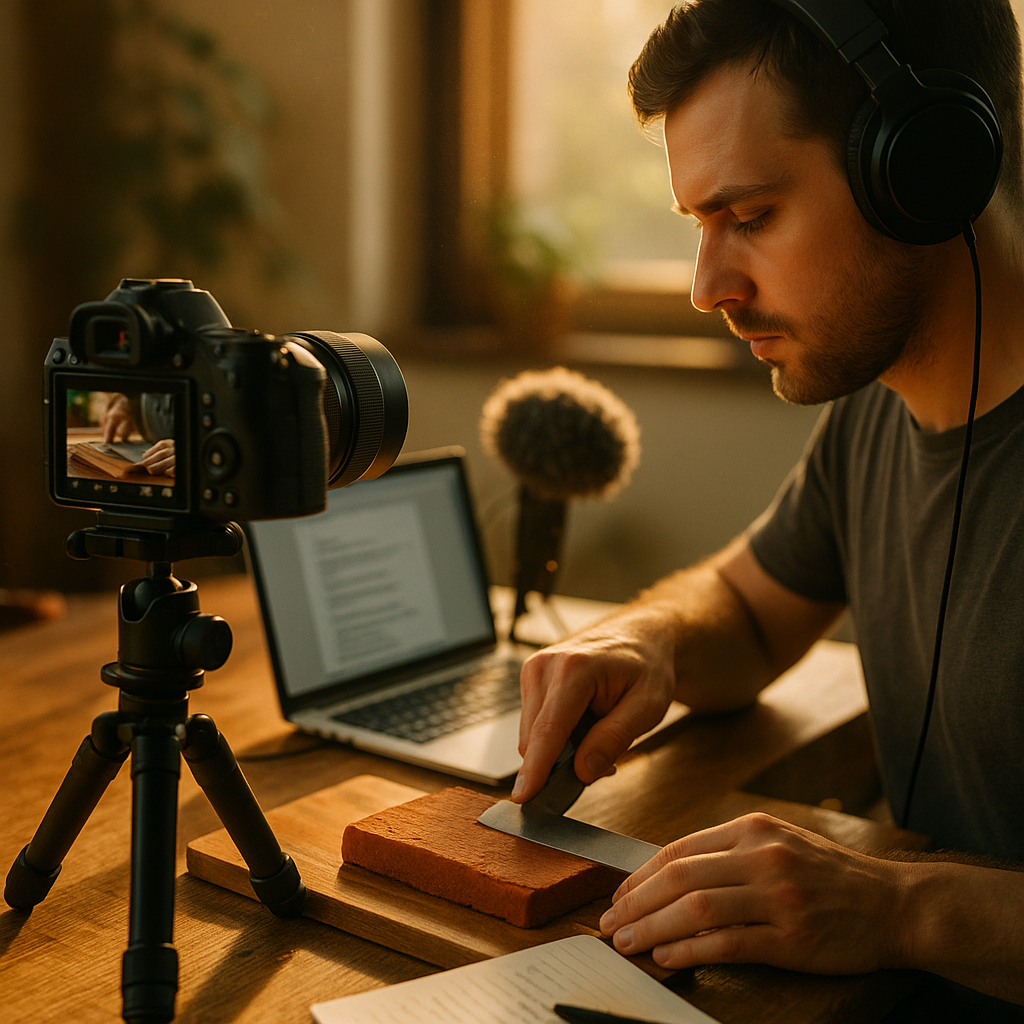
TikTok’s #satisfying tag has racked up tens of billions of views, and the oddly specific niche of ASMR adjacent “process” content regularly outperforms standard product demos by double digit engagement margins. If your home or beauty brand isn’t scripting satisfying process videos yet, you’re leaving reach on the table that costs nothing but a little production discipline.
This isn’t about whispering into a microphone for ten minutes. It’s about structuring sensory triggers, product reveals, and pacing so the content earns watch time while still doing a job: selling.
Why “Satisfying” Is a Performance Metric, Not Just a Vibe
Platforms reward completion rate and rewatch behavior more than almost any other signal. Satisfying content, think slow pours, clean cuts, crisp snaps, oddly perfect symmetry, triggers exactly that. Viewers don’t scroll away from a soap bar being sliced into ribbons or a serum dropper releasing one perfect bead. They watch it twice.
For brand marketers, that translates into cheaper organic reach and stronger retention on paid placements. A 2024 Sprout Social analysis noted that sensory and process driven content consistently ranks among the highest dwell time categories on short form video, a trend that’s only intensified as algorithms lean harder into watch time as a ranking signal (source).
Satisfying process content works because it hijacks a biological response, not a marketing hook. That makes it harder to fake and easier to measure.
The category sits adjacent to full ASMR, which relies on binaural audio and whisper triggers. Brands don’t need to go that deep. A clean macro shot of product texture, paired with crisp foley audio, does most of the work without requiring a dedicated ASMR creator roster.
What Home and Beauty Brands Are Actually Scripting
The format works across categories, but it overperforms in two verticals specifically: home goods and beauty. Both have inherently tactile products, texture, pour, scoop, swipe, that translate well to close up, sound rich footage.
- Beauty: serum drops, cream swirls, powder compacting, lipstick bullet reveals, packaging unboxing with satisfying click closures.
- Home: cleaning product foam reveals, candle wick trims, organizer snap fits, fabric softener pours, slime-adjacent cleaning putty extraction from keyboards or vents.
Cleaning content in particular has become its own subgenre. Grout brightening, baseboard wipe downs, and “satisfying reset” videos pull enormous engagement because they combine transformation with sensory payoff. A brand like Method or Mrs. Meyer’s doesn’t need a celebrity partnership to win here. They need a creator who understands pacing and a script that controls for brand visibility without breaking the trance.
That tension, keeping the brand name visible while not interrupting the sensory flow, is the single hardest part of scripting this format. Get it wrong and you’ve made ASMR content that happens to feature a product. Get it right and you’ve made an ad that doesn’t feel like one.
The Three-Beat Structure That Actually Works
Most high-performing satisfying process videos follow a loose but consistent rhythm:
- Setup (0 to 2 seconds): Establish the object and the anticipated action. No dialogue. Let the product and the implied motion do the hooking.
- Process (2 to 12 seconds): The core sensory moment. Pour, scoop, snap, swipe, peel. This is where sound design and camera stability matter more than anything else in the script.
- Reveal and reset (12 to 20 seconds): Show the finished state, the clean surface, the perfect swatch, the sealed container. End on stillness, not motion. Stillness is what triggers the rewatch.
Notice there’s barely any talking in that structure. That’s intentional. Dialogue breaks the trance state these videos are built on. If you need a CTA, put it in text overlay or a caption, not narration. For brands experimenting with mute-friendly formats more broadly, the approach overlaps heavily with what we’ve covered in silent-first video editing, where visual pacing has to carry the entire narrative.
Scripting Without Killing the Satisfaction
Here’s the paradox every brand runs into: scripting implies control, and control is the enemy of a format that’s supposed to feel effortless and organic. The solution isn’t to script dialogue. It’s to script the shot list, the timing, and the sound cues.
A usable brief for a creator should include:
- Shot sequence: Exact order of actions (unbox, open, scoop, swipe, close).
- Sound priority: Which moment needs the cleanest audio capture (usually the texture moment, not the unboxing).
- Brand visibility cue: Where the logo or packaging needs to be clearly in frame without becoming the focal point.
- Pacing notes: Slow motion cues, cut timing, and whether a loop-back ending is appropriate.
- Caption and CTA placement: Text overlay only, timed to the reveal beat, not the process beat.
This is less a script and more a choreography sheet. Creators who specialize in this format, and there’s a growing cohort of them, will often push back on over-scripted dialogue because they know it tanks performance. Trust that instinct. Your job as the brand is to protect the sensory integrity of the content while making sure your product is unmistakably the star.
The best brief for satisfying content reads more like a cinematography note than a marketing script. If your document has quotable lines in it, you’ve probably over-engineered the format.
Compliance Still Applies, Even When Nobody’s Talking
Just because there’s no spoken claim doesn’t mean disclosure and FTC obligations disappear. A sponsored satisfying video featuring a skincare product still needs a clear #ad or #sponsored disclosure, per FTC endorsement guidelines. Visual-only content sometimes gets treated as a gray area by creators who assume disclosure rules only apply to spoken endorsements. They don’t.
The bigger risk area is implied claims. A “before and after” cleaning video that shows a stain vanishing in one wipe implies efficacy. If that result was staged, sped up, or cherry-picked, you’re exposed. Brands scripting transformation-heavy satisfying content should look at how disclosure and trust are handled in myth vs fact video formats, where the same honesty standards apply even without a voiceover.
Platform-specific ad policies matter too. TikTok and Meta both have rules around manipulated demonstrations in paid content, and retail media networks are getting stricter about verifiable product claims in any sponsored video, satisfying or not. If you’re running this content through paid channels, cross check it against the same review standards used for retail media ad review before it goes live.
Where This Fits in a Broader Content Library
Satisfying process videos rarely work as a standalone strategy. They’re a top-of-funnel reach play that feeds a larger content ecosystem. Think of them as the scroll-stopper that earns the view, while other formats, tutorials, reviews, comparisons, do the conversion work further down.
Brands building organic libraries benefit from treating these clips the way they’d treat any other reusable asset: tag them, categorize by product line, and feed high performers into paid boosting once organic data confirms what’s working. This mirrors the approach outlined in short form video libraries, where reach and ROI are treated as two separate optimization problems rather than one.
It’s also worth testing satisfying cuts against split screen reaction formats to see which drives more saves versus shares. Saves tend to correlate with purchase intent in beauty categories specifically, since viewers bookmark process videos as a reference for technique, not just entertainment. If your team already runs reaction-style testing, the structure used in split screen duet responses is a reasonable template to adapt for A/B testing satisfying cuts against more conversational formats.
Measuring What Actually Matters
Standard engagement metrics undersell this format if you’re only looking at likes and comments. The metrics that matter more:
- Average watch time percentage: This format should consistently clear 80 percent completion on sub-15 second clips.
- Rewatch rate: Platforms like TikTok surface this in creator analytics. A high rewatch rate is the clearest signal the sensory hook worked.
- Save rate: Particularly important for beauty, where viewers treat the clip as a tutorial reference.
- Sound-on retention: If your analytics show high drop-off the moment sound is required, your audio design needs work, not your script.
Run these numbers against your existing content benchmarks from platforms like eMarketer or your own paid media dashboards (TikTok Ads Manager breaks this out well) to see if satisfying content is actually earning cheaper reach than your standard demo videos. In most home and beauty accounts we’ve reviewed, it does, often by a meaningful margin.
FAQs
What makes a process video “satisfying” instead of just a product demo?
Pacing, sound design, and a clean visual payoff. A demo explains a product. A satisfying video lets the sensory action, the pour, the snap, the swipe, do the communicating without narration.
Do satisfying videos require ASMR-trained creators?
No. Full ASMR requires specialized mic technique and whisper-based delivery. Satisfying process content just needs clean audio capture, steady hands, and good lighting. Most skilled UGC creators can produce it with a clear shot brief.
How do you keep branding visible without breaking the sensory flow?
Place packaging and logos naturally in the frame during setup and reveal beats, not during the core process beat. Overlay text for CTAs instead of narration.
Does this content still need FTC disclosure if there’s no talking?
Yes. Sponsored content requires clear disclosure regardless of format. Visual-only videos still need an #ad or #sponsored tag per FTC endorsement guidelines.
What’s the ideal length for a satisfying process video?
Most top performers run 10 to 20 seconds. Longer cuts work for compilation style content, but single-moment clips perform best short, looped, and rewatchable.
Start by auditing one product line for its most tactile moment, the pour, the snap, the swipe, and build a single 15-second satisfying cut around it before scaling the format across your catalog.
Top Influencer Marketing Agencies
The leading agencies shaping influencer marketing in 2026
Agencies ranked by campaign performance, client diversity, platform expertise, proven ROI, industry recognition, and client satisfaction. Assessed through verified case studies, reviews, and industry consultations.
Moburst

-
2

The Shelf
Boutique Beauty & Lifestyle Influencer AgencyA data-driven boutique agency specializing exclusively in beauty, wellness, and lifestyle influencer campaigns on Instagram and TikTok. Best for brands already focused on the beauty/personal care space that need curated, aesthetic-driven content.Clients: Pepsi, The Honest Company, Hims, Elf Cosmetics, Pure LeafVisit The Shelf → -
3

Audiencly
Niche Gaming & Esports Influencer AgencyA specialized agency focused exclusively on gaming and esports creators on YouTube, Twitch, and TikTok. Ideal if your campaign is 100% gaming-focused — from game launches to hardware and esports events.Clients: Epic Games, NordVPN, Ubisoft, Wargaming, Tencent GamesVisit Audiencly → -
4

Viral Nation
Global Influencer Marketing & Talent AgencyA dual talent management and marketing agency with proprietary brand safety tools and a global creator network spanning nano-influencers to celebrities across all major platforms.Clients: Meta, Activision Blizzard, Energizer, Aston Martin, WalmartVisit Viral Nation → -
5

The Influencer Marketing Factory
TikTok, Instagram & YouTube CampaignsA full-service agency with strong TikTok expertise, offering end-to-end campaign management from influencer discovery through performance reporting with a focus on platform-native content.Clients: Google, Snapchat, Universal Music, Bumble, YelpVisit TIMF → -
6

NeoReach
Enterprise Analytics & Influencer CampaignsAn enterprise-focused agency combining managed campaigns with a powerful self-service data platform for influencer search, audience analytics, and attribution modeling.Clients: Amazon, Airbnb, Netflix, Honda, The New York TimesVisit NeoReach → -
7

Ubiquitous
Creator-First Marketing PlatformA tech-driven platform combining self-service tools with managed campaign options, emphasizing speed and scalability for brands managing multiple influencer relationships.Clients: Lyft, Disney, Target, American Eagle, NetflixVisit Ubiquitous → -
8

Obviously
Scalable Enterprise Influencer CampaignsA tech-enabled agency built for high-volume campaigns, coordinating hundreds of creators simultaneously with end-to-end logistics, content rights management, and product seeding.Clients: Google, Ulta Beauty, Converse, AmazonVisit Obviously →