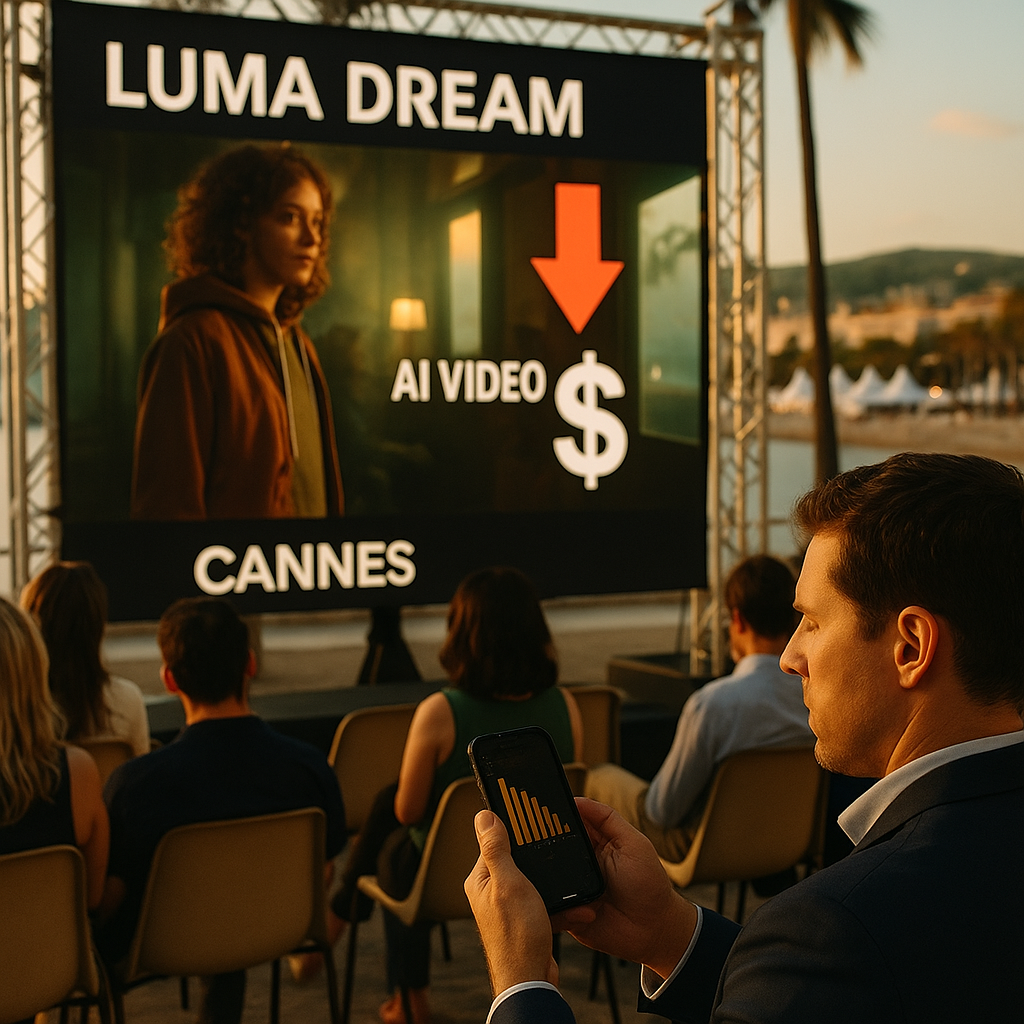
The 90% Cost Drop That’s Rewriting Every Video Budget
Luma AI’s “Dream Brief” competition at Cannes Lions attracted over 3,000 submissions, and the 12 finalists produced brand-quality video spots for under $5,000 each — work that would have cost $150,000 to $500,000 through traditional production pipelines just 18 months ago. AI-generated video advertising has officially moved from novelty experiment to budget-line consideration, and the Cannes stage gave it a legitimacy stamp that procurement teams now have to reckon with.
What the Dream Brief Finalists Actually Produced
Let’s be specific about what “brand quality” means in this context, because the gap between a viral AI demo on X and an ad that can survive legal review, brand guidelines, and consumer scrutiny is enormous.
The Dream Brief finalists created 15- to 60-second video advertisements for real brand briefs. These weren’t abstract art films. They featured product shots, narrative arcs, synchronized audio, and in several cases, photorealistic human likenesses. Luma’s Ray2 model handled the video generation, but finalists layered in post-production using tools like Runway, ElevenLabs for voice synthesis, and Adobe After Effects for compositing.
Three things stood out across the winning entries:
- Consistency within a single spot: Characters maintained stable appearances across cuts — a problem that plagued earlier AI video tools and killed brand usability.
- Product fidelity: Logos, packaging, and product details held together without the warping or hallucination artifacts that plagued earlier generations of diffusion models.
- Emotional range: The best entries weren’t just technically clean. They told stories that provoked genuine audience response during the Cannes screenings.
None of this means the output was flawless. Several finalists acknowledged manual correction of AI artifacts — hands, reflections, text rendering. But the correction burden has dropped from “rebuild from scratch” to “touch up in post.” That distinction matters for production math.
The Dream Brief finalists spent an average of 40-60 hours per spot including iteration, prompt engineering, and post-production — compared to 4-8 weeks for a comparable traditional shoot. The labor shifted, but it didn’t disappear.
New Cost Benchmarks Every CMO Will Ask About
Here’s the number that will circulate in every Q3 budget meeting: $3,000 to $8,000 per finished AI-generated video spot at the Dream Brief quality tier. That includes compute costs, music licensing, voice synthesis, and human post-production hours.
Compare that against industry benchmarks. According to the production cost data from Statista, a mid-tier 30-second commercial in the U.S. typically runs $50,000 to $200,000 when factoring in crew, talent, location, and post. Even a low-budget direct-response spot rarely dips below $15,000.
But cost isn’t the whole story. Speed is the real weapon.
Dream Brief finalists reported turnaround times of 5 to 14 days from brief to finished spot. That collapses a timeline that traditionally stretches 6 to 12 weeks. For brands running influencer campaigns that need to react to cultural moments, seasonal shifts, or social commerce trends, that velocity is transformative.
The cost benchmarks break down roughly like this:
- Compute and generation: $200-$800 (depending on iteration volume and model access tier)
- Voice and audio: $300-$1,200 (ElevenLabs, licensed music, sound design)
- Human post-production: $1,500-$4,000 (compositing, artifact correction, color grading)
- Rights and clearances: $500-$2,000 (varies significantly by use case)
That last line item — rights and clearances — is where the real complexity hides.
Brand Risk Is the Actual Conversation
Cost savings mean nothing if a spot gets your brand sued, dragged on social media, or flagged by regulators. The Dream Brief finalists surfaced three distinct brand risk categories that every marketing leader needs to build into their AI video governance framework.
Intellectual property ambiguity. Who owns an AI-generated video? The person who wrote the prompt? The company that built the model? The brands whose training data influenced the output? Luma’s terms of service grant commercial usage rights to creators, but this legal territory remains unsettled. The FTC’s evolving position on AI-generated content adds regulatory pressure, particularly around disclosure requirements when synthetic media is used in advertising.
Likeness and consent risks. Several Dream Brief entries featured photorealistic human figures. Even when these weren’t based on real individuals, the resemblance question creates liability. Brands operating in the EU face additional constraints under AI Act provisions. If your AI-generated spokesperson looks like a real person — even accidentally — you’ve got a problem.
Quality control at scale. The finalists produced one spot each under competition conditions with heavy personal investment. Scaling this to a 50-asset campaign across multiple markets introduces failure modes that don’t exist at portfolio scale. Artifact rates, brand guideline drift, and tonal inconsistency compound when you’re generating volume.
The brands that will win with AI-generated video aren’t the ones that adopt it fastest — they’re the ones that build governance frameworks fast enough to match their production speed. A 5-day turnaround is worthless if legal review takes 30.
This risk calculus connects directly to broader questions about human-labeled content as a trust signal. Some brands will lean into AI-generated creative. Others will position their human-made content as a premium differentiator. The strategic choice depends on your audience’s tolerance and your category’s regulatory exposure.
Emerging Production Standards: What the Cannes Judges Valued
The Dream Brief jury included creative directors from major agencies alongside Luma’s technical team. Their evaluation criteria offer a de facto scorecard for AI video quality that brand teams can adopt internally.
Four dimensions dominated the judging rubric:
- Narrative coherence: Did the spot tell a complete story with setup, tension, and resolution? AI’s tendency toward beautiful-but-meaningless visuals was penalized.
- Brand alignment: Did the creative serve the brief’s strategic objectives, or did it just demonstrate technical prowess? This is the gap between a demo reel and an ad.
- Technical execution: Minimal artifacts, consistent lighting, stable character rendering, and clean product integration.
- Emotional resonance: This was weighted most heavily. The jury explicitly stated that technical polish without emotional impact wouldn’t win.
That last point matters enormously for marketers evaluating AI video tools. The technology is advancing faster on technical fidelity than on emotional storytelling. The human skill — strategic creative direction, understanding audience psychology, crafting narrative — remains the bottleneck and the differentiator.
This is exactly why the intersection with influencer marketing deserves attention. Creators who understand their audiences emotionally and can direct AI tools strategically represent a new production hybrid. The rise of niche influencers in marketing aligns perfectly with this model — smaller creators with deep audience understanding, now armed with production capabilities that previously required a full agency.
How to Build Your AI Video Playbook Now
Waiting for the technology to “mature” is the wrong move. The Dream Brief proved the capability threshold has been crossed. Here’s what operational readiness looks like:
Audit your existing production spend. Identify the 20% of your video assets that are high-volume, lower-stakes executions — social cutdowns, product demos, A/B test variants, localized adaptations. These are your AI-first candidates. Leave hero spots and emotionally complex brand films in human hands for now.
Establish a governance framework before you scale. Define who reviews AI-generated assets, what disclosure language accompanies them, and what your liability protocol is for likeness disputes. Loop in legal early. Most marketing legal teams haven’t developed AI video-specific review criteria yet, and you don’t want to build those under crisis conditions.
Invest in prompt engineering and creative direction talent. The Dream Brief winners weren’t just good at typing prompts. They were experienced visual storytellers who understood composition, pacing, and emotional arc. Hire or train for this hybrid skill set. The tools are democratic; the taste isn’t.
Benchmark against your own data. Run a controlled test: produce three versions of the same brief — one traditional, one AI-generated, one hybrid. Measure performance across Meta’s advertising platform or equivalent channels. Let the data settle the argument, not the hype cycle.
Watch the regulatory landscape weekly. The data sovereignty environment is shifting rapidly. AI-generated advertising disclosure requirements are being debated in multiple jurisdictions right now. Getting ahead of mandatory labeling is cheaper than retrofitting compliance across a library of assets.
The Bottom Line for Marketing Leaders
Luma’s Dream Brief didn’t just showcase what AI video can do — it established a reference class for what it costs, how fast it moves, and where it breaks. Build your governance framework this quarter, run your first controlled production test next quarter, and have a clear AI video policy in place before your competitors’ spots start outperforming yours at one-tenth the budget.
Frequently Asked Questions
How much does AI-generated video advertising cost compared to traditional production?
Based on benchmarks from Luma’s Dream Brief finalists at Cannes, a finished AI-generated video spot costs approximately $3,000 to $8,000, including compute, audio, post-production, and rights clearances. Comparable traditional production typically ranges from $50,000 to $200,000 for a mid-tier 30-second commercial in the U.S., making AI-generated alternatives roughly 90% less expensive.
What are the main brand risks of using AI-generated video in advertising?
The three primary risk categories are intellectual property ambiguity around ownership of AI-generated content, likeness and consent risks when photorealistic human figures are used, and quality control challenges when scaling beyond single-asset production. Regulatory requirements for AI content disclosure are also evolving across multiple jurisdictions, adding compliance risk.
What production standards are emerging for AI-generated video ads?
The Cannes Dream Brief judging criteria emphasized four dimensions: narrative coherence, brand alignment with strategic objectives, technical execution including minimal artifacts and consistent rendering, and emotional resonance. Emotional impact was weighted most heavily, indicating that human creative direction remains the key differentiator in AI video production.
How long does it take to produce an AI-generated video advertisement?
Dream Brief finalists reported turnaround times of 5 to 14 days from brief to finished spot, with approximately 40 to 60 hours of active work including iteration, prompt engineering, and post-production. This compares to a traditional production timeline of 6 to 12 weeks for comparable output.
Should brands disclose when video advertising is AI-generated?
Disclosure requirements are evolving rapidly. The FTC is developing positions on AI-generated content in advertising, and the EU AI Act includes provisions affecting synthetic media. Proactively implementing disclosure language is recommended to stay ahead of mandatory labeling requirements and maintain consumer trust.