


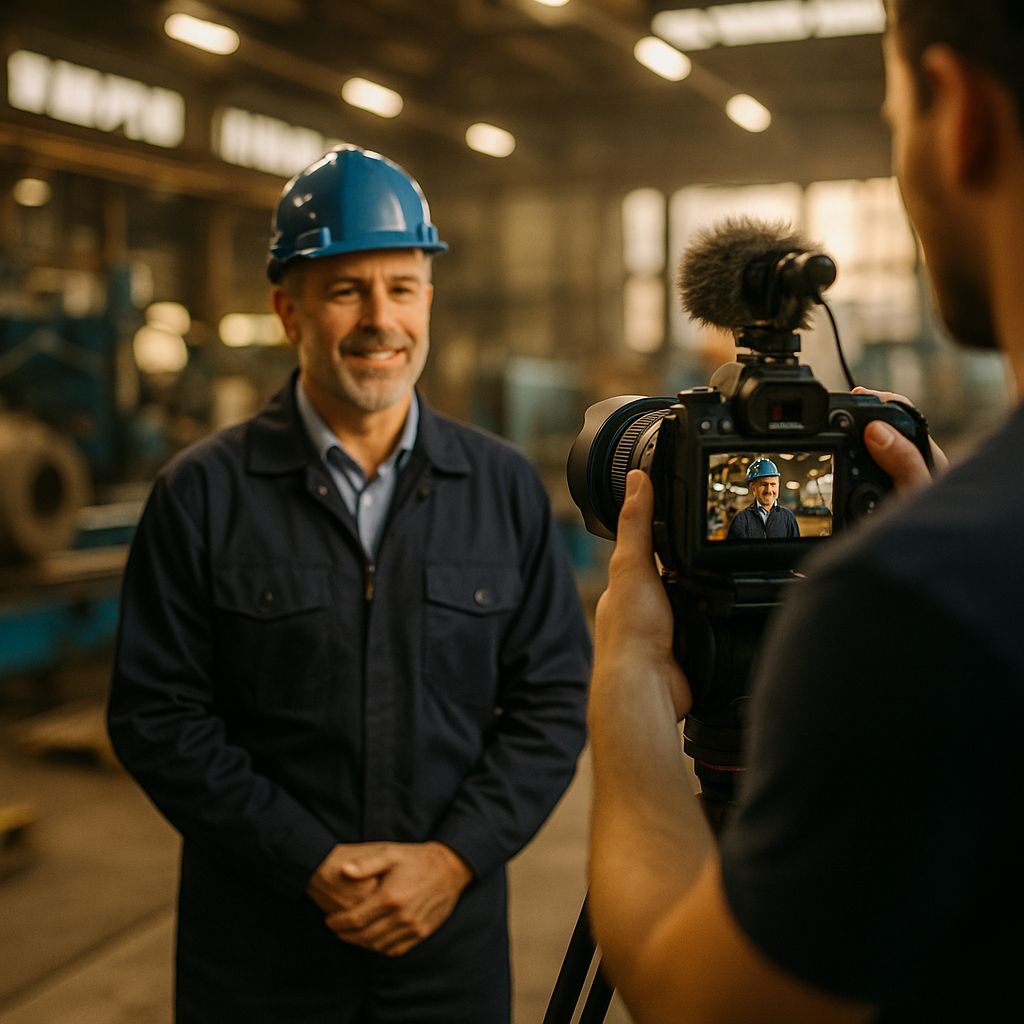
In 2025, manufacturing leaders face a recruiting reality: candidates want proof of culture, purpose, and growth, not just a job posting. This case study: a traditional manufacturer using video to humanize talent shows how one plant-based employer rebuilt trust, increased qualified applicants, and improved retention by putting real people on camera—without losing operational rigor. Ready to see what worked?
Employer branding video strategy: The company, the challenge, and the opportunity
Company profile (anonymized for confidentiality): Mid-sized, multi-site manufacturer with a 50+ year operating history, primarily B2B. Roles ranged from CNC operators and maintenance techs to quality engineers, planners, and frontline supervisors. The company had strong safety discipline, stable orders, and long-tenured employees—yet struggled to communicate that value to modern candidates.
The recruiting problem: The talent team reported three recurring issues:
- Low response to outreach for skilled trades and mid-level leadership roles.
- High early attrition during the first 90 days, driven by mismatched expectations about schedule, training, and advancement.
- Generic employer perception: candidates associated “traditional manufacturing” with outdated processes, limited growth, and impersonal management.
What changed in 2025: The company recognized that written job descriptions and career-page copy couldn’t carry the emotional load needed to overcome skepticism. They needed credibility. Video offered a way to show real people, real work, and real standards—while addressing common candidate questions upfront (pay progression, shift patterns, PPE, training, and career paths).
Strategic insight: Manufacturing is already visual. The employer simply hadn’t applied that advantage to recruiting. The opportunity was to turn operations into transparent storytelling—without compromising safety, IP, or compliance.
Recruitment marketing video: Building the plan with trust, safety, and authenticity
The team built a recruitment marketing video program around one rule: every video must answer a candidate’s “What’s it really like?” question with concrete, verifiable detail. To align with EEAT principles, they used subject-matter experts, documented processes, and clear ownership.
Stakeholders and roles:
- HR/Talent Acquisition owned candidate insights, distribution, and measurement.
- Operations leaders validated accuracy of workflows, schedules, and expectations.
- Safety and Quality reviewed footage for compliance and correctness.
- High-performing employees served as on-camera voices and co-writers for scripts.
- Legal/IT set filming boundaries (no sensitive customer info, no proprietary control screens).
Pre-production steps that reduced risk:
- Candidate-question mapping: Recruiters compiled top 25 questions from interviews, declines, and exit feedback (e.g., “How fast can I move up?” “What does training look like?” “How strict is attendance?”).
- Role truth checklist: Hiring managers confirmed the non-negotiables—shift times, overtime patterns, physical requirements, and certification expectations—so the videos would prevent misalignment, not create it.
- Safety-first shot list: The team planned angles that showcased PPE compliance and correct machine guarding. If something couldn’t be filmed safely, it didn’t get filmed.
- On-camera preparation: Employees were coached to speak in their own words. Scripts were treated as prompts, not lines.
Why authenticity mattered more than polish: Candidates can detect “corporate” content quickly. The company intentionally kept production lean—clear audio, steady shots, and good lighting—while prioritizing candid, specific statements (for example: how long onboarding takes, who mentors new hires, and what “good performance” looks like in week one).
Employee story videos: Content pillars that made the workforce feel human
The company produced a structured series rather than a single brand film. This allowed them to target different roles, reduce drop-off, and answer follow-up questions before candidates asked them in an interview.
Six content pillars that performed best:
- 1) “Day-in-the-life” by role: CNC operator, maintenance tech, QA inspector, production supervisor. Each video showed start-of-shift routine, safety checks, handoffs, and how work is prioritized.
- 2) “Why I stayed” tenure stories: Employees with 5–20+ years explained what kept them there—typically steady leadership, predictable scheduling, paid training, and internal mobility.
- 3) Training and progression: A clear visual of onboarding (first day orientation, weeks 1–4 shadowing, 30/60/90-day check-ins) plus examples of promotions.
- 4) Leadership accessibility: Short interviews with plant manager and frontline supervisors about feedback culture, how issues get escalated, and what they do when goals slip.
- 5) Safety and quality culture: Not slogans. Real demonstrations: pre-task risk assessment, lockout/tagout expectations, and what happens after a near miss.
- 6) Community and purpose: How products are used, what customers value, and how the plant supports local programs—kept factual and tied to employee pride.
What they avoided (and why):
- Vague perks-only content: Candidates wanted career stability and clarity more than “free snacks.”
- Overpromising flexibility: Manufacturing schedules are real. They described them plainly and highlighted options where they truly existed.
- Staged testimonials: If an employee didn’t feel comfortable praising something, the team redirected to concrete experiences (“My trainer checked in daily the first two weeks”).
How videos answered follow-up questions inside the content: Each piece ended with 2–3 rapid answers to common questions for that role, such as “What shift will I start on?” “What does overtime look like?” and “What do I need to succeed in the first month?” This reduced repetitive recruiter calls and improved interview readiness.
Talent attraction through video: Distribution that met candidates where they actually look
Great content fails if it lives only on a career page. The company treated distribution like a product launch, using clear calls-to-action and consistent placement throughout the candidate journey.
Where the videos went (and how they were used):
- Job postings: Each priority role included a 30–45 second clip above the “Apply” button, summarizing expectations and training support.
- Career site: Videos were organized by role family, shift, and location. Candidates could self-select what mattered to them.
- Recruiter outreach: Templates included one video link aligned to the candidate’s role, plus a single qualifying question (for example, “Are you open to a rotating weekend schedule?”).
- Interview confirmation emails: Candidates received a “What to expect on-site” video (parking, PPE, tour steps). This reduced no-shows and anxiety.
- Employee referrals: The referral page used “Why I stayed” videos so employees could share credible content with their network.
SEO and accessibility choices that improved reach:
- Transcripts and on-page summaries for each video so search engines and candidates could scan key points quickly.
- Descriptive titles aligned to intent (e.g., “CNC Operator Training Path” instead of “Our People”).
- Captions for silent viewing and accessibility. Many candidates watched on mobile during breaks.
- Fast-loading embeds so videos didn’t slow the application experience.
How they handled candidate concerns proactively: A frequent drop-off point was uncertainty about pay progression and overtime. The company didn’t post confidential ranges publicly for every role, but they explained how pay moves (skills-based steps, certification milestones, review cadence) and what drives overtime (seasonality, preventive maintenance windows). That transparency improved trust without exposing sensitive details.
HR video content ROI: What changed, what was measured, and why it mattered
To align with EEAT and helpful-content expectations, the company treated results like an operational improvement project: define baseline, implement changes, monitor weekly, and validate with multiple data sources.
Metrics they tracked (beyond views):
- Qualified application rate (applications meeting minimum requirements).
- Interview-to-offer ratio by role family.
- Offer acceptance rate and decline reasons.
- First-90-day retention and early-exit themes.
- Time-to-fill for priority roles.
- Candidate experience feedback via a short post-interview survey.
Observed outcomes after rollout: The company reported improvements across its talent funnel, especially for roles with the most detailed “day-in-the-life” videos. Recruiters noted fewer late-stage surprises around schedule and physical demands, and hiring managers described interviews as more productive because candidates arrived with realistic expectations.
What drove performance (root causes, not hype):
- Expectation alignment: Videos reduced “hidden information” that typically surfaces late (shift patterns, pace, overtime).
- Credibility transfer: Seeing peers speak plainly created trust that copy alone couldn’t.
- Self-selection: Some candidates opted out earlier, which improved efficiency and quality of interviews.
- Manager accountability: Leaders knew candidates had seen the reality on video, so onboarding had to match.
How they maintained trust over time: Videos were reviewed quarterly by HR and operations to ensure they still reflected current schedules, equipment, and training programs. When a process changed, the team either updated the video or added an on-page note with the revision date. That simple governance step protected credibility.
Manufacturing recruitment case study: Lessons learned and a repeatable playbook
This case study produced a practical playbook other traditional manufacturers can adopt without building an in-house studio. The focus stays on operational truth and candidate usefulness.
Playbook steps to replicate:
- 1) Start with roles that hurt the most: Choose 3–5 high-volume or hard-to-fill positions and build role-specific content first.
- 2) Capture proof, not promises: Film training, shift handoffs, daily startup routines, and team huddles—moments that show how work actually runs.
- 3) Use employee SMEs as co-authors: They protect authenticity and prevent HR from guessing what matters on the floor.
- 4) Answer uncomfortable questions: Overtime, attendance, and physical requirements should be explained clearly and respectfully.
- 5) Create a distribution map: Place the right video at the right step—job post, outreach, interview confirmation, and onboarding.
- 6) Set governance: Assign owners, review quarterly, and retire videos that no longer reflect reality.
Common pitfalls (and how to avoid them):
- Overproducing early: A single cinematic brand film rarely answers role-specific questions. Build modular clips first.
- Ignoring supervisors: Frontline leaders shape the daily experience. Include them, and validate claims with them.
- Skipping accessibility: Captions and transcripts expand reach and reduce friction for candidates.
- Measuring vanity metrics only: Track qualified applicants, retention, and offer acceptance to prove ROI.
Final operational takeaway: Treat recruitment video like a process improvement initiative. When the content is accurate, distributed intentionally, and maintained, it doesn’t just attract talent—it reduces churn by aligning expectations from day one.
FAQs: Video recruiting in traditional manufacturing
-
What types of videos work best for manufacturing hiring?
Role-specific “day-in-the-life” videos, training-path explainers, and honest employee tenure stories perform best because they show the job clearly and reduce uncertainty about schedule, pace, and advancement.
-
How do we keep videos authentic without creating compliance risks?
Use a safety-reviewed shot list, avoid filming proprietary screens/customer identifiers, and have operations, safety, and quality sign off on accuracy. Coach employees with prompts, not scripts.
-
Do we need to disclose exact pay in the videos?
Not necessarily. If exact ranges aren’t feasible, explain the pay structure: progression steps, certification milestones, review cadence, and what behaviors drive increases. Clarity builds trust even without exact numbers.
-
Where should we place recruiting videos for the biggest impact?
Embed short clips in job postings near the apply button, organize longer videos by role on the career site, include one relevant link in recruiter outreach, and send a “what to expect” video with interview confirmations.
-
How do we measure ROI on recruitment videos?
Track qualified application rate, interview-to-offer ratio, offer acceptance, first-90-day retention, time-to-fill, and candidate feedback. These metrics show whether video is improving fit and reducing churn.
-
How often should we update the videos?
Review quarterly and update anytime core facts change—shift schedules, training structure, required certifications, or safety procedures. Retire videos that no longer match reality to protect credibility.
Video helped this manufacturer compete for talent by replacing vague claims with visible proof: real people explaining real work, standards, and growth. In 2025, that transparency matters because candidates compare employers quickly and distrust generic messaging. The clear takeaway is simple: build role-specific videos, distribute them across the hiring journey, and keep them accurate—then let authenticity do the recruiting.