


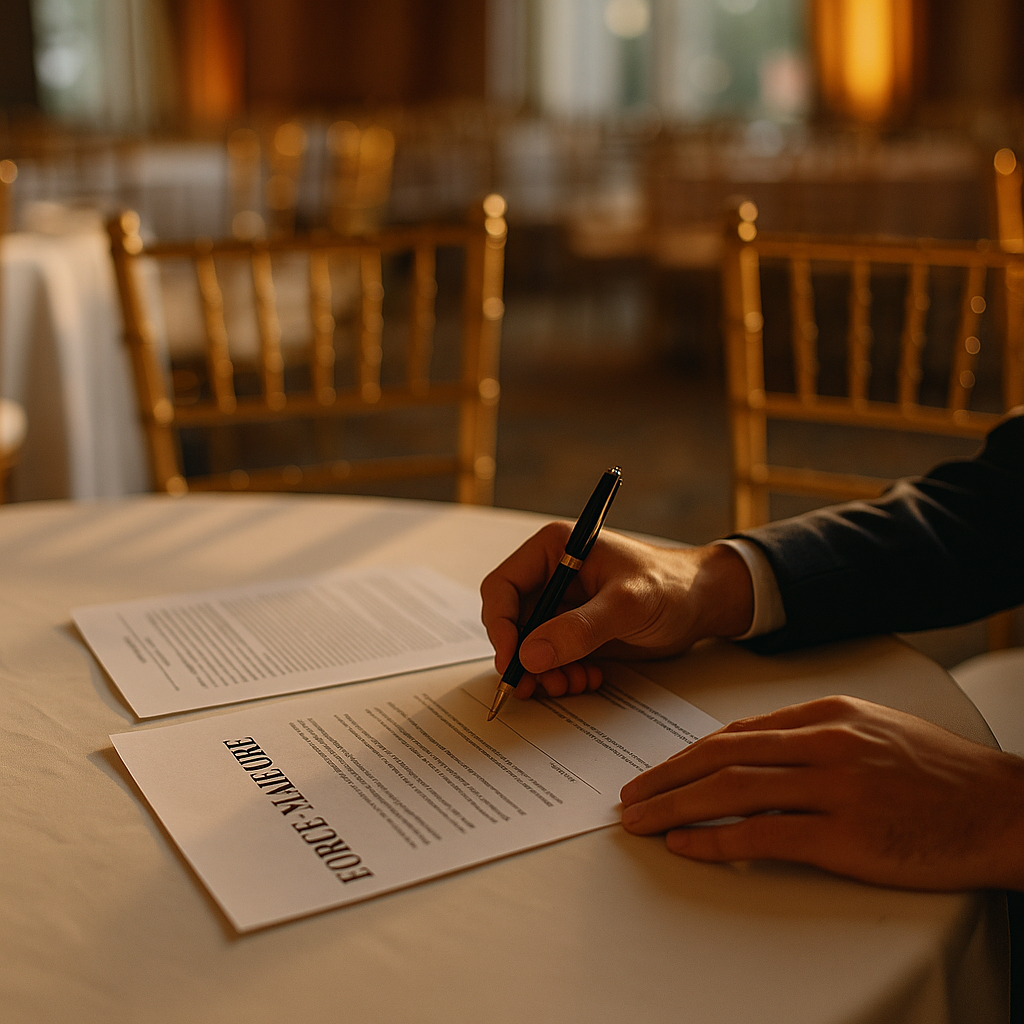
Understanding how to negotiate a force majeure clause in an event venue contract can be the difference between costly cancellations and smooth contract adaptations. As unforeseen disruptions become more common, mastering this critical contract component safeguards your investments and event plans. So, how do you ensure your force majeure clause is robust and fair for all parties?
Defining a Force Majeure Clause in Venue Agreements
Force majeure (French for “greater force”) is a standard legal clause that excuses parties from fulfilling contract obligations due to extraordinary events beyond their control. In event venue contracts, typical force majeure triggers include:
- Natural disasters (storms, floods, earthquakes)
- Pandemics or public health emergencies
- War or terrorism
- Government regulations or lockdowns
- Strikes or labor disputes
Why is this clause essential? If a force majeure event occurs, neither you nor the venue can be held liable for non-performance or delays. However, vague or one-sided clauses can leave event organizers financially exposed. Clearly defining force majeure and its implications in the contract is crucial.
Identifying Key Terms When Reviewing Force Majeure Clauses
The negotiation phase is your best opportunity to shape how force majeure will protect (or expose) your interests. Key terms to examine include:
- Specific events: Are relevant scenarios, like pandemics or supply chain disruptions, explicitly listed?
- Notification requirements: What are the deadlines and modes for communicating a force majeure event?
- Mitigation obligations: Does the contract obligate either party to minimize damages or explore alternatives?
- Remedies: Are you entitled to refunds, rescheduling, or credits if the event is canceled?
- Force majeure period: How long must an event last before the clause applies?
Review clauses from the perspective of both parties. Clear, mutual obligations reduce ambiguity during high-stress situations.
Strategies to Negotiate a Balanced Force Majeure Clause
Approaching negotiations with informed, reasonable demands increases your chances of securing favorable terms. Employ these negotiation strategies for force majeure clauses in 2025:
- Customize event lists: Don’t accept boilerplate language. Specify modern risks like cyberattacks, government-imposed travel bans, or utility outages relevant to your event.
- Address partial performance: What happens if only part of the venue or some suppliers are affected? Ensure flexibility for partial refunds or service adjustments.
- Insist on mutuality: The force majeure clause should benefit both the organizer and the venue. Mutual obligations promote good faith and avoid adversarial standoffs.
- Negotiate remedies up front: Outline options such as full or partial refunds, rescheduling rights, or credits for future events. Set clear timelines for remedy decisions.
- Clarify notification and proof requirements: Ensure requirements for invoking the clause are practical. For example, written notice within 3 business days and requirement to provide evidence of the event (like government orders).
Prepare in advance by researching industry norms and recent legal precedents. Studies from 2023 and 2024 show that event professionals who negotiated tailored force majeure terms were twice as likely to avoid post-cancellation disputes.
Recent Legal Trends Affecting Force Majeure in Venue Contracts
With the evolving legal landscape post-COVID, courts and professional bodies have clarified many aspects of force majeure in event contracts:
- Courts require specificity: Recent rulings emphasize the need for specific force majeure language. General references to “Acts of God” may not be enforceable for modern disruptions.
- Pandemics and government actions are now standard: After 2020, most industries recognize pandemics, health emergencies, and government shutdowns as essential inclusions.
- Force majeure is separate from impossibility: Some disruptions may make events unprofitable, but not “impossible.” Contracts should clarify at what point performance becomes commercially unreasonable.
- Good faith and fair dealing: Venues and organizers must show they acted in good faith—attempting to mitigate or reschedule—before claiming force majeure protection.
In 2025, event planners benefit from including explanatory addenda that clarify ambiguous terms or cite authoritative government and industry guidance as part of their contract package.
Best Practices for Enforcing and Invoking the Force Majeure Clause
Understanding the contract is not enough; knowing how to invoke a force majeure clause ensures your protection is actionable when disruptions arise. Follow these best practices:
- Document everything: Collect records, correspondence, and official notices related to the force majeure event.
- Notify promptly: Adhere to notification deadlines and formats as set in the contract. Late notices may void your rights.
- Communicate transparently: Work openly with the venue to reach mutually acceptable solutions. Early, honest discussions can lead to flexible outcomes like rescheduling or partial refunds.
- Consult legal counsel: Complex situations or disputes may require experienced contract-law professionals. A legal review may uncover additional remedies or risks.
- Plan for the future: After resolving one disruption, review final outcomes. Revise your force majeure templates and negotiation approach for future events based on lessons learned.
Well-executed responses result in fewer disputes, protect business relationships, and support recovery planning for both parties.
FAQs: Negotiating Force Majeure Clauses in Event Venue Contracts
-
What is a force majeure clause in an event venue contract?
A force majeure clause relieves parties from contractual obligations when unforeseeable, uncontrollable events prevent performance, such as natural disasters or government lockdowns.
-
Which events should I include in a force majeure clause?
Include events most relevant to your location and event type—pandemics, governmental orders, severe weather, terrorism, utility failures, and cyber-intrusions are standard in 2025 contracts.
-
Can a force majeure clause protect against financial loss?
The clause may enable refunds, credits, or rescheduling, but its scope will depend on negotiated terms. Insurance policies may further protect against losses not covered by the contract.
-
Is a generic force majeure clause sufficient?
No. Customization is essential. Boilerplate language often misses crucial details and may not hold up legally, especially for modern disruptions like pandemics or tech failures.
-
What happens if only part of my event is affected?
Negotiate terms for partial performance—such as reduced payments or partial refunds—to better manage risks that don’t fully prevent the event but create significant disruption.
In summary, learning how to negotiate a force majeure clause in an event venue contract is critical for risk management in 2025. Take the time to customize each term—protecting your finances, your event, and your reputation in an unpredictable world.