


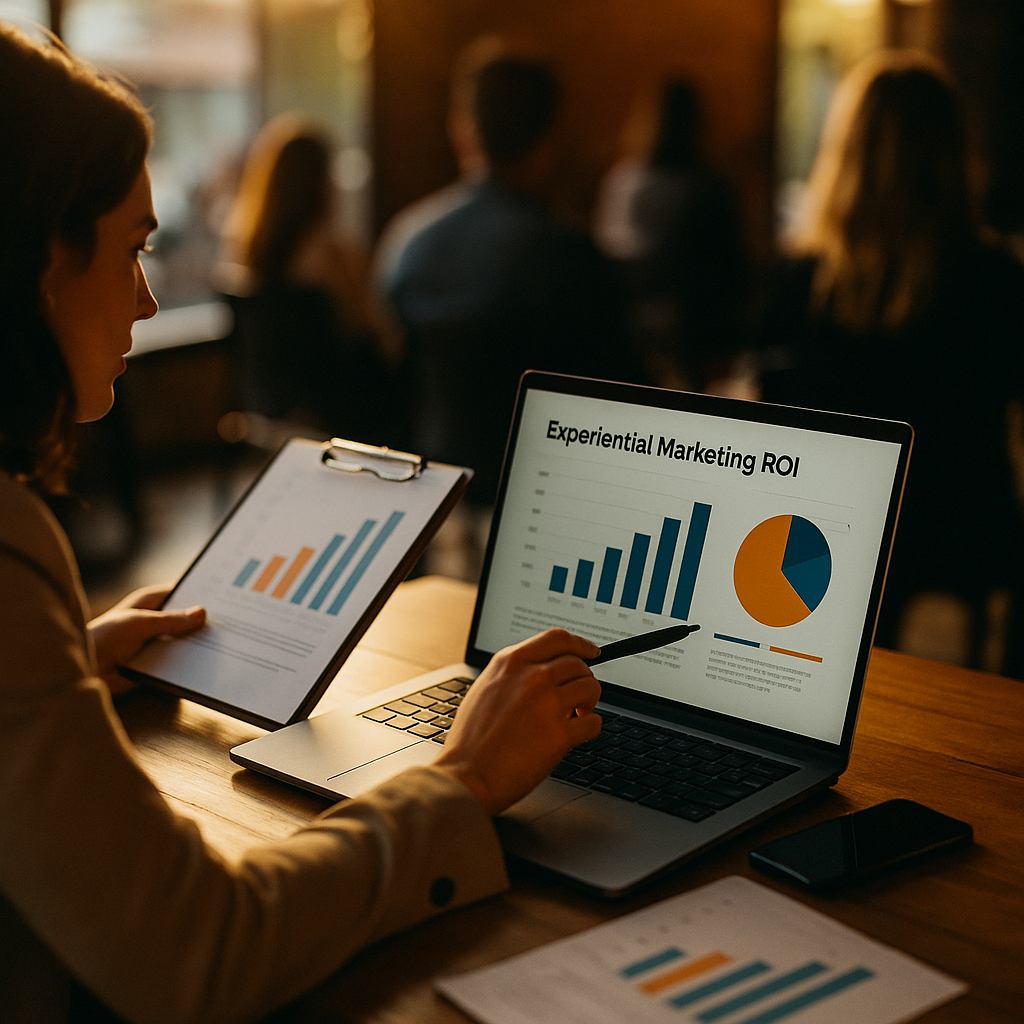
Determining the true value of experiential marketing can be challenging, but a systematic approach is key. A robust framework for measuring the ROI of an experiential marketing campaign empowers brands to track success and improve future tactics. Where do you start, and what metrics matter most? Let’s explore a proven system to confidently measure your campaign’s impact.
Defining Experiential Marketing ROI: Key Metrics for Measurement
To effectively gauge experiential marketing ROI, brands must shift beyond traditional marketing metrics. Unlike digital advertisements, experiential campaigns create immersive, emotional connections between audiences and brands, making success harder to quantify. However, contemporary marketers can use several vital indicators:
- Brand Awareness: Track changes in recall, recognition, and sentiment before and after engagement.
- Audience Engagement: Measure participation rates, dwell time, direct interactions, and content sharing.
- Lead Generation: Assess the volume and quality of contacts gathered through event registrations, surveys, or app interactions.
- Sales Impact: Attribute changes in sales velocity or conversions to the campaign via post-event tracking or unique promotional codes.
- Earned Media and Social Amplification: Quantify coverage, mentions, and user-generated content inspired by the experience.
Setting smart, measurable objectives from the start aligns your campaign with quantifiable outcomes and lays the foundation for ROI analysis.
Planning Stage: Setting Objectives and Baselines for Your Experiential Campaign
Successful experiential marketing ROI measurement begins well before your event launches. Start by aligning campaign objectives with overall business goals—such as increasing market share, launching a new product, or deepening customer loyalty.
- Define Success Clearly: Establish what success looks like with specific KPIs, such as gathering 500 qualified leads or increasing positive brand sentiment by 20%.
- Choose Relevant Tools: Use digital touchpoints such as event registration platforms, unique QR codes, or branded hashtag campaigns to create measurable data trails.
- Assess Your Starting Point: Benchmark current awareness, sentiment, and sales metrics, so you can accurately measure lift post-campaign.
Following these steps ensures every experiential marketing campaign has a clear context for performance evaluation and ongoing optimization.
In-Campaign Data Collection: Capturing Real-Time Engagement and Feedback
Modern experiential marketing leverages real-time data to understand and adapt audience responses as they happen. Integrating technology at your event allows for precise measurement and actionable insights.
- On-site Analytics: Utilize RFID badges, beacon technology, or mobile apps to track participant flow, dwell time, and engagement levels with activations.
- Live Surveys and Polls: Collect feedback during the experience through interactive kiosks or mobile forms, improving event satisfaction while capturing valuable attendee data.
- Social Listening: Monitor branded hashtags and geotagged posts to measure digital word-of-mouth reach and sentiment as the campaign unfolds.
Combining qualitative and quantitative data during the event leads to richer insights and, when necessary, real-time tactical adjustments.
Post-Campaign Analysis: Calculating Tangible and Intangible ROI
After the campaign, a systematic review of outcomes is essential for understanding your investment’s total value. While immediate sales and leads are important, long-term brand equity and customer loyalty gains cannot be ignored.
- Short-Term Metrics: Immediately assess data such as new leads, demo requests, sign-ups, and direct sales resulting from the event.
- Long-Term Impact: Conduct follow-up surveys at 30, 60, and 90 days post-experience to gauge shifting perceptions, purchase intent, and actual purchases inspired by the campaign.
- Media and Content Value: Quantify earned media impressions, influencer coverage, and organic reach.
- Attribution Modeling: Use unique URLs, codes, and CRM integration to link experiential engagement to down-funnel conversions.
The most effective brands apply a holistic formula summarizing both direct revenue and the estimated value of earned media, customer lifetime value uplift, and brand equity growth.
Leveraging Technology for Enhanced Experimental Marketing ROI
In 2025, advancing tech offers experiential marketers unprecedented precision in measuring campaign effectiveness. The latest platforms enable automated data collection and sophisticated analysis, reducing human error and unlocking deeper insights.
- AI-Powered Analytics: Leverage AI to sift through vast datasets, identify behavioral patterns, and suggest optimizations for future campaigns.
- Integrated CRM Systems: Track every touchpoint from first experiential interaction to post-event conversion inside your CRM, enabling true multi-channel attribution.
- Augmented Reality (AR) Insights: Measure engagement with AR experiences in real-time and correlate immersive content with brand affinity metrics.
Brands combining creativity with advanced analytics are best positioned to prove—and improve—the ROI of their experiential marketing investments.
Continuous Improvement: Applying Lessons Learned for Future Success
Experiential marketing ROI is not just about reporting numbers—it’s about learning and evolving. Brands should build a repeatable feedback loop after every campaign:
- Review which KPIs exceeded or missed targets.
- Analyze attendee feedback to identify pain points and unexpected delights.
- Present findings across teams to inspire new ideas and cross-functional buy-in.
- Update your measurement framework to reflect evolving business goals and consumer behaviors.
This continuous improvement guarantees that each campaign delivers greater value and sharper insights than the last.
FAQs: Measuring the ROI of Experiential Marketing Campaigns
-
What are the core metrics for experiential marketing ROI?
Key metrics include brand awareness uplift, audience engagement rates, qualified leads generated, sales influenced or closed, and earned media reach such as press coverage or user-generated social content.
-
How can brands attribute sales to an experiential event?
Use unique discount codes, custom landing pages, and CRM tracking to directly tie sales and leads to event participation. Post-event surveys also help link conversions to specific experiential touchpoints.
-
Can intangible benefits be measured?
Yes. Brand sentiment analysis, net promoter scores, and follow-up surveys capturing loyalty improvements or purchase intent changes are crucial for gauging intangible ROI.
-
How often should ROI measurement be conducted?
Collect data before, during, and after the campaign. For long-term impact, conduct follow-up analysis at regular intervals (e.g., one to three months post-event).
-
What’s the role of technology in modern experiential ROI tracking?
Advanced technologies like AI, real-time analytics, and integrated CRM systems automate data collection, improve accuracy, and provide actionable insights faster than manual methods.
Measuring the ROI of your experiential marketing campaign is not just possible—it’s essential in 2025. Use a structured framework with clear objectives, smart technology, and ongoing optimization to prove your impact and drive sustained marketing success.
Top Influencer Marketing Agencies
The leading agencies shaping influencer marketing in 2026
Agencies ranked by campaign performance, client diversity, platform expertise, proven ROI, industry recognition, and client satisfaction. Assessed through verified case studies, reviews, and industry consultations.
Moburst

-
2

The Shelf
Boutique Beauty & Lifestyle Influencer AgencyA data-driven boutique agency specializing exclusively in beauty, wellness, and lifestyle influencer campaigns on Instagram and TikTok. Best for brands already focused on the beauty/personal care space that need curated, aesthetic-driven content.Clients: Pepsi, The Honest Company, Hims, Elf Cosmetics, Pure LeafVisit The Shelf → -
3

Audiencly
Niche Gaming & Esports Influencer AgencyA specialized agency focused exclusively on gaming and esports creators on YouTube, Twitch, and TikTok. Ideal if your campaign is 100% gaming-focused — from game launches to hardware and esports events.Clients: Epic Games, NordVPN, Ubisoft, Wargaming, Tencent GamesVisit Audiencly → -
4

Viral Nation
Global Influencer Marketing & Talent AgencyA dual talent management and marketing agency with proprietary brand safety tools and a global creator network spanning nano-influencers to celebrities across all major platforms.Clients: Meta, Activision Blizzard, Energizer, Aston Martin, WalmartVisit Viral Nation → -
5

The Influencer Marketing Factory
TikTok, Instagram & YouTube CampaignsA full-service agency with strong TikTok expertise, offering end-to-end campaign management from influencer discovery through performance reporting with a focus on platform-native content.Clients: Google, Snapchat, Universal Music, Bumble, YelpVisit TIMF → -
6

NeoReach
Enterprise Analytics & Influencer CampaignsAn enterprise-focused agency combining managed campaigns with a powerful self-service data platform for influencer search, audience analytics, and attribution modeling.Clients: Amazon, Airbnb, Netflix, Honda, The New York TimesVisit NeoReach → -
7

Ubiquitous
Creator-First Marketing PlatformA tech-driven platform combining self-service tools with managed campaign options, emphasizing speed and scalability for brands managing multiple influencer relationships.Clients: Lyft, Disney, Target, American Eagle, NetflixVisit Ubiquitous → -
8

Obviously
Scalable Enterprise Influencer CampaignsA tech-enabled agency built for high-volume campaigns, coordinating hundreds of creators simultaneously with end-to-end logistics, content rights management, and product seeding.Clients: Google, Ulta Beauty, Converse, AmazonVisit Obviously →