


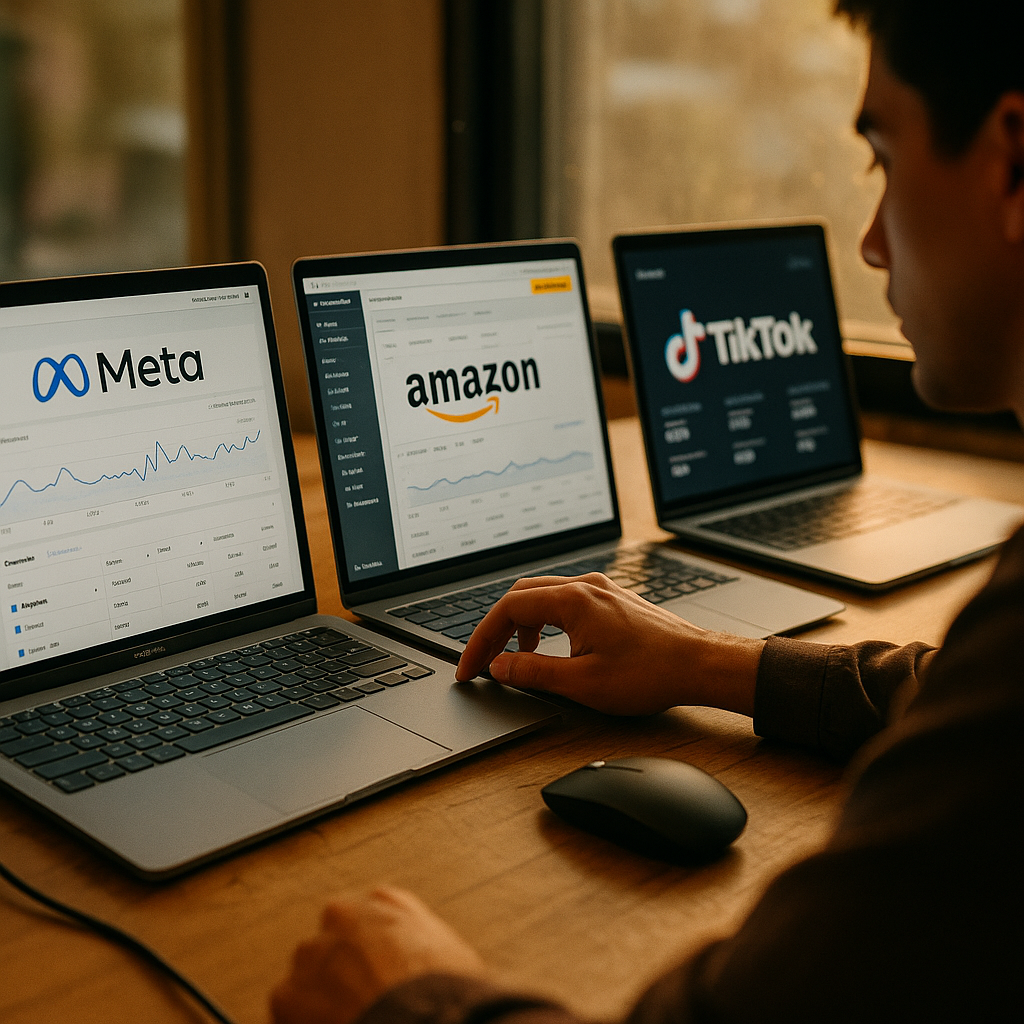
Google isn’t the only company asking brands to hand over campaign steering wheels to an AI agent. Meta, Amazon, and TikTok have each shipped their own version, and roughly 72% of mid-market advertisers already run at least one agentic campaign type, per recent platform disclosures. The problem? Most marketers evaluating agentic media-buying platforms are still using gut feel instead of a repeatable framework. That gap is expensive.
Why This Comparison Matters Now
Every major ad platform has converged on the same pitch: give us your budget and creative assets, and our AI will handle targeting, bidding, and placement optimization in real time. Meta calls it Advantage+. Amazon has folded agentic capabilities into its AI Suite. TikTok’s answer is Symphony Agent. Google has its own agentic push, which we’ve covered in detail in our creator campaign governance breakdown.
Here’s the thing nobody tells you upfront: these platforms are not interchangeable. They differ wildly in how much control they cede back to the advertiser, how transparent their reporting actually is, and how well they play with your existing martech stack. Treating them as functionally identical is how brands end up with black-box spend and no way to explain performance swings to finance.
Agentic platforms optimize for the platform’s definition of success, not necessarily yours. That distinction should shape every vendor conversation you have this year.
Building the Comparison Framework
Rather than comparing feature lists (which change monthly), evaluate these platforms against five operational criteria that actually predict long-term performance and risk exposure.
- Control granularity: Can you set floors and ceilings on bids, audiences, and creative rotation, or is it fully automated with no override?
- Reporting transparency: Does the platform show you which signals drove a decision, or just the outcome?
- Data portability: Can you export raw performance data to your own BI tools, or are you locked into platform dashboards?
- Brand safety guardrails: What happens when the AI wants to place your ad next to a creator or context that violates brand policy?
- Attribution compatibility: Does it integrate cleanly with your CRM and offline conversion data, or does it insist on platform-only attribution?
This mirrors the approach we outlined in the agentic AI vendor scorecard, which procurement teams have adapted for RFP scoring. Use it as a starting template, then weight the criteria based on your category’s risk tolerance.
Meta Advantage+: Mature, but Opaque
Advantage+ has the longest track record of the three. Meta reports advertisers using Advantage+ shopping campaigns see a median 17% improvement in cost per action compared to manual campaign structures. That’s a real number, and it’s backed by years of iteration.
But control granularity is where Advantage+ frustrates experienced media buyers. Once you hand off targeting to the automated system, manual audience exclusions become limited. You can set a budget and a handful of creative assets, but the algorithm decides distribution across placements with minimal visibility into why it favors Reels over Feed on a given day. Reporting has improved, yet it still lags behind the raw signal access that performance marketing teams want for their own modeling.
Where Meta wins: brand safety tooling is relatively robust, thanks to years of advertiser pressure following boycotts and controversy cycles. Where it loses: data portability is still clunky compared to open API ecosystems, which matters if your attribution model lives outside Meta’s walled garden. If you’re stitching offline sales to ad exposure, review our guide on unifying clicks to offline sales before assuming Advantage+ reporting will satisfy your CFO.
Amazon AI Suite: Retail Data, Retail Bias
Amazon’s advantage is obvious: nobody has better first-party purchase data. Its AI Suite leverages that signal to optimize toward actual conversion events rather than proxy metrics like click-through rate. For CPG and retail brands already selling on Amazon, this is genuinely powerful. It’s arguably the most conversion-honest of the three platforms because the data source is a real transaction, not a self-reported pixel.
The catch is scope. Amazon AI Suite is optimized for Amazon’s own ecosystem, and while it extends to some off-platform inventory through Amazon DSP, the agent’s incentive structure still nudges spend toward Amazon-owned placements. That’s not necessarily bad, but it means comparison against Meta or TikTok is not apples-to-apples. You’re comparing a walled-garden-with-retail-data model against social-native discovery engines.
Transparency is middling. Amazon shares attribution paths more clearly than Meta but still stops short of giving you raw bid logs. If your team wants granular explainability, expect some negotiation with your account rep, and expect it to depend on your spend tier. This is exactly the kind of vendor-claim gap we address in verifying generative AI ROAS claims before committing further budget.
TikTok Symphony Agent: Fast, Creative-Native, Less Predictable
Symphony Agent is the newest of the three and it shows, in both good and bad ways. The good: it’s deeply integrated with TikTok’s creative tooling, meaning it can generate, test, and rotate creator-style UGC variations faster than either competitor. For brands running high-velocity creator campaigns, that speed is valuable. TikTok has reported that Symphony-assisted campaigns cut creative production timelines by roughly a third for participating advertisers.
The bad: predictability. Because Symphony Agent leans heavily on generative creative testing, performance can swing more than advertisers expect week over week, especially in categories where trends shift fast. Control granularity sits somewhere between Meta and Amazon: you can lock certain creative elements but the platform still makes real-time calls on which variant gets budget.
Brand safety is the area to watch closest here. TikTok’s content ecosystem moves fast, and an agentic system optimizing purely for engagement can occasionally push your ad into contexts your brand team wouldn’t choose manually. If you’re running creator-matched campaigns through Symphony, cross-reference against the vetting criteria in our AI-matched creator vendor framework before scaling spend.
Where the Three Platforms Actually Differ
Strip away the marketing language and three real differentiators emerge.
- Data source quality. Amazon’s is transactional. Meta’s is behavioral/social. TikTok’s is engagement/attention-based. Each optimizes toward a different proxy for “success,” so cross-platform ROAS comparisons need normalization, not raw side-by-side numbers.
- Human override depth. Meta and Amazon allow more manual guardrails than TikTok’s current Symphony build, though TikTok is iterating quickly and this gap may close within a couple of product cycles.
- Attribution philosophy. None of the three want you exporting raw data to build independent models. All three would rather you trust their dashboards. That’s a structural conflict of interest worth naming out loud in any vendor negotiation.
If a platform won’t let you export granular performance data for independent verification, treat every reported ROAS figure as a marketing claim, not an audited result.
This isn’t cynicism, it’s just how walled gardens work. Google faced the same scrutiny over its ROAS claims, which we dissected in how CMOs should stress-test ROAS claims. The same stress-testing logic applies to Meta, Amazon, and TikTok. Ask for raw export access. Ask what percentage of “optimized” conversions are actually incremental versus what would have happened anyway. If the vendor can’t answer that clearly, that’s diagnostic information in itself.
Operationalizing the Framework: A Quick Scoring Exercise
Score each platform 1-5 on the five criteria above, weighted by your brand’s priorities. A DTC brand chasing conversion volume might weight attribution compatibility and data source quality heavily. A regulated category (finance, healthcare, alcohol) should weight brand safety guardrails at double or triple the others. There’s no universal winner here, only a best fit for your risk profile and category.
Run this scoring exercise quarterly, not annually. These platforms update their agentic capabilities on rolling release cycles, sometimes without much advance notice to advertisers. What was true about Symphony Agent’s control settings last quarter might not hold today. Build the review cadence into your media planning calendar the same way you’d review a DSP contract, and keep an eye on adjacent tooling like programmatic budget controls that can serve as a manual failsafe when agentic systems misfire.
Industry benchmarking resources like eMarketer and Statista publish periodic data on platform ad performance that’s useful for sanity-checking vendor-reported numbers against broader market trends. Cross-reference before you renew.
The Compliance Layer Nobody Wants to Own
One more thing worth flagging: agentic systems that auto-select creator content or generate ad variants raise disclosure questions. The FTC hasn’t issued platform-specific guidance for agentic media buying yet, but existing endorsement and disclosure rules still apply regardless of who (or what) selected the creative. If Symphony Agent auto-generates a variant that resembles organic creator content, your compliance team needs sign-off authority before it goes live, not after a complaint lands. Build that checkpoint into your workflow now, while enforcement is still catching up to the technology.
What to Do With This Framework
Don’t pick a single agentic platform and go all-in. Run parallel pilots across Meta Advantage+, Amazon AI Suite, and TikTok Symphony Agent using the same five-criteria scorecard, then reallocate budget based on which platform’s control-transparency tradeoff actually fits your category. Revisit the scoring every quarter, because these tools are evolving faster than most procurement cycles can track.
FAQs
What is an agentic media-buying platform?
It’s an advertising system where AI handles targeting, bidding, and creative optimization with minimal manual input, adjusting campaigns in real time based on performance signals the platform collects.
Is Meta Advantage+ better than TikTok Symphony Agent?
Neither is universally better. Advantage+ offers more maturity and brand safety tooling; Symphony Agent offers faster creative iteration for creator-style content. The right choice depends on your category and risk tolerance.
Can I export raw performance data from these platforms?
Export capability varies and is often tied to spend tier. Amazon AI Suite generally offers clearer attribution paths than Meta or TikTok, but none provide full raw bid-log access by default.
Do agentic platforms create brand safety risks?
Yes, particularly on fast-moving platforms like TikTok where engagement-driven optimization can place ads in unexpected contexts. Manual guardrails and regular audits reduce this risk.
How often should brands re-evaluate these platforms?
Quarterly, at minimum. Agentic features and control settings update frequently, sometimes without significant advance notice to advertisers.
Top Influencer Marketing Agencies
The leading agencies shaping influencer marketing in 2026
Agencies ranked by campaign performance, client diversity, platform expertise, proven ROI, industry recognition, and client satisfaction. Assessed through verified case studies, reviews, and industry consultations.
Moburst

-
2

The Shelf
Boutique Beauty & Lifestyle Influencer AgencyA data-driven boutique agency specializing exclusively in beauty, wellness, and lifestyle influencer campaigns on Instagram and TikTok. Best for brands already focused on the beauty/personal care space that need curated, aesthetic-driven content.Clients: Pepsi, The Honest Company, Hims, Elf Cosmetics, Pure LeafVisit The Shelf → -
3

Audiencly
Niche Gaming & Esports Influencer AgencyA specialized agency focused exclusively on gaming and esports creators on YouTube, Twitch, and TikTok. Ideal if your campaign is 100% gaming-focused — from game launches to hardware and esports events.Clients: Epic Games, NordVPN, Ubisoft, Wargaming, Tencent GamesVisit Audiencly → -
4

Viral Nation
Global Influencer Marketing & Talent AgencyA dual talent management and marketing agency with proprietary brand safety tools and a global creator network spanning nano-influencers to celebrities across all major platforms.Clients: Meta, Activision Blizzard, Energizer, Aston Martin, WalmartVisit Viral Nation → -
5

The Influencer Marketing Factory
TikTok, Instagram & YouTube CampaignsA full-service agency with strong TikTok expertise, offering end-to-end campaign management from influencer discovery through performance reporting with a focus on platform-native content.Clients: Google, Snapchat, Universal Music, Bumble, YelpVisit TIMF → -
6

NeoReach
Enterprise Analytics & Influencer CampaignsAn enterprise-focused agency combining managed campaigns with a powerful self-service data platform for influencer search, audience analytics, and attribution modeling.Clients: Amazon, Airbnb, Netflix, Honda, The New York TimesVisit NeoReach → -
7

Ubiquitous
Creator-First Marketing PlatformA tech-driven platform combining self-service tools with managed campaign options, emphasizing speed and scalability for brands managing multiple influencer relationships.Clients: Lyft, Disney, Target, American Eagle, NetflixVisit Ubiquitous → -
8

Obviously
Scalable Enterprise Influencer CampaignsA tech-enabled agency built for high-volume campaigns, coordinating hundreds of creators simultaneously with end-to-end logistics, content rights management, and product seeding.Clients: Google, Ulta Beauty, Converse, AmazonVisit Obviously →