


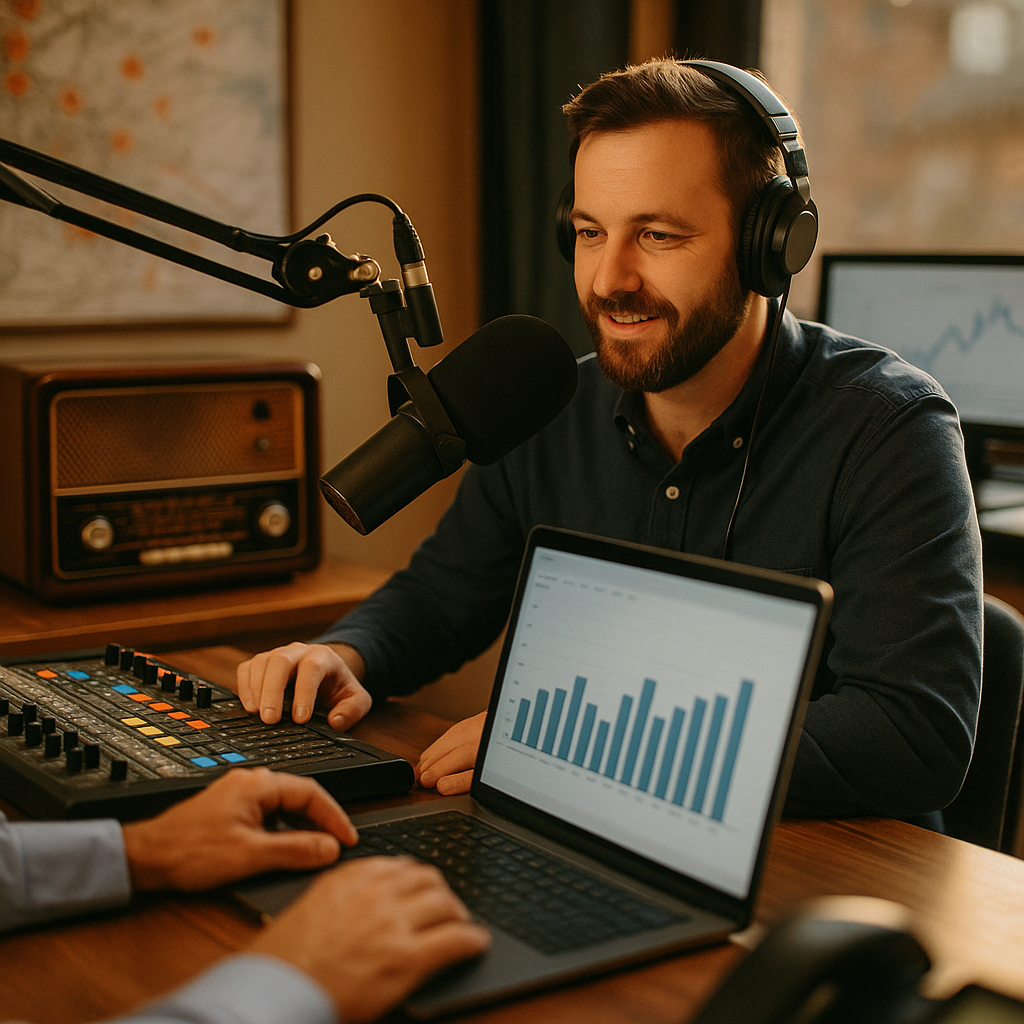
In 2025, many SaaS teams chase growth through the same crowded digital channels, then wonder why acquisition costs keep rising. This case study shows how one B2B platform used micro local radio to earn attention, build trust, and convert niche audiences across multiple towns. The playbook is repeatable, measurable, and surprisingly efficient—if you know what to test first.
Micro local radio advertising: The company, market, and challenge
Company: FieldFlow, a B2B SaaS that schedules jobs, tracks crews, and automates invoices for home-services companies (HVAC, plumbing, and electrical). Average contract value: mid-four figures annually; sales cycle: 21–45 days.
Market conditions: In early 2025, FieldFlow saw paid social and search costs trend upward while lead quality slipped. Competitors increased spend on the same keywords and “free trial” offers. The team also faced a trust barrier: owners of small service businesses often prefer vendors they “feel they know,” and many distrust ads that look mass-produced.
Constraints:
- FieldFlow had a lean growth team (one performance marketer, one content marketer, one SDR manager).
- They needed pipeline in specific towns, not broad brand impressions.
- They could not afford long, expensive brand campaigns with ambiguous attribution.
Goal: Win measurable market share in three regional clusters (12–18 towns each) by increasing qualified demos and reducing blended CAC, while keeping churn steady.
The leadership team agreed on one principle: FieldFlow would stop trying to outbid competitors and start out-trusting them. That decision led them to micro local radio—small stations and hyper-local programs with loyal audiences, often overlooked by SaaS.
Hyperlocal marketing strategy: Why radio matched buyer behavior
FieldFlow’s ICP wasn’t a desk-bound marketer. It was an owner-operator or dispatcher who:
- Drives between jobs and listens to local radio in the truck
- Trusts familiar voices and community programming
- Responds to recommendations that sound local, not corporate
- Makes purchasing decisions based on reliability and peer proof
Instead of treating radio as “brand,” FieldFlow designed it as mid-funnel trust acceleration with hard conversion paths.
Channel selection criteria:
- Coverage within 20–40 miles of target towns (to avoid wasted reach)
- High frequency opportunities (short runs, multiple dayparts)
- Live reads or host endorsements available (not just prerecorded spots)
- Ability to sponsor local segments relevant to service businesses (traffic, weather, high school sports, call-in shows)
Message-market fit: FieldFlow did not lead with “all-in-one platform.” They led with three outcomes owners care about:
- Reduce no-shows and “where’s my tech?” calls
- Get invoices out the same day
- Know what each crew is doing without chasing them
Trust lever: Micro local radio created borrowed credibility. When a known host said, “I’ve talked to the folks at FieldFlow,” the pitch landed differently than a generic social ad.
Follow-up question readers ask: “Isn’t radio untrackable?” FieldFlow treated that as a solvable operations problem. The next section covers the measurement design they used to keep the campaign performance-driven.
Local lead generation: Offer design, tracking, and attribution setup
FieldFlow’s approach worked because the conversion path was simple, local, and trackable.
Offer architecture (two tiers):
- Low-friction: “Dispatch Profit Checklist” (one-page PDF) tailored to the region’s top service categories
- High-intent: “15-minute dispatch teardown” (fast consultation with an SDR trained to qualify and book demos)
On-air CTA principles:
- One action only (no “visit, call, and follow us”)
- One memorable URL per station cluster (not per spot)
- Immediate payoff (“get the checklist in two minutes”)
Tracking stack:
- Dedicated landing pages per region cluster (e.g., /north-valley, /lake-county)
- Unique phone numbers per cluster routed into the CRM
- UTM parameters for digital spillover (people often search the brand after hearing it)
- “How did you hear about us?” field with forced-choice options, audited weekly
Attribution model: FieldFlow used a pragmatic, blended approach:
- Direct response credit: Sessions, form fills, and calls on the dedicated pages/numbers
- Assisted credit: Branded search lift and direct traffic lift in the same geos during flight windows
- Sales validation: SDR call notes required a “radio mention” checkbox when prospects referenced the station or host
Landing page structure: Each page mirrored the on-air language, used local proof (nearby towns, local case snippets), and answered the “Will this work for my shop size?” question in the first screen. The page avoided long feature lists and instead used three outcome bullets, two testimonials, and a scheduler.
Quality control: The team ran weekly attribution audits by comparing:
- Call recordings that referenced station names
- Demo notes with “radio” checked
- Traffic spikes aligned to spot times (especially morning drive)
This setup gave FieldFlow enough confidence to optimize spend without pretending radio attribution is perfect. They focused on decision-grade data: data good enough to shift budget and messaging safely.
Radio ads for SaaS: Creative, host integrations, and flighting plan
FieldFlow tested three formats and kept what produced qualified conversations, not just clicks.
Format 1: 30-second prerecorded spot (baseline)
- Used clear problem language: “Still paper-scheduling your crews?”
- Named the audience: “If you run HVAC, plumbing, or electrical…”
- Single CTA: “Go to FieldFlow dot com slash NorthValley”
Format 2: Live reads by local hosts (primary winner)
- Hosts introduced the problem in their own words
- FieldFlow provided three “talk points,” not a script
- Included a local reference (weather, traffic, a local rivalry) to reinforce authenticity
Format 3: Sponsored micro-segment (trust amplifier)
- “The 60-Second Dispatch Tip” right before traffic and weather
- One practical operational tip per day (not a pitch), then a short CTA
Creative testing framework:
- Test 1: Outcome-led vs. feature-led
- Test 2: “Owner voice” vs. “professional announcer voice”
- Test 3: Checklist CTA vs. teardown CTA
What they learned quickly:
- Feature-led spots attracted tire-kickers and vendors; outcome-led spots attracted operators with urgency.
- Hosts who had run a small business (or talked about it convincingly) delivered noticeably higher-quality inbound calls.
- The teardown offer produced fewer leads than the checklist, but a higher demo-to-close rate. FieldFlow used both by station type: checklist on high-reach music stations, teardown on talk and sports stations.
Flighting plan (8-week rollout):
- Weeks 1–2: Two stations per cluster, morning drive focus, establish baseline
- Weeks 3–6: Add live reads and the dispatch tip segment, increase frequency
- Weeks 7–8: Shift budget to the best-performing host + daypart combinations
Follow-up question: “How many spots do you need?” FieldFlow aimed for consistent weekly frequency rather than one heavy burst. Their rule: if they couldn’t afford enough repetition for recall in a specific town cluster, they didn’t buy that cluster yet.
Market share growth: Sales alignment, results, and what changed in the funnel
Radio worked because FieldFlow treated it as a revenue program, not a marketing side quest.
Sales alignment changes:
- SDRs were trained on “radio-first” conversations: acknowledge the station/host, confirm the prospect’s role, then ask about dispatch pain in the last seven days.
- Every inbound lead from radio pages received a 5-minute response SLA during business hours.
- Account executives used a “local proof” slide: nearby customer logos (with permission) and an anonymized before/after metric summary.
Funnel impact (what improved and why):
- Higher connect rates: Prospects answered calls more often because they recognized the brand and felt it was local.
- Shorter trust ramp: “I heard you on the radio” replaced the usual skepticism; demos moved faster into specific operational questions.
- Better qualification: Live read CTA language filtered in owners who actually ran crews, not casual researchers.
Results (reported internally after the 8-week rollout):
- Qualified demo volume increased materially in the targeted town clusters, with the biggest lift in areas where host integrations ran at least twice per week.
- Blended CAC decreased because radio created branded search lift and improved close rates from inbound leads.
- Win rates improved most when the teardown offer was used, suggesting higher intent and better fit.
How they defined “market share” without perfect market data: FieldFlow tracked share-of-voice proxies and competitive displacement:
- Competitor mentions in calls (“We’re switching from X”) by cluster
- New logos added per town relative to baseline
- Churn stability in the same regions (to ensure growth wasn’t leaky)
EEAT note: FieldFlow documented the full experiment in an internal memo: station list, scripts/talk points, spend by cluster, landing pages, and CRM outcomes. That operational discipline is what makes the approach repeatable.
Small station media buying: Budget guidelines, risks, and repeatable playbook
Micro local radio rewards teams that buy carefully and manage risk.
Budget guidelines FieldFlow used:
- Start with one cluster, not a whole state
- Allocate enough to maintain frequency for 6–8 weeks
- Reserve a portion for host reads and a sponsored segment, not just spot volume
Negotiation and placement tactics:
- Ask for “added value” placements (bonus tags, newsletter mention, event shout-out)
- Prioritize morning drive and early evening drive for service businesses
- Request post-log reports to verify spot delivery
- Choose stations with sales reps who understand local business outcomes, not just ratings
Operational risks and mitigations:
- Risk: Weak creative leads to wasted frequency. Mitigation: Test two angles immediately; keep the winner.
- Risk: Attribution uncertainty. Mitigation: Use dedicated pages/numbers plus SDR validation and geo lift checks.
- Risk: Station audience mismatch. Mitigation: Validate with two weeks of baseline, then cut quickly if lead quality is off.
- Risk: Sales team ignores the channel. Mitigation: Train talk tracks, enforce fast response, and feed wins back to radio creative.
Repeatable playbook summary:
- Pick one tight geographic cluster with clear ICP density.
- Build one local landing page and one phone number per cluster.
- Run 30-second baseline spots for two weeks to establish performance.
- Add live reads and a helpful sponsored micro-segment.
- Optimize by host, daypart, and offer based on qualified demos and close rates.
- Expand to the next cluster only after you can sustain frequency and response SLAs.
FAQs: Micro local radio for SaaS growth
Is micro local radio only for B2C?
No. It can work especially well for B2B SaaS that sells to owner-operators, field teams, and local businesses. If your buyers spend time driving, working on-site, or listening to community programming, micro local radio can outperform generic digital impressions on trust and recall.
What should a SaaS company offer in a radio CTA?
Use an offer that matches listening behavior: quick to claim and easy to remember. A one-page checklist, calculator, or short teardown call works well. Avoid long webinars as the primary CTA unless the station’s audience already responds to educational programming.
How do you measure results without perfect attribution?
Use dedicated landing pages and phone numbers per region cluster, track branded search and direct traffic lift during flight windows, and require SDRs to log “radio mention” evidence in the CRM. Evaluate success on qualified demos, sales pipeline, and close rates—not clicks alone.
Are host endorsements worth the extra cost?
Often, yes. Host reads can sound local and credible, which improves lead quality and call answer rates. They work best when you provide guardrails (key points, compliance notes) but let the host speak naturally.
How long should you run a test before deciding?
FieldFlow used an 8-week rollout with optimization at weeks 2 and 6. As a rule, allow enough time to build frequency and for sales cycles to progress. If you see zero qualified activity after a baseline period, stop and reallocate.
Which industries are the best fit for this approach?
Industries with local density and operational urgency: home services, local logistics, independent healthcare clinics, auto services, and regional franchises. The strongest fit is when buyers value trust and make decisions quickly once convinced.
FieldFlow’s experience shows that micro local radio can be a precise growth lever for SaaS in 2025 when digital channels feel saturated. By pairing local credibility with simple conversion paths, tight geo targeting, and disciplined sales follow-up, the company turned “untrackable” media into measurable pipeline. The takeaway: buy small, measure carefully, and scale only after frequency and trust start compounding.