


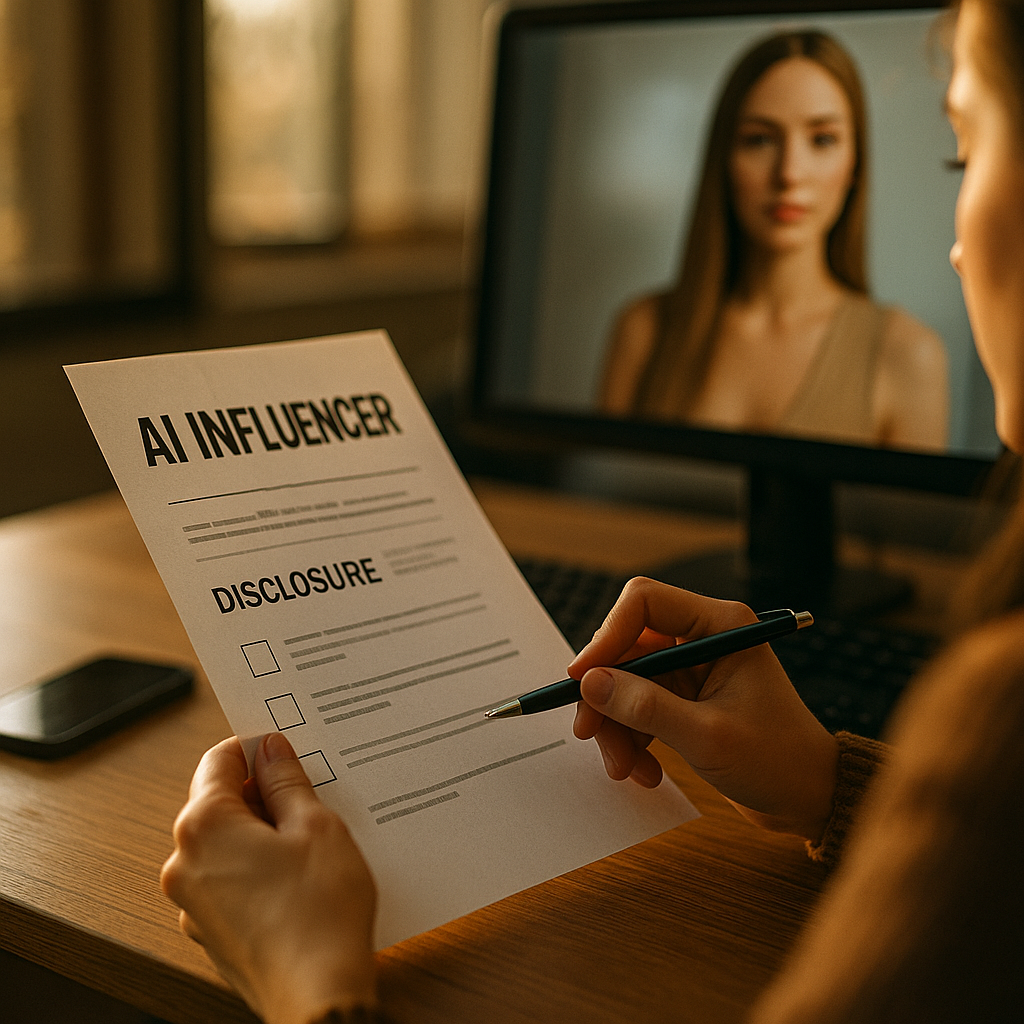
Understanding New Disclosure Rules for AI Generated Influencer Likeness is now essential for brands, creators, agencies, and platforms navigating fast-moving marketing standards in 2025. Regulators and consumer advocates are pushing for clearer labeling, stronger consent, and tighter accountability when a “person” on screen is synthetic or simulated. Get this wrong and you risk trust, takedowns, and legal exposure—so what exactly has changed?
AI influencer disclosure requirements: what “new rules” really mean in 2025
In 2025, “new disclosure rules” rarely come from one single law that applies everywhere. Instead, the practical reality is a tightening mesh of:
- Advertising and consumer-protection enforcement focused on deception and misleading endorsements (especially around “who” is speaking, and whether claims are real).
- Platform policies requiring labels, restrictions, or verification for synthetic or manipulated media.
- Contractual obligations from brands and agencies demanding proof of permissions, disclosure language, and audit trails.
- Privacy, publicity, and biometric rules that govern use of an individual’s face, voice, or other identity attributes.
The theme is consistent: if the audience could reasonably think a real influencer recorded a message, but AI generated it, you must disclose that material fact clearly and close to the content. If an influencer’s likeness is used, you must also show you had valid rights to do so. “Hidden in the caption,” “buried in a link,” or “implied” disclosures are increasingly treated as insufficient.
Most compliance teams now treat AI likeness as a higher-risk category than basic sponsored content because it combines two sensitive elements: advertising persuasion and identity simulation. Expect stricter review, more documentation, and less tolerance for ambiguity.
Synthetic media transparency: how to disclose AI-generated likeness without confusing viewers
Effective synthetic media transparency means the disclosure is clear, prominent, and understandable to an average viewer. In practice, that means placing the disclosure where people actually notice it: on-screen, in the spoken audio when appropriate, and in the caption near the beginning—not only in hashtags or a “more” section.
Use plain language that describes what happened. Strong examples include:
- On-screen label: “AI-generated video. Likeness used with permission.”
- Caption lead: “This is an AI-generated version of [Name] created for this ad.”
- Audio disclosure (if voice is synthetic): “This message is generated using AI.”
Weak disclosures tend to be vague or euphemistic, such as “digitally enhanced,” “virtual,” or “powered by AI,” when the key issue is that the depicted person did not perform or speak in the way viewers may assume. If the content involves a simulated endorsement, the disclosure should not only say “AI”; it should clarify whether the influencer actually approved the message.
To reduce confusion, pair disclosure with a short explanation when it matters:
- If the influencer approved the script: state that approval.
- If the influencer did not approve the script: do not imply endorsement; consider avoiding the likeness entirely.
- If the influencer is fictional or “virtual”: state that the influencer is not a real person.
Answering the viewer’s natural questions (“Is this real?” “Did they say that?” “Did they agree to this?”) inside the disclosure is the difference between transparency and a label that technically exists but still misleads.
Right of publicity and consent: using influencer likeness lawfully and defensibly
Disclosure is not a substitute for permission. Even a perfectly labeled AI-generated ad can create legal risk if you lack rights to use someone’s likeness. In 2025, organizations that treat consent as a check-the-box step are the ones most likely to face disputes.
A defensible consent and rights package usually includes:
- Written authorization granting use of name, image, voice, and other identifiable traits for AI generation and distribution channels.
- Scope details: territories, duration, campaign context, allowed edits, and whether reuse is permitted.
- Approval rights: who approves scripts, final renders, and variations (including A/B tests).
- Revocation and takedown terms that specify what happens if the influencer withdraws consent or a platform flags the content.
- Data handling terms for training assets and reference material (storage, deletion, security controls).
Consent must also be informed. Influencers should understand whether their likeness will be used to generate new lines, new scenes, or entirely new performances. If the agreement is vague, you risk disputes over “unexpected use,” especially when content is repurposed across platforms or turned into multiple variants.
Brands often ask: “If we licensed their photos for ads, doesn’t that cover AI video?” Not necessarily. Many licenses cover use of existing materials, not generation of new performances or simulated speech. Treat AI likeness as its own permission category with explicit language.
Deceptive endorsement compliance: avoiding misleading claims when AI speaks for a person
When an AI-generated likeness delivers a product endorsement, the compliance burden increases because viewers may infer real experience, real usage, and real opinions. If the influencer did not genuinely use the product, or did not make the statements, the content can become misleading even if it is labeled “AI-generated.”
To meet deceptive endorsement compliance expectations, align three elements:
- Identity clarity: the audience must understand the performance is synthetic or simulated.
- Endorsement truthfulness: claims about results, experience, or performance must be truthful, typical where required, and supportable.
- Relationship disclosure: sponsorship, paid partnership, or material connections must be clear and close to the endorsement.
Practical safeguards that reduce risk:
- Script controls: require substantiation for performance claims; avoid absolute promises.
- Influencer approval workflow: document approval of final language if their persona is used to “endorse.”
- Separation of roles: if the influencer is only a “talent likeness,” state that they are not giving a personal testimonial unless they truly are.
Many teams now use a “reasonable viewer” test during review: would a typical viewer walk away believing a real human tried the product, spoke the words, or held the opinion? If yes, you need either (a) reality to match that impression, or (b) disclosures and creative changes that remove the false impression.
Platform labeling policies: meeting social network rules for AI-generated content
Even when your legal and advertising disclosures are solid, platform labeling policies can still block distribution. Major platforms increasingly require:
- Content-level labels for synthetic or manipulated media, especially around politics, public interest, or sensitive topics.
- Prohibitions on misleading synthetic media, impersonation, or undisclosed manipulation.
- Verification and identity checks for accounts that monetize or run ads, particularly when using a real person’s likeness.
Because platform rules change quickly, build a process that keeps you current:
- Pre-flight checklist per platform: label placement, caption formatting, and whether an “AI content” toggle exists.
- Creative variants: one version may need an on-screen label while another may require different metadata or disclosures in an ad manager.
- Escalation path: designate who responds to policy flags, requests for proof of consent, or takedown notices.
Answering a common follow-up: “Can we just comply with the strictest platform?” Often yes, but watch for platform-specific format requirements. A label that works in long-form video may be unreadable in short-form, vertical formats. Optimize for legibility on mobile: high-contrast text, sufficient duration on-screen, and placement away from UI overlays.
AI campaign governance: a practical compliance checklist for brands and agencies
Helpful compliance in 2025 is operational, not theoretical. Strong AI campaign governance blends legal review, creative execution, and documentation so that teams can move quickly without guessing.
Use this workflow to reduce risk while maintaining speed:
- 1) Classify the asset: Is it a real influencer recording? A virtual influencer (fictional)? Or an AI-generated likeness of a real person? Each category has different consent and disclosure needs.
- 2) Confirm rights: Obtain explicit permission for AI generation and distribution scope; confirm music, stock footage, and background IP too.
- 3) Define disclosure language: Prepare approved on-screen and caption disclosures; keep them consistent across edits and localizations.
- 4) Control claims: Substantiate product claims; require influencer approval for testimonial-style statements; avoid implying personal use unless true.
- 5) Build an audit trail: Store dated approvals, model releases, scripts, and final renders; note where disclosures appear.
- 6) Monitor post-launch: Track comments and press; be ready to clarify, correct, or remove content if confusion emerges.
Teams often ask whether they need a watermark or technical “content credentials.” If your platform or jurisdiction encourages it, technical provenance tools can strengthen transparency, but they should complement—not replace—plain-language disclosure. Viewers judge what they can see and hear; regulators do too.
FAQs
-
What counts as an AI-generated influencer likeness?
An AI-generated influencer likeness is content where a real person’s recognizable identity (face, voice, mannerisms, or other identifiers) is simulated or synthesized to create a new performance. It can include deepfake-style video, voice cloning, or generated images that suggest the influencer participated when they did not.
-
Is a caption disclosure enough, or do we need on-screen text?
For video, on-screen disclosure is usually the safest choice because many viewers never read captions. If the AI-generated element is central (the person speaking), use on-screen text and consider an audio disclosure, then reinforce it in the caption near the beginning.
-
Do we need the influencer’s consent if we only used a publicly available photo or clip?
Public availability is not the same as permission. Using material to generate a new performance can implicate publicity, privacy, and contractual rights. Obtain explicit written authorization that covers AI generation, distribution, and reuse.
-
Can we say “AI-enhanced” instead of “AI-generated”?
Only if it is accurate and not misleading. If the content creates a performance that did not occur—new words, new facial movements, or a synthetic voice—use direct language like “AI-generated” or “synthetic,” and clarify whether the influencer approved the message.
-
What if the influencer approved the campaign but didn’t review every variant?
Set clear approval terms in writing. If you plan to generate multiple variants, define guardrails (allowed topics, claims, tone, and prohibited statements) and require review for higher-risk versions, such as those making strong performance claims or referencing personal experiences.
-
How do we handle AI-generated voice in an ad?
Disclose that the voice is AI-generated, secure voice rights specifically, and avoid scripts that imply a personal testimonial unless it is true and approved. Keep the disclosure close to the audio experience—either spoken at the start/end or shown on-screen during the segment.
In 2025, the safest path is simple: disclose clearly, secure explicit consent, and keep endorsements truthful. Treat AI-generated likeness as both an identity-rights issue and an advertising transparency issue, then operationalize it with repeatable checks and documentation. When your disclosures answer “what’s real” and “who approved this,” you protect trust—and your campaign performance.
Top Influencer Marketing Agencies
The leading agencies shaping influencer marketing in 2026
Agencies ranked by campaign performance, client diversity, platform expertise, proven ROI, industry recognition, and client satisfaction. Assessed through verified case studies, reviews, and industry consultations.
Moburst

-
2

The Shelf
Boutique Beauty & Lifestyle Influencer AgencyA data-driven boutique agency specializing exclusively in beauty, wellness, and lifestyle influencer campaigns on Instagram and TikTok. Best for brands already focused on the beauty/personal care space that need curated, aesthetic-driven content.Clients: Pepsi, The Honest Company, Hims, Elf Cosmetics, Pure LeafVisit The Shelf → -
3

Audiencly
Niche Gaming & Esports Influencer AgencyA specialized agency focused exclusively on gaming and esports creators on YouTube, Twitch, and TikTok. Ideal if your campaign is 100% gaming-focused — from game launches to hardware and esports events.Clients: Epic Games, NordVPN, Ubisoft, Wargaming, Tencent GamesVisit Audiencly → -
4

Viral Nation
Global Influencer Marketing & Talent AgencyA dual talent management and marketing agency with proprietary brand safety tools and a global creator network spanning nano-influencers to celebrities across all major platforms.Clients: Meta, Activision Blizzard, Energizer, Aston Martin, WalmartVisit Viral Nation → -
5

The Influencer Marketing Factory
TikTok, Instagram & YouTube CampaignsA full-service agency with strong TikTok expertise, offering end-to-end campaign management from influencer discovery through performance reporting with a focus on platform-native content.Clients: Google, Snapchat, Universal Music, Bumble, YelpVisit TIMF → -
6

NeoReach
Enterprise Analytics & Influencer CampaignsAn enterprise-focused agency combining managed campaigns with a powerful self-service data platform for influencer search, audience analytics, and attribution modeling.Clients: Amazon, Airbnb, Netflix, Honda, The New York TimesVisit NeoReach → -
7

Ubiquitous
Creator-First Marketing PlatformA tech-driven platform combining self-service tools with managed campaign options, emphasizing speed and scalability for brands managing multiple influencer relationships.Clients: Lyft, Disney, Target, American Eagle, NetflixVisit Ubiquitous → -
8

Obviously
Scalable Enterprise Influencer CampaignsA tech-enabled agency built for high-volume campaigns, coordinating hundreds of creators simultaneously with end-to-end logistics, content rights management, and product seeding.Clients: Google, Ulta Beauty, Converse, AmazonVisit Obviously →