


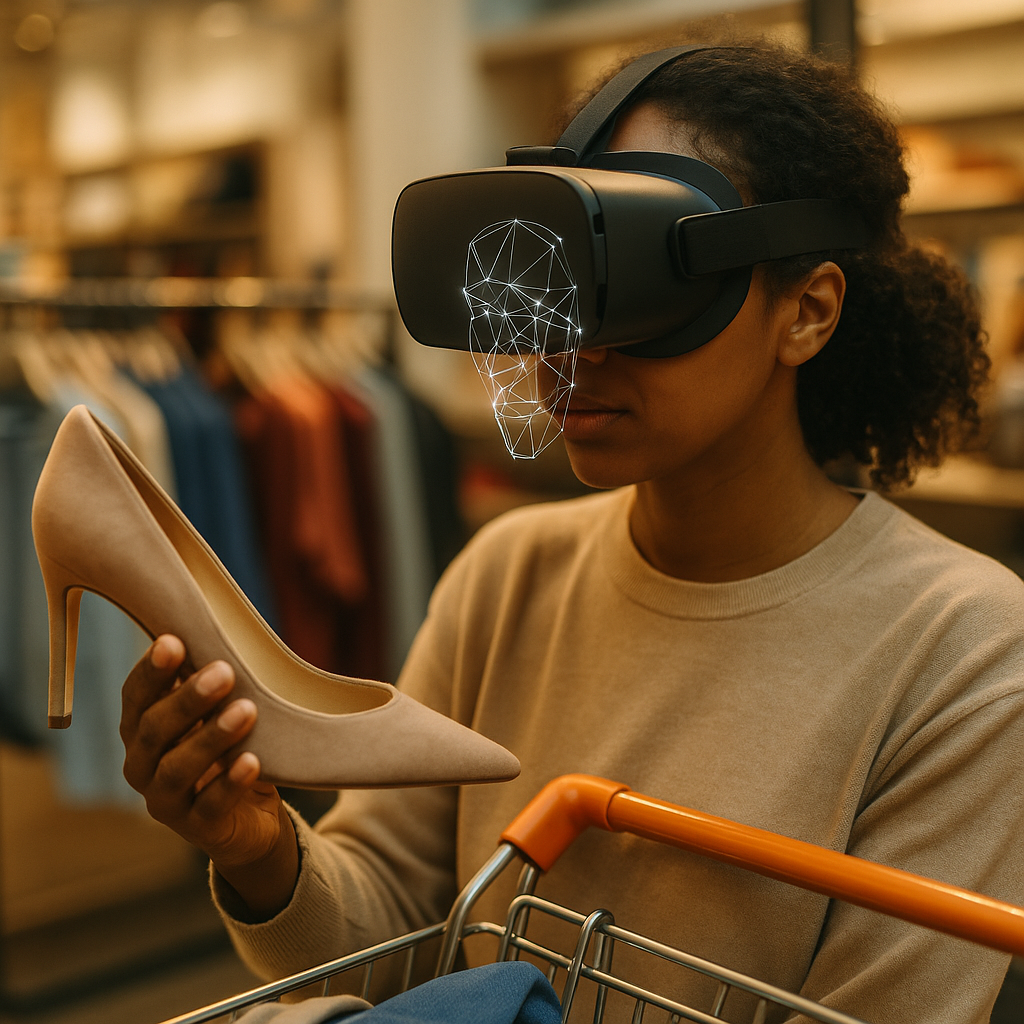
Virtual reality commerce is moving fast, and shoppers now browse, try, and buy inside immersive worlds. That convenience comes with a sensitive tradeoff: biometric signals can reveal identity, health indicators, emotions, and intent. This guide to Navigating Biometric Data Privacy in Virtual Reality Shopping explains what is collected, what laws and standards matter, and how to reduce risk without sacrificing experience—because trust is the real conversion engine.
Biometric data in VR shopping: what’s collected and why it matters
VR shopping can capture far more than clicks and cart adds. Many headsets and controllers generate continuous streams that, alone or combined, can qualify as biometric data or become biometric when used to identify a person. In practice, retailers and platform providers collect these signals to personalize experiences, prevent fraud, and optimize design. The same signals can also enable profiling, re-identification, and sensitive inferences.
Common biometric and biometric-adjacent signals in VR retail include:
- Eye tracking: gaze vectors, fixation duration, pupil dilation, blink rate. Used for foveated rendering, attention analytics, and product placement testing.
- Face tracking: facial landmarks and expressions. Used for avatar animation, emotion detection, and “virtual try-on” alignment.
- Voice prints and speech: tone, cadence, and unique voice characteristics. Used for voice checkout, support, and identity verification.
- Hand and body tracking: skeletal mapping, gesture patterns, gait-like movement. Used for natural navigation, sizing, and behavioral biometrics.
- Physiological signals: heart rate, skin conductance, breathing rate (often via accessories). Used for comfort/safety and “engagement” measurement.
- Spatial/environmental mapping: room scans, depth maps, object outlines. Not always “biometric,” but can expose private living conditions and enable re-identification when linked to an account.
Why it matters: Biometric data is persistent and hard to change. If a password leaks, you reset it. If a voice print, face geometry, or unique movement signature leaks, you cannot meaningfully rotate it. In VR, the risk rises because data can be collected continuously and passively, often when users believe they are simply “browsing.”
Answering a common question: Is eye tracking always biometric? Not always. But if it is used to uniquely identify someone, or is linked to a profile in a way that enables identification or sensitive inference, it becomes high-risk personal data in many regulatory frameworks. Treat it as sensitive by default.
VR privacy regulations 2025: how biometric rules apply in immersive commerce
In 2025, VR shopping typically involves multiple parties: the headset maker, a platform operator, the retailer, advertising/analytics vendors, and payment providers. Privacy obligations can attach to each party depending on who determines purposes and means of processing. The most defensible approach is to assume biometric data triggers heightened duties across jurisdictions.
Key regulatory themes that matter in VR commerce:
- Transparency and purpose limitation: clearly disclose what you collect and why; do not repurpose biometric signals for unrelated advertising or profiling without a lawful basis and explicit user choice.
- Data minimization: collect only what is necessary for the feature (for example, use on-device eye tracking for rendering without sending raw gaze streams to servers).
- Consent and sensitive data controls: many laws treat biometrics as sensitive, requiring explicit consent or equivalent protections, plus easy withdrawal.
- Data subject rights: access, deletion, correction, portability, and opt-out mechanisms should work even when data is streamed, derived, or embedded in models.
- Security and breach readiness: strong encryption, segregation, and incident response are expected; regulators often view biometric loss as severe harm.
Practical follow-up: Who is responsible if a third-party VR analytics SDK collects gaze data? Usually both the retailer and the vendor have obligations. The retailer should ensure contractual limits, conduct vendor due diligence, and provide user-facing disclosures. If your brand is the storefront, customers will still hold you accountable.
Also consider children and teens. VR shopping can appeal to younger users, and many jurisdictions impose stricter consent and profiling restrictions for minors. If your experience can be accessed by minors, build age-appropriate design and default protections rather than treating it as an edge case.
Eye tracking and facial recognition risks: profiling, inference, and re-identification
Eye tracking and facial data are powerful because they can expose intent and emotion—what users notice, what they avoid, what frustrates them, and what persuades them. In a shopping context, those insights can be used responsibly to improve usability, or irresponsibly to manipulate decisions.
Risk areas to actively manage:
- Behavioral profiling: gaze heatmaps tied to identity can reveal preferences that users never explicitly shared, including sensitive interests.
- Emotion inference: facial expressions and pupil dilation can be used to infer stress or excitement. These inferences are often probabilistic, yet may be treated as “truth” in targeting.
- Re-identification: even if you remove names, unique eye movement patterns, face geometry, or motion signatures can re-link data to a person, especially when combined with device IDs.
- Discrimination and exclusion: models trained on non-representative data can misread expressions or gestures across demographics, harming accessibility and fairness.
- Dark patterns in 3D: immersive design can steer attention and choices more forcefully than web UI, raising ethical and legal concerns when paired with biometrics.
Answering another likely question: Can we just “anonymize” biometric data? Be cautious. True anonymization is difficult when data is high-dimensional and unique. A safer pattern is to avoid collection, process on-device, aggregate early, and store only short-lived, purpose-bound summaries that cannot be traced back to an individual.
If your experience uses facial recognition for login or loyalty benefits, consider alternatives such as passkeys, device-based authentication, or one-time tokens. If facial recognition is truly necessary, keep templates on-device when possible, avoid cross-context linking, and provide a clear non-biometric option with equal functionality.
Consent and transparency UX: building user trust in immersive retail
In VR, traditional consent banners do not translate well. Users cannot easily read long policies, and interruptions can trigger discomfort. Yet biometric processing demands clarity. The best consent UX is layered, timely, and tied to specific features.
Design consent so it is informed, granular, and reversible:
- Just-in-time prompts: ask for eye tracking permission at the moment the user enables a feature like “gaze-to-select” or “smart try-on,” not at first launch.
- Feature-level toggles: separate “performance” uses (rendering, calibration) from “analytics” or “personalization” uses. Default analytics to off for sensitive signals.
- Plain-language summaries: short statements such as “We process gaze on your device to improve rendering. We don’t store raw gaze data.”
- Persistent privacy dashboard: a VR-native control panel where users can review permissions, delete data, and change settings without leaving the experience.
- Equal access paths: ensure users can shop fully without enabling biometric features, avoiding coercive “consent walls.”
Make your disclosures specific. Users want to know: What exactly is captured? Is it stored? For how long? Is it shared? Is it used for ads? Is it used to train AI models? A helpful privacy notice answers these directly and avoids vague terms like “may” and “could” when you already know your practices.
Common follow-up: Can we rely on platform-level permissions? Use them, but do not stop there. Platform prompts are necessary but not sufficient. Your brand still needs to explain your own purposes, retention, sharing, and user choices. Treat platform permission as the first layer, not the entire consent strategy.
Data security and retention: minimizing biometric exposure end-to-end
Security and retention decisions determine how damaging a breach or misuse becomes. Because biometric data is difficult to change, aim to reduce what leaves the device, shorten retention windows, and prevent internal over-access.
Best-practice controls for VR biometric data:
- On-device processing by default: keep raw gaze, face landmarks, and voice features local where feasible; upload only derived, non-identifying results.
- Edge aggregation: if analytics are needed, aggregate before upload (for example, session-level metrics rather than time-stamped gaze streams).
- Strong encryption: encrypt in transit and at rest; protect keys with hardware-backed storage where possible.
- Access controls and logging: enforce least privilege; log and review access to biometric pipelines and datasets.
- Short retention: define retention per purpose (debug logs for days, fraud signals for a bounded period, consent records as required) and automate deletion.
- Separate identifiers: avoid storing biometrics alongside direct identifiers; use pseudonymous tokens and keep mapping tables tightly controlled.
- Model governance: if training models, track provenance, consent scope, and deletion feasibility for training data; avoid training on sensitive biometrics unless essential.
Answering a practical concern: What about recordings of VR sessions for “quality review”? Session recordings can unintentionally capture biometric and household data. If you must record, get explicit consent, mask or exclude sensitive streams, restrict viewers, and set very short retention. Prefer synthetic replays (event logs) over video-like captures.
For retailers integrating multiple vendors, perform privacy and security reviews of SDKs that touch sensor data. Require documentation on what data they collect, where it is processed, and whether it is used for their own purposes. Contractually prohibit secondary use, including ad targeting or training unrelated models, unless users explicitly opt in.
Responsible personalization and governance: EEAT for VR shopping teams
EEAT-focused content and experiences prioritize accuracy, user benefit, and accountability. In VR shopping, that means aligning product goals with privacy engineering and ethical guardrails, then documenting decisions so they can be audited.
Governance practices that strengthen trust and reduce risk:
- Biometric data inventory: map each sensor stream, processing purpose, storage location, retention period, and sharing pathway.
- Risk assessments: conduct and update privacy impact assessments for features like eye tracking analytics, emotion inference, and identity verification.
- Human review for high-stakes inferences: avoid automated decisions that could materially affect pricing, eligibility, or offers based on biometric-derived traits.
- Clear accountability: name owners for privacy, security, and data governance; create escalation paths for incidents and user complaints.
- User testing for comprehension: validate that people understand what they consent to in VR, not just in legal text.
- Accessibility and fairness: test tracking and avatar systems across diverse users; provide non-biometric alternatives for navigation and checkout.
Responsible personalization answers a key shopper question: Am I being helped or being manipulated? Helpful personalization uses limited data, stays within the shopping context, and is easy to turn off. Manipulative personalization uses sensitive inference to exploit emotion or attention. Draw that line explicitly in policy and product requirements, and enforce it with technical controls.
Finally, publish a clear, VR-specific privacy summary written by your team, not copied from a generic website template. Explain what your experience does in normal language, and keep it current as features change. That visible commitment supports trust, reduces support tickets, and improves conversion without relying on invasive data collection.
FAQs: biometric privacy in virtual reality shopping
Is VR shopping safe if a headset uses eye tracking?
It can be safe if eye tracking is processed on-device, raw data is not stored or shared, and you have clear controls to disable analytics uses. Risk increases when gaze data is linked to identity, retained long-term, or shared with advertisers or third-party analytics.
Can a retailer identify me from movement or gaze even without my name?
Potentially, yes. Unique motion patterns, voice characteristics, and eye movement features can enable re-identification, especially when combined with device IDs, account logins, or loyalty programs. Assume high-dimensional sensor data can become identifying and protect it accordingly.
Do I need to give biometric consent to use a VR store?
You should not be forced to. A trustworthy VR store offers a fully functional path without biometric-enhanced features and asks permission only when a feature truly requires it. If refusal blocks shopping, the consent may not be meaningful.
What should a good VR privacy notice tell me?
It should specify which sensors are used, what data is stored versus processed locally, purposes (rendering, accessibility, fraud, analytics), retention periods, sharing partners, whether data trains AI models, and how to access, delete, or export your information.
How can I reduce biometric tracking as a shopper?
Disable eye/face tracking permissions you do not need, avoid linking VR shopping to social accounts, review in-app privacy dashboards, and prefer experiences that state “on-device processing” and short retention. If available, use passkeys or device authentication instead of face or voice login.
What are the biggest red flags in VR commerce?
Vague disclosures, bundled “take it or leave it” consent, long retention with no explanation, third-party SDKs that collect sensor data for their own purposes, and emotion or attention scoring used to target offers without explicit opt-in.
VR retail can feel effortless, but biometric data makes it uniquely intimate. Treat gaze, face, voice, and motion signals as sensitive by default, and demand clear purpose, minimal collection, and short retention. For businesses, privacy-forward design reduces legal exposure and improves loyalty. For shoppers, permission controls and informed choices keep convenience from turning into surveillance—will your next virtual purchase earn your trust?