


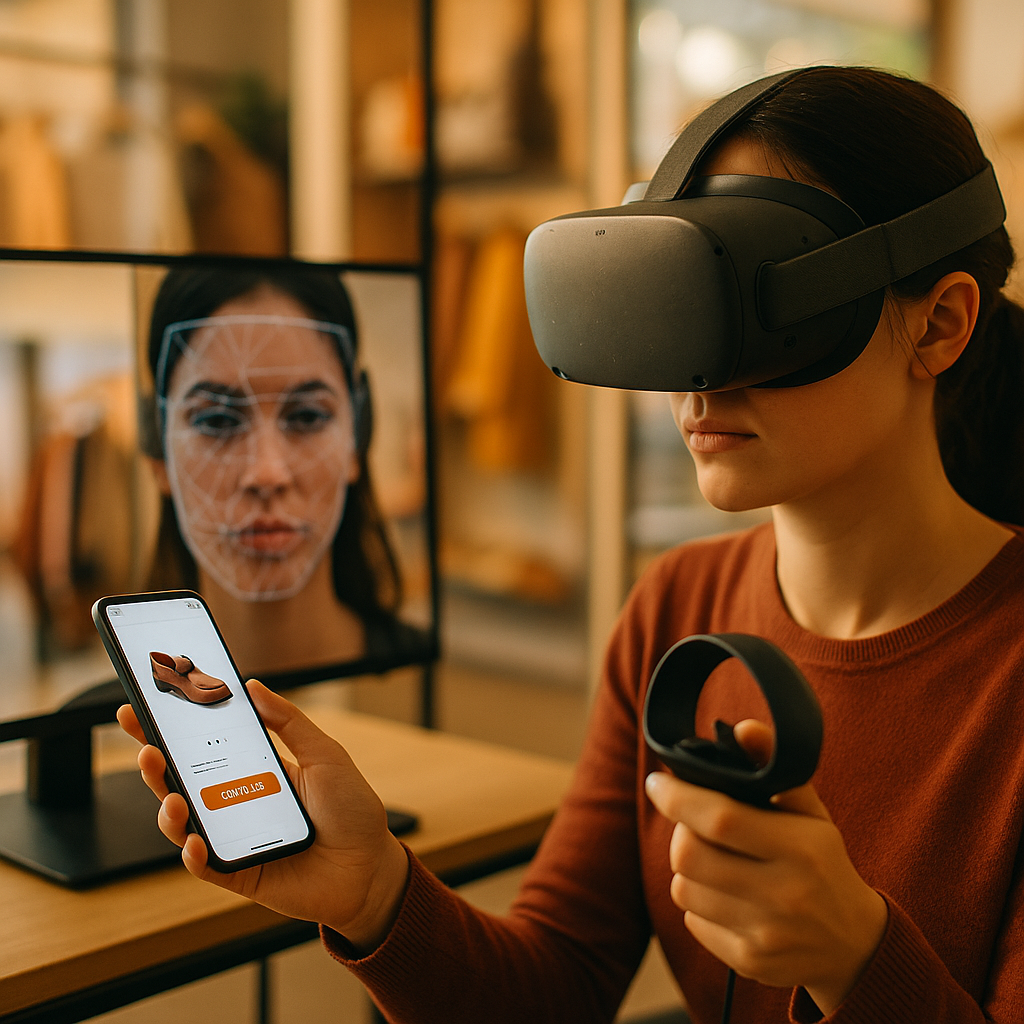
Virtual reality shopping is shifting from novelty to mainstream, and with it comes a new class of sensitive information: the signals your body generates while you browse. Navigating biometric data privacy in virtual reality shopping means understanding what headsets and apps infer about you, how that data moves through ad tech, and what protections you can demand. Ready to spot the hidden trade-offs?
Biometric data in VR: what’s collected and why it matters
VR retail experiences can feel frictionless because they measure far more than clicks. In many VR storefronts, the system can capture or derive biometric data—information tied to your body, behavior, or physiology—often in real time. That can improve personalization, accessibility, and fraud prevention. It can also expose intimate traits if handled carelessly.
Common biometric and biometric-adjacent signals in VR shopping include:
- Eye tracking and gaze patterns: what you look at, for how long, and in what order. Used to optimize product placement, pricing tests, and ad effectiveness.
- Facial expressions: inferred emotions such as surprise or discomfort, sometimes used to tailor product recommendations or measure “engagement.”
- Voiceprints and voice features: if voice commands are enabled, some systems can infer identity markers beyond the spoken words.
- Hand and body motion: gesture signatures, gait-like movement patterns, hand size, tremor, and coordination. Useful for control schemes and accessibility, but potentially identifying.
- Physiological signals: heart rate, breathing patterns, or skin response if sensors or connected wearables are used for “immersion.”
- Spatial environment mapping: room layout and objects detected to enable boundaries and mixed reality overlays. This can reveal living conditions and routines.
Why it matters: biometric data is hard to change if compromised. A leaked password can be reset; your gaze patterns or voice features cannot. In a shopping context, biometrics can also reveal preferences and vulnerabilities—what catches your attention, what stresses you, and what nudges you toward impulsive decisions. That combination makes biometric privacy a core safety issue, not just a compliance checkbox.
If you’re wondering whether “inferred” data counts: in practice, it does. Even when a platform claims it does not store raw biometrics, it may store derived profiles (attention score, emotional valence, purchase intent) that can be similarly sensitive and just as valuable to marketers.
Eye tracking privacy: the biggest VR shopping risk surface
Eye tracking privacy deserves special attention because gaze is both uniquely identifying and extremely revealing. In VR stores, gaze can serve as an input method (dwell-to-select), a measurement tool (heatmaps), and a personalization engine. It can also become a behavioral fingerprint.
Key risks to understand:
- Re-identification: Even anonymized gaze datasets can sometimes be linked back to individuals when combined with device IDs, account data, or third-party trackers.
- Manipulative personalization: If a system learns what draws your attention, it can optimize the experience to steer choices—subtly changing shelf placement, timing of offers, or scarcity prompts.
- Sensitive inferences: Gaze and pupil responses can correlate with stress, fatigue, interest, and potentially health-related traits, depending on sensor precision and analysis methods.
What you should look for in a VR retailer’s privacy disclosures (and what to ask support if it’s missing):
- Whether eye tracking is on by default or opt-in.
- Whether the app stores raw gaze streams or only aggregated metrics.
- How long eye tracking data is retained and whether it is used for advertising.
- Whether gaze data is shared with analytics vendors, ad platforms, or “measurement partners.”
Practical step: if the headset or app offers a “use eye tracking for system features only” mode, choose it. It can preserve usability (like foveated rendering) while reducing the chance your gaze becomes a marketing asset.
Consumer consent in VR: making opt-in real, not cosmetic
In 2025, consumer consent in VR must work under conditions that are very different from web browsing. You may be wearing a headset, interacting through motion controllers, and making quick decisions while immersed. That environment can make consent prompts easy to miss and hard to understand.
Meaningful consent in VR shopping should meet four criteria:
- Specific: Separate permissions for eye tracking, voice features, facial tracking, environment mapping, and third-party sharing—no single “accept all sensors” gate.
- Informed: Plain-language explanations of what is collected, what is inferred, and who receives it. Avoid vague phrases like “improve experience” without examples.
- Freely given: You should still be able to shop without handing over high-risk biometrics unless they are strictly necessary for core functionality.
- Revocable: Easy toggles inside the VR session and in the companion mobile app, with clear effects and no penalty pricing.
Watch for consent anti-patterns that undermine your control:
- Bundled permissions that force you to enable biometrics to access basic browsing.
- “Just-in-time” prompts that appear during checkout pressure moments, when users are less likely to evaluate trade-offs.
- Dark patterns like “Enable for best deals” without explaining what data powers those deals.
If you manage privacy for a brand or platform, treat consent as part of product quality. In audits, document the full consent journey: first launch, feature activation, re-consent after changes, and the path to disable. A strong consent design reduces legal exposure and builds trust that converts.
VR retail security: storage, sharing, and breach prevention
VR retail security is not just about protecting accounts; it’s about minimizing the amount of biometric and sensor data that could be exposed or misused. Because VR shopping often involves multiple vendors—platform, retailer, payment processor, analytics, ad measurement—data can spread quickly unless the architecture is deliberately constrained.
Security and privacy controls that deserve priority:
- Data minimization: Collect only what is needed for a specific feature. If hand tracking is used solely for navigation, avoid storing detailed motion logs.
- On-device processing: Prefer running gaze or expression analysis locally, sending only coarse, aggregated results when required.
- Short retention windows: Keep raw sensor streams for seconds, not weeks. Store aggregates only when necessary for business reporting.
- Strong encryption: Encrypt data in transit and at rest; protect encryption keys with modern key management and strict access controls.
- Vendor governance: Maintain a data map of every third party, what they receive, and whether they can use it for their own purposes.
- Separation of identities: Avoid linking biometric-derived profiles to real names, payment identifiers, or persistent cross-app IDs unless essential.
Answering a common follow-up: “Is anonymization enough?” Not by itself. In immersive ecosystems, device identifiers, session tokens, spatial maps, and behavioral patterns can re-link “anonymous” data. Safer approaches combine minimization, aggregation, purpose limits, and strict sharing controls.
If you run a VR storefront, a practical EEAT step is to publish a clear security and privacy page that includes: what sensors you use, how you secure the data, how users can opt out, and how you evaluate vendors. Pair that with internal evidence—risk assessments, access logs, and penetration testing—so your public claims are backed by real practice.
Regulatory compliance for biometrics: what shoppers and brands should expect
Regulatory compliance for biometrics varies by region, but the direction is consistent: biometric data demands higher protection, clearer consent, and stronger user rights. For VR shopping, compliance becomes more complex because platforms may process data across devices and services, and because “inferences” can carry similar risk to raw biometrics.
In 2025, responsible VR retailers and platforms typically align with these baseline expectations:
- Purpose limitation: State exactly why biometric data is processed (navigation, accessibility, fraud detection) and do not reuse it for unrelated advertising without explicit consent.
- Access and deletion: Provide user-friendly tools to request a copy of data and to delete data, including derived profiles where applicable.
- Special protections for children: Treat youth users as high risk; require age-appropriate experiences and stronger consent mechanisms where needed.
- Data protection impact assessments: For high-risk processing like emotion inference or persistent gaze profiling, conduct documented risk reviews and mitigations.
- Cross-border safeguards: If data moves internationally, ensure legal transfer mechanisms and consistent protection standards.
For shoppers, the practical takeaway is to use your rights. If a VR retailer does not explain what biometric signals it processes, ask. If an app lacks a deletion option, request it through support. If you receive a vague response, that’s a meaningful signal about how the company treats privacy.
For brands, compliance is also a reputation strategy. VR commerce depends on trust; a single incident involving sensitive sensor data can chill adoption. Build privacy-by-design into product roadmaps, not just launch checklists.
Privacy-by-design in metaverse commerce: smart choices that reduce exposure
Privacy-by-design in metaverse commerce means building the shopping experience so it works well even when users share less. Done right, it improves conversion because customers feel safe, not watched.
High-impact design patterns for safer VR shopping:
- Offer “privacy-first mode”: Disable non-essential sensors (eye tracking, facial tracking) while keeping core browsing and checkout intact.
- Use local personalization: Store preferences on-device or in the user’s account with clear controls, rather than streaming sensor data to multiple partners.
- Make sensor use obvious: Provide in-VR indicators when mic, eye tracking, or environment mapping is active, plus a one-click pause.
- Segment analytics: Use aggregated session analytics that cannot be traced back to an individual, especially for heatmaps and attention metrics.
- Limit emotion inference: If you experiment with affective computing, treat it as high risk; keep it opt-in, short-lived, and clearly explained.
- Build a “data receipt”: After a session, show what categories were collected, what was shared, and what can be deleted—simple, scannable, and actionable.
If you’re a shopper choosing between VR retail apps, a quick evaluation checklist helps:
- Can you browse without enabling eye tracking or voice features?
- Is there an in-app privacy dashboard with clear toggles?
- Does the policy explicitly address biometrics, retention, and third-party sharing?
- Can you delete session data and derived profiles?
If those answers are unclear, consider using the platform in “least data” mode, restricting microphone permissions, and avoiding account linking until you trust the experience.
FAQs
What counts as biometric data in VR shopping?
Biometric data can include eye tracking, facial expression tracking, voiceprints, and physiological signals, plus behavioral patterns like distinctive hand motions. Even when raw signals aren’t stored, derived metrics such as attention scores or emotion inferences can be sensitive and should be treated with similar care.
Can VR shopping apps sell my eye tracking data?
Some apps may share gaze-derived analytics with vendors or partners, depending on their privacy terms and your consent choices. Look for clear disclosures about third-party sharing and advertising use, and prefer apps that keep eye tracking off by default or limit it to on-device features.
How do I reduce biometric data collection while still using VR shopping?
Disable non-essential permissions (eye tracking, microphone, facial tracking) in headset settings and in the app’s privacy dashboard. Choose privacy-first modes when available, avoid linking accounts across services, and review options to delete session history and personalization profiles.
Is “anonymized” VR sensor data safe?
Not always. VR datasets can be re-identified when combined with device IDs, account details, spatial maps, or unique behavior patterns. Safer approaches include minimizing collection, processing on-device, aggregating metrics, and restricting sharing.
What should a trustworthy VR retailer disclose?
A trustworthy retailer clearly lists which sensors are used, what data is stored versus processed live, retention periods, third-party recipients, and how to opt out or delete data. It should also explain whether biometric data influences prices, recommendations, or advertising.
Do I have the right to delete biometric data from a VR shopping platform?
In many regions, privacy laws provide deletion rights, especially for sensitive categories like biometrics. Even where the legal right is limited, reputable companies typically offer deletion and account closure tools. If the app lacks controls, contact support and request deletion of both raw data and derived profiles.
Virtual reality retail can be convenient, but it becomes risky when biometric signals turn into permanent profiles. Protect yourself by limiting sensors, demanding clear consent, and choosing apps that minimize collection and keep processing on-device whenever possible. For brands, privacy-by-design reduces exposure, strengthens trust, and supports long-term growth. Treat biometric data as high stakes—because it is.