


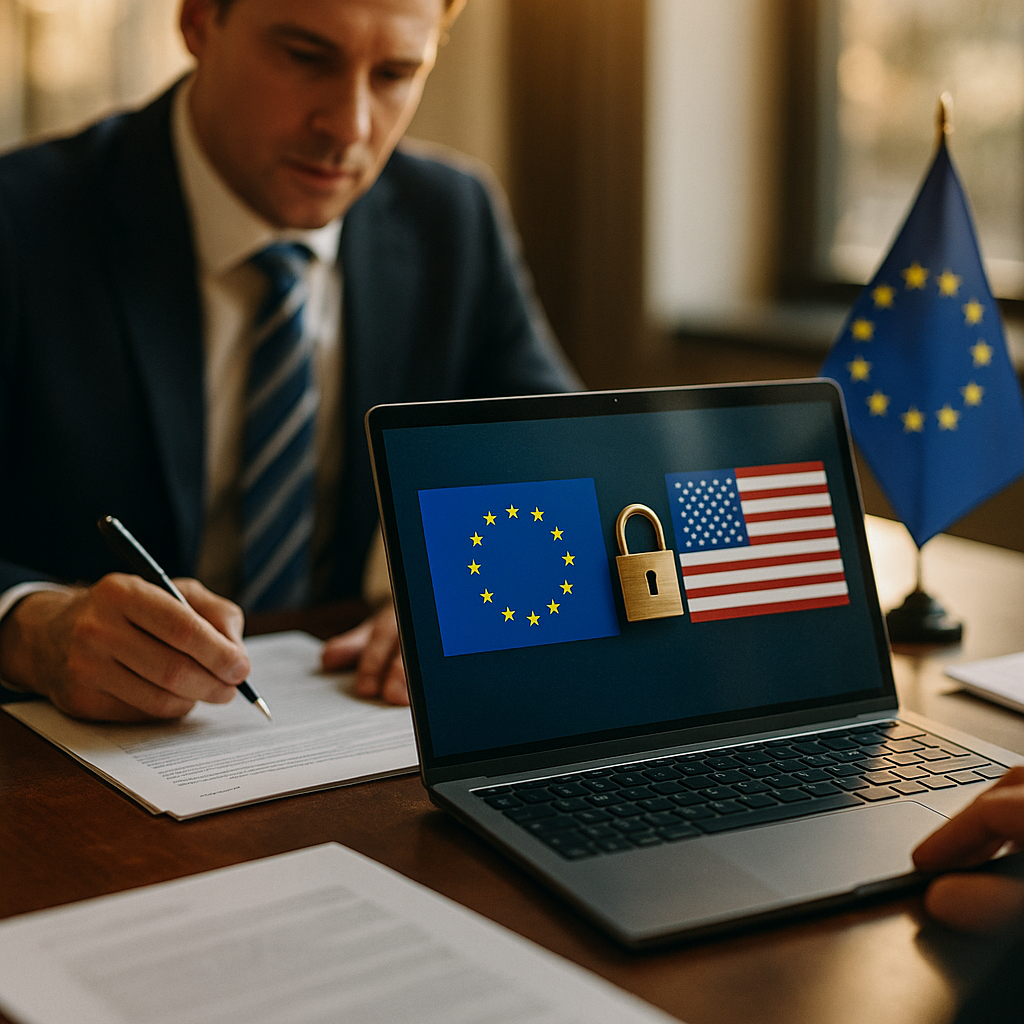
Navigating EU US Data Privacy Shields in a Post Third Party World is now a board-level concern for any organization moving personal data across the Atlantic. In 2025, regulators expect evidence, not intentions: mapped flows, enforceable contracts, and technical controls that reduce access risk. This guide explains what works, what fails, and how to build a defensible transfer program before the next audit hits.
EU-U.S. Data Privacy Framework compliance: what “the Shield” means now
When teams say “Privacy Shield,” they usually mean a trusted, standardized way to move EU personal data to the United States. In 2025, the practical reference point is the EU-U.S. Data Privacy Framework (DPF), which provides a recognized basis for transfers when the U.S. recipient is properly certified and the transfer fits the scope of that certification.
To treat DPF as a reliable mechanism, confirm the basics and document them:
- Certification status and scope: Verify that the U.S. organization is listed as certified and that the certification covers the relevant data types and processing purposes.
- Onward transfer conditions: DPF participants must impose specific protections when they send data to another processor or controller. Ask for their onward-transfer clauses and vendor oversight process.
- Redress and accountability: Confirm how data subjects can complain and how disputes are handled. Your privacy notices should point to realistic channels, not dead links.
Many organizations discover a common gap: the U.S. recipient is certified, but critical subprocessors are not. In a post third party environment where you depend on long vendor chains, the transfer risk often sits with the fourth or fifth link. The fix is not to abandon DPF; it is to pair it with disciplined vendor management and hard controls on onward transfers.
If the U.S. recipient is not certified (or certification does not cover your processing), you still have viable options. You move to Standard Contractual Clauses (SCCs) with a Transfer Impact Assessment and technical safeguards. The rest of this article shows how to make those options defensible, especially when third-party identifiers are disappearing.
Standard Contractual Clauses (SCCs): building resilient transatlantic transfers
For many businesses, SCCs remain the default tool because they work across a wide range of partners and scenarios. In a “post third party” world, SCCs do more than legalize transfers; they force operational clarity about who processes what, where, and why.
To make SCCs stand up in real scrutiny, structure your program around these practical steps:
- Choose the right SCC module: Controller-to-controller, controller-to-processor, processor-to-processor, or processor-to-controller. Misalignment is a common audit finding.
- Complete the annexes with precision: List categories of data, purposes, retention, technical and organizational measures, and all subprocessors. Treat annexes as operational documents, not boilerplate.
- Enforce subprocessor controls: Include approval rights, notice obligations, and an obligation to flow down equivalent protections. Set an internal rule: no unreviewed subprocessors for EU data.
- Design for “minimum necessary” access: Align contracts with technical measures like least privilege, key management, and segmentation.
Readers often ask: “If third-party cookies are fading, aren’t cross-border risks lower?” Not necessarily. Marketing identifiers may shrink, but cross-border transfers remain high because modern operations run on cloud hosting, customer support tooling, fraud detection, HR platforms, and analytics—many of which are U.S.-based or use U.S. personnel for support. SCCs help, but only when paired with a credible risk assessment and controls that reduce exposure to unauthorized access.
Transfer Impact Assessments (TIAs): proving necessity, proportionality, and safeguards
A Transfer Impact Assessment is where legal theory meets operational reality. In 2025, the most effective TIAs read like a security-and-privacy engineering brief: clear data flows, realistic threat models, and measurable protections.
Build TIAs that hold up by answering the questions regulators and procurement teams actually test:
- What data is transferred? Identify whether it includes sensitive categories, precise location, communications content, or data about children. Overbroad categories weaken your rationale.
- Who can access it? Distinguish between routine business access, privileged admin access, and exceptional access (e.g., lawful requests). Document role-based controls.
- Where is it stored and processed? Include regions, backup locations, and support access locations. Many programs miss remote support and incident response access paths.
- What is the business necessity? Explain why the transfer is needed and whether there is a feasible EU/EEA alternative for the same purpose.
- What supplementary measures reduce risk? Provide a controls matrix: encryption, pseudonymization, logging, key custody, and challenge procedures for access requests.
A strong TIA also anticipates follow-up questions: “If we pseudonymize, can we still run analytics?” Yes, if you design pseudonymous identifiers that support aggregation while keeping re-identification keys under strict control. “If we encrypt, does the vendor still need plaintext?” Sometimes, but you can often redesign so only a minimal service component sees decrypted data.
Use TIAs as a living artifact: update them when you add new data categories, integrate a new subprocessor, change hosting regions, or introduce a new identity strategy to replace third-party tracking.
First-party data strategy: privacy-by-design after third-party cookies
“Post third party” changes what data you collect and how you justify it. As third-party cookies and similar identifiers decline, companies lean on first-party data, consented relationships, and server-side measurement. That shift can improve privacy outcomes, but it can also increase transfer complexity because first-party data is typically more directly identifiable and more valuable.
To keep your first-party strategy aligned with EU expectations, focus on privacy-by-design fundamentals:
- Purpose limitation with enforceable governance: Tie each use case to a purpose, lawful basis, retention schedule, and access profile. Avoid “future analytics” as a blanket justification.
- Consent that is specific and testable: If you rely on consent, design UX that supports granular choices and preserves proof of consent without collecting more data than needed.
- Data minimization in identity and measurement: Prefer event-level data with short retention and aggregation. Avoid building shadow profiles that recreate third-party tracking under a different name.
- Server-side controls that reduce leakage: Server-side tagging can limit data sent to many vendors, but only if you implement allowlists, field-level filtering, and strict change control.
Answering the likely internal objection—“But we need personalization”—requires a clear architecture choice: personalization can often be done with on-device or in-region processing, or using segmented cohorts rather than individual-level profiles. Where individual-level personalization is essential, reduce exposure by storing identifying attributes in the EU and sending only pseudonymous tokens to U.S. services with strict key separation.
In practice, the best “post third party” programs unify privacy, marketing, and security requirements: a single data catalog, a single vendor map, and a single set of controls that apply regardless of whether the data originates from a website, app, call center, or in-store interaction.
Vendor risk management: controlling onward transfers in complex supply chains
In 2025, most cross-border risk sits in vendor ecosystems: CDPs, cloud platforms, customer support, embedded analytics, payment tooling, and AI features that may route data to multiple regions. Effective programs treat vendor management as a continuous control, not an annual questionnaire.
Build a defensible vendor posture with these measures:
- Maintain a transfer register: For each vendor, document transfer mechanism (DPF, SCCs, or another lawful route), regions, subprocessors, and data categories.
- Contract for auditability and transparency: Require subprocessor lists, change notices, and the right to receive meaningful security evidence. Ensure you can terminate or suspend transfers if a vendor cannot maintain safeguards.
- Limit data fields shared by default: Implement field-level governance so vendors receive only what their function requires. This is one of the fastest ways to reduce transfer risk.
- Operationalize incident and request handling: Define timelines and responsibilities for breach notifications, data subject rights support, and governmental request challenges.
- Assess AI features specifically: Many platforms add AI assistants that ingest prompts, tickets, transcripts, or logs. Treat these as new processing purposes requiring review, not minor product updates.
Organizations often ask: “Do we need to replace all U.S. vendors?” Not usually. The more sustainable approach is to classify vendors by risk and data sensitivity, then apply proportionate controls. For low-risk data, DPF certification plus strong contractual limitations may be enough. For high-risk data (health, precise location, HR, financial), prioritize EU processing options or designs that keep re-identification keys and sensitive attributes under EU control.
Technical safeguards: encryption, pseudonymization, and access controls that regulators respect
Legal mechanisms work best when your technical controls make the residual risk genuinely low. In transatlantic transfers, that typically means reducing the chance that data is accessible in intelligible form to unauthorized parties and limiting who can access it—even within your own organization and your vendors.
Prioritize safeguards that are concrete and verifiable:
- Strong encryption in transit and at rest: Use modern configurations and rotate keys. Document where keys are stored and who can access them.
- Key management and separation of duties: Keep encryption key control separate from data hosting where feasible. Restrict privileged access and require approvals for key operations.
- Pseudonymization with controlled re-identification: Replace direct identifiers with tokens; keep mapping tables in a controlled environment, ideally within the EU/EEA for EU datasets.
- Least-privilege access and privileged access management: Enforce role-based access, short-lived credentials, and just-in-time admin access with logging and review.
- Comprehensive logging and monitoring: Retain logs long enough to investigate incidents, and monitor for unusual export patterns or admin actions.
- Data retention and deletion automation: Reduce the amount of data available to transfer or access by deleting or aggregating data on schedule.
A useful internal test is: “If we received a lawful access request routed through a vendor, what would the vendor actually be able to disclose?” If the answer is “a large amount of plaintext personal data,” you need stronger design. If the answer is “pseudonymized datasets without EU-held keys” or “encrypted content without key access,” you have a materially better risk position.
These safeguards also support EEAT-aligned governance: they are auditable, measurable, and align with privacy principles like minimization and integrity/confidentiality. Document them in your TIAs and vendor annexes so your legal posture matches your engineering reality.
FAQs: EU-U.S. transfers and privacy shields in a post third party world
Is the EU-U.S. Data Privacy Framework enough on its own?
It can be enough for a given transfer if the U.S. recipient is properly certified for the relevant processing and you have verified onward-transfer controls. Many organizations still add contractual and technical safeguards to reduce operational risk, especially for sensitive data.
When should we use SCCs instead of the DPF?
Use SCCs when the U.S. recipient is not certified under the DPF, when the certification scope does not match your processing, or when your procurement policy requires a contract-based mechanism. SCCs are also common when you need finer control over subprocessors and technical measures.
What does “post third party” change for compliance?
It shifts data strategies toward first-party relationships, server-side tracking, and richer customer datasets. That often increases sensitivity and identifiability, so you must tighten data minimization, consent governance, and vendor controls—especially for cross-border processing.
Do we still need a Transfer Impact Assessment if we use SCCs?
Yes. A TIA documents the specific risks of the transfer and the supplementary measures you use to address them. Treat it as a living document updated when data types, vendors, regions, or processing purposes change.
How do we reduce risk without replacing all U.S.-based tools?
Start by minimizing fields shared, using pseudonymization, restricting access, and improving key management. For higher-risk use cases, redesign so sensitive attributes and re-identification keys remain in the EU/EEA while vendors receive only what they need to deliver the service.
What evidence should we be ready to show in an audit?
Be prepared to provide a transfer register, vendor contracts and annexes, DPF verification where relevant, completed TIAs, records of processing, subprocessor oversight records, and proof of technical controls such as access logs, encryption/key management practices, and retention/deletion policies.
The key takeaway is simple: use the right transfer mechanism, then prove it with operational evidence. In 2025, “privacy shield” success depends on disciplined vendor oversight, living TIAs, and technical controls that reduce access to intelligible data. As third-party identifiers fade, first-party data becomes more sensitive and more regulated. Build your program around minimization, transparency, and verifiable safeguards—and you’ll stay compliant while still shipping products.