


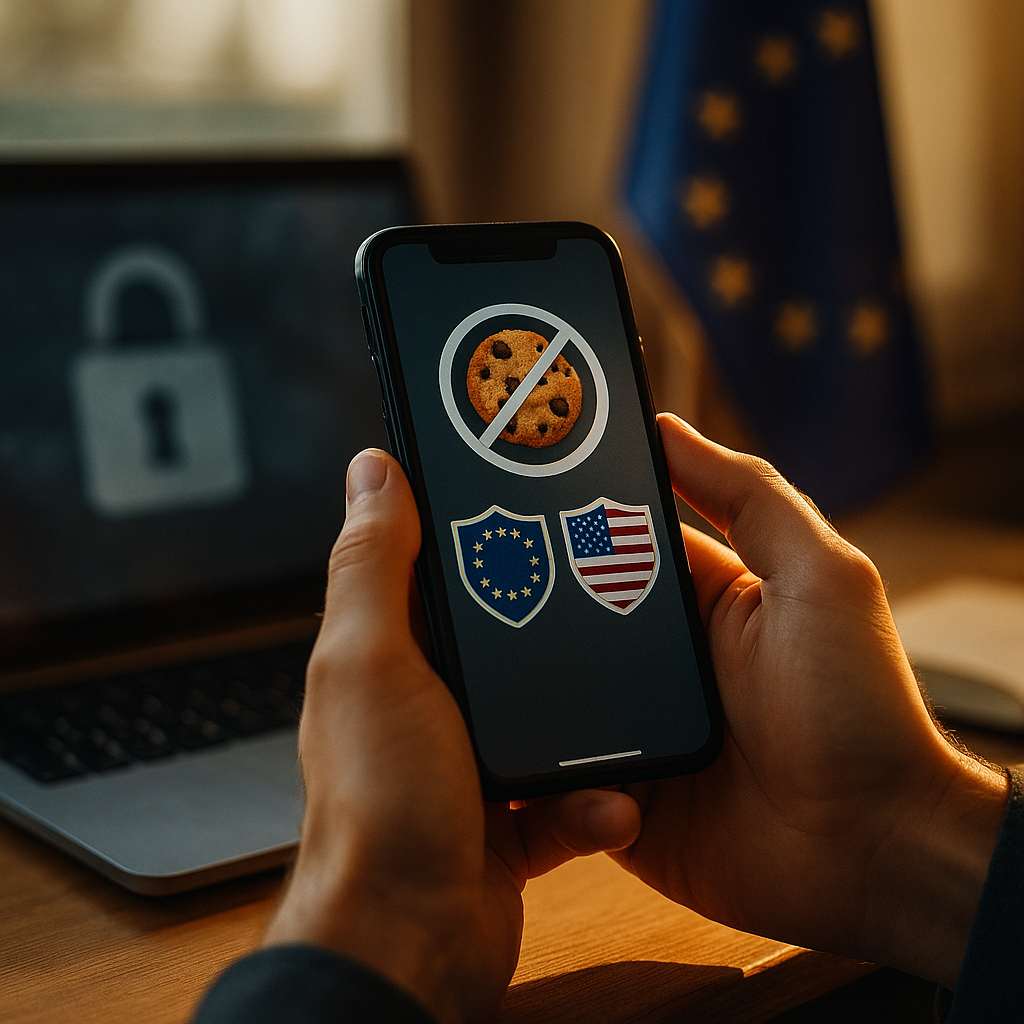
In 2025, privacy teams face two simultaneous shifts: stricter cross-border enforcement and the steady decline of third-party identifiers. This guide explains how to navigate EU US Data Privacy Shields while adapting measurement, personalization, and vendor governance to a post cookie tracking reality. You’ll learn what regulators expect, what contracts must include, and how to keep marketing and analytics working—without increasing risk. Ready to de-risk your data flows?
Understanding EU–US data transfer frameworks
Most organizations that operate in Europe and rely on US-based cloud, analytics, customer support, ad tech, or HR platforms must solve the same problem: lawful international transfers. Under the GDPR, personal data can move outside the European Economic Area only if an approved transfer mechanism is in place and the overall protection is “essentially equivalent” to EU standards.
In practice, teams typically choose from:
- Adequacy-based transfers (where the destination framework is recognized as providing adequate protection). This reduces paperwork but does not eliminate accountability.
- Standard Contractual Clauses (SCCs) with a documented transfer risk assessment (often called a TIA) and “supplementary measures” where needed.
- Binding Corporate Rules (BCRs) for larger groups, suited to intra-group transfers but slower to implement.
- Derogations (explicit consent, contract necessity, etc.). These are narrow and should not be used for routine, large-scale transfers.
Where “shield” language still appears in procurement or marketing materials, treat it carefully. Regulators and customers expect you to identify the current legal basis used for transfers, the data categories affected, and the controls you apply. That expectation is heightened in a post-cookie environment because more businesses are leaning on first-party data and server-side integrations—often increasing the volume and sensitivity of data transferred.
Practical takeaway: Maintain an up-to-date transfer inventory that maps each EU data source (site, app, CRM, support tooling) to each US recipient, the transfer mechanism used, and the security measures applied. If you cannot explain a transfer in a single paragraph, you likely cannot defend it during a customer due diligence review.
GDPR compliance in cross-border data transfers
Cross-border compliance succeeds when legal, security, and product teams agree on what data is transferred, why it is necessary, and how it is protected. In 2025, authorities are increasingly focused on outcomes: minimizing exposure, strengthening controls, and proving accountability.
To align your cross-border transfers with GDPR expectations, focus on four steps:
- Data minimization and purpose limitation: Transfer only what the US vendor needs. If your analytics tool can function without raw IP addresses, unique device identifiers, or full URLs containing query parameters, remove them at collection time.
- Lawful basis and transparency: Ensure your privacy notice clearly describes international transfers, categories of recipients, and user rights. If you rely on consent for certain tracking or personalization, your consent mechanisms must be valid and granular.
- Transfer risk assessment (TIA): Document the destination context, the vendor’s ability to resist disproportionate access requests, and the technical and organizational measures you apply. Treat the TIA as a living record tied to vendor changes and product changes.
- Security measures that actually reduce risk: Use encryption in transit and at rest, strict access controls, logging, retention limits, and key management that prevents casual access. Where feasible, implement pseudonymization before transfer.
Readers often ask: “If we have SCCs, are we done?” No. SCCs are a foundation, not a shield. You must ensure the overall protection is appropriate, which usually means demonstrating how your security architecture and governance reduce practical risk.
Another common question: “Do we need EU hosting to avoid transfers?” Not necessarily. EU hosting can reduce transfer complexity, but many services still involve remote support access or telemetry processing in the US. Evaluate the full service chain, including sub-processors and operational access.
Post-cookie tracking solutions for privacy-first marketing
As third-party cookies continue to disappear from key browsers and mobile platforms remain tightly permissioned, measurement and targeting shift toward approaches that use first-party relationships, aggregated reporting, and privacy-preserving computation. This is good for user trust, but it changes your compliance and transfer posture: first-party data is typically richer, more linkable, and more likely to be considered sensitive in context.
Effective post-cookie approaches that align with privacy-first principles include:
- First-party analytics: Prefer tools and configurations that collect minimal identifiers, avoid cross-site profiling, and support EU-only processing where needed. Configure IP anonymization or truncation and strip URL parameters that may contain personal data.
- Contextual advertising: Target based on page context rather than user profiles. This reduces reliance on persistent identifiers and can lower transfer risk because less personal data is processed.
- Conversion measurement with aggregation: Use aggregated conversion APIs and modeled insights where available, while documenting what identifiers are transmitted and how long they persist.
- Server-side tagging with guardrails: Server-side setups can improve performance and control, but they can also centralize sensitive data flows. Add strict allowlists for outbound events, enforce data schemas, and implement automated tests that reject payloads containing unexpected fields.
- Consent-aware personalization: If personalization depends on user-level profiling, ensure it is gated by valid consent where required, and provide easy opt-outs. Where possible, use on-device or session-based personalization that avoids long-term tracking.
Follow-up question: “Does post-cookie mean we stop tracking?” No. It means you track in ways that are proportionate, transparent, and less invasive. Your goal is measurement that withstands audits and customer scrutiny. In 2025, “privacy-first” is not a slogan; it is a design constraint you can verify in logs, payloads, and vendor contracts.
Data transfer impact assessments and SCCs
If you use SCCs (common in EU–US vendor relationships), you also need a robust process for evaluating transfer risks and applying supplementary measures. A strong program is repeatable, evidence-based, and linked to procurement and engineering workflows.
Build your TIA and SCC governance around these elements:
- Scope clarity: Define the data categories (customers, employees, prospects), the purpose, and whether special categories might be inferred (for example, health interests from content consumption).
- Vendor posture evidence: Request security documentation (SOC 2 or equivalent), encryption and key management details, incident response commitments, and transparency reporting where available.
- Supplementary measures mapping: Tie each identified risk to a measure. Examples include client-side encryption, pseudonymization, tokenization, EU-based key custody, strict access policies, and contractual commitments around challenging overbroad requests.
- Sub-processor control: Ensure you receive notice of sub-processor changes and have a practical process to assess them. A long list of sub-processors is not automatically bad; unmanaged changes are.
- Operational enforcement: Confirm that measures are implemented technically, not just promised. For example, verify log retention, role-based access, and data deletion through tests or attestations.
Readers also ask: “How often should we redo TIAs?” Reassess when you add new data categories, change vendors, enable new features (like session replay), shift to server-side tracking, or when a vendor changes sub-processors. Otherwise, set a periodic review cadence aligned with your vendor risk program.
Consumer consent management and transparency
In a post-cookie world, consent and transparency become operational—embedded in product decisions rather than treated as a banner. When users can’t tell what data is collected, where it goes, and why, they lose trust and regulators see heightened risk.
Strengthen consent and transparency with the following practices:
- Make choices meaningful: Provide clear categories (analytics, personalization, advertising) and avoid bundling. If refusing consent degrades the experience, explain what changes and why.
- Honor signals consistently: Ensure your consent status propagates to tags, SDKs, server-side endpoints, and downstream vendors. A common failure mode is that a “no” choice stops browser tags but not server-side events.
- Reduce dark patterns: Keep language plain, avoid confusing toggles, and ensure “reject” is as easy as “accept” where required.
- Document data flows in user-facing terms: Explain cross-border transfers without legal fog. Users do not need acronyms; they need to know what data is shared and how it is protected.
- Enable rights requests end-to-end: If a user requests deletion or access, you must be able to locate data across systems and vendors, including analytics and marketing platforms, within required timelines.
Follow-up question: “If we rely on legitimate interests for analytics, do we still need a banner?” It depends on your jurisdictional requirements and the technologies used. Many EU contexts still require consent for certain storage/access operations on user devices and for behavioral advertising. Work from a jurisdiction-by-jurisdiction assessment and implement controls that default to the most protective configuration where uncertainty remains.
Vendor due diligence and security controls for global data flows
Vendor risk is now a core privacy competency. Even if your internal practices are strong, a single misconfigured SaaS integration can create unlawful transfers or excessive sharing. In 2025, customers increasingly ask for proof: not just policies, but enforcement.
Operationalize vendor due diligence with a checklist that blends privacy, security, and engineering:
- Contract essentials: A robust DPA, clear processor instructions, breach notification timelines, audit rights (or credible alternatives), sub-processor terms, and deletion/return commitments at contract end.
- Data boundaries: Field-level specifications for what is sent. Use event schemas and automated validation to prevent accidental leakage of emails, phone numbers, or free-text fields into analytics.
- Access governance: Enforce least privilege, MFA, and role separation. Require logs for administrative access and confirm retention.
- Encryption and key management: Confirm where keys are stored, who can access them, and whether you can use customer-managed keys for high-risk data sets.
- Incident readiness: Integrate vendor incidents into your response plan. Ensure you can quickly disable data sharing (kill switches) and rotate credentials.
- Ongoing monitoring: Reassess vendors periodically, track feature changes, and run privacy reviews when product teams enable new integrations.
Answering the likely question: “What should marketing teams do differently?” Marketing should treat every new pixel, SDK, and audience workflow as a data transfer project. Require a lightweight intake form that captures purpose, data fields, recipients, storage duration, and whether identifiers are hashed, tokenized, or aggregated. This keeps growth fast without creating invisible risk.
FAQs
What are EU–US data privacy “shields” in 2025?
Teams often use “shields” as shorthand for EU–US transfer mechanisms. In 2025, you should identify the exact mechanism you rely on—such as adequacy-based transfers, SCCs with a TIA, or BCRs—and document your supplementary measures and vendor controls.
Do SCCs cover analytics and advertising data transfers?
SCCs can support transfers for analytics and advertising, but you must still ensure data minimization, appropriate lawful basis, and effective supplementary measures. High-volume tracking and rich identifiers increase risk and may require stronger technical controls and tighter configurations.
How do we measure conversions without third-party cookies?
Use first-party measurement, aggregated conversion reporting, contextual strategies, and consent-aware server-side tagging. Design event payloads to avoid unnecessary identifiers, restrict sharing to approved vendors, and set retention limits aligned with the stated purpose.
Do we need EU-only hosting to be compliant?
Not always. EU-only hosting can reduce transfer complexity, but support access, telemetry, and sub-processing can still create transfers. Evaluate the full processing chain and implement controls like encryption, pseudonymization, strict access governance, and contractual restrictions.
What should a transfer risk assessment include?
A practical TIA defines the data and purpose, evaluates the recipient and destination context, reviews vendor evidence, maps risks to supplementary measures, and records decisions and review triggers. It should be updated when data flows, vendors, or features change.
How do we ensure our consent choices are respected across systems?
Propagate consent state to client-side tags, mobile SDKs, server-side endpoints, and downstream vendors. Use allowlists and schema validation, implement automated tests, and periodically audit outbound traffic to confirm that “no consent” truly stops restricted processing.
As third-party cookies fade, cross-border data transfers face sharper scrutiny and higher expectations for proof. Navigating EU–US data flows in 2025 means pairing the right legal mechanism with disciplined engineering: minimize data, document transfers, apply enforceable security measures, and keep consent consistent across every channel. The clear takeaway is simple: privacy resilience comes from measurable controls, not labels—build systems you can explain, audit, and defend.