


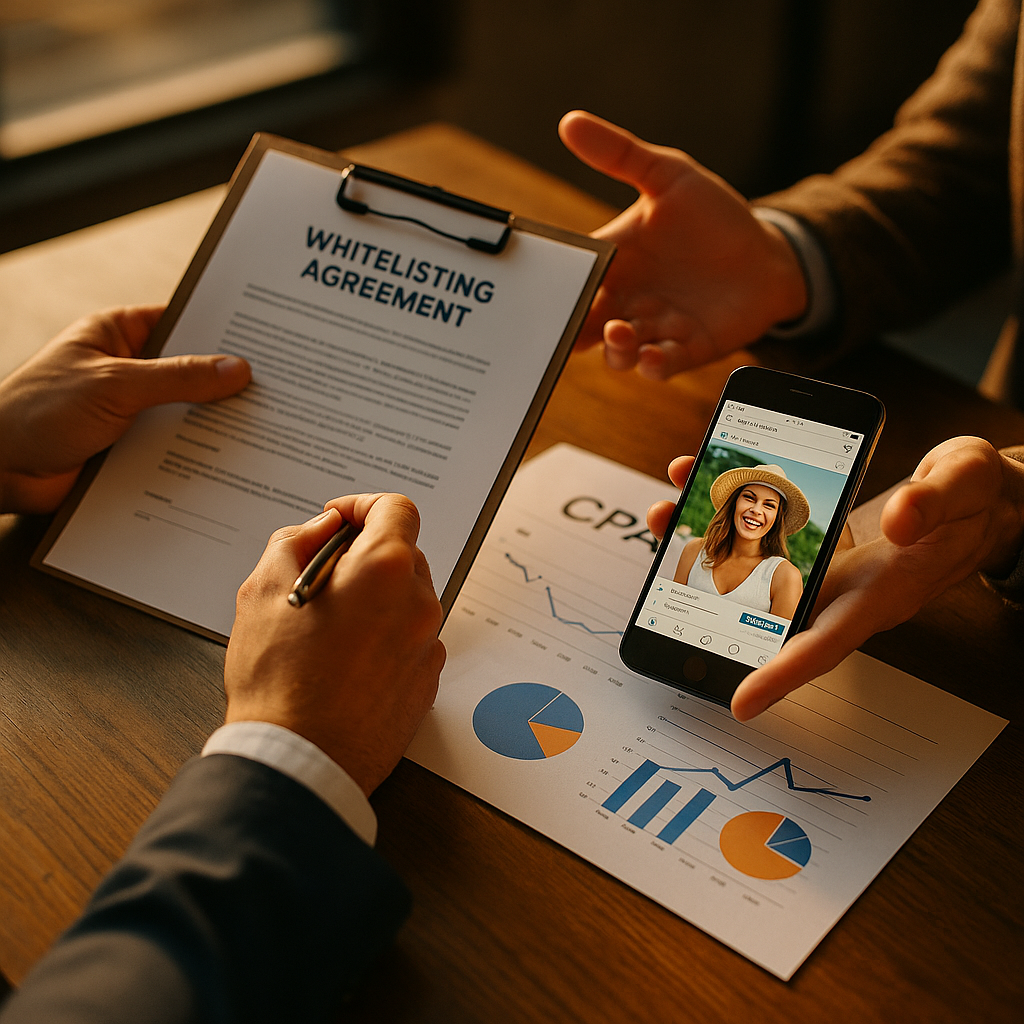
Whitelisted creator ads consistently outperform standard brand ads on cost-per-acquisition — often by 30 to 50 percent — yet most brands still negotiate whitelisting terms as an afterthought, buried in the final days before launch. That sequencing error is costing you real budget.
Why Whitelisted Creator Ads Perform Differently
When a brand runs a standard ad through its own Business Manager, the platform serves it with brand-owned targeting history, brand-page social proof, and the visual identity of a corporate account. Users see the logo. They know it’s an ad. The psychological distance is immediate.
Whitelisted creator ads run through the creator’s account. The “Sponsored” label appears, but the surrounding context — the creator’s handle, their comment history, their audience’s trust — does the heavy lifting. Meta’s ad infrastructure treats the creator’s account signals as part of the delivery algorithm’s quality score. The result is lower CPMs, higher relevance scores, and — critically — lower CPA.
This is not a marginal difference. Brands running structured whitelisting programs across Meta and TikTok are routinely reporting CPA reductions in the 30–50 percent range compared to equivalent brand-side campaigns. The variable is not creative quality alone. It’s the account from which that creative is served.
The account context is part of the ad product. Negotiating whitelisting access before the brief is written isn’t just smart — it’s the only way to unlock the full performance delta.
The Negotiation Mistake Most Brands Make
Most influencer contracts are built around content deliverables: how many posts, what format, which platforms, by what date. Whitelisting rights are appended as a clause — sometimes an optional one — near the end of the agreement. By the time legal reviews it, the creator has already been briefed on a timeline that doesn’t account for the ad account connection process, creative approval loops, or the audience warmup period needed before paid amplification.
The fix is structural. Whitelisting terms need to be negotiated before the creative brief is finalized, not after. That means three things specifically:
- Access duration: Negotiate a minimum of 60–90 days of whitelisting rights from the content publish date. Thirty days is almost never enough to run meaningful A/B tests and optimize toward CPA targets.
- Creative latitude: Secure the right to run dark posts — sponsored content that does not appear on the creator’s public feed. This gives your media team flexibility to test angles, CTAs, and landing pages without requiring the creator’s ongoing involvement.
- Audience permissions: Clarify whether you can build lookalike audiences from the creator’s engaged audience. This is separate from whitelisting and requires an explicit contractual grant. Without it, you’re leaving a high-value targeting layer on the table.
For brands managing large rosters, these terms need to be standardized. See how contract rights and attribution work at national campaign scale for a framework you can adapt.
What to Actually Say in the Negotiation
Creators push back on whitelisting for two legitimate reasons: loss of control over their feed identity, and fear that the brand will use their account to run content they’d never approve organically. Both are addressable.
On control: dark posts resolve the feed concern entirely. The creator’s public profile is untouched. Paid amplification happens through their ad account ID, not their content grid.
On brand safety: include a creative approval clause that gives the creator a 48-hour review window for any paid variation that wasn’t included in the original content deliverable. This is operationally lightweight and removes the creator’s primary objection in most cases.
On compensation: whitelisting rights should carry a fee premium. Industry practice in 2026 ranges from 15–30 percent above the base content fee for 60-day rights, scaling upward for longer windows or lookalike audience permissions. Build this into your initial offer rather than treating it as an upsell. Creators respond better when whitelisting is framed as a partnership extension, not an extraction.
If you’re benchmarking compensation structures, hybrid compensation benchmarks at scale provide useful reference points for structuring these conversations.
Building the Finance Case
Finance teams don’t care about whitelisting as a concept. They care about cost efficiency and forecast accuracy. Your job is to translate the performance delta into numbers they can put in a model.
Start with your current brand ad CPA. Pull the last 90 days of performance from your brand-side campaigns on Meta or TikTok Ads Manager. That number is your baseline.
Then model two scenarios: one where whitelisting rights are not secured and the campaign runs on brand-side only, and one where 60 percent of the paid amplification budget flows through creator accounts. Apply a conservative 25 percent CPA reduction to the whitelisted portion. At most campaign budgets above $150K, the dollar savings in that second scenario more than cover the whitelisting fee premium.
Present it as a cost reduction, not a budget ask. That framing change is not semantic. Finance approves cost reduction initiatives with a different threshold than they apply to incremental spend requests.
For a more detailed model of how to structure these approvals, the phased creator activation framework shows how to sequence spend in a way that builds evidence at each stage before full budget commitment.
When you model whitelisted creator ads as a CPA reduction mechanism rather than an influencer marketing line item, the finance conversation changes entirely. You’re no longer defending a channel — you’re presenting an efficiency play.
Platform-Specific Mechanics You Need to Know
Meta’s whitelisting process operates through Business Manager partnerships. The creator grants your brand’s Business Manager access to their Facebook Page and Instagram account, which enables you to run ads using their account identity. The setup takes 24–72 hours in practice, longer if the creator has never done it before and needs guided onboarding.
TikTok operates through its Spark Ads format. The creator generates an authorization code from their TikTok app, which you enter into TikTok Ads Manager. Authorization codes expire, so you need to build renewal checkpoints into your campaign calendar if you’re running longer flights.
YouTube’s equivalent is handled through Google’s Brand Connect or directly via the creator’s Google Ads account linking. It’s less standardized and more relationship-dependent, but the performance logic is identical. For CPC benchmarks that help you evaluate channel-level efficiency, CPC benchmarks by category are worth reviewing before you allocate across platforms.
One operational note: creator ad account health matters. If a creator has received policy violations or has a low account quality score, your whitelisted ads will inherit that signal. Vet account health before finalizing the partnership, not after the content is already produced.
Performance Floors and What Happens When It Doesn’t Work
Whitelisting is not a guarantee. It’s a structural advantage that still requires good creative, accurate targeting, and a product-market fit that the ad can close. If the creative brief is weak or the landing page experience is broken, a 30 percent CPA improvement becomes a 30 percent improvement on a bad number.
Set performance floors before the campaign launches. Define the CPA threshold at which you pause paid amplification and revert to brand-side ads. This protects budget and gives finance a defined risk boundary, which makes the initial approval much easier to secure. The creator performance floors framework covers how to set CPC, CTR, and conversion standards that hold up under scrutiny.
Also document what you learned. Every whitelisted campaign generates data about which creator audiences convert, which creative angles drive the CPA reduction, and which platform mechanics produced the efficiency gain. That institutional knowledge compounds. Brands that run structured whitelisting programs for 12+ months consistently report larger efficiency gains over time as targeting and creative optimization accumulates.
Your next step: Pull your last 90-day brand-side CPA, model the 25 percent whitelisting scenario at your current campaign budget, and bring that comparison to your next finance review. The math will do the work.
Frequently Asked Questions
What is whitelisted creator advertising?
Whitelisted creator advertising (also called creator licensing or allowlisting) is when a brand runs paid ads through a creator’s social media account rather than its own brand account. This leverages the creator’s account identity, trust signals, and audience history to improve ad delivery and performance, typically resulting in lower CPMs and CPA compared to standard brand-side ads.
How much does whitelisting typically cost above a standard content fee?
In 2026, standard industry practice is to pay a 15–30 percent premium above the base content fee for 60-day whitelisting rights. Longer windows, dark post rights, and lookalike audience permissions typically command higher premiums. These fees should be built into the initial contract offer, not negotiated as an add-on after content is produced.
What is the difference between a dark post and a regular whitelisted ad?
A regular whitelisted ad amplifies existing organic content through the creator’s account, making it visible to both the creator’s existing audience and the paid targeted audience. A dark post is a paid ad that runs through the creator’s account but does not appear on their public profile or feed. Dark posts give brands more creative flexibility and protect the creator’s feed identity, which reduces creator pushback on whitelisting deals.
Can I build lookalike audiences from a whitelisted creator’s account?
Not automatically. Building lookalike audiences from a creator’s engaged audience requires an explicit contractual grant separate from standard whitelisting access. You need to include this permission specifically in your creator agreement. Without it, you can still run whitelisted ads, but you cannot use the creator’s audience data as a seed for lookalike targeting.
How do I present whitelisting ROI to a finance team?
Frame whitelisting as a CPA reduction mechanism rather than an incremental spend request. Pull your current brand-side CPA as a baseline, model a scenario where 50–60 percent of your paid amplification budget runs through creator accounts with a conservative 25 percent CPA reduction applied, and show the total dollar savings against the whitelisting fee premium. At campaign budgets above $150K, the savings typically exceed the added cost. Use phased spending models to reduce perceived risk and secure initial budget approval before scaling.
What should I check about a creator’s account before whitelisting?
Check account health and policy standing before finalizing any partnership. Creators with active policy violations or low account quality scores on Meta or TikTok will pass those negative signals to your whitelisted ads, reducing delivery quality and efficiency. Vet account health as part of your creator due diligence process, ideally before the content brief is issued.
Top Influencer Marketing Agencies
The leading agencies shaping influencer marketing in 2026
Agencies ranked by campaign performance, client diversity, platform expertise, proven ROI, industry recognition, and client satisfaction. Assessed through verified case studies, reviews, and industry consultations.
Moburst

-
2

The Shelf
Boutique Beauty & Lifestyle Influencer AgencyA data-driven boutique agency specializing exclusively in beauty, wellness, and lifestyle influencer campaigns on Instagram and TikTok. Best for brands already focused on the beauty/personal care space that need curated, aesthetic-driven content.Clients: Pepsi, The Honest Company, Hims, Elf Cosmetics, Pure LeafVisit The Shelf → -
3

Audiencly
Niche Gaming & Esports Influencer AgencyA specialized agency focused exclusively on gaming and esports creators on YouTube, Twitch, and TikTok. Ideal if your campaign is 100% gaming-focused — from game launches to hardware and esports events.Clients: Epic Games, NordVPN, Ubisoft, Wargaming, Tencent GamesVisit Audiencly → -
4

Viral Nation
Global Influencer Marketing & Talent AgencyA dual talent management and marketing agency with proprietary brand safety tools and a global creator network spanning nano-influencers to celebrities across all major platforms.Clients: Meta, Activision Blizzard, Energizer, Aston Martin, WalmartVisit Viral Nation → -
5

The Influencer Marketing Factory
TikTok, Instagram & YouTube CampaignsA full-service agency with strong TikTok expertise, offering end-to-end campaign management from influencer discovery through performance reporting with a focus on platform-native content.Clients: Google, Snapchat, Universal Music, Bumble, YelpVisit TIMF → -
6

NeoReach
Enterprise Analytics & Influencer CampaignsAn enterprise-focused agency combining managed campaigns with a powerful self-service data platform for influencer search, audience analytics, and attribution modeling.Clients: Amazon, Airbnb, Netflix, Honda, The New York TimesVisit NeoReach → -
7

Ubiquitous
Creator-First Marketing PlatformA tech-driven platform combining self-service tools with managed campaign options, emphasizing speed and scalability for brands managing multiple influencer relationships.Clients: Lyft, Disney, Target, American Eagle, NetflixVisit Ubiquitous → -
8

Obviously
Scalable Enterprise Influencer CampaignsA tech-enabled agency built for high-volume campaigns, coordinating hundreds of creators simultaneously with end-to-end logistics, content rights management, and product seeding.Clients: Google, Ulta Beauty, Converse, AmazonVisit Obviously →