


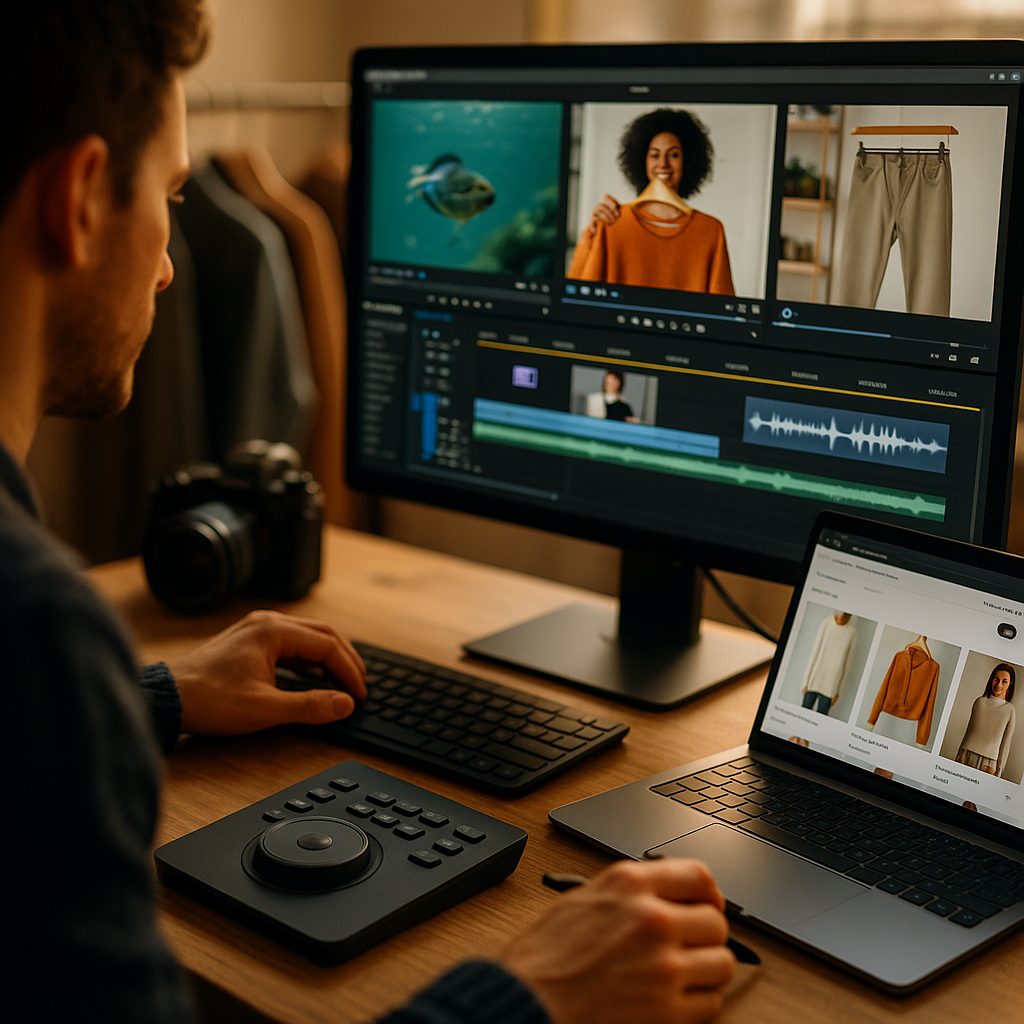
Your product team cuts one hero video. Your channels need nine versions of it. That gap — one asset, nine formats — is where most e-commerce video budgets quietly bleed out. AI video editing agents promise to close it, but NemoVideo, Opus Clip, and Descript approach the problem so differently that picking the wrong one costs you weeks, not dollars.
This isn’t a feature checklist post. It’s a working comparison built around three things brand and agency teams actually get judged on: how fast the tool turns raw footage into publishable assets, what it really costs once you factor in per-format output, and whether the final clips hold up across TikTok, Instagram, YouTube Shorts, and Amazon listings without a human redo pass.
Why This Comparison Matters More in E-Commerce Than Anywhere Else
Influencer and UGC-driven e-commerce brands don’t make one video and call it done. A single unboxing clip might need to become a 9:16 TikTok cut, a 1:1 Instagram feed post, a 16:9 YouTube pre-roll, and a silent, caption-heavy version for a product detail page. Multiply that by dozens of creator submissions a month, and manual editing stops scaling around the same time your CFO starts asking why the video budget tripled.
Teams running 20+ SKUs with rotating creator content report spending more human hours reformatting existing footage than producing new footage — a sign the bottleneck isn’t creative, it’s operational.
That’s the real test for any AI editing agent: not “can it make one good clip,” but “can it run this at volume without a quality collapse by clip number 40.”
Speed: Who Actually Cuts Production Time?
Speed claims are easy to make and hard to verify, so we tested each tool against the same task: a 12-minute raw creator video (product review format), turned into five platform-specific cuts.
- NemoVideo processed the full multi-format batch in roughly 6-8 minutes, using its agentic workflow to detect hook moments, auto-reframe for aspect ratio, and generate platform-native captions in one pass. The agent model means you queue the job and walk away — it’s not asking for approval at each step.
- Opus Clip came in close behind on single-clip generation but slows down when you need distinct treatments per platform rather than the same viral moment resized. Its strength is finding the clip-worthy segment, not tailoring five separate outputs from it.
- Descript was the slowest of the three for batch output because it’s fundamentally a manual-first editor with AI assist layered in. Great for precision, but every format variation requires a human to open a new sequence.
If your team ships daily and needs unattended, overnight batch processing, NemoVideo’s agent-driven approach removes the most friction. If you’re producing fewer, higher-stakes hero assets where a human should review every cut, Descript’s control is worth the extra time.
Cost-Per-Format: The Number Vendors Don’t Want You Calculating
Sticker price is meaningless in this category. What matters is cost per finished, platform-ready asset — and that number changes dramatically depending on how many formats you need per source video.
Here’s the math brands should actually run before signing a contract:
- NemoVideo prices around a flat monthly agent-credit model where multi-format generation from one source draws down credits per output, not per project. For teams generating 5+ formats per asset, this tends to land at the lowest true cost-per-format because the base processing (transcription, scene detection) isn’t re-billed for each variant.
- Opus Clip operates on a clip-count model tied to minutes processed. It’s competitive if you need one or two viral clips per source video, but costs climb fast once you’re generating five-plus distinct format variants, since each new export can trigger fresh processing.
- Descript charges by seat and feature tier rather than by output volume, which sounds simpler but hides the real cost: editor hours. A $24-$50/month seat looks cheap until you calculate the labor cost of a human reformatting the same video five times.
The cheapest per-seat tool is often the most expensive per-format tool once you account for the human time needed to hit multi-platform output — a distinction most vendor pricing pages conveniently skip.
This is the same trap brands fall into with ad platform ROAS claims — the headline number and the real, all-in cost rarely match. If you want a framework for interrogating vendor pricing claims more broadly, the vendor due-diligence checklist we built for AI ad platforms applies almost directly to video tooling too.
Multi-Platform Output Quality: Where the Differences Get Real
Speed and cost matter, but none of it matters if the output looks wrong on the platform it lands on. This is where the three tools genuinely diverge in philosophy.
NemoVideo treats each platform as a distinct rendering target, not just a resize job. It adjusts caption placement to avoid TikTok’s UI overlap zones, shortens hook timing for Shorts versus the longer setup tolerance on Instagram Reels, and can auto-generate a static thumbnail-optimized frame for YouTube. The tradeoff: its style is fairly opinionated, and brands with a very specific visual identity sometimes need to override its defaults.
Opus Clip is still the strongest at one specific job: identifying the single most engaging moment in long-form content and turning it into a short. Its virality scoring is genuinely useful for creator-sourced UGC where you’re not sure which 20 seconds will perform. But its multi-platform reformatting is closer to “resize and caption” than a true per-platform rebuild, which means Instagram and TikTok versions can end up feeling identical when they shouldn’t.
Descript gives you the most manual control over every pixel and caption style, which is exactly why quality per platform can be excellent — if a human is willing to do the platform-specific tuning by hand. Left on autopilot, its default exports are competent but generic.
None of this happens in a vacuum. Platform algorithms are still evolving fast, and what counted as “native-feeling” video six months ago on TikTok already looks dated. Brands relying on any of these tools should keep an eye on platform-side changes the same way they track ad governance shifts — the kind of thing we cover in comparing AI ad governance across Meta, TikTok, and Amazon.
Compliance and Disclosure: The Part E-Commerce Teams Forget
Multi-format video output isn’t just a creative problem, it’s a compliance surface. If your creator content includes paid partnerships, every reformatted version needs to carry the correct disclosure treatment for that specific platform, not a blanket “sponsored” tag copied across all five outputs.
None of the three tools automatically enforces disclosure placement per platform rules — that’s still a human review step, and it should stay one. FTC guidance on endorsement and testimonial disclosures doesn’t differentiate by editing tool; the responsibility sits with the brand regardless of what software cut the clip. Teams that skip this step because “the AI handled it” are the ones that end up in enforcement letters.
If disclosure workflows are still a manual afterthought on your team, it’s worth pairing whichever video tool you choose with the settings guidance in AI disclosure settings for Google, Meta, and TikTok ads — the platform-specific nuance there translates directly to organic and paid video output.
So Which One Should You Actually Buy?
There’s no universal winner here, and any vendor comparison claiming otherwise is selling something.
- Choose NemoVideo if you’re running high creator-content volume and need true unattended multi-format batch output at the lowest per-format cost. Best fit for DTC brands running 15+ SKUs or agencies managing multiple client accounts.
- Choose Opus Clip if your bottleneck is finding the viral moment in long-form UGC and you’re mostly repurposing to one or two short-form platforms, not five.
- Choose Descript if brand precision matters more than volume, and you have editor headcount to do platform-specific tuning by hand.
Most mature e-commerce video operations end up running a hybrid: Opus Clip or NemoVideo for volume repurposing, Descript for the handful of hero assets that get paid media spend behind them. Treating this like a single-vendor decision is the mistake — the same interoperability problem we’ve flagged in broader martech stacks applies here too, as detailed in why marketing AI tools still refuse to talk to each other.
Before committing budget, run the same 12-minute-video test we did here on your own footage. Vendor demo reels are always shot for the tool’s strengths — your product videos won’t be that forgiving, and that’s exactly the gap you need to see before you sign an annual contract.
FAQs
Which AI video editing agent is cheapest for e-commerce brands at scale?
NemoVideo tends to have the lowest true cost-per-format for brands generating five or more platform variants per source video, because its credit model doesn’t re-bill base processing for each output. Opus Clip and Descript can look cheaper on a per-seat basis but often cost more once editor labor for reformatting is factored in.
Can these tools replace a human video editor entirely?
Not for hero or paid-media assets. All three still need human review for brand voice, disclosure compliance, and quality control. They’re strongest at removing repetitive reformatting work, not final creative judgment.
Does Opus Clip work well for e-commerce product videos, or is it built mainly for podcasts and talking-head content?
Opus Clip’s virality-detection engine was built primarily around long-form talk content, and it performs best finding standout moments in interviews or reviews. For structured e-commerce content like unboxings or demos, it’s usable but less precise than tools built with product-first workflows in mind.
How do I calculate cost-per-format instead of just comparing subscription prices?
Divide the total monthly cost (subscription plus any per-export fees) by the number of finished, platform-ready assets you actually publish, not just the raw clips generated. Include estimated editor hours for any manual cleanup at an hourly rate to get the real number.
Do AI video tools handle sponsored content disclosure automatically?
No. None of the three tools covered here automatically apply platform-specific disclosure labels. That remains a manual compliance step, and brands are responsible for it regardless of which editing tool produced the final clip.
Is a multi-tool approach realistic for a small e-commerce team?
Yes, and it’s often more cost-effective than expected. Many teams use one agent tool for high-volume repurposing and a manual editor like Descript only for a small number of paid or flagship assets, keeping overall spend lower than a single all-purpose enterprise contract.
FAQs
Which AI video editing agent is cheapest for e-commerce brands at scale?
NemoVideo tends to have the lowest true cost-per-format for brands generating five or more platform variants per source video, because its credit model doesn’t re-bill base processing for each output. Opus Clip and Descript can look cheaper on a per-seat basis but often cost more once editor labor for reformatting is factored in.
Can these tools replace a human video editor entirely?
Not for hero or paid-media assets. All three still need human review for brand voice, disclosure compliance, and quality control. They’re strongest at removing repetitive reformatting work, not final creative judgment.
Does Opus Clip work well for e-commerce product videos, or is it built mainly for podcasts and talking-head content?
Opus Clip’s virality-detection engine was built primarily around long-form talk content, and it performs best finding standout moments in interviews or reviews. For structured e-commerce content like unboxings or demos, it’s usable but less precise than tools built with product-first workflows in mind.
How do I calculate cost-per-format instead of just comparing subscription prices?
Divide the total monthly cost (subscription plus any per-export fees) by the number of finished, platform-ready assets you actually publish, not just the raw clips generated. Include estimated editor hours for any manual cleanup at an hourly rate to get the real number.
Do AI video tools handle sponsored content disclosure automatically?
No. None of the three tools covered here automatically apply platform-specific disclosure labels. That remains a manual compliance step, and brands are responsible for it regardless of which editing tool produced the final clip.
Is a multi-tool approach realistic for a small e-commerce team?
Yes, and it’s often more cost-effective than expected. Many teams use one agent tool for high-volume repurposing and a manual editor like Descript only for a small number of paid or flagship assets, keeping overall spend lower than a single all-purpose enterprise contract.
Top Influencer Marketing Agencies
The leading agencies shaping influencer marketing in 2026
Agencies ranked by campaign performance, client diversity, platform expertise, proven ROI, industry recognition, and client satisfaction. Assessed through verified case studies, reviews, and industry consultations.
Moburst

-
2

The Shelf
Boutique Beauty & Lifestyle Influencer AgencyA data-driven boutique agency specializing exclusively in beauty, wellness, and lifestyle influencer campaigns on Instagram and TikTok. Best for brands already focused on the beauty/personal care space that need curated, aesthetic-driven content.Clients: Pepsi, The Honest Company, Hims, Elf Cosmetics, Pure LeafVisit The Shelf → -
3

Audiencly
Niche Gaming & Esports Influencer AgencyA specialized agency focused exclusively on gaming and esports creators on YouTube, Twitch, and TikTok. Ideal if your campaign is 100% gaming-focused — from game launches to hardware and esports events.Clients: Epic Games, NordVPN, Ubisoft, Wargaming, Tencent GamesVisit Audiencly → -
4

Viral Nation
Global Influencer Marketing & Talent AgencyA dual talent management and marketing agency with proprietary brand safety tools and a global creator network spanning nano-influencers to celebrities across all major platforms.Clients: Meta, Activision Blizzard, Energizer, Aston Martin, WalmartVisit Viral Nation → -
5

The Influencer Marketing Factory
TikTok, Instagram & YouTube CampaignsA full-service agency with strong TikTok expertise, offering end-to-end campaign management from influencer discovery through performance reporting with a focus on platform-native content.Clients: Google, Snapchat, Universal Music, Bumble, YelpVisit TIMF → -
6

NeoReach
Enterprise Analytics & Influencer CampaignsAn enterprise-focused agency combining managed campaigns with a powerful self-service data platform for influencer search, audience analytics, and attribution modeling.Clients: Amazon, Airbnb, Netflix, Honda, The New York TimesVisit NeoReach → -
7

Ubiquitous
Creator-First Marketing PlatformA tech-driven platform combining self-service tools with managed campaign options, emphasizing speed and scalability for brands managing multiple influencer relationships.Clients: Lyft, Disney, Target, American Eagle, NetflixVisit Ubiquitous → -
8

Obviously
Scalable Enterprise Influencer CampaignsA tech-enabled agency built for high-volume campaigns, coordinating hundreds of creators simultaneously with end-to-end logistics, content rights management, and product seeding.Clients: Google, Ulta Beauty, Converse, AmazonVisit Obviously →