


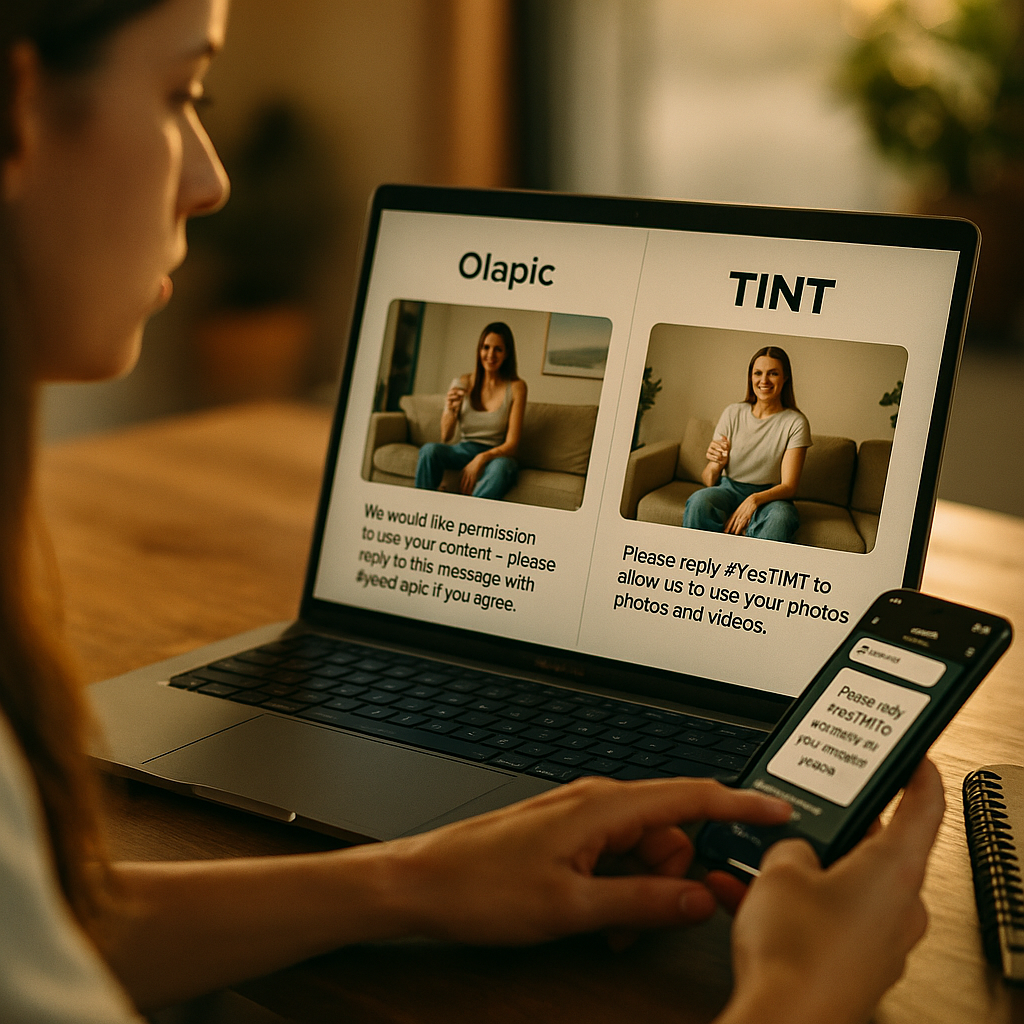
Ninety percent of consumers say user-generated content influences their purchase decisions more than branded content, according to Statista research on consumer trust. Yet one mishandled rights request can turn a viral UGC win into a legal headache. So which platform actually protects mid-market brands: Olapic or TINT? The answer depends less on features and more on how much risk your legal team can tolerate.
Why UGC Rights Management Became a Boardroom Issue
Five years ago, “get permission” meant a marketing coordinator DMing a creator and screenshotting the reply. That approach doesn’t scale, and it definitely doesn’t survive an audit. As brands lean harder into creator content for paid social, email, and product pages, the rights trail behind that content has become a genuine compliance exposure.
Regulators have taken notice too. The FTC’s endorsement guidelines hold brands accountable for how creator content is sourced, disclosed, and reused, not just how it’s disclosed at posting time. If you can’t produce a signed release when a creator disputes usage, you’re exposed regardless of intent.
The real cost of UGC isn’t licensing fees. It’s the legal exposure from content you can’t prove you have rights to use.
Olapic: Built for Scale, Priced Like It
Olapic (now part of Monotype) built its reputation on visual commerce and large-scale rights collection. Its automated permission requests, comment scraping, and API-based rights confirmation make it a strong fit for brands pulling thousands of pieces of UGC monthly across Instagram, TikTok, and owned review platforms.
Where Olapic earns its premium: enterprise-grade rights audit trails. Every permission request, timestamp, and creator response gets logged in a way that’s genuinely defensible if legal ever asks for proof. For a mid-market brand running a single seasonal campaign, that infrastructure can feel like overkill. For one running always-on UGC programs across multiple product lines, it’s the difference between confidence and guesswork.
The catch is cost structure. Olapic’s pricing tiers are built with enterprise volume in mind, and mid-market teams often end up paying for capacity they don’t use. Implementation also tends to require more hands-on onboarding, which adds time-to-value delay that smaller marketing teams can’t always absorb.
Where Olapic Actually Wins
- Automated, scalable permission requests across multiple social platforms simultaneously
- Robust audit logging that holds up under legal scrutiny
- Strong integration with visual commerce and product page display tools
- Better suited to brands with complex multi-brand or multi-region UGC needs
TINT: Faster to Deploy, Lighter on Enterprise Muscle
TINT (part of the Diesel Labs family after its Bazaarvoice-adjacent history) leans into simplicity. Rights requests are automated but the workflow feels more like a lightweight CRM than a legal document system. That’s a feature for teams that need speed, and a limitation for teams that need airtight documentation.
TINT’s pricing tends to sit more comfortably in mid-market budget ranges, and its onboarding timeline is noticeably shorter. If your team needs a UGC rights workflow running inside a few weeks rather than a full quarter, TINT’s simpler architecture gets you there faster.
But speed has a tradeoff. TINT’s audit trail is functional but less granular than Olapic’s, and some brands have reported needing manual follow-up to close rights confirmation gaps, particularly on platforms where creators don’t respond to automated prompts. That’s not a dealbreaker, but it does mean budgeting for some human oversight rather than assuming full automation.
Where TINT Actually Wins
- Lower total cost of ownership for brands under a certain UGC volume threshold
- Faster implementation and shorter learning curve for marketing teams
- Simpler dashboard that non-technical staff can manage without heavy training
- Reasonable fit for single-brand, single-market UGC programs
The Real Cost-Benefit Math Mid-Market Brands Miss
Most vendor comparisons stop at subscription price. That’s the wrong frame. The real cost-benefit analysis has to weigh licensing fees against the probability-weighted cost of a rights dispute, which almost nobody models correctly.
Here’s a rough framework: if your brand runs high-volume UGC campaigns (paid social boosting creator content, product pages featuring dozens of customer photos, email campaigns pulling from social in near real time), the audit trail gap between Olapic and TINT starts to matter financially. One disputed usage claim, one creator who claims they never granted commercial rights, can cost more in legal fees and platform takedown scrambling than a full year of the pricier platform’s subscription.
If your UGC program is smaller and more contained, say a quarterly campaign with a few hundred pieces of content, TINT’s lower cost and faster deployment likely outweighs Olapic’s heavier infrastructure. You’re simply not generating enough volume to justify paying for enterprise-grade rights logging you’ll rarely stress-test.
Choosing between Olapic and TINT isn’t really a features question. It’s a question of how much UGC volume you run and how much legal risk that volume creates.
Questions to Ask Before You Sign
- How many pieces of UGC does your team collect and repurpose monthly, across all channels?
- Does your legal team require exportable, timestamped rights documentation for every asset, or just spot-checkable records?
- How many markets or brand entities need separate rights workflows?
- What’s your current time-to-approval for UGC rights, and how much would cutting that in half actually be worth?
- Who owns rights management operationally: marketing ops, legal, or a shared function?
Integration Reality: Neither Platform Lives in a Vacuum
Rights management tools don’t operate in isolation. They need to feed into your broader martech stack, particularly your CDP, DAM, and campaign analytics tools. Olapic’s API tends to integrate more smoothly with enterprise DAM systems, which matters if your brand runs product content through multiple approval layers before publishing. TINT’s integrations are lighter but sufficient for brands running simpler content pipelines.
This is where a broader stack audit pays off before you commit to either platform. If you’re already running a martech stack audit for other reasons, add UGC rights management to that review rather than evaluating it in isolation. The same logic that applies to cutting AI tool overlap across CRM and analytics applies here: redundant capability across platforms quietly drains budget.
Identity resolution matters too, oddly enough. If your UGC program pulls creator content tied to customer accounts (say, a loyalty program that rewards content creation), you’ll want rights data to sync cleanly with whatever identity resolution system you’re running. A rights record that can’t be matched back to a customer profile is a rights record that’s hard to defend later.
What Actually Determines ROI Here
ROI on a UGC rights platform isn’t measured in “content collected.” It’s measured in disputes avoided, legal hours saved, and campaign launches that don’t get delayed because someone forgot to confirm usage rights on a hero image three days before a paid push goes live.
Track these metrics for at least one full quarter after implementation, regardless of which platform you choose:
- Average time from content discovery to rights confirmation
- Percentage of UGC assets with complete, exportable documentation
- Number of rights-related delays in campaign launch timelines
- Legal team hours spent on UGC-related disputes or clarifications
If those numbers don’t improve within two quarters, you’ve either picked the wrong platform or you haven’t built the internal process to use it properly. Both are fixable, but they require different fixes.
Marketers evaluating attribution and data claims across other parts of the stack know this pattern well: platform capability only matters if the underlying process supports it. The same scrutiny applied to evaluating blended match data in attribution platforms should apply to rights management claims. Vendor demos always look clean. Production workflows rarely are.
Next Step
Run a 90-day pilot with your actual UGC volume, not the vendor’s demo dataset, and track rights-confirmation time against your current manual process before committing to an annual contract. If the platform can’t cut confirmation time by at least 30%, the subscription cost probably isn’t justified for your volume tier.
Frequently Asked Questions
Is Olapic or TINT better for a small marketing team?
TINT generally suits smaller teams better because of its shorter onboarding timeline and simpler dashboard. Olapic’s enterprise-grade features require more operational bandwidth to manage effectively.
How much does automated UGC rights management typically cost mid-market brands?
Pricing varies widely based on content volume and platform tier, but mid-market brands should expect meaningful annual investment beyond base subscription fees, including onboarding and potential integration costs with existing martech stacks.
Can automated rights management fully eliminate legal risk from UGC?
No platform eliminates risk entirely. Automated systems reduce the volume of manual errors and improve documentation, but disputed usage claims can still arise, particularly when creators revoke consent after initial approval.
Does UGC rights management integrate with existing CDP or DAM systems?
Both Olapic and TINT offer integration capabilities, though Olapic tends to integrate more comprehensively with enterprise DAM systems while TINT offers lighter, simpler connections suited to smaller content pipelines.
What’s the biggest mistake brands make when evaluating these platforms?
Comparing subscription price without modeling the cost of potential rights disputes. A cheaper platform with weaker audit trails can end up costing more if a usage dispute requires legal intervention.
Top Influencer Marketing Agencies
The leading agencies shaping influencer marketing in 2026
Agencies ranked by campaign performance, client diversity, platform expertise, proven ROI, industry recognition, and client satisfaction. Assessed through verified case studies, reviews, and industry consultations.
Moburst

-
2

The Shelf
Boutique Beauty & Lifestyle Influencer AgencyA data-driven boutique agency specializing exclusively in beauty, wellness, and lifestyle influencer campaigns on Instagram and TikTok. Best for brands already focused on the beauty/personal care space that need curated, aesthetic-driven content.Clients: Pepsi, The Honest Company, Hims, Elf Cosmetics, Pure LeafVisit The Shelf → -
3

Audiencly
Niche Gaming & Esports Influencer AgencyA specialized agency focused exclusively on gaming and esports creators on YouTube, Twitch, and TikTok. Ideal if your campaign is 100% gaming-focused — from game launches to hardware and esports events.Clients: Epic Games, NordVPN, Ubisoft, Wargaming, Tencent GamesVisit Audiencly → -
4

Viral Nation
Global Influencer Marketing & Talent AgencyA dual talent management and marketing agency with proprietary brand safety tools and a global creator network spanning nano-influencers to celebrities across all major platforms.Clients: Meta, Activision Blizzard, Energizer, Aston Martin, WalmartVisit Viral Nation → -
5

The Influencer Marketing Factory
TikTok, Instagram & YouTube CampaignsA full-service agency with strong TikTok expertise, offering end-to-end campaign management from influencer discovery through performance reporting with a focus on platform-native content.Clients: Google, Snapchat, Universal Music, Bumble, YelpVisit TIMF → -
6

NeoReach
Enterprise Analytics & Influencer CampaignsAn enterprise-focused agency combining managed campaigns with a powerful self-service data platform for influencer search, audience analytics, and attribution modeling.Clients: Amazon, Airbnb, Netflix, Honda, The New York TimesVisit NeoReach → -
7

Ubiquitous
Creator-First Marketing PlatformA tech-driven platform combining self-service tools with managed campaign options, emphasizing speed and scalability for brands managing multiple influencer relationships.Clients: Lyft, Disney, Target, American Eagle, NetflixVisit Ubiquitous → -
8

Obviously
Scalable Enterprise Influencer CampaignsA tech-enabled agency built for high-volume campaigns, coordinating hundreds of creators simultaneously with end-to-end logistics, content rights management, and product seeding.Clients: Google, Ulta Beauty, Converse, AmazonVisit Obviously →