


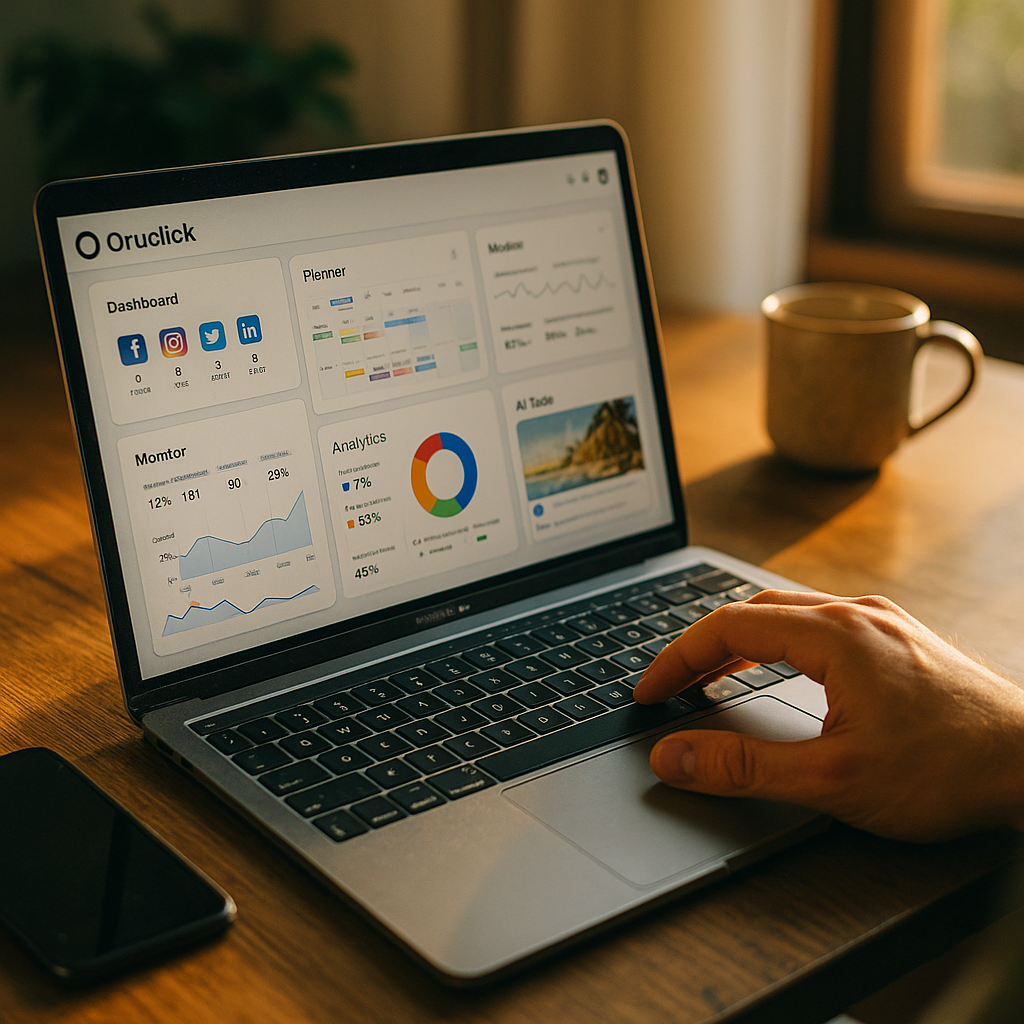
Solo marketers now juggle an average of five to seven disconnected tools just to run a single social calendar, according to workflow surveys from Sprout Social. That’s a scheduler, a caption generator, an analytics dashboard, a design tool, and something for community replies. OruClick and a new wave of all-in-one AI social suites are betting that solo operators and lean agencies will trade flexibility for consolidation. The question is whether that trade actually pays off.
Why the Five-Tool Stack Became the Norm
Nobody set out to build a five-tool stack. It happened by accretion. You started with Buffer or Later for scheduling, added Canva for graphics, bolted on ChatGPT for captions, wired up a separate analytics tool because native insights weren’t good enough, and eventually added a inbox tool to manage DMs and comments across platforms. Each addition solved a real problem. Each also added a login, a monthly invoice, and a export-import ritual that ate into actual creative time.
For agencies, that overhead gets absorbed by teams and line items. For solo marketers and one-person shops, it’s a tax on every single week. A freelance social manager running accounts for six clients doesn’t have a research department. They have a laptop, a coffee habit, and a Sunday night spent reconciling engagement numbers across three dashboards that don’t talk to each other.
The real cost of a fragmented stack isn’t the subscription fees — it’s the hours spent stitching data and content between tools that were never designed to work together.
What OruClick Actually Consolidates
OruClick positions itself as a single workspace covering content generation, scheduling, publishing, analytics, and light community management across the major platforms. Instead of drafting a caption in one app, resizing a graphic in another, and scheduling in a third, the workflow lives in one interface: prompt, generate, preview per-platform, schedule, then review performance without leaving the tab.
That’s the pitch, anyway. In practice, “all-in-one” tools succeed or fail on a few specific dimensions:
- Depth per function — does the built-in analytics module actually rival a dedicated tool, or is it a watered-down summary?
- Platform coverage — does it support the platforms your audience actually lives on, including newer formats on TikTok and LinkedIn video?
- AI quality — is the caption and content generation genuinely brand-aware, or generic output that needs heavy editing anyway?
- Data portability — can you export your content calendar and performance history if you switch tools later?
Solo marketers evaluating OruClick should treat each of these as a separate line item, not a bundled assumption. A suite that nails scheduling but delivers mediocre analytics hasn’t actually replaced your stack — it’s just relocated the weak link.
The Real ROI Math for Solo Operators
Here’s a rough back-of-envelope comparison. A typical five-tool stack for a solo marketer running multiple client accounts might look like: a scheduler ($30-$60/month), an AI writing tool ($20-$30/month), a design tool ($13-$55/month depending on tier), a dedicated analytics tool ($50-$100/month for anything beyond native platform data), and a social inbox tool ($15-$40/month). That’s realistically $130-$285 a month before you count the time cost of switching between them.
An all-in-one suite priced in the $40-$90/month range for a solo tier looks like an obvious win on paper. But the comparison only holds if the bundled features are actually usable substitutes, not diminished versions you’ll outgrow in a quarter. This is the same trap buyers hit in enterprise martech, where bundled platforms promise consolidation but deliver budget tradeoffs nobody modeled up front.
Ask this before signing: if you dropped the suite tomorrow, could you export twelve months of content and performance data in a usable format? If the answer is no, you’re not buying a tool — you’re accepting lock-in.
Where AI Suites Genuinely Save Time (and Where They Don’t)
AI-generated first drafts of captions, hashtag suggestions, and optimal posting time predictions are now table stakes. eMarketer data has repeatedly shown that solo creators and small teams cite content volume, not strategy, as their biggest bottleneck. That’s exactly the gap AI suites are built to close.
Where they genuinely help:
- First-draft caption variants across tone and length, cutting drafting time significantly
- Auto-resizing and reformatting a single asset across aspect ratios for each platform
- Suggesting posting windows based on account-specific engagement history rather than generic best-practice charts
- Flagging underperforming content patterns before you’ve burned a week on a losing format
Where they still fall short: nuanced brand voice for regulated industries, genuinely original creative concepts, and community management that requires judgment rather than templated replies. If you’re managing accounts for finance, healthcare, or other compliance-heavy clients, AI-drafted copy still needs a human compliance pass. That’s not a limitation unique to OruClick — it’s true of every generative tool on the market right now, including the debate playing out in enterprise AI governance discussions among larger brands.
Compliance and Platform Risk Nobody Talks About
Solo marketers rarely think about platform policy risk until it bites them. Consolidating publishing into one third-party suite means that suite’s API relationships with Meta, TikTok, and LinkedIn become your operational dependency. If OruClick loses API access to a platform, or a platform changes rate limits, your scheduled content pipeline breaks — and you may not find out until posts silently fail to publish.
This isn’t a hypothetical. Third-party scheduling tools have lost or had throttled access to platform APIs before, sometimes with little notice to end users. Check the vendor’s status page history and read their terms on data retention. If you’re managing branded content with FTC-relevant disclosure requirements, confirm the tool actually supports required disclosure tagging rather than leaving it as a manual afterthought — the FTC’s endorsement guidelines apply regardless of which tool posts the content.
Consolidation concentrates risk as much as it concentrates convenience. One vendor outage now means every platform goes dark at once, not just one.
Data privacy matters too. An all-in-one suite touching your DMs, follower data, and client accounts is handling more sensitive information than a single-purpose scheduler ever would. If you operate with EU or UK clients, verify the vendor’s data processing terms align with GDPR expectations — the ICO’s guidance is a useful baseline even for tools based outside the UK.
A Practical Evaluation Checklist
Before consolidating your stack into OruClick or a competitor, run through this:
- Trial with a real client account, not a demo. Generic demos hide the friction that shows up with your actual content mix.
- Test analytics against native platform data. Pull the same week’s numbers from Instagram Insights or TikTok’s dashboard and compare. Discrepancies matter.
- Check export functionality on day one, not when you’re trying to leave. Portability tested early is portability you can trust later.
- Price out the actual usage tier you need, not the marketing-page starter price. Solo marketers running six client accounts often need a mid-tier plan, not the cheapest one advertised.
- Read the fine print on AI content ownership. Some tools claim broad usage rights over generated content; confirm you retain full ownership for client deliverables.
This kind of granular vendor scrutiny is exactly what’s reshaping bigger platform decisions too — the same logic that’s now driving payment ops criteria in platform RFPs applies at the solo-marketer scale: the unglamorous operational details decide whether a tool earns its keep, not the flashy feature list.
Who Should Actually Switch, and Who Should Wait
If you’re a solo marketer managing three to eight client accounts with fairly standard content needs (feed posts, Stories, basic Reels), an all-in-one suite like OruClick is worth a serious trial. The time saved on tool-switching alone likely justifies the monthly cost.
If you’re managing highly regulated clients, running paid social alongside organic, or need analytics granular enough for attribution modeling, keep your dedicated analytics tool for now and use the suite for content and scheduling only. Hybrid stacks aren’t a failure state — they’re often the smarter move until all-in-one tools mature further on the deep-analytics side.
Run a 30-day parallel test before fully migrating: keep your current stack live while trialing OruClick on one client, and compare hours saved against data fidelity lost. That single test will tell you more than any feature comparison page ever could.
FAQs
What is OruClick used for?
OruClick is an all-in-one AI social media suite that combines content generation, scheduling, publishing, and analytics into a single workspace, aimed primarily at solo marketers and small agencies looking to consolidate multiple point tools.
Is an all-in-one social media suite cheaper than separate tools?
Usually, yes on paper — a typical five-tool stack can run $130-$285 a month, while all-in-one suites often price solo tiers between $40-$90 a month. The real savings depend on whether the bundled features are strong enough to replace dedicated tools rather than serving as a weaker substitute.
What are the risks of consolidating social media tools into one platform?
The main risks are vendor lock-in, data portability limits, and concentrated platform API risk — if the suite loses access to a platform’s API or has an outage, all your scheduled content across every channel is affected at once, rather than just one tool’s function.
Can AI social media tools handle FTC disclosure requirements?
Some tools support disclosure tagging natively, but many leave it as a manual step. Marketers should verify this directly with the vendor and cross-check against current FTC endorsement guidelines rather than assuming automatic compliance.
Should agencies also consider all-in-one AI suites, or just solo marketers?
All-in-one suites are generally strongest for solo marketers and very small teams with straightforward content needs. Larger agencies managing complex attribution, paid-organic integration, or regulated clients often still need dedicated analytics and compliance tools alongside a consolidated content suite.
FAQs
Visible FAQ content above; duplicate structured data follows for search engines.
Top Influencer Marketing Agencies
The leading agencies shaping influencer marketing in 2026
Agencies ranked by campaign performance, client diversity, platform expertise, proven ROI, industry recognition, and client satisfaction. Assessed through verified case studies, reviews, and industry consultations.
Moburst

-
2

The Shelf
Boutique Beauty & Lifestyle Influencer AgencyA data-driven boutique agency specializing exclusively in beauty, wellness, and lifestyle influencer campaigns on Instagram and TikTok. Best for brands already focused on the beauty/personal care space that need curated, aesthetic-driven content.Clients: Pepsi, The Honest Company, Hims, Elf Cosmetics, Pure LeafVisit The Shelf → -
3

Audiencly
Niche Gaming & Esports Influencer AgencyA specialized agency focused exclusively on gaming and esports creators on YouTube, Twitch, and TikTok. Ideal if your campaign is 100% gaming-focused — from game launches to hardware and esports events.Clients: Epic Games, NordVPN, Ubisoft, Wargaming, Tencent GamesVisit Audiencly → -
4

Viral Nation
Global Influencer Marketing & Talent AgencyA dual talent management and marketing agency with proprietary brand safety tools and a global creator network spanning nano-influencers to celebrities across all major platforms.Clients: Meta, Activision Blizzard, Energizer, Aston Martin, WalmartVisit Viral Nation → -
5

The Influencer Marketing Factory
TikTok, Instagram & YouTube CampaignsA full-service agency with strong TikTok expertise, offering end-to-end campaign management from influencer discovery through performance reporting with a focus on platform-native content.Clients: Google, Snapchat, Universal Music, Bumble, YelpVisit TIMF → -
6

NeoReach
Enterprise Analytics & Influencer CampaignsAn enterprise-focused agency combining managed campaigns with a powerful self-service data platform for influencer search, audience analytics, and attribution modeling.Clients: Amazon, Airbnb, Netflix, Honda, The New York TimesVisit NeoReach → -
7

Ubiquitous
Creator-First Marketing PlatformA tech-driven platform combining self-service tools with managed campaign options, emphasizing speed and scalability for brands managing multiple influencer relationships.Clients: Lyft, Disney, Target, American Eagle, NetflixVisit Ubiquitous → -
8

Obviously
Scalable Enterprise Influencer CampaignsA tech-enabled agency built for high-volume campaigns, coordinating hundreds of creators simultaneously with end-to-end logistics, content rights management, and product seeding.Clients: Google, Ulta Beauty, Converse, AmazonVisit Obviously →