


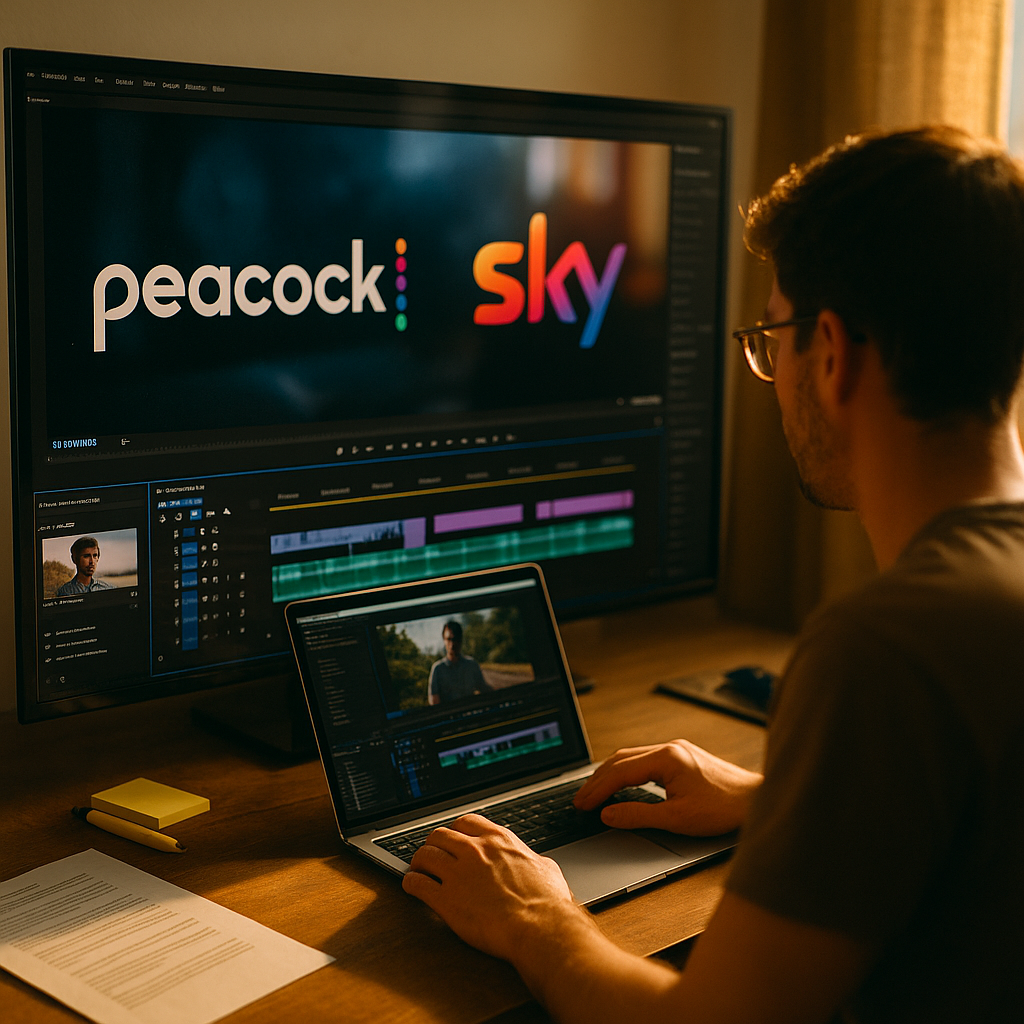
Only 12% of influencer-produced video is technically compliant with connected TV delivery specs on the first export, according to Statista streaming ad benchmarks. That gap is expensive. Brands chasing the streaming to social crossover moment, pushing creator content onto Peacock and Sky inventory, keep discovering that a viral vertical clip and a broadcast-grade CTV asset are not the same product. They just look similar on a phone screen.
Why Peacock and Sky Are Suddenly Part of the Creator Conversation
Peacock and Sky used to sit in a different budget line entirely, separate from influencer marketing, closer to traditional media buying. That wall is coming down. NBCUniversal’s ad-supported tiers and Sky’s addressable inventory across the UK and Europe have both opened programmatic and direct-sold slots specifically for branded creator content, not just repurposed TV commercials. eMarketer has tracked connected TV ad spend climbing steadily as linear budgets shrink, and a meaningful chunk of that growth is going toward content that started life as a creator brief, not a studio shoot.
Why does this matter to a brand strategist who has never bought a streaming ad slot? Because the creative your agency commissioned for TikTok or Instagram is increasingly being asked to do double duty. A retail client wants the same UGC testimonial running on Peacock during a sponsored cooking show break. A CPG brand wants its Sky Kids sponsorship to reuse the same creator who did a YouTube Shorts unboxing. The economics only work if the asset survives the jump.
A vertical 9:16 clip cropped straight into a 16:9 CTV slot loses roughly 40% of its usable frame, often cutting off the product, the face, or the on-screen text that made it work in the first place.
The Format Mismatch Nobody Budgets For
Here’s the uncomfortable truth: social-first creator content is built around a completely different viewing context than streaming inventory. Social platforms assume a thumb, a phone, and three seconds to earn attention. Peacock and Sky assume a remote, a sofa, and a viewer who is not going anywhere for the next 30 minutes. That changes everything about how the asset needs to be built.
- Aspect ratio. Peacock and Sky both require 16:9 delivery for in-stream ad slots. No exceptions, no letterboxed verticals with blurred bars, even though that trick works fine on some FAST channels.
- Safe zones. Text and graphics burned in for a phone’s center-frame habit will sit dangerously close to the edge on a living room TV, where overscan and bezel cropping still exist on older sets.
- Subtitle and caption placement. Social platforms favor mid-frame captions for muted autoplay. Broadcast delivery specs expect lower-third captioning that respects title-safe margins, and Sky in particular enforces this for accessibility compliance under UK broadcasting codes.
- Loudness standards. Social audio is mixed loud and flat. CTV platforms enforce loudness normalization (typically around -24 LKFS for US delivery, -23 LUFS for UK/EBU R128 on Sky), so a creator’s punchy TikTok mix will get auto-leveled or, worse, flagged and bounced back for remix.
None of this is exotic technical trivia. It is the baseline QC checklist that broadcast ad ops teams have run for decades. Creator teams just haven’t had to think about it until now, because their entire production pipeline was built around vertical-first, mobile-native delivery.
What the Spec Sheet Actually Demands
Every network’s technical delivery guide reads like a legal document, but the practical brief boils down to a shorter list than most teams assume:
- Resolution: minimum 1920×1080, with some Peacock premium placements requesting 3840×2160 masters even if the final delivery downscales.
- Codec and container: ProRes or high-bitrate H.264 masters, not the compressed MP4 exports social platforms are used to receiving.
- Frame rate consistency: 23.976 or 29.97fps depending on the region, matched to broadcast standards rather than the 30fps or 60fps social defaults.
- Closed captioning files: separate SCC or SRT deliverables, distinct from the burned-in captions used for social cutdowns.
- Slate and bumper requirements: agency slates, color bars, and countdown leaders that social content never needs but broadcast QC will reject a file for missing.
If that list sounds like a different job entirely, that’s because it partly is. This is where a lot of influencer agencies get caught flat-footed, treating a CTV placement like a bigger version of a social post rather than a distinct deliverable with its own QC gate.
Compliance Gets Sharper, Not Softer, on the Big Screen
Disclosure rules do not relax when content moves from a feed to a living room screen. If anything, regulators pay closer attention because the format looks more like traditional advertising. In the US, the FTC’s endorsement guidance still applies in full to any sponsored creator content running on Peacock inventory, meaning disclosure needs to be clear and conspicuous within the asset itself, not buried in a caption that won’t exist on a CTV player.
Sky operates under UK and EU frameworks, where the ICO’s data guidance intersects with broadcast-specific advertising codes that Ofcom and the ASA jointly enforce. A disclosure format that passed muster as a small “#ad” tag on Instagram will not satisfy a CTV compliance review. Brands need on-screen disclosure that’s legible at sofa-viewing distance, not phone-scroll distance, for the entire duration it needs to register with a viewer.
This is also where contracts get messy. A creator agreement drafted for social usage rights rarely covers CTV distribution, and licensing that gap after the fact is a slower, costlier negotiation than building it in up front.
Building a Repurposing Workflow That Doesn’t Blow the Budget
The smart move isn’t shooting separate assets for social and streaming. It’s building a master file architecture that can service both without a full reshoot. Teams already doing this well tend to follow a version of the multi platform master edit approach: capture in a format wide enough to reframe downward, then cut region-specific and platform-specific exports from that single master.
Practically, that means:
- Shoot with 16:9 in mind from the start, even for content whose primary destination is vertical social, so the CTV crop already exists in-frame.
- Build caption and graphic templates in title-safe zones by default, so social cutdowns just get the extra breathing room removed rather than redesigned.
- Keep a high-bitrate master archived per project specifically for broadcast delivery, separate from the compressed exports handed to social schedulers.
- Loop compliance review into the edit timeline early, not as a last-minute gate before delivery.
Teams that have already adapted their CTV pipeline for FAST channels and smart TV apps will recognize a lot of this from the living room ready reformatting playbook. Peacock and Sky just raise the compliance and technical bar a notch higher because they’re not indie FAST channels, they’re major network platforms with QC teams who will bounce a non-conforming file without much patience.
Trailer and teaser cuts deserve their own line item too. A vertical hook that worked as a scroll-stopper needs a completely different pacing structure for a pre-roll or mid-roll streaming slot, where the viewer isn’t scrolling away, they’re just waiting for the show to resume. The CTV trailer format built for that exact tension is worth studying before defaulting to a straight crop of the social hook.
The cheapest CTV compliance failure to avoid is the one that never happens: build the 16:9 safe zone into the original shoot, and you never pay for a re-edit later.
Rights and Licensing: The Part Legal Actually Cares About
Talent agreements need explicit CTV and streaming usage language, not a general “digital distribution” clause that legal assumed covered it. Music licensing is its own trapdoor: a track cleared for social platforms under their blanket licensing deals is very often not cleared for broadcast or CTV distribution, where sync licensing works under different rules entirely. Catching this before delivery, not after a network’s legal review flags it, saves weeks.
Thumbnail and title-card testing also behaves differently on CTV, where there’s no algorithmic thumbnail split test the way there is on YouTube or social feeds. Teams used to running split test thumbnails for social performance need a different creative decision process for CTV, since the placement is often fixed by the network’s scheduling rather than an algorithm.
None of this is a reason to avoid the crossover. Streaming inventory on Peacock and Sky reaches an audience that skews older, higher-income, and less ad-fatigued than pure social feeds, according to eMarketer’s connected TV audience research. That’s a genuinely valuable incremental reach play for brands who’ve maxed out their social frequency caps. It just requires treating the format shift as a real production line item, not an afterthought export setting.
Next Step
Before your next influencer brief includes a Peacock or Sky placement, get your production and legal teams in the same room to lock 16:9 safe zones, disclosure placement, and CTV usage rights into the contract, not the post-production scramble. That single meeting will save more budget than any editing software upgrade.
FAQs
What resolution do Peacock and Sky require for creator-produced video ads?
Both typically require a minimum of 1920×1080 delivery in 16:9, with some premium Peacock placements requesting 4K masters even when the final ad downscales to 1080p for distribution.
Can a vertical social video be reformatted for CTV without reshooting?
Yes, if the original footage was shot wide enough to allow reframing. A vertical crop of a horizontally shot master works far better than trying to expand a tight vertical frame into 16:9, which usually requires new footage or graphic padding.
Do FTC disclosure rules apply to creator content running on Peacock?
Yes. FTC endorsement guidance applies regardless of platform, and disclosure needs to be clear and conspicuous within the video itself since caption-based disclosures common on social platforms don’t carry over to CTV players.
Is Sky’s compliance process different from Peacock’s?
Sky operates under UK and EU broadcasting codes enforced by Ofcom and the ASA, which have specific requirements around disclosure legibility and loudness standards distinct from US FTC and platform-specific rules Peacock follows.
Does music cleared for social platforms work on Peacock or Sky?
Usually not. Social platforms often operate under blanket licensing deals that don’t extend to broadcast or CTV distribution, so sync licensing needs to be checked separately before delivery.
Top Influencer Marketing Agencies
The leading agencies shaping influencer marketing in 2026
Agencies ranked by campaign performance, client diversity, platform expertise, proven ROI, industry recognition, and client satisfaction. Assessed through verified case studies, reviews, and industry consultations.
Moburst

-
2

The Shelf
Boutique Beauty & Lifestyle Influencer AgencyA data-driven boutique agency specializing exclusively in beauty, wellness, and lifestyle influencer campaigns on Instagram and TikTok. Best for brands already focused on the beauty/personal care space that need curated, aesthetic-driven content.Clients: Pepsi, The Honest Company, Hims, Elf Cosmetics, Pure LeafVisit The Shelf → -
3

Audiencly
Niche Gaming & Esports Influencer AgencyA specialized agency focused exclusively on gaming and esports creators on YouTube, Twitch, and TikTok. Ideal if your campaign is 100% gaming-focused — from game launches to hardware and esports events.Clients: Epic Games, NordVPN, Ubisoft, Wargaming, Tencent GamesVisit Audiencly → -
4

Viral Nation
Global Influencer Marketing & Talent AgencyA dual talent management and marketing agency with proprietary brand safety tools and a global creator network spanning nano-influencers to celebrities across all major platforms.Clients: Meta, Activision Blizzard, Energizer, Aston Martin, WalmartVisit Viral Nation → -
5

The Influencer Marketing Factory
TikTok, Instagram & YouTube CampaignsA full-service agency with strong TikTok expertise, offering end-to-end campaign management from influencer discovery through performance reporting with a focus on platform-native content.Clients: Google, Snapchat, Universal Music, Bumble, YelpVisit TIMF → -
6

NeoReach
Enterprise Analytics & Influencer CampaignsAn enterprise-focused agency combining managed campaigns with a powerful self-service data platform for influencer search, audience analytics, and attribution modeling.Clients: Amazon, Airbnb, Netflix, Honda, The New York TimesVisit NeoReach → -
7

Ubiquitous
Creator-First Marketing PlatformA tech-driven platform combining self-service tools with managed campaign options, emphasizing speed and scalability for brands managing multiple influencer relationships.Clients: Lyft, Disney, Target, American Eagle, NetflixVisit Ubiquitous → -
8

Obviously
Scalable Enterprise Influencer CampaignsA tech-enabled agency built for high-volume campaigns, coordinating hundreds of creators simultaneously with end-to-end logistics, content rights management, and product seeding.Clients: Google, Ulta Beauty, Converse, AmazonVisit Obviously →